Preparing for a Home Survey: What You Should Know and Do
By Housey · Last reviewed 19th of May 2026
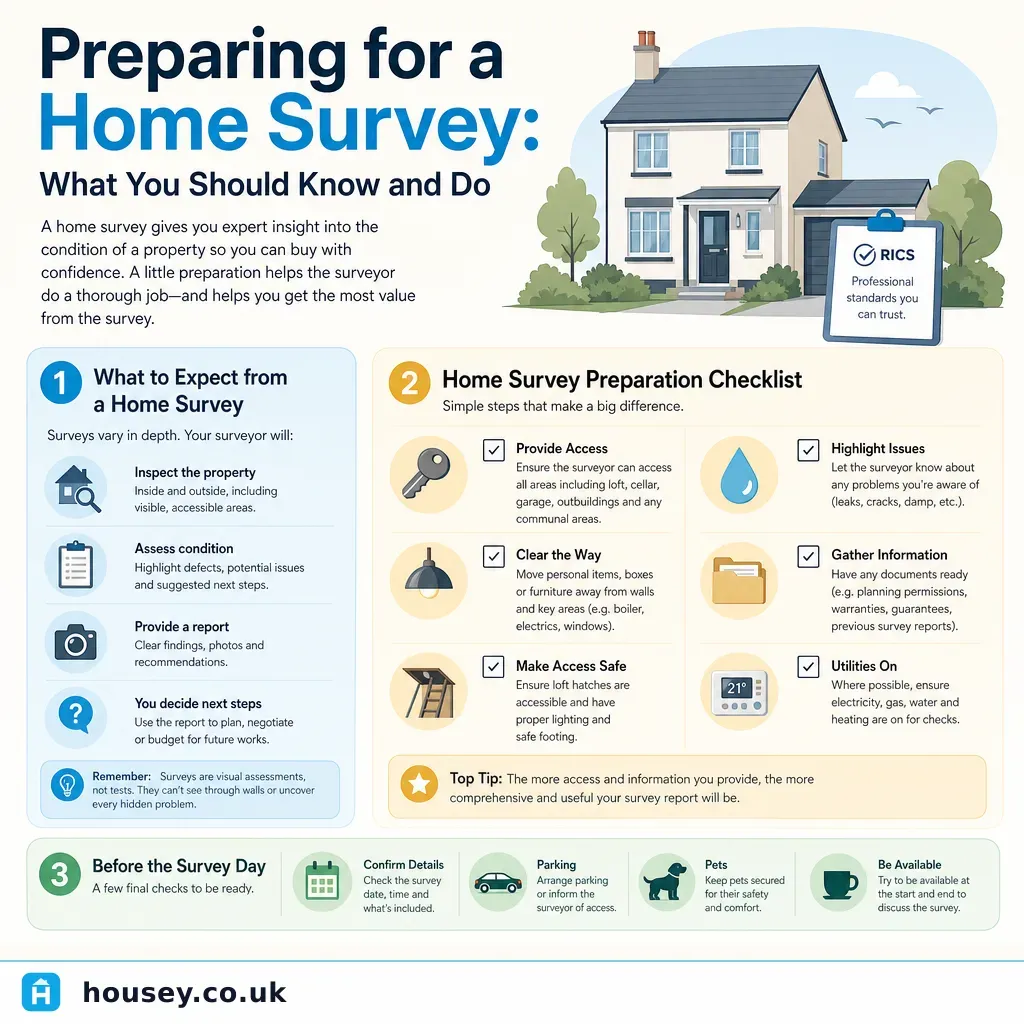
Preparing for a Home Survey: What You Should Know and Do
Once an offer on a property has been accepted, most buyers instruct a surveyor to inspect the home before exchange of contracts. The survey is not a formality — it is a substantive investigation that can confirm confidence in a purchase, reveal defects that affect the agreed price, or flag issues requiring specialist follow-up before you commit. Knowing which survey level to commission, what documents to have available, and what the surveyor is actually able to inspect helps you get a more thorough, useful report.
Key points
- RICS home surveys come in three levels: Level 1 (Condition Report), Level 2 (HomeBuyer Report), and Level 3 (Building Survey) — the right level depends on the property's age, construction type, and visible condition.
- Surveyors conduct a visual inspection only and do not lift floorboards, open wall surfaces, or test appliances unless specifically agreed in the terms of engagement.
- Buyers can submit written questions or specific concerns to the surveyor before the inspection date — ask the instructing firm how to do this.
- A RICS Level 2 survey typically takes 2–4 hours on an average UK home; a Level 3 can take 4–8 hours or more depending on size and complexity.
- Building Regulations completion certificates, planning permissions, FENSA certificates, Gas Safe records, and any structural engineer's reports should be assembled and made available before the inspection.
Which survey level do you need?
The RICS Home Survey Standard defines three levels of inspection, each suited to different property types and buyer requirements. Choosing the right level avoids paying for more than you need — or missing defects because the inspection was too light.
Survey level | Best for | Not ideal for | Typical output |
|---|---|---|---|
RICS Level 1 — Condition Report | New-build and near-new homes in obviously good condition | Any property with age, alterations, or visible defects | Traffic-light condition ratings; no advice on repairs |
RICS Level 2 — HomeBuyer Report | Conventional homes of standard construction in reasonable condition, broadly post-1900 | Older, unusual, heavily altered, or visibly defective properties | Condition ratings, repair advice, market valuation (if instructed) |
RICS Level 3 — Building Survey | Pre-1919 homes, listed buildings, solid-wall construction, significant alterations, or visible defects | Very new homes where a lighter survey suffices | In-depth description of defects, repair options, and maintenance advice |
Which survey should you choose?
- Choose a Level 1 if the property is a new-build or near-new home with no visible defects or alterations.
- Choose a Level 2 if the property is a conventional semi, terrace, or flat of standard construction built after approximately 1900, in broadly reasonable condition.
- Choose a Level 3 if the property is pre-1919, has solid walls, shows visible cracking, has had significant alterations such as loft conversions or extensions, is listed, or is of non-standard construction such as timber frame or concrete panel.
- Ask a structural engineer (in addition to or instead of a general survey) if there are active cracks, suspected subsidence, or evidence of structural movement — a general survey may flag the concern, but an engineer provides the diagnosis and remediation specification.
- Check with your mortgage lender before instructing — some lenders require a specific survey level or arrange their own valuation separately from a buyer's survey.
What the surveyor inspects — and what they don't
A RICS surveyor carries out a visual, non-invasive inspection. They look at what is visible and accessible without causing damage; they do not move furniture, lift carpets, break open wall surfaces, or test mechanical or electrical systems unless specifically agreed.
Typically inspected:
- Roof covering (viewed from ground level, eaves level, or from within the loft if safely accessible)
- Chimney stacks and flashings
- External walls, pointing, render, and cladding
- Windows, doors, and external joinery
- Gutters and rainwater goods
- Internal walls, ceilings, and floor surfaces (visible areas only)
- Loft space (if a hatch is accessible and entry is safe)
- Signs of damp, timber decay, and structural movement, using a damp meter and visual assessment
Not typically inspected without specific agreement:
- Behind fitted furniture or beneath fitted carpets and floor coverings
- Areas with restricted access — locked rooms, low crawl spaces, sealed loft hatches
- Appliances, heating systems, or electrical installations (a Gas Safe inspection or Electrical Installation Condition Report (EICR) are separate assessments)
- Drains and underground services (a CCTV drain survey can be arranged separately)
If you have specific concerns — a damp patch noticed on a viewing, cracking in a party wall, or a loft conversion you want examined — submit these in writing to the surveyor before the inspection date.
Documents to gather before the survey
The more complete the documentation the seller provides, the more context the surveyor has to assess the property accurately. As a buyer, ask your solicitor or the seller's agent to make the following available before the inspection:
- Building Regulations completion certificate — for any extension, loft conversion, or structural alteration.
- Planning permission — for any works requiring consent, including extensions and changes of use.
- FENSA or CERTASS certificate — for replacement windows and doors installed after April 2002.
- Gas Safe certificate — the most recent boiler service record and installation certificate.
- Electrical Installation Condition Report (EICR) — mandatory for rented properties; useful for all buyers to understand the state of the electrical installation.
- Party wall agreements — where works were carried out under the Party Wall etc. Act 1996.
- Structural engineer's reports — if any previous structural movement or remedial work has been carried out.
- Guarantees and warranties — for damp-proofing treatments, timber treatment, cavity-wall insulation, or specialist remedial works.
- Energy Performance Certificate (EPC) — to understand insulation levels, heating type, and energy rating.
A missing certificate does not automatically prevent the survey from proceeding, but a surveyor who can cross-reference condition findings against documented works produces a more accurate report.
What buyers can and should do before the inspection
As a buyer, you will not be present during the survey — the surveyor inspects the property independently. There are, however, steps you can take beforehand to improve the quality of the inspection:
- Confirm access. The seller or their agent arranges access for the surveyor. Confirm the date, time, and who will be present well in advance — a failed access attempt delays your exchange timeline.
- Submit specific concerns in writing. Most surveying firms allow buyers to submit questions or observations before the inspection. If you noticed cracking during a viewing, ask the surveyor to pay particular attention to that area.
- Discuss the survey level with the surveyor before booking. If you are uncertain whether a Level 2 or Level 3 is appropriate, most firms will offer brief pre-instruction advice. This is worth a short conversation before you commit.
- Do not renegotiate before reading the full report. Wait for the written report before discussing any price adjustment with the seller. Acting on incomplete or verbal information can complicate negotiations.
- Factor the timeline into your exchange plan. Level 2 reports are typically delivered within 3–5 working days of the inspection; Level 3 reports may take 5–10 working days. Agree this with the firm when you instruct.
When to get professional help
A survey report is the start of the assessment process, not the end. If the report identifies any of the following, act on the recommendation for further investigation before exchange:
- Active or historical structural movement — particularly stepped cracking through brickwork or cracking at corners of door and window openings.
- Suspected subsidence or significant differential settlement.
- Japanese knotweed or other invasive species on or near the boundary — a specialist ecology survey may be required.
- Major roof structure defects or significant timber decay.
- Extensive damp penetration or rising damp affecting multiple areas of the property.
Do not assume a condition rating is a minor issue without reading the surveyor's written commentary carefully. Ratings must be read in the context of the explanatory text.
How Housey can help
Housey connects buyers with vetted surveyors offering RICS home surveys across the UK. If you're deciding between options, compare a RICS Level 2 HomeBuyer Report with a RICS Level 3 Building Survey to ensure you're instructing the right level for your property's age and condition. For properties with suspected structural issues, a structural survey may be more appropriate than a standard home survey.
Frequently asked questions
Do I need to be present for a home survey?
No. The surveyor inspects the property independently, usually with the estate agent or seller arranging access. As a buyer, you are not expected to attend. You receive the written report after the inspection. Some surveyors will speak with you briefly by telephone after issuing the report — ask about this when you instruct.
How long does a home survey take?
A RICS Level 2 HomeBuyer Report typically takes 2–4 hours on an average-sized property; a Level 3 Building Survey can take 4–8 hours or more on older or larger homes. The written report usually follows within 3–10 working days, depending on the firm and survey level.
Can a home survey slow down my purchase?
Rarely does the survey inspection itself cause significant delay — the report is typically delivered within one to two weeks of booking. Delays are more likely if the report identifies issues requiring further specialist investigations before buyer and seller can agree on price or remedial works. Build survey time into your exchange timeline from the outset.
What happens if the survey finds problems?
The report gives you information, not an obligation. You can proceed without renegotiating, request a price reduction to reflect repair costs, ask the seller to carry out remedial works before exchange, or withdraw from the purchase. A surveyor cannot advise on whether to proceed — that decision rests with you and your solicitor.
Is a mortgage valuation the same as a survey?
No. A mortgage valuation is carried out for the lender's benefit to confirm the property is adequate security for the loan. It is not a detailed inspection and will not identify defects in any meaningful depth. Most buyers commission an independent RICS survey separately from the lender's valuation.
Sources and further reading
- RICS Home Survey Standard — guidance for consumers — Royal Institution of Chartered Surveyors
- GOV.UK — Buying or selling your home — HM Government
- Citizens Advice — surveys and valuations when buying a home — Citizens Advice
- GOV.UK — Building regulations approval — HM Government
Useful next reads
 Surveys & Inspections
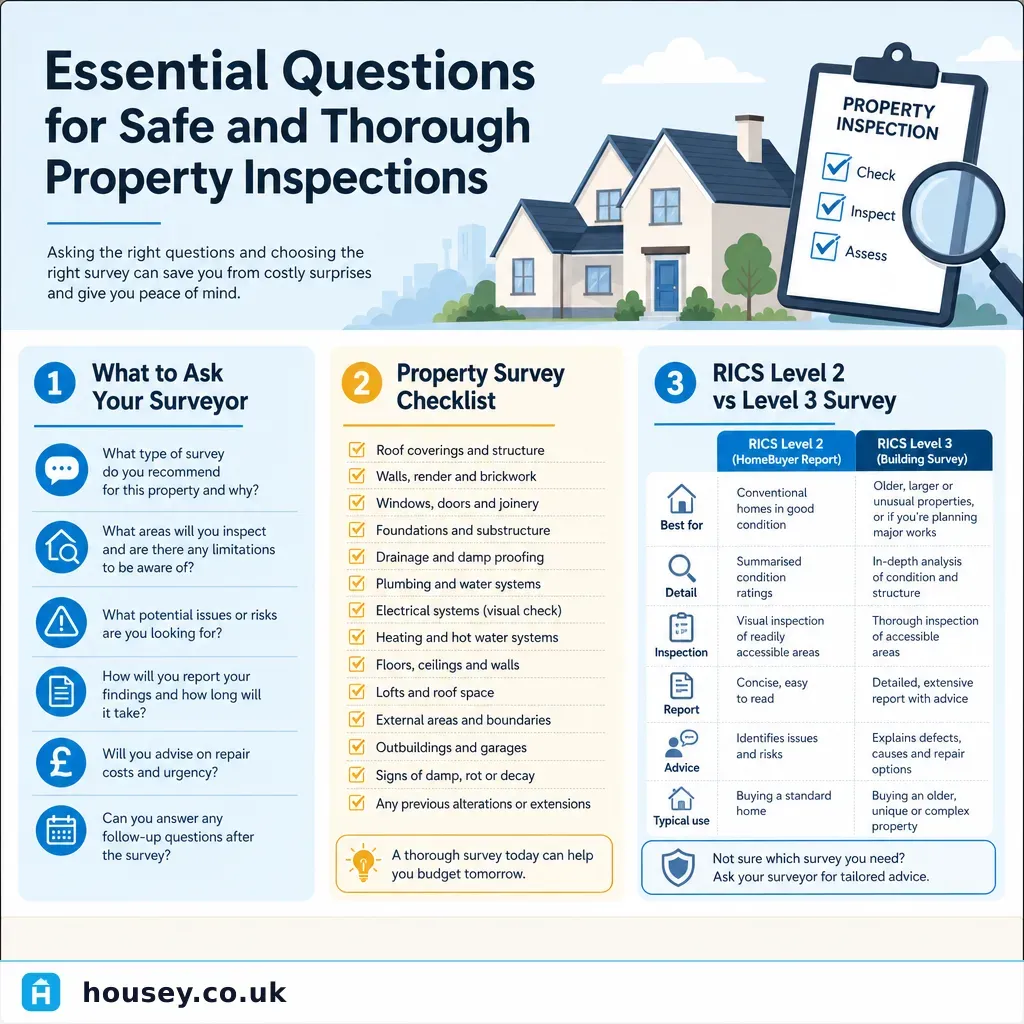
Essential Questions for Safe and Thorough Property Inspections
Before commissioning a property survey, confirm what type of inspection suits your property's age and condition, ask the surveyor what defects they will and will not assess, and understand what the report will recommend.
 Surveys & Inspections
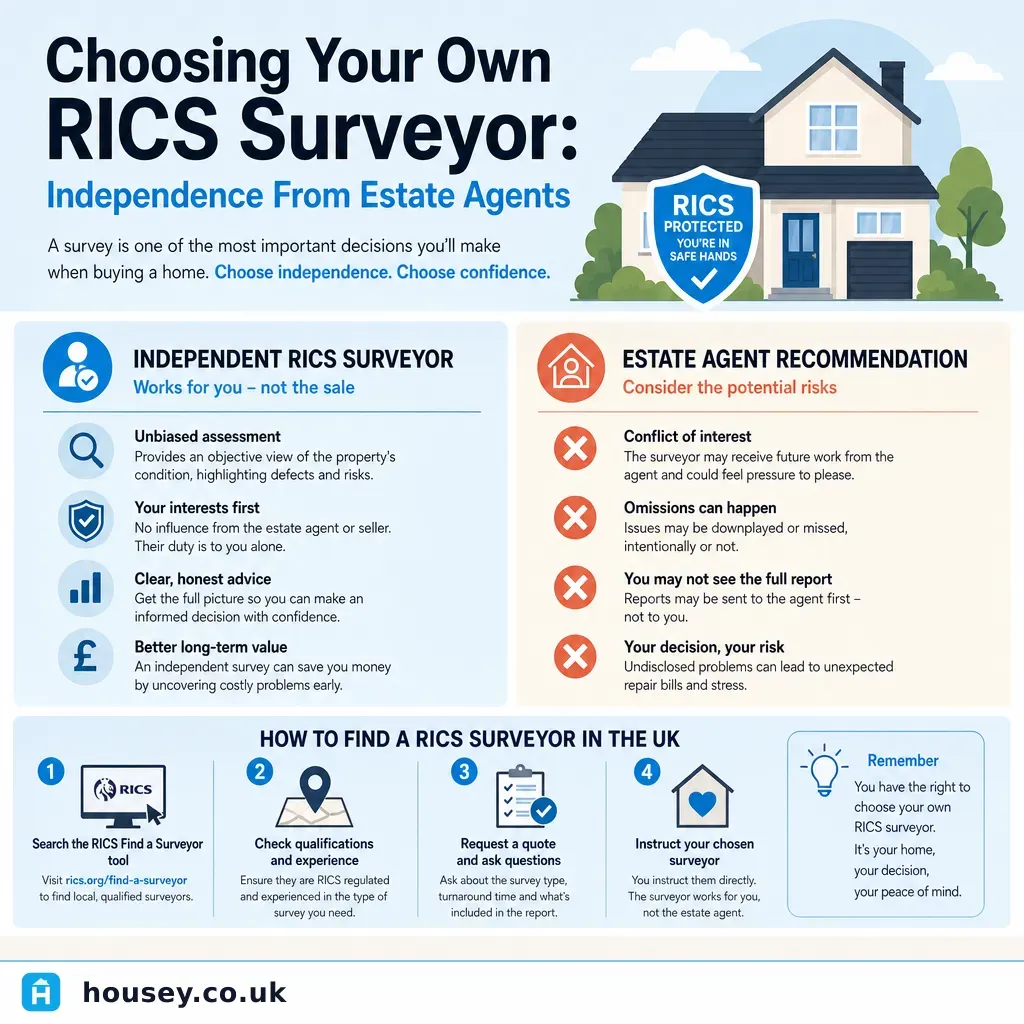
Choosing Your Own RICS Surveyor: Independence From Estate Agents
You have every right to choose your own RICS surveyor independently of your estate agent's recommendation.
 Surveys & Inspections
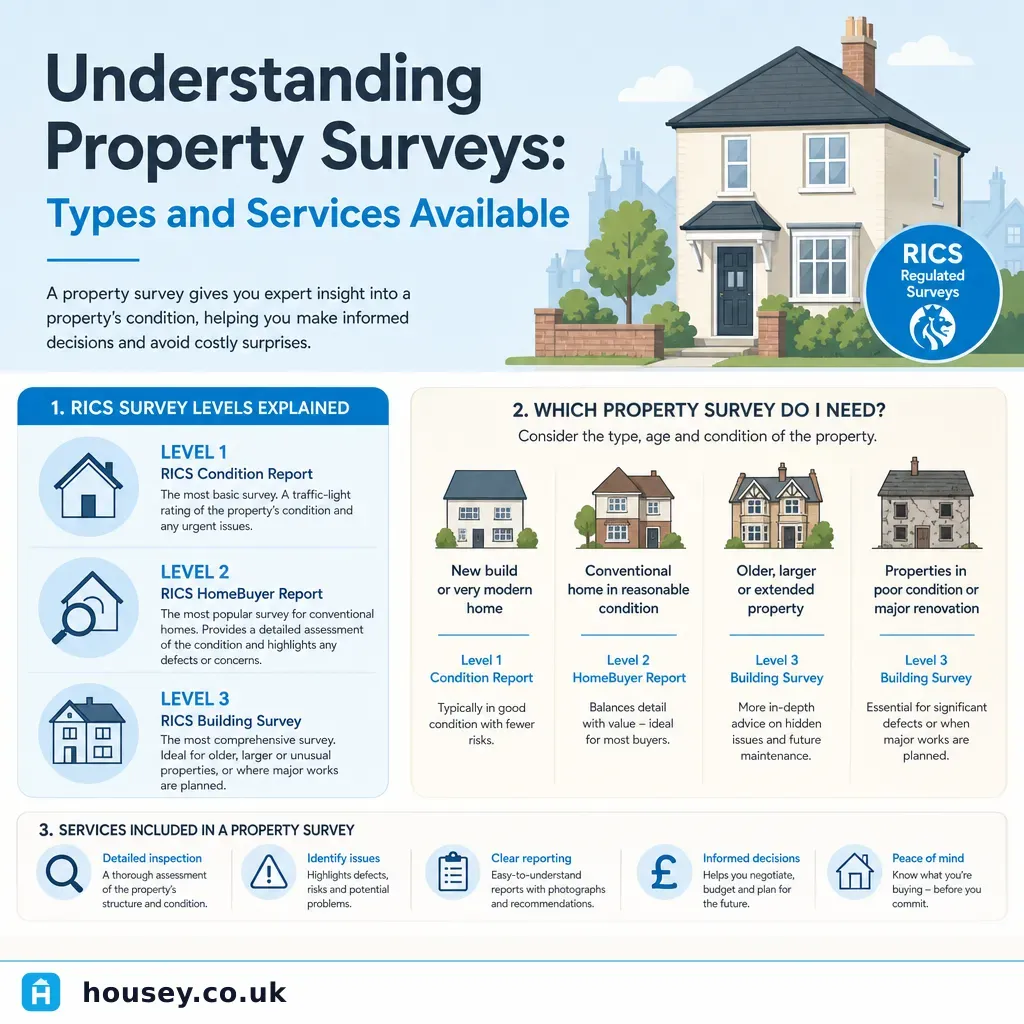
Understanding Property Surveys: Types and Services Available
UK property surveys follow three RICS-defined levels: Level 1 (Condition Report), Level 2 (Home Survey), and Level 3 (Building Survey).
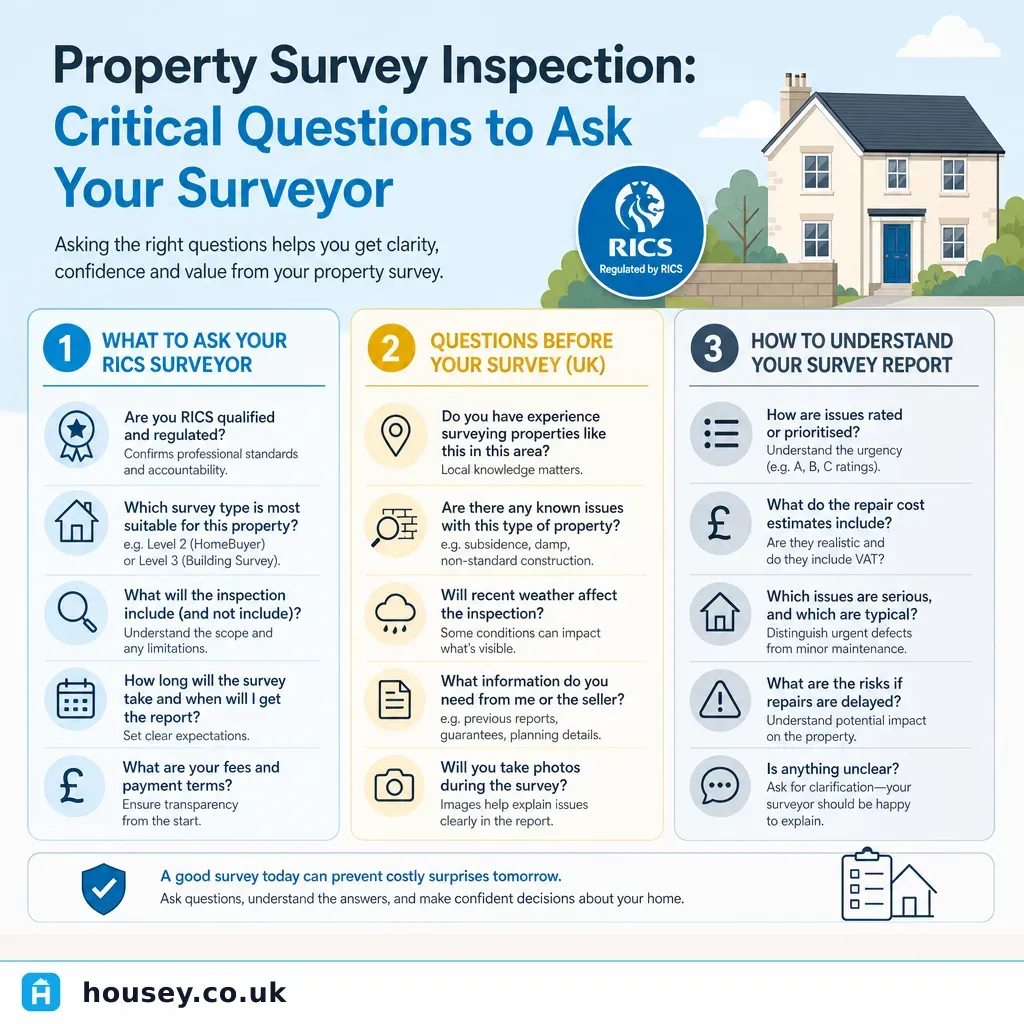 Surveys & Inspections
Property Survey Inspection: Critical Questions to Ask Your Surveyor
Before instructing a surveyor, ask which RICS level suits your property and what the report will and will not cover.
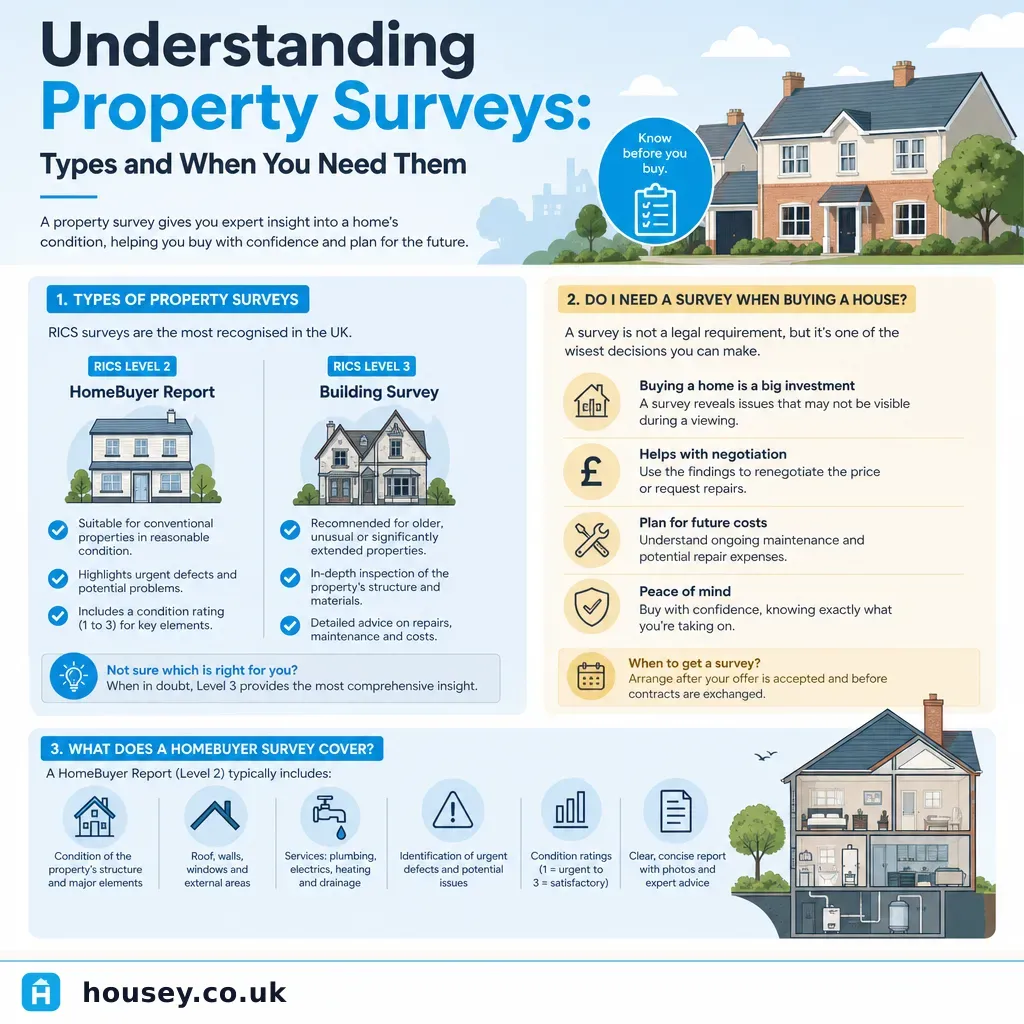 Surveys & Inspections
Understanding Property Surveys: Types and When You Need Them
The three main RICS survey types are the Level 1 Condition Report (for standard properties in good condition), the Level 2 Home Survey (conventional homes in reasonable condition), and the Level 3 Building Survey (older, unusual, or defective properties).