How Professional Home Surveys Deliver Real Value For Buyers
By Housey · Last reviewed 30th of May 2026
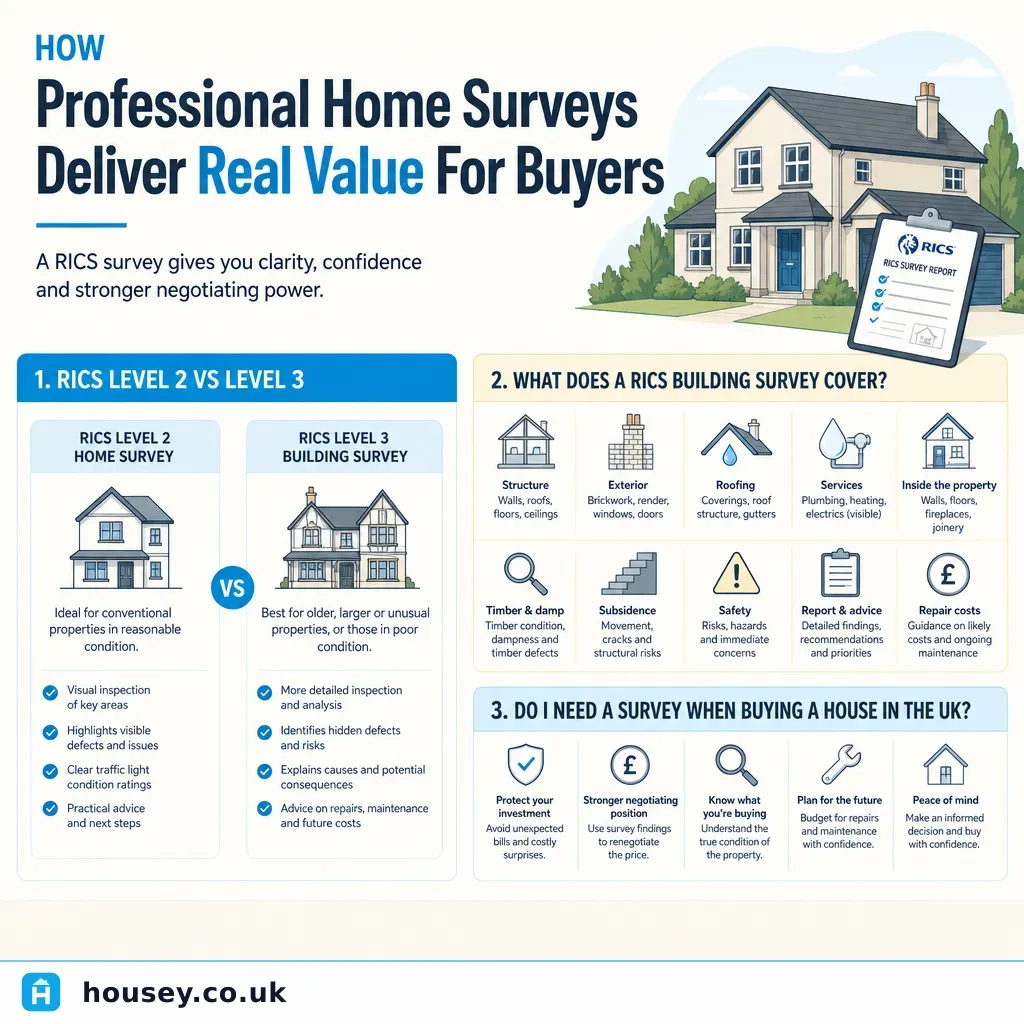
How Professional Home Surveys Deliver Real Value For Buyers
Most buyers instruct a mortgage valuation and assume it covers the condition of the property — but a valuation is a lender's risk assessment, not a detailed inspection on the buyer's behalf. Commissioning a RICS-accredited home survey before exchange of contracts gives you an independent, professional assessment of what you are actually buying. For many UK buyers, the cost of a survey is the lowest-cost protection available against expensive post-purchase defects.
Key points
- A mortgage valuation is produced for the lender's benefit; buyers typically have no legal recourse against the valuing surveyor for missed defects.
- RICS home surveys are classified at three levels: Level 1 (Condition Report), Level 2 (HomeBuyer Survey), and Level 3 (Building Survey), with the right choice depending on property age, type, and condition.
- A RICS Level 3 Building Survey is recommended for all properties built before 1900, substantially altered properties, non-standard construction types, and any property showing visible signs of movement or damp.
- Buyers who commission a survey and receive a defect report frequently use the findings to renegotiate the purchase price before exchange of contracts.
- A RICS Level 2 survey typically costs £400–£800 and a Level 3 survey £600–£1,500, depending on property size and location (indicative, last reviewed 2026-05-30).
Comparing RICS survey levels
Survey level | What it covers | Best for | Not ideal for | Typical cost* |
|---|---|---|---|---|
RICS Level 1 (Condition Report) | Brief condition ratings for main elements; no detailed advice | New-build or recently built conventionally constructed homes in good condition | Any property with age, alterations, or visible defects | £300–£500 |
RICS Level 2 (HomeBuyer Survey) | Visual inspection; condition ratings; advice on significant defects; optional market valuation | Conventional homes in reasonable condition built post-1900 | Older properties, non-standard construction, visible movement or damp | £400–£800 |
RICS Level 3 (Building Survey) | Detailed visual and accessible-area inspection; construction description; remediation advice | Victorian and Edwardian properties, unusual construction, any property with known or suspected defects | New-builds in straightforward condition | £600–£1,500 |
*Indicative UK costs, last reviewed 2026-05-30. Fees depend on property size, age, and location. Source: RICS.
What a survey actually tells you
A RICS home survey provides a structured, professional assessment of the property's visible and accessible fabric. Depending on the level chosen, it typically covers:
- Structural elements: roof structure, walls, floors, and chimney stacks.
- Damp and moisture: evidence of rising damp, penetrating damp, or condensation.
- Drainage and services: condition of visible drainage, gutters, and above-ground services — though surveys do not test services in detail.
- Timber defects: evidence of rot, woodworm, or structural timber decay.
- Condition ratings: each element is rated 1 (no repair currently needed), 2 (defects requiring attention), or 3 (serious defects requiring urgent attention or further investigation).
What a survey does not cover: areas that are not visible or accessible (behind fitted furniture, under floor coverings, within service voids), underground drainage (a separate CCTV drain survey is needed), pest assessments, or asbestos identification — both require separate specialist instructions.
Why commissioning a survey often pays for itself: a worked UK scenario
A buyer agrees to pay £285,000 for a 1930s semi-detached property in the East Midlands. The mortgage valuation confirms the property is suitable for lending. The buyer commissions a RICS Level 2 survey at a cost of £550.
The survey identifies:
- Condition 3 (urgent) — penetrating damp to the rear bay window, with an estimated repair cost of £2,500–£4,500.
- Condition 2 — flat roof section to the garage showing end-of-life coverings, likely requiring replacement within two to three years, estimated £1,200–£2,000.
- Condition 2 — chimney stack requiring repointing, estimated £600–£1,200.
The buyer uses the survey findings to renegotiate the agreed price to £281,000 — a saving of £4,000, more than seven times the survey cost. They also now have a clear remediation plan and can budget for the works after completion.
This is an illustrative scenario based on a common outcome pattern. Actual survey findings, repair costs, and negotiation outcomes depend on the specific property, surveyor, and market conditions.
Which survey level do you need?
- Choose a RICS Level 1 if the property is a modern new-build (built within the last ten years) in good condition with no visible defects.
- Choose a RICS Level 2 if the property was built post-1900, is of conventional brick and tile construction, and shows no visible signs of structural movement, significant damp, or major alterations.
- Choose a RICS Level 3 if the property was built before 1900, has been substantially extended or altered, is of non-standard construction such as concrete frame, timber frame, or stone, or shows cracks, sticking doors or windows, or significant damp.
- Commission a structural engineer in addition to a general survey if there are specific signs of structural movement — stepped cracks in brickwork, sagging lintels, or significant differential settlement — that require engineering diagnosis rather than a general inspection.
- Add a CCTV drain survey if the property is older, if the surveyor notes drainage concerns, or if you have any reason to suspect drain condition.
Red flags that make a survey essential
Some property characteristics significantly increase the risk of undisclosed defects and make commissioning a survey close to essential:
- The property is more than fifty years old.
- There are visible cracks on external or internal walls, particularly stepped diagonal cracks through brickwork.
- The property has been substantially extended, converted, or altered.
- The asking price has been reduced, which may reflect an undisclosed problem.
- The property has been empty for a prolonged period.
- Doors or windows are sticking, which can indicate structural movement or significant moisture ingress.
- The property is near large trees, sits on clay subsoil, or is in a flood-risk area.
- The property has a flat roof, chimney stack, or other vulnerable element that has not been recently inspected.
When to get professional help
A RICS home survey is itself a professional service — but additional specialists may be needed beyond the standard survey:
- Structural concerns: appoint a chartered structural engineer if the survey identifies or cannot rule out active structural movement.
- Asbestos: if the property was built or significantly renovated before 2000 and works are planned, consider a separate asbestos survey carried out by a UKAS-accredited company.
- Drains: commission a CCTV drain survey if drainage defects are flagged or the property is older.
- Specialist construction: thatched, timber-framed, or listed properties benefit from a surveyor with specific experience in that construction type.
How Housey can help
Housey connects buyers with RICS-registered surveyors across the UK. Compare quotes for RICS Home Surveys or choose the right level for your property: a RICS Level 1 survey for modern homes in good condition, a RICS Level 2 survey for most post-1900 conventional properties, or a RICS Level 3 survey for older, altered, or complex homes.
Frequently asked questions
Is a mortgage valuation the same as a home survey?
No. A mortgage valuation is carried out for the lender to confirm the property offers adequate security for the loan. It is typically a brief inspection, the report belongs to the lender, and buyers generally have no legal recourse against the valuing surveyor for defects not identified. It does not replace an independent home survey commissioned by the buyer.
How much does a RICS survey cost in the UK?
A RICS Level 2 survey typically costs £400–£800 for a standard three-bedroom property, and a Level 3 Building Survey typically costs £600–£1,500, depending on property size, age, and location. These are indicative ranges, last reviewed 2026-05-30. Always request a fixed-fee quotation in writing and confirm what is included.
Can I use a survey report to negotiate the purchase price?
Yes. A survey identifying significant defects or urgent repairs gives you an objective, professionally supported basis to renegotiate before exchange of contracts. The reduction sought does not automatically equal the full repair cost — it depends on market conditions, the seller's circumstances, and the severity of defects — but a report provides a credible, evidence-based starting point.
What happens if the survey finds serious defects?
You have several options: renegotiate the agreed price to reflect remediation costs; request the seller carries out specified repairs before completion; proceed at the agreed price having budgeted for works; or withdraw before exchange, losing survey and legal fees but incurring no further liability. Your surveyor advises on defect severity and cost; your solicitor advises on your legal position.
Sources and further reading
- RICS: Home surveys guidance — official RICS information on survey levels and finding a surveyor
- GOV.UK: Buying a home — overview guidance for buyers in England
- Which?: House surveys explained — independent consumer guidance on survey types
- Citizens Advice: Buying and selling your home — practical guidance for buyers
- HSE: Asbestos guidance — information on asbestos risks in domestic properties
Useful next reads
 Surveys & Inspections
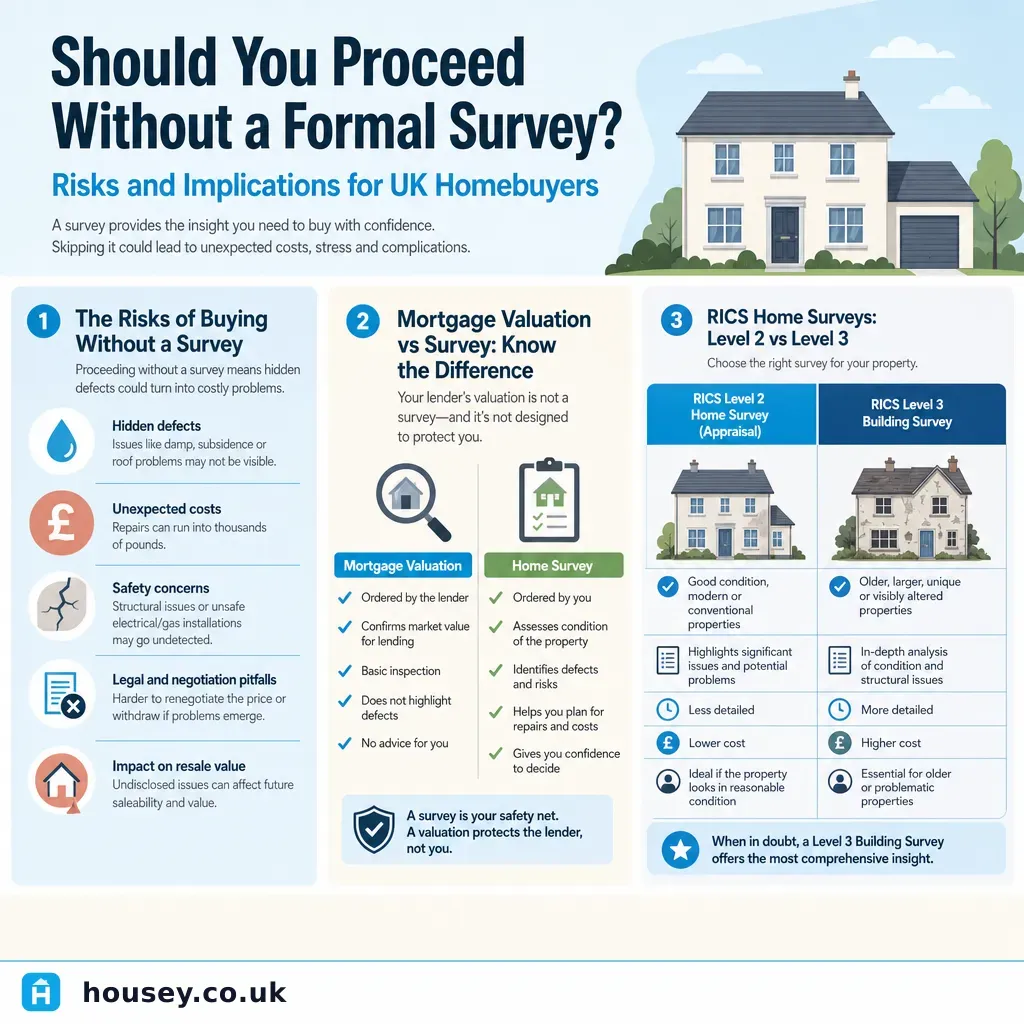
Should You Proceed Without a Formal Survey? Risks and Implications
In England and Wales there is no legal requirement to obtain a survey before exchange, but caveat emptor means any undisclosed defects become your problem the moment contracts are exchanged.
 Surveys & Inspections
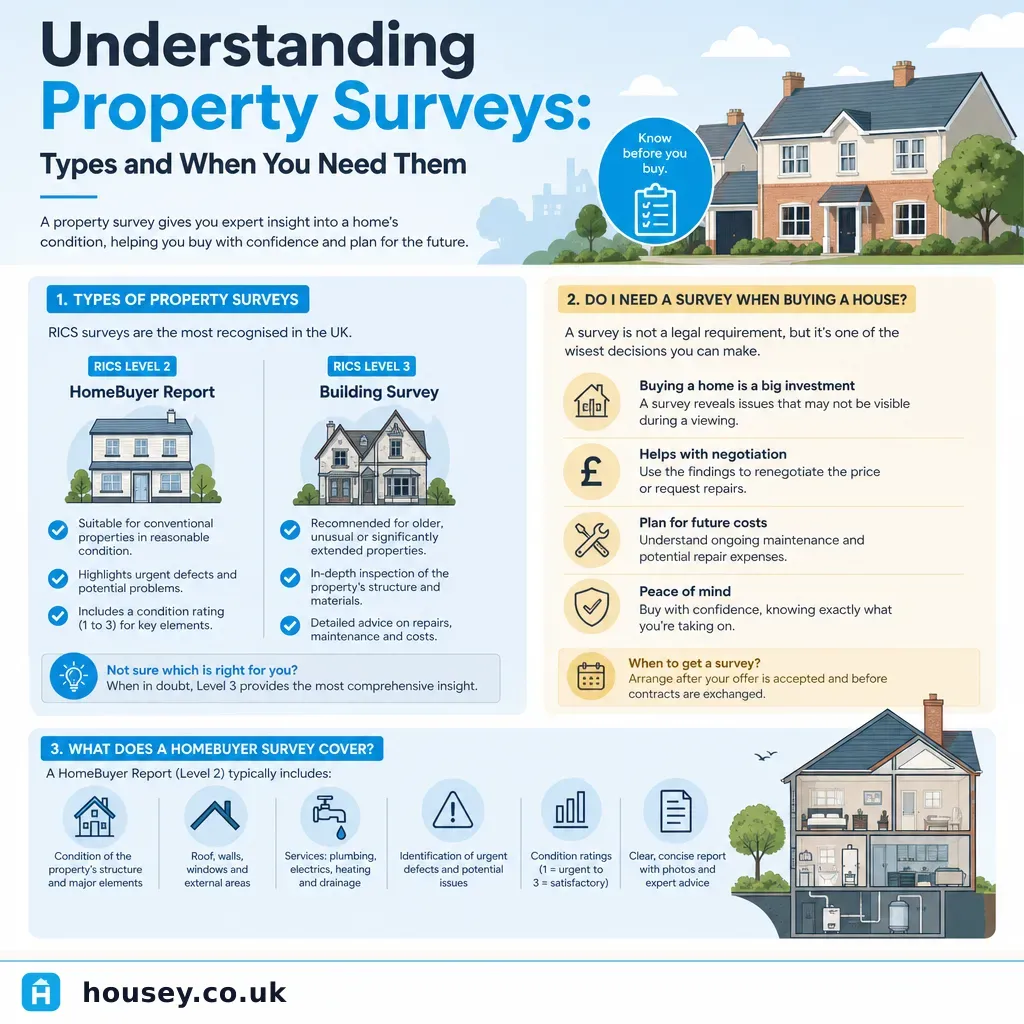
Understanding Property Surveys: Types and When You Need Them
The three main RICS survey types are the Level 1 Condition Report (for standard properties in good condition), the Level 2 Home Survey (conventional homes in reasonable condition), and the Level 3 Building Survey (older, unusual, or defective properties).
 Surveys & Inspections
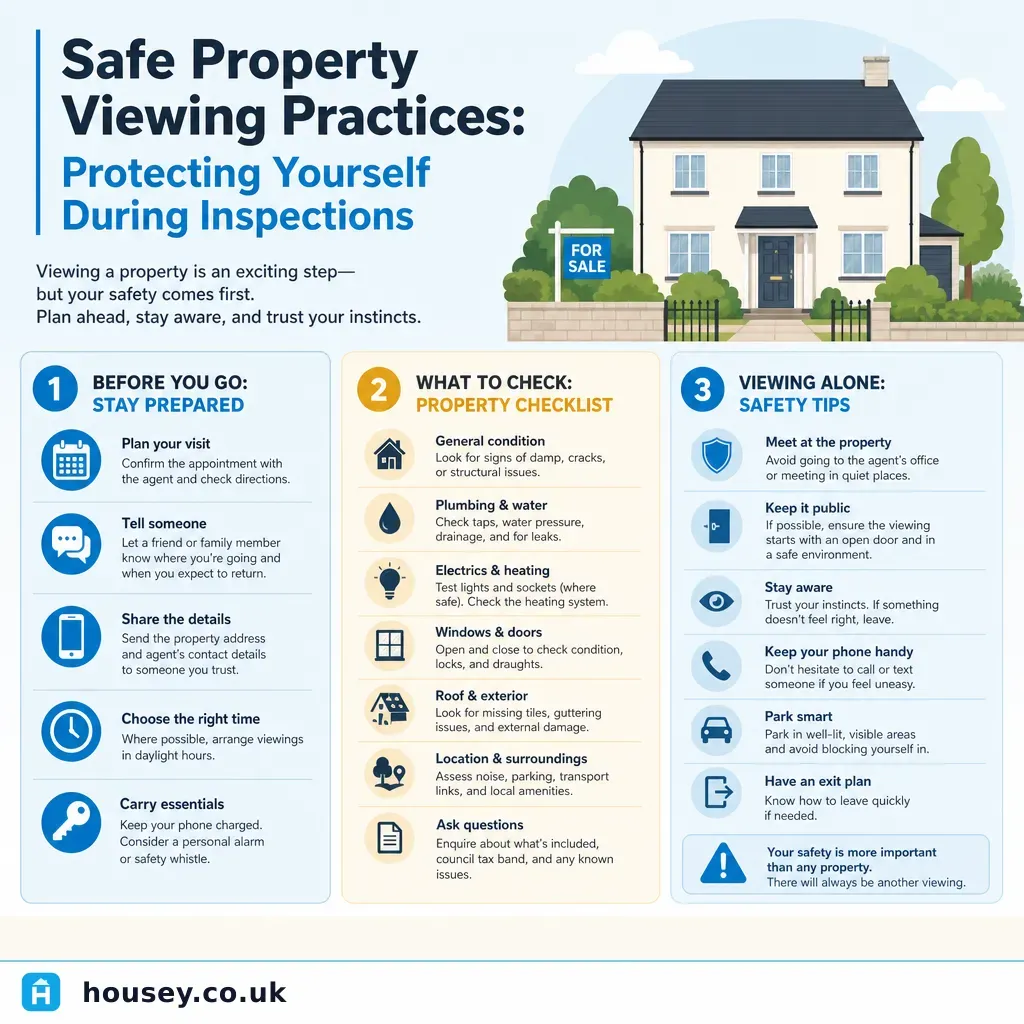
Safe Property Viewing Practices: Protecting Yourself During Inspections
When viewing a property in the UK, always tell someone where you are going and share the full address before you leave.
 Surveys & Inspections
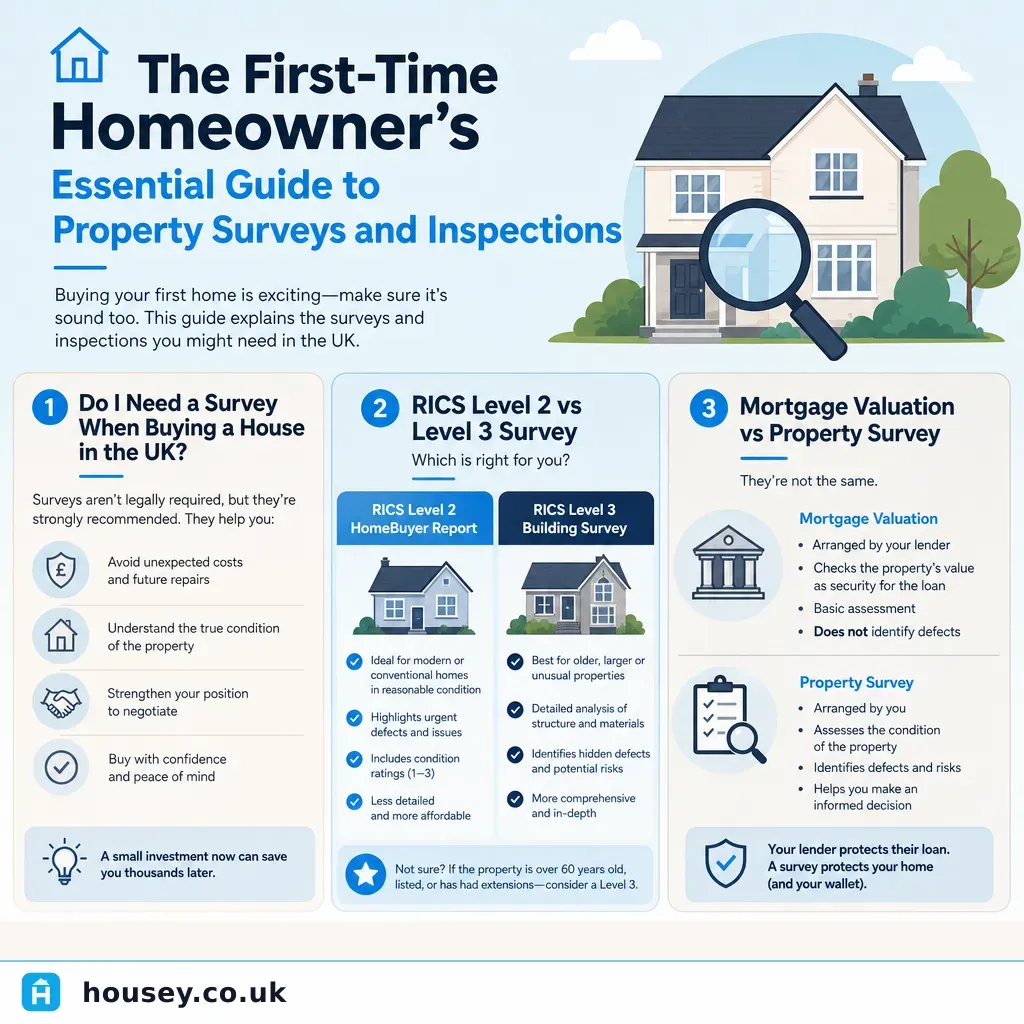
The First-Time Homeowner's Essential Guide to Property Surveys and Inspections
First-time buyers in the UK need more than the mortgage valuation — that report protects the lender, not you.
 Surveys & Inspections
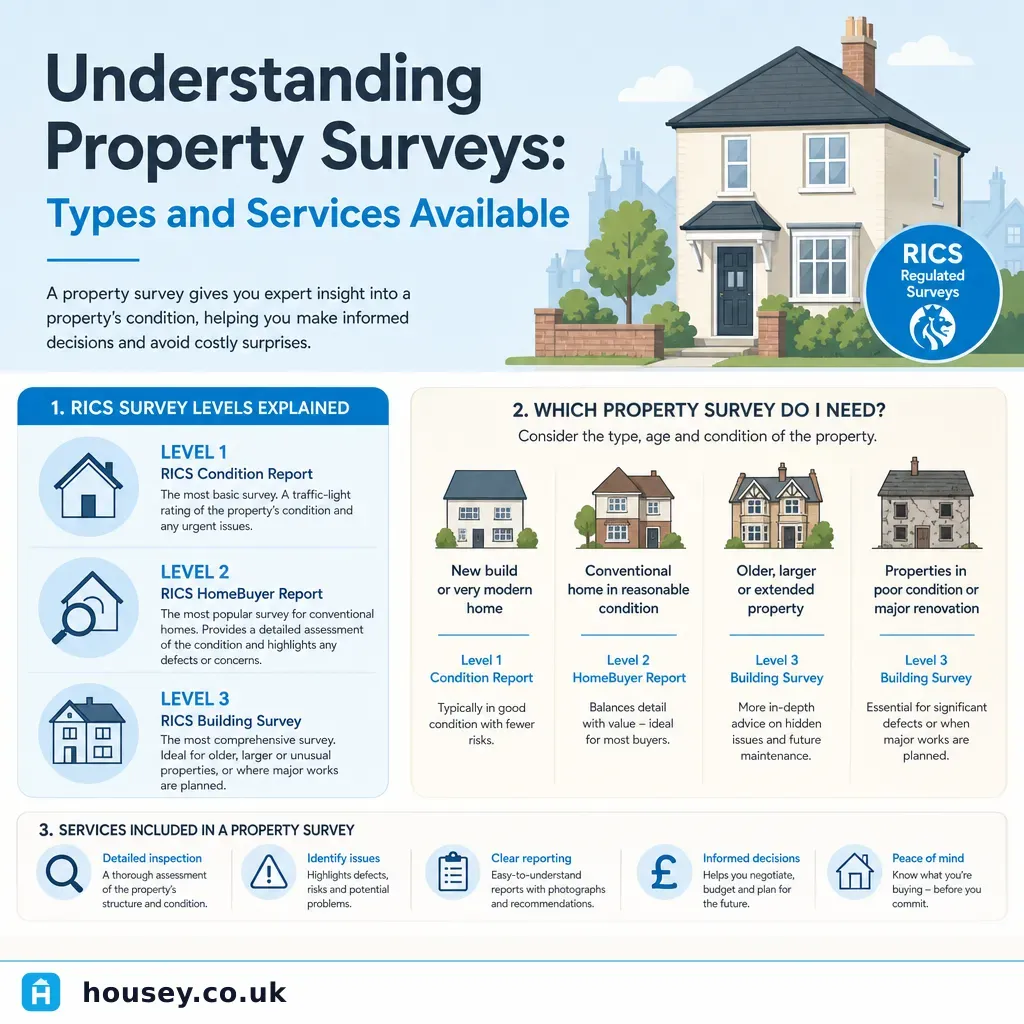
Understanding Property Surveys: Types and Services Available
UK property surveys follow three RICS-defined levels: Level 1 (Condition Report), Level 2 (Home Survey), and Level 3 (Building Survey).