Clean and Quiet Demolition Methods: Minimising Disruption and Dust
By Housey · Last reviewed 24th of May 2026
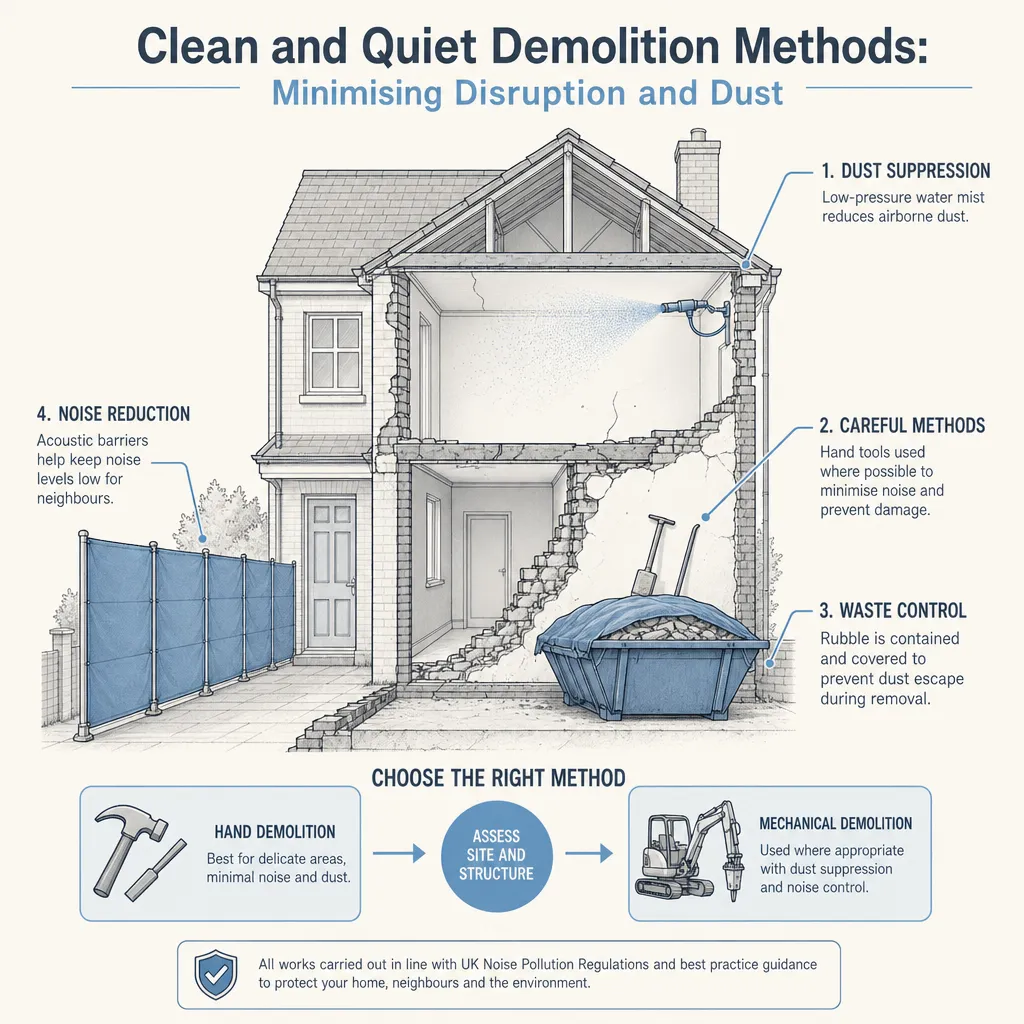
Clean and Quiet Demolition Methods: Minimising Disruption and Dust
Demolition is rarely as simple as pulling things down. Whether you're removing a single internal wall or preparing a site for a full redevelopment, the way the work is carried out affects your neighbours, your health, your local authority's tolerance, and the safety of the structure being removed. In the UK, residential demolition — even of internal elements — is subject to health and safety law, planning conditions, and in some cases permitted development restrictions. Choosing the right method from the outset reduces complaints, enforcement risk, and rework.
Key points
- Under the Control of Pollution Act 1974, local authorities can issue a Section 60 notice imposing conditions on construction and demolition noise; some councils require prior notification under Section 61 before works begin.
- BS 5228 (Code of Practice for Noise and Vibration Control on Construction and Open Sites) sets out industry best practice for managing demolition noise; contractors have a legal duty under the Health and Safety at Work Act 1974 to protect workers and the public.
- Asbestos-containing materials (ACMs) are present in a high proportion of UK buildings constructed before 2000; a refurbishment and demolition asbestos survey is legally required under the Control of Asbestos Regulations 2012 before any demolition begins.
- Hand demolition (manual deconstruction) produces significantly less noise, vibration, and airborne dust than mechanical demolition, and is often the only appropriate method in terraced or semi-detached properties.
- Wet suppression — applying water mist or hose water to demolition debris and cutting surfaces — is the primary dust control measure endorsed by the Health and Safety Executive (HSE) for construction and demolition sites.
Why demolition method matters in residential settings
Mechanical demolition using excavators and breakers is fast and cost-effective on open or isolated sites. In residential areas — particularly where properties share party walls, where neighbours are close, or where the site is within a conservation area — the vibration, noise, and dust generated by mechanical methods can cause structural damage to adjacent buildings, respiratory health risks, and disputes with neighbours or the local authority.
The choice of demolition method is also constrained by structural considerations: in a terraced row, removing a structure without properly supporting and weatherproofing the party wall can leave the adjoining property exposed and structurally weakened. A structural engineer should advise on party wall implications before works start.
Comparison of demolition methods
Method | Noise level | Dust generated | Vibration | Best suited for | Not suitable for |
|---|---|---|---|---|---|
Hand demolition | Low–moderate | Low (manageable with wet suppression) | Minimal | Party walls, listed structures, confined sites, residential terraces | Large open sites where speed is critical |
Small excavator or mini-plant | Moderate | Moderate | Low–moderate | Detached garden walls, outbuildings, detached garages | Semi-detached or terraced where vibration could affect neighbours |
Full mechanical demolition | High | High without suppression | Significant | Detached structures, cleared open sites, large-scale clearance | Residential sites with close neighbours |
Diamond drilling and wire sawing | Low | Low with water suppression | Minimal | Precise cuts in reinforced concrete or masonry sections | Bulk or high-volume removal |
Dust suppression techniques
Effective dust management is a legal obligation, not a courtesy. The principal methods used by professional demolition contractors are:
Wet suppression — wetting debris, cut faces, and rubble with water mist or hoses before and during demolition. This is the most widely used and cost-effective technique, and the one most commonly required by local authorities under Section 60 conditions.
Dust screens and hoarding — close-boarded site hoarding contains coarse debris; perimeter dust screens (shade cloth or purpose-made proprietary screens) reduce airborne spread to neighbouring properties and the public highway.
Negative-pressure enclosures — used for high-risk work such as licensed asbestos removal or soft-strip of contaminated materials; air is extracted through HEPA filters before release to atmosphere.
HEPA-filtered vacuum extraction — attached directly to cutting or grinding tools to capture dust at source before it becomes airborne.
Damping of rubble skips — covering loaded skips and lightly wetting the surface before removal prevents secondary dust generated by wind or further loading on site.
Noise management and neighbour obligations
The legal noise limits that matter most in residential demolition are set by:
- Section 60 of the Control of Pollution Act 1974 — local authorities can impose conditions on working methods, hours, and noise levels at any point during demolition works without advance warning.
- Section 61 prior consent — a contractor can proactively apply to the council to agree conditions before starting, reducing the risk of mid-project enforcement action. This is strongly recommended for projects lasting more than a few days.
- BS 5228 — the industry reference standard for predicting and managing demolition noise, frequently cited in planning conditions and Section 61 agreements.
- Planning conditions — if your project has planning permission, conditions typically restrict working hours (commonly 08:00–18:00 Monday to Friday, 08:00–13:00 Saturday, no Sunday or bank holiday working).
Neighbours are entitled to raise a statutory nuisance complaint with the council under the Environmental Protection Act 1990 if demolition noise or dust exceeds reasonable limits. A proactive letter to adjacent properties explaining the scope, expected duration, and the contractor's contact details reduces complaints significantly and is considered good practice on well-managed sites.
Important limitations
This article provides general information about demolition methods and site management. Rules and risks vary depending on the specific structure, its construction type, neighbouring properties, and local authority requirements. In particular:
- Asbestos is a serious health hazard. Do not disturb any material suspected to contain asbestos — licensed removal is required in many circumstances under the Control of Asbestos Regulations 2012.
- Structural stability during and after demolition — especially where party walls are involved — must be assessed by a qualified professional before works begin.
- Planning, listed building consent, and conservation area consent requirements vary by property and location; always verify with your local planning authority.
A competent demolition contractor and, where appropriate, a structural engineer should assess your specific project before work starts.
When this becomes urgent
Stop work and seek professional advice immediately if:
- Cracking, movement, or leaning is observed in any adjacent or remaining structure during demolition
- Any material suspected to contain asbestos is disturbed or unexpectedly exposed
- Ground instability, unexpected voids, or water ingress is encountered during excavation
- The local authority issues an enforcement notice or stop notice relating to the works
- Utility services (gas, electricity, water) are unexpectedly encountered during demolition
What to ask a qualified professional
Before appointing a demolition contractor, ask:
- Are you a member of the National Federation of Demolition Contractors (NFDC) or hold equivalent accreditation?
- Has a pre-demolition asbestos survey (refurbishment and demolition survey) been carried out, or will you arrange one before works start?
- What specific dust and noise suppression methods will you use, and how will compliance be documented on site?
- Have you notified or obtained prior consent under Section 60 or 61 of the Control of Pollution Act 1974 where required?
- How will party wall stability be maintained and monitored throughout the works?
- Who is responsible for waste removal, and what are the disposal arrangements for any hazardous materials including ACMs?
- Is VAT included in your quote, and what would trigger additional costs?
When to get professional help
Demolition is not DIY work where structural elements are concerned. Seek a qualified demolition contractor or structural engineer whenever:
- The structure to be demolished is load-bearing or attached to an adjacent property
- The building contains or may contain asbestos-containing materials (common in any UK property built before 2000)
- The local authority has imposed conditions or requires advance notification
- The work is within a conservation area or involves a listed building
- A Party Wall Agreement may be needed under the Party Wall etc. Act 1996
How Housey can help
Housey connects you with accredited demolition contractors experienced in residential and mixed-use sites, including party wall situations and asbestos-safe working procedures. Request quotes and compare methodologies and accreditations before instructing.
Frequently asked questions
Do I need planning permission to demolish a residential building?
Demolishing a dwelling requires prior approval from the local planning authority under the Town and Country Planning (General Permitted Development) Order. Demolition within a conservation area or of a listed building requires conservation area consent or listed building consent respectively. Always check with your local planning authority before starting any demolition work.
What is a pre-demolition asbestos survey?
A pre-demolition asbestos survey is a comprehensive inspection of the entire structure, including hidden voids and cavities, to locate all asbestos-containing materials before demolition begins. It is a legal requirement under the Control of Asbestos Regulations 2012 for any demolition or major refurbishment project in the UK.
How do I report excessive demolition noise or dust to the council?
Contact your local authority's environmental health department. Under the Control of Pollution Act 1974 and the Environmental Protection Act 1990, councils have powers to investigate and issue abatement notices for statutory nuisances caused by demolition noise or dust. Most councils have an online reporting portal or a dedicated environmental health phone line.
Can I demolish my own garage without specialist help?
Minor detached timber outbuildings may be removed without specialist involvement, but garages — particularly those attached to the house, built from masonry or concrete, or sharing a wall with a neighbour — should be assessed first. Check for drainage or service connections, and consider whether an asbestos check is advisable given the building's age.
Sources and further reading
- Control of Pollution Act 1974 — Sections 60 and 61 — legislation.gov.uk
- Control of Asbestos Regulations 2012 — legislation.gov.uk
- Managing and working with asbestos — Health and Safety Executive
- National Federation of Demolition Contractors — NFDC
- When is permission required? (Demolition) — GOV.UK Planning Practice Guidance
Useful next reads
 Improvement & Build
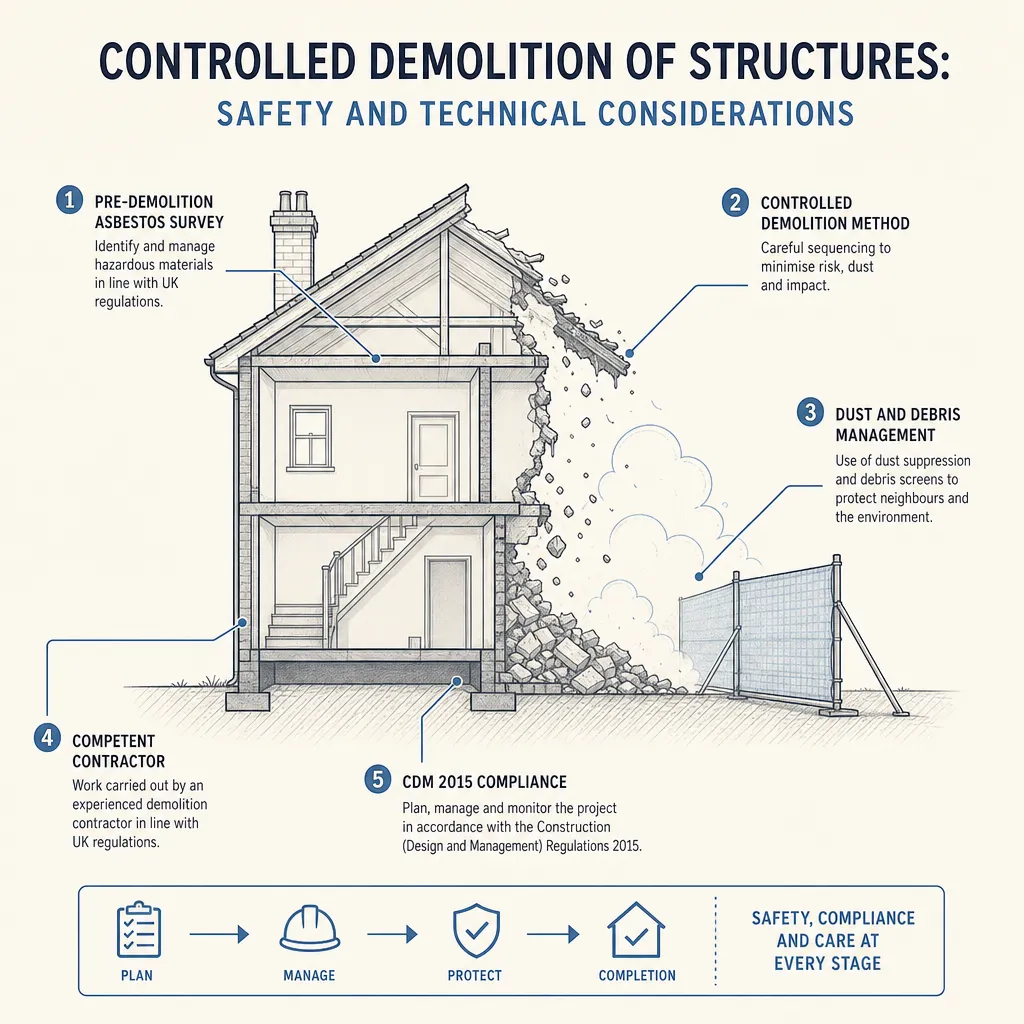
Controlled Demolition of Structures: Safety and Technical Considerations
Controlled demolition in the UK covers any planned, engineered removal of a structure, governed by CDM 2015 and HSE requirements.
 Improvement & Build
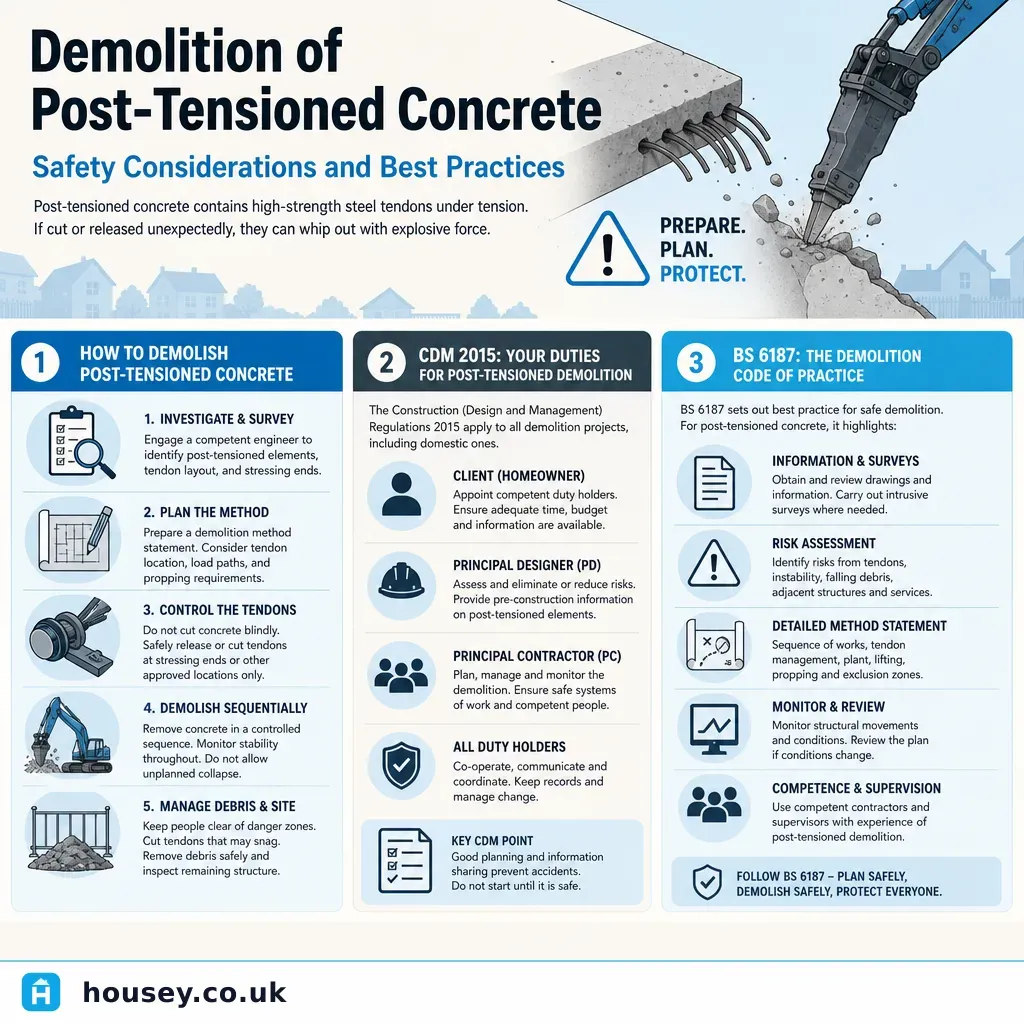
Demolition of Post-Tensioned Concrete: Safety Considerations and Best Practices
Post-tensioned concrete contains steel tendons under loads of up to 1,860 MPa.
 Improvement & Build
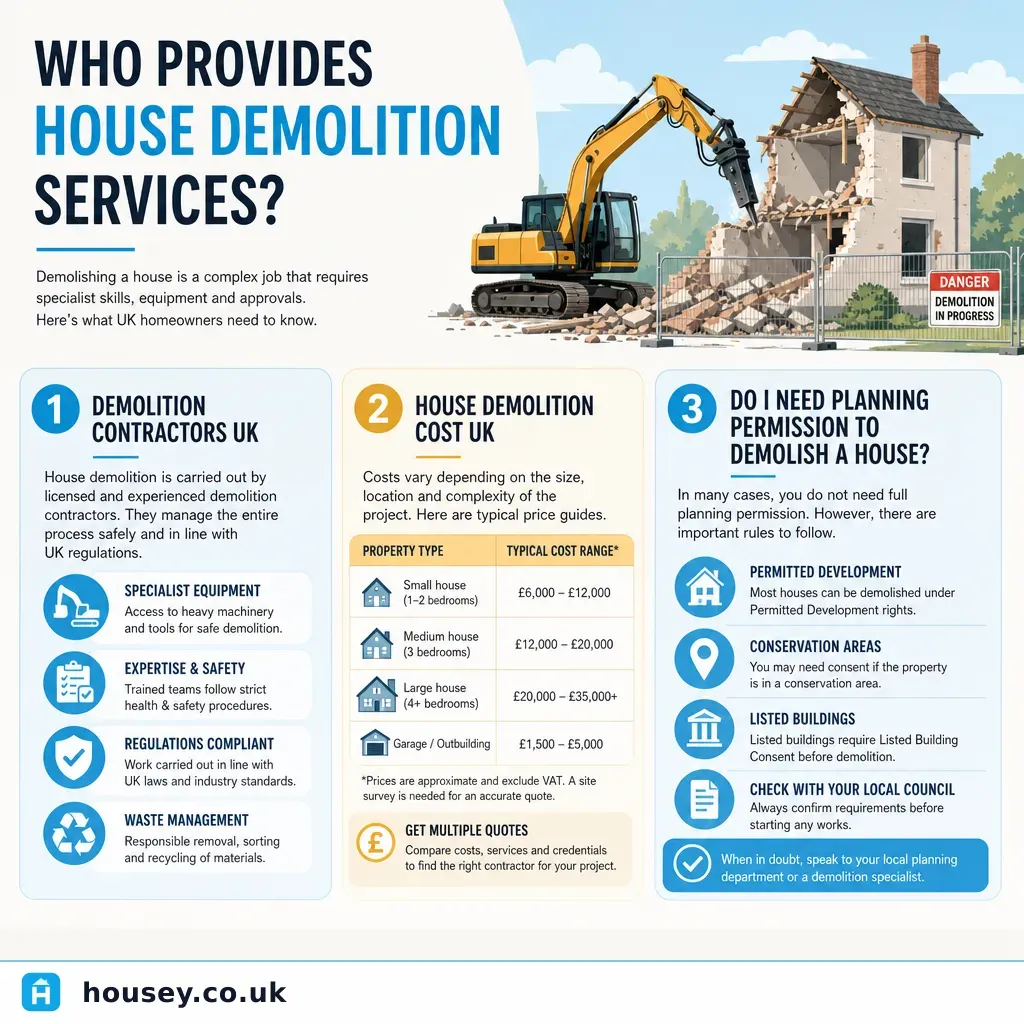
Who Provides House Demolition Services
House demolition in the UK is carried out by specialist demolition contractors, often members of the National Federation of Demolition Contractors (NFDC).
 Improvement & Build
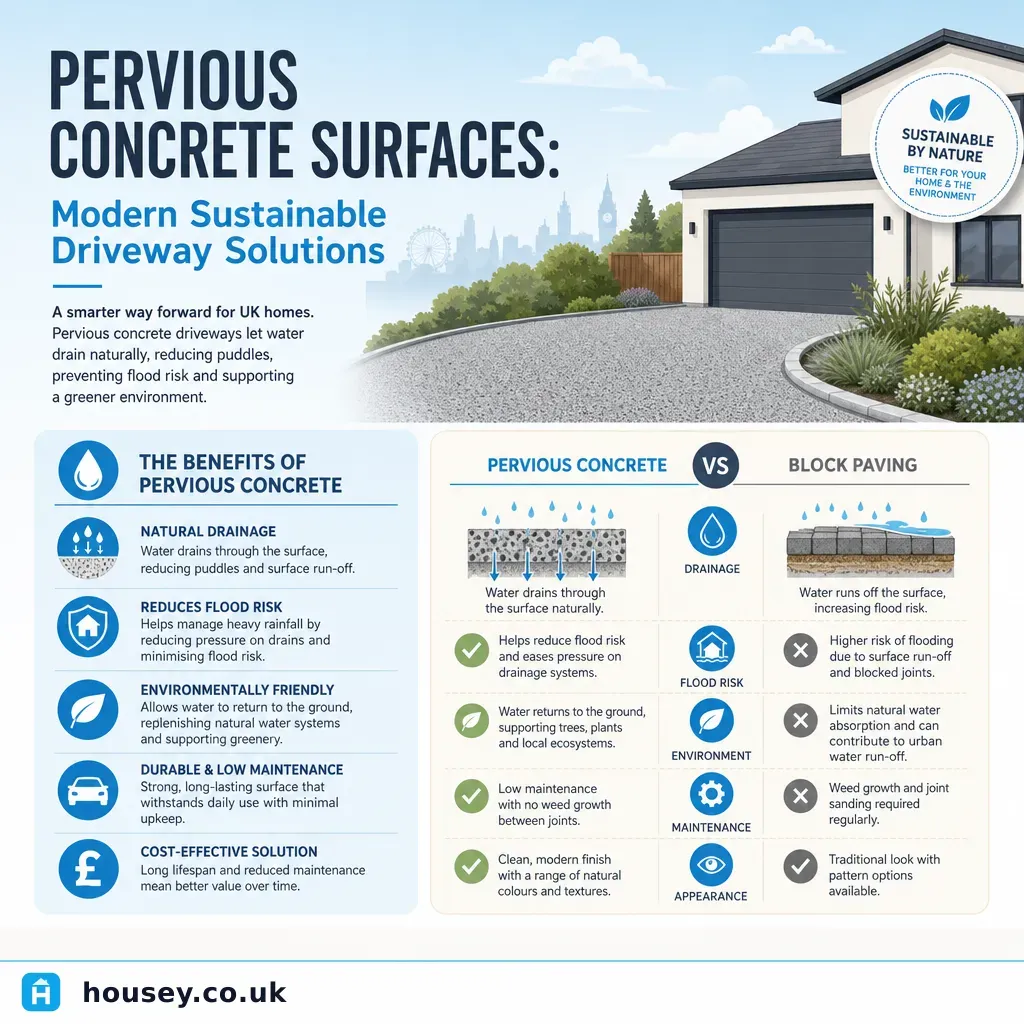
Pervious Concrete Surfaces: Modern Sustainable Driveway Solutions
Pervious concrete (also called porous or no-fines concrete) is a specialist concrete mix with large voids that allow rainwater to pass through the surface and into the sub-base below.
 Improvement & Build
Open Plan Living Space Conversion Costs
Opening up a living space in the UK typically costs £3,000–£15,000+ depending on whether walls are load-bearing, the beam specification required, and the extent of remodelling.