Demolition of Post-Tensioned Concrete: Safety Considerations and Best Practices
By Housey · Last reviewed 24th of May 2026
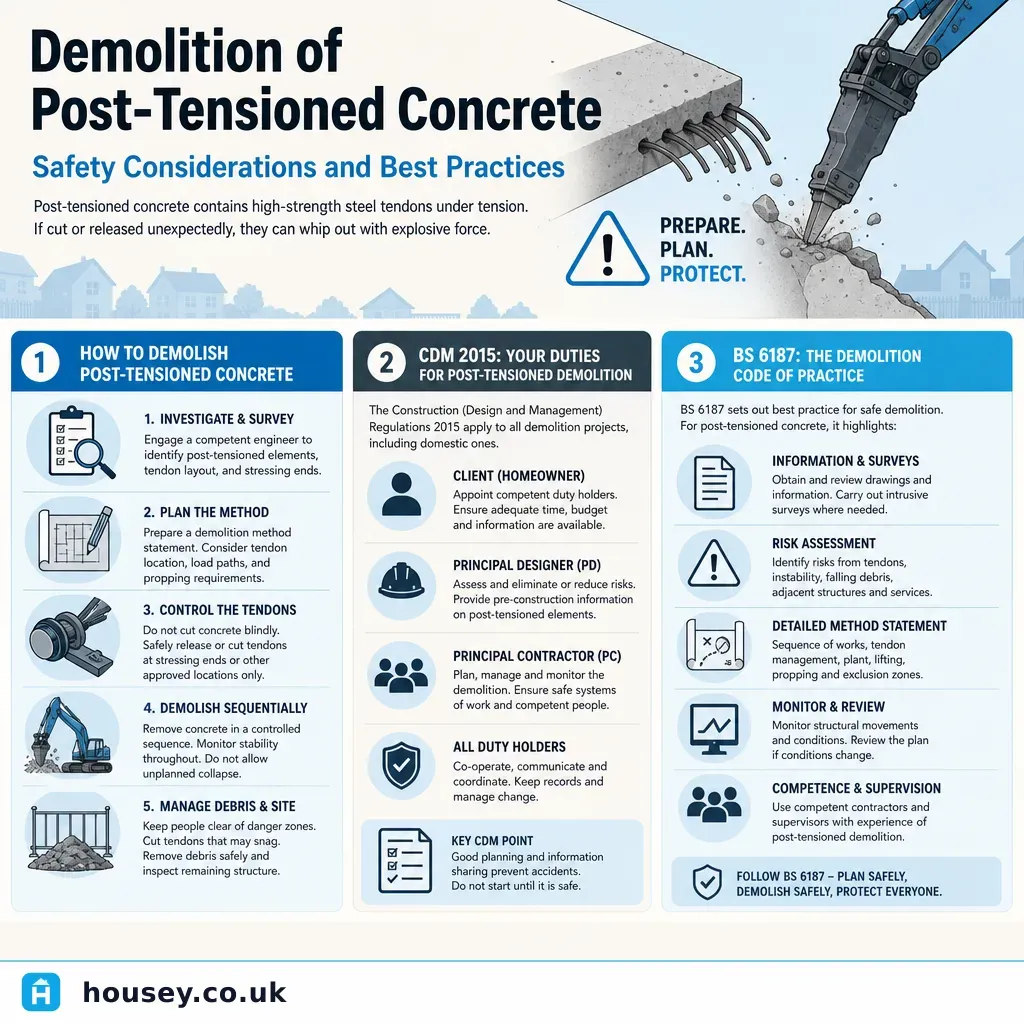
Demolition of Post-Tensioned Concrete: Safety Considerations and Best Practices
Post-tensioned (PT) concrete is found across UK commercial and residential buildings — multi-storey car parks, flat-slab office blocks, apartment podium decks, and some larger residential schemes built from the 1970s onwards. When these structures reach end of life or require significant alteration, the demolition process is fundamentally different from — and far more hazardous than — work on conventionally reinforced concrete. The stored energy locked inside the structure presents risks that have caused fatalities on demolition sites where PT elements were not properly identified and managed.
Key points
- Post-tensioned concrete contains steel tendons or strand cables stressed to loads typically between 1,000 and 1,860 MPa — cutting or shocking them without controlled de-tensioning can release energy with explosive, potentially fatal force.
- BS 6187:2011, the Code of Practice for Demolition, requires a pre-demolition structural appraisal for all structures containing post-tensioned elements.
- The Construction (Design and Management) Regulations 2015 (CDM 2015) mandate a pre-construction phase plan that must identify post-tensioned elements and specify the safe method for their removal.
- Ground-penetrating radar (GPR) is the standard non-destructive technique used to locate tendon profiles before any cutting or breaking begins on site.
- Only contractors registered with the National Federation of Demolition Contractors (NFDC), or with equivalent demonstrated competence in PT structures, should be engaged for this type of demolition.
What makes post-tensioned concrete different?
Conventional reinforced concrete uses passive steel bars (rebar) that resist tensile forces but hold no stored energy. Post-tensioned concrete works differently: steel tendons or multi-strand cables are threaded through ducts cast into the concrete and tensioned using hydraulic jacks after the concrete has cured. The tension is locked off at anchor plates embedded at each end of the slab or beam. This puts the entire concrete section into permanent compression, allowing thinner, longer-spanning slabs and reduced deflection under load.
The danger arises because those tendons remain under enormous load — typically 100 to 300 kN per strand — even decades after construction. Any sudden cut, whether by a disc cutter, hydraulic shear, or demolition saw, can release that stored energy almost instantaneously. The result is a violent recoil of tendon ends, potential fragmentation of anchor zones, and risk of sudden partial or total structural collapse of the element being worked on.
Identifying post-tensioned structures
Before any demolition or alteration work begins, the structure must be positively identified. Common indicators include:
- Anchor pockets or blister ends on beam or slab edges, often patched with grout but leaving a distinctive raised profile
- Unusually thin slabs relative to span — flat-plate PT floors may be only 200–250 mm thick for 8–10 m spans
- Construction drawings specifying "PT", "prestressed flat slab", or "bonded/unbonded tendons"
- Buildings constructed between the 1960s and 2000s, when PT flat-slab construction was particularly prevalent in commercial and multi-residential settings
If original structural drawings cannot be located, a chartered structural engineer should commission a GPR survey and potentially a covermeter survey to map reinforcement and tendon positions before any work is priced or programmed.
The controlled de-tensioning process
Safe demolition of PT concrete requires a method statement prepared by a chartered structural engineer, reviewed and approved before work begins on site. The general sequence is:
- Locate all tendons using GPR or as-built drawings verified on site.
- Assess anchor condition — corroded or damaged anchors increase the risk of uncontrolled release during de-tensioning.
- Establish exclusion zones around anchor ends during de-tensioning operations.
- Cut in a controlled, sequenced manner — never cut all tendons in one section simultaneously. The structural engineer specifies the order to prevent progressive collapse.
- Monitor structural movement throughout the sequence, particularly in multi-storey situations where PT floors contribute to lateral stability.
For unbonded tendons (the most common type in UK flat slabs), each tendon runs inside a greased plastic sheath and can be individually de-tensioned. Bonded tendons — grouted into metal ducts — present additional complexity; the grout must be assessed for condition, as voids may indicate corrosion and unpredictable tendon behaviour during cutting.
Standard RC demolition vs PT concrete demolition
Factor | Reinforced concrete (RC) | Post-tensioned concrete (PT) |
|---|---|---|
Stored energy in steel | None — rebar is passive | High — typically 100–300 kN per strand |
Pre-demolition survey | Good practice | Mandatory under BS 6187:2011 and CDM 2015 |
Cutting method | Standard hydraulic shears, excavator-mounted breakers | Controlled sequence only; specialist equipment required |
Structural engineer involvement | Recommended for complex RC structures | Essential — must prepare and sign off method statement |
Risk of sudden collapse | Lower; failure is typically progressive | Higher, especially if anchors are corroded or unexpected |
Contractor accreditation | NFDC-registered demolition contractor | NFDC-registered with specific PT competence |
Important limitations
This article provides general information about the hazards associated with demolishing post-tensioned concrete structures. It does not constitute engineering advice, structural assessment, or a demolition method statement. Every PT structure is different — span, age, bonded or unbonded system, anchor condition, and loading history all affect risk significantly. A qualified chartered structural engineer and a competent demolition contractor must assess your specific structure before any work is programmed or priced.
When this becomes urgent
Stop work immediately and seek professional input if any of the following are observed:
- Cutting or breaking has begun and workers encounter unexpected resistance or unusual sounds suggesting stored tension is present
- Anchor pockets or blister plates are visible on slab or beam edges that were not identified in the pre-demolition survey
- Structural drawings for the building cannot be located or do not clearly describe the post-tensioned system used
- Any cracking, deflection, or visible movement occurs in adjacent floors, columns, or walls during demolition operations
What to ask a qualified professional
Before appointing a structural engineer or demolition contractor for PT concrete work, ask:
- Can you provide evidence of previous post-tensioned concrete demolition projects, including method statements you have prepared or approved?
- Will a chartered structural engineer prepare and sign the demolition method statement for this project?
- How will tendon positions be confirmed on site — GPR, as-built drawings, or both?
- What exclusion zone radius and controls do you propose during de-tensioning operations?
- How will the risk of progressive collapse be managed if multiple PT floors are involved?
- Are you registered with the National Federation of Demolition Contractors (NFDC)?
- What structural monitoring will be in place during the controlled de-tensioning sequence?
When to get professional help
Post-tensioned concrete demolition is not a task where professional involvement is optional — it is a legal requirement under CDM 2015 and industry standards. If you are a developer, property owner, or project manager facing PT demolition:
- Appoint a principal designer under CDM 2015 as early as possible in the project programme
- Commission a structural survey and desk study before any contractors are invited to tender
- Do not accept a quote from any contractor who cannot demonstrate specific PT experience and provide a signed structural engineer's method statement
- Notify the HSE if the project meets the F10 notification threshold (more than 30 working days with more than 20 simultaneous workers, or more than 500 person-days)
How Housey can help
Housey connects property owners and developers with vetted, experienced specialist demolition contractors who have demonstrable competence in complex structural demolition, including post-tensioned concrete. Describe your project and receive quotes from specialists who understand the regulatory requirements and safety obligations.
Frequently asked questions
How can I tell if a building contains post-tensioned concrete?
The clearest visual sign is anchor pockets or blister ends on exposed slab or beam edges — usually grouted over but leaving a distinctive raised patch. Buildings from the 1970s–2000s used PT flat-slab construction widely in commercial settings. If original structural drawings are available, look for references to "PT", "prestressed slab", or "unbonded tendons". If drawings are unavailable, commission a GPR survey before any work is priced.
Is post-tensioned concrete demolition more expensive than standard RC demolition?
Yes, typically significantly so. Additional costs arise from the pre-demolition structural survey, GPR tendon location, the structural engineer's method statement and site attendance, specialist equipment, and the slower sequenced operations required. Indicative UK costs vary considerably by project scale and complexity — always obtain itemised quotes from multiple NFDC-registered contractors with specific PT experience. Last reviewed 2026-05-24.
Do I need to notify the HSE before demolishing a PT concrete structure?
CDM 2015 F10 notification is required when a project involves more than 30 working days with more than 20 simultaneous workers, or more than 500 person-days of construction work. Many PT demolition projects meet this threshold. The HSE's Construction Information Sheet No. 26 on demolition provides additional guidance on managing structural stability risks throughout the demolition sequence.
What is the difference between bonded and unbonded post-tensioned tendons?
In bonded PT systems, tendons run through metal ducts that are subsequently grouted, locking them permanently to the concrete. In unbonded systems — the most common in UK flat slabs — each tendon runs inside a greased plastic sheath and is not bonded to the surrounding concrete. Unbonded tendons can in principle be individually de-tensioned more straightforwardly, but anchor and sheath condition must still be carefully assessed by a structural engineer first.
Sources and further reading
- BS 6187:2011 Code of Practice for Full and Partial Demolition — BSI (British Standards Institution)
- Construction (Design and Management) Regulations 2015 — legislation.gov.uk
- HSE Construction Information Sheet No. 26: Demolition — Health and Safety Executive
- National Federation of Demolition Contractors — NFDC
- Post-tensioned concrete in buildings — The Concrete Centre
Useful next reads
 Improvement & Build
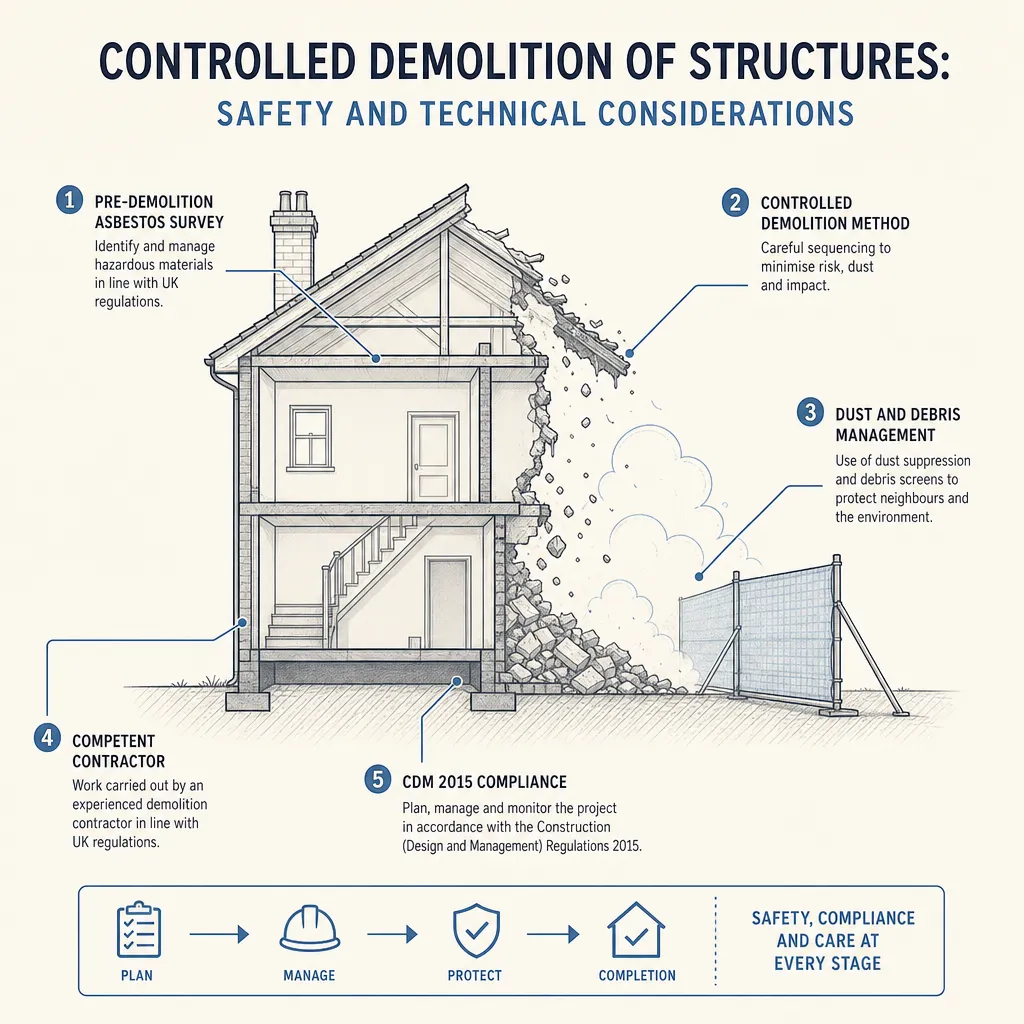
Controlled Demolition of Structures: Safety and Technical Considerations
Controlled demolition in the UK covers any planned, engineered removal of a structure, governed by CDM 2015 and HSE requirements.
 Improvement & Build
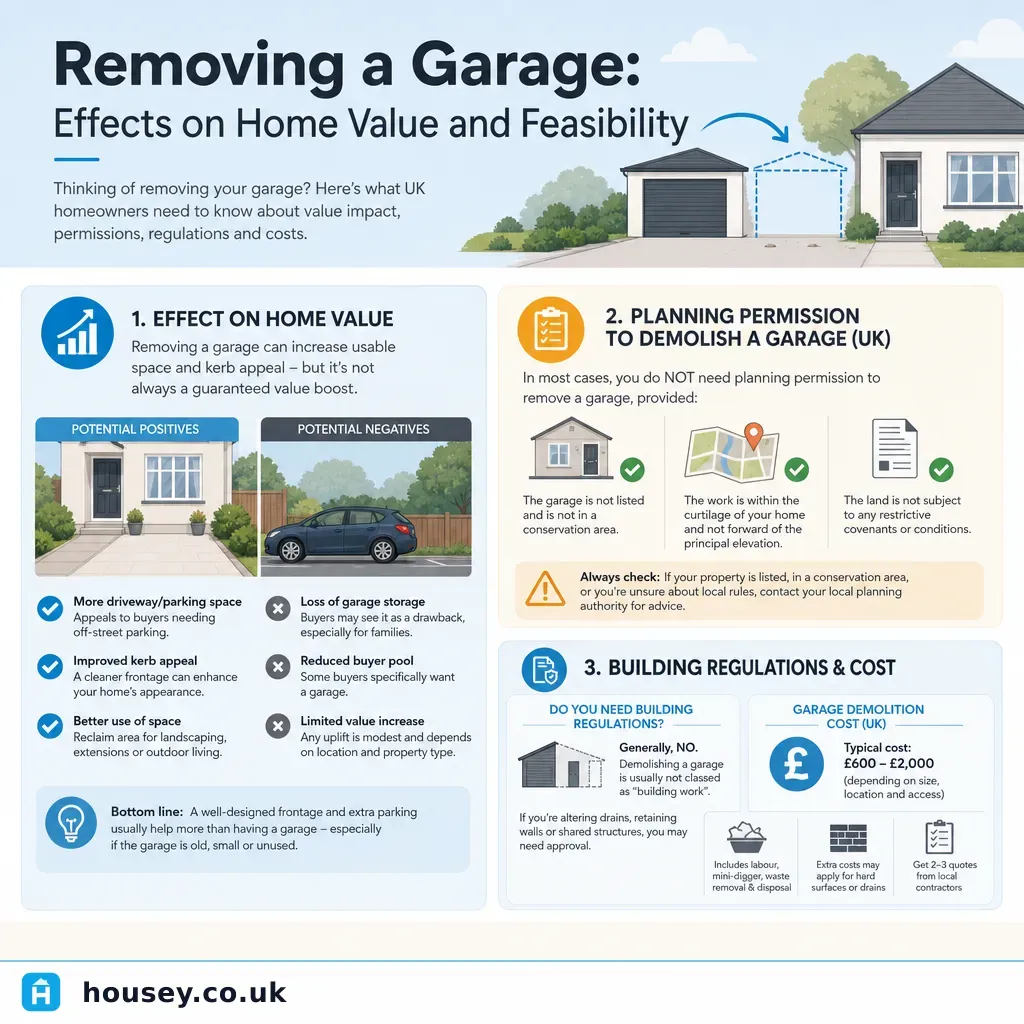
Removing a Garage: Effects on Home Value and Feasibility
Demolishing a garage in England may require prior notification to the local planning authority, and structural or building regulations assessments are often needed if the garage is attached to or integral with the house.
 Improvement & Build
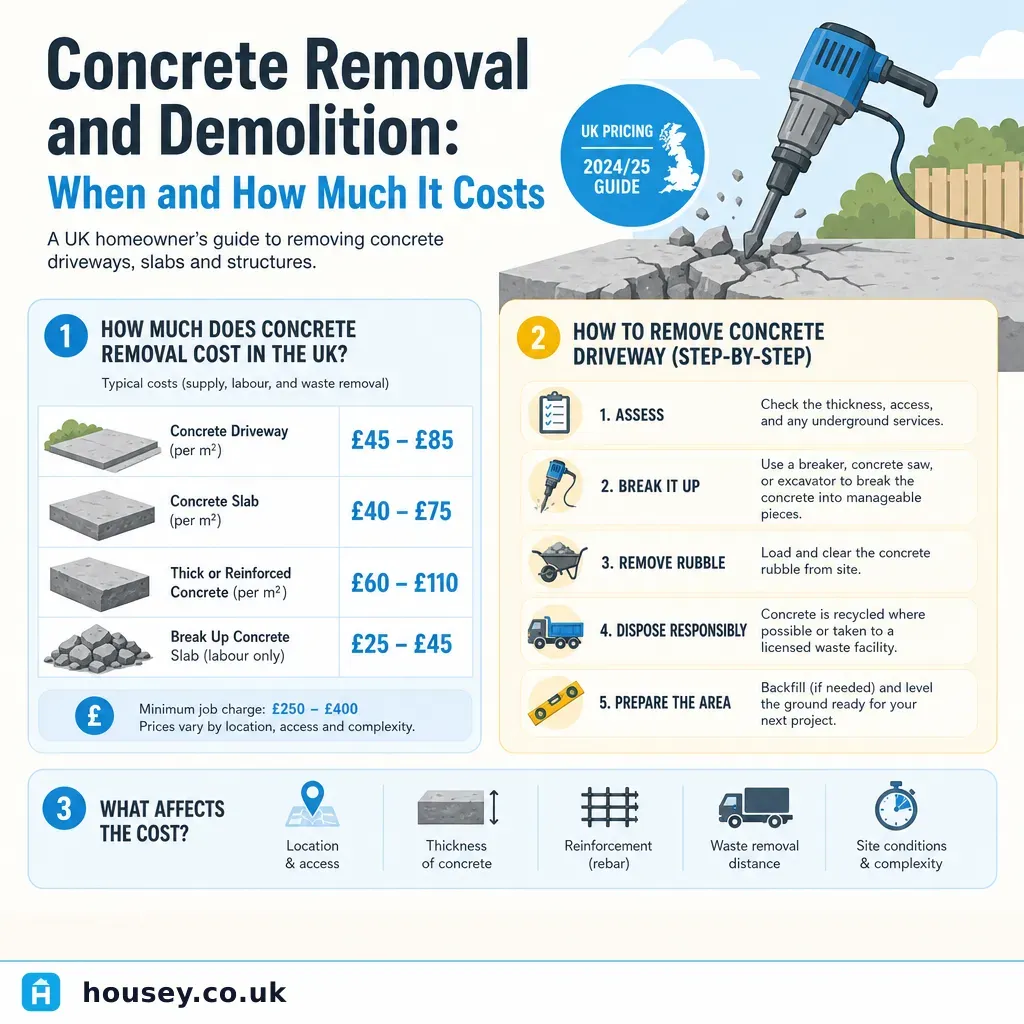
Concrete Removal and Demolition: When and How Much It Costs
Concrete removal in the UK typically costs £25–£65 per square metre for unreinforced slabs, rising to £55–£110 per square metre for reinforced concrete containing rebar.
 Improvement & Build
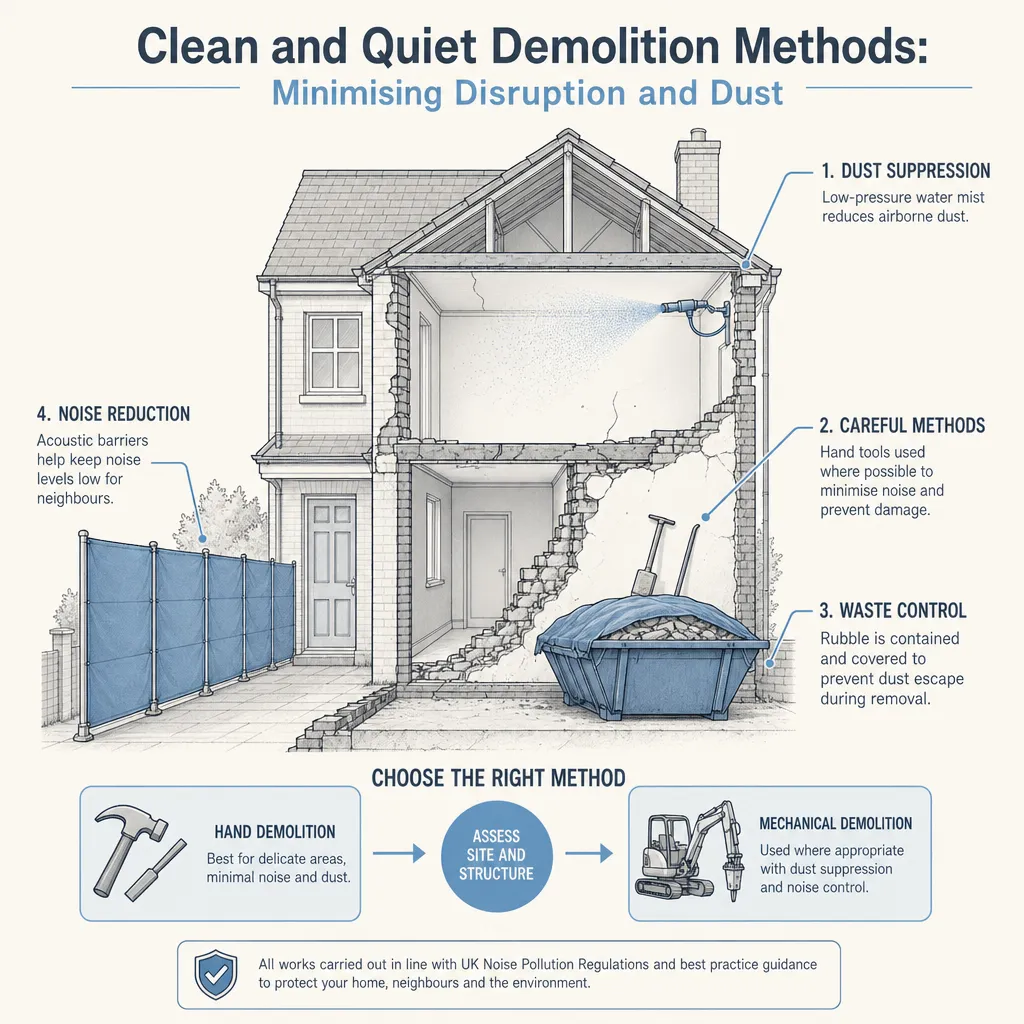
Clean and Quiet Demolition Methods: Minimising Disruption and Dust
Hand demolition and wet suppression are the primary tools for minimising disruption on UK residential sites.
 Improvement & Build
Who Provides House Demolition Services
House demolition in the UK is carried out by specialist demolition contractors, often members of the National Federation of Demolition Contractors (NFDC).