Controlled Demolition of Structures: Safety and Technical Considerations
By Housey · Last reviewed 24th of May 2026
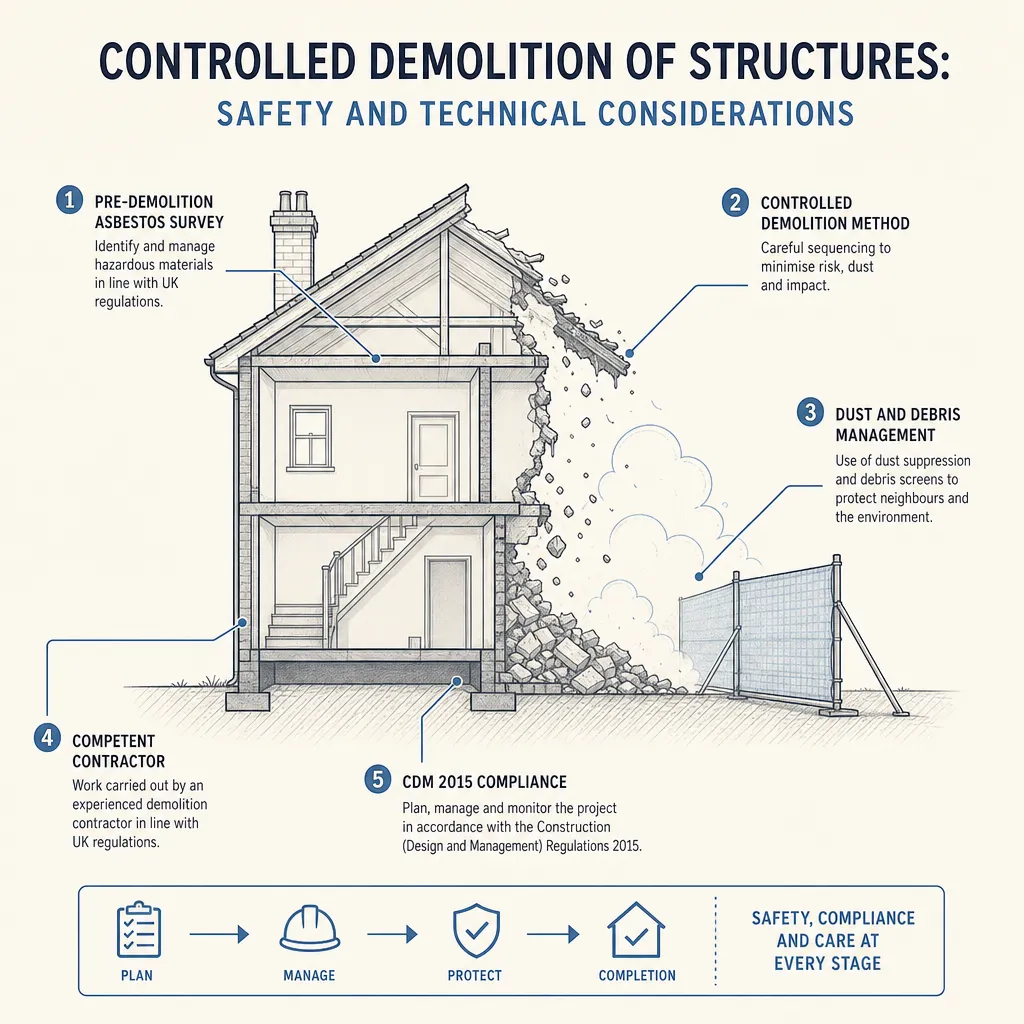
Controlled Demolition of Structures: Safety and Technical Considerations
Demolition is far more than knocking things down — in the UK, it sits within one of the most tightly regulated areas of the construction industry, governed by the Construction (Design and Management) Regulations 2015 (CDM 2015) and a range of Health and Safety Executive (HSE) requirements. Whether you are planning to remove a garage, an outbuilding, or a larger structure, understanding the technical and legal framework helps you avoid costly enforcement action, serious injury, and project delays.
Key points
- Demolition work is classified as construction work under CDM 2015, triggering specific legal duties for clients, principal designers, and contractors.
- A pre-demolition refurbishment and demolition (R&D) asbestos survey is mandatory under the Control of Asbestos Regulations 2012 before any work that will disturb the building fabric.
- Most residential buildings over 115 m³ in volume require prior approval from the local planning authority under the Town and Country Planning (Demolition — Description of Buildings) Direction 2021.
- Explosive demolition requires an HSE Explosives Licence and is reserved for large commercial or industrial structures; it is not a method used in residential projects.
- Demolition waste is controlled waste under the Environmental Protection Act 1990; contractors must hold a waste carrier licence and dispose of materials at a licensed facility.
What is controlled demolition?
Controlled demolition is the planned, engineered removal of a structure — distinct from accidental collapse. It covers methods ranging from manual hand-demolition to mechanical demolition using hydraulic excavators, and in very specific circumstances, the use of explosives (blasting or implosion). In everyday UK practice, the term most commonly describes any demolition carried out safely, in a planned sequence, by a competent contractor.
The National Federation of Demolition Contractors (NFDC) sets industry best practice. Its members operate under comprehensive safety, environmental, and planning standards, and NFDC membership is a widely recognised indicator of competence when selecting a contractor.
Comparison of demolition methods
Method | Best for | Not ideal for | Typical professional | Main risk if wrong approach |
|---|---|---|---|---|
Manual/hand demolition | Selective internal removal, heritage structures, confined spaces | Large volumes of material, time-critical projects | Licensed demolition contractor | Structural instability, asbestos or dust exposure |
Mechanical demolition (excavator) | Residential outbuildings, garages, conventional structures | Listed buildings, confined urban sites close to neighbours | Licensed demolition contractor | Damage to adjacent structures, underground service strikes |
Top-down demolition | Multi-storey urban structures requiring progressive dismantling | Single-storey rural buildings | Specialist demolition contractor | Collapse risk if sequence not followed precisely |
Explosive demolition (blasting/implosion) | Large industrial or commercial structures, bridges | Residential or urban sites, structures near occupied buildings | HSE Explosives Licence holder | Catastrophic structural failure, blast and vibration damage |
Planning and regulatory requirements
In England, the Town and Country Planning Act 1990 and the Town and Country Planning (Demolition — Description of Buildings) Direction 2021 determine whether planning consent is required. Most residential demolitions of buildings with a volume over 115 m³ need prior approval from the local planning authority (LPA) before work starts. In conservation areas, Article 4 directions can impose additional controls, and listed buildings require separate listed building consent — demolition without consent is a criminal offence under the Planning (Listed Buildings and Conservation Areas) Act 1990.
Under CDM 2015, the client — usually the homeowner commissioning the demolition — carries legal duties from the outset. If the project involves more than one contractor, lasts longer than 30 working days with more than 20 workers simultaneously, or exceeds 500 person-days in total, it must be notified to the HSE using the F10 notification form before work begins.
Hazard management: asbestos, underground services, and ground conditions
A risk assessment and method statement (RAMS) must be prepared before any demolition work starts. Three hazard areas require particular attention:
Asbestos: Under the Control of Asbestos Regulations 2012, a refurbishment and demolition (R&D) survey is mandatory before work that disturbs the building fabric. This survey is more intrusive than a standard management survey and must be carried out by a UKAS-accredited surveyor. Any asbestos found must be removed by a licensed contractor before demolition proceeds.
Underground services: Utility records should be checked and a cable and pipe avoidance tool (CAT) survey undertaken before any excavation or ground-level work. PAS 128:2022 sets out best practice for underground utility surveys. Striking a buried gas main or high-voltage cable during demolition is a potentially fatal hazard.
Ground conditions: On brownfield or contaminated land, a Phase 1 desk study — and a Phase 2 intrusive investigation if contamination is suspected — is advisable before work starts. Findings affect soil waste classification, disposal obligations, and site suitability for redevelopment.
Red flags: when to stop and call a specialist
- Suspected asbestos-containing materials are present (textured ceiling finishes, corrugated roof sheeting installed before 2000, pipe lagging) — do not disturb; commission an R&D survey first.
- The building is listed, in a conservation area, or within the curtilage of a listed structure.
- The proposed demolition falls within 3 m of a neighbouring building subject to the Party Wall etc. Act 1996.
- Soft, waterlogged, or unexpectedly disturbed ground is encountered during initial site investigation.
- Cracks or settlement appear in neighbouring structures that could be connected to the proposed works.
- The demolition plan involves explosives — this requires an HSE Explosives Licence and specialist qualifications that must never be assumed.
Important limitations
This article provides general information about demolition regulations and practice in England. Requirements vary by local planning authority, property type, location, tenure, and site-specific conditions. Demolition is classified as a high-risk construction activity under CDM 2015. Nothing here constitutes legal, structural, or health and safety advice. A licensed demolition contractor, structural engineer, and planning consultant should assess your situation before any work begins.
What to ask a qualified professional
Before instructing a demolition contractor, ask:
- Are you a current member of the National Federation of Demolition Contractors (NFDC), or do you hold equivalent accreditation?
- Will you prepare a pre-demolition structural survey and written method statement before work starts?
- Do you hold an appropriate waste carrier licence for disposal of all demolition materials?
- Who will carry out the asbestos R&D survey, and is this cost included in your quotation?
- Have you checked for all underground services on and adjacent to the site?
- Will you manage the F10 notification to the HSE if CDM notification thresholds are triggered?
- How will you protect neighbouring properties and members of the public during works?
- What public liability and employers' liability insurance do you hold, and can you provide certificates?
When to get professional help
Demolition of any structure beyond a very small garden shed — one with no hazardous materials and wholly within your own boundary — should involve a licensed, accredited contractor. Seek immediate professional advice if:
- Asbestos is suspected anywhere in the structure.
- The building is listed or falls within a conservation area.
- The structure shares a wall with, or is within 3 m of, an adjacent property.
- Demolition would affect the foundation ground conditions of a building you intend to retain.
- CDM 2015 notification thresholds appear likely to be exceeded.
How Housey can help
Housey connects you with vetted demolition contractors experienced in UK regulatory requirements, pre-demolition surveys, and CDM-compliant working practices. Submit your project details and receive quotes from specialists who can manage the process from planning notification through to final site clearance.
Frequently asked questions
Do I need planning permission to demolish a building in the UK?
In England, most residential buildings with a volume over 115 m³ require prior approval from the local planning authority before demolition. Outbuildings under this threshold may not need approval, but conservation area designations, listed building status, and Article 4 directions can change this. Always check with your local planning authority before starting any demolition work.
What is a pre-demolition asbestos survey?
A refurbishment and demolition (R&D) survey is a mandatory asbestos survey carried out before demolition or major refurbishment that will disturb the building fabric. It is more intrusive than a management survey and must be carried out by a UKAS-accredited surveyor. Any identified asbestos must be removed by a licensed contractor before demolition proceeds under the Control of Asbestos Regulations 2012.
Can I demolish a garage or outbuilding myself?
Only if the structure is small, contains no hazardous materials, sits entirely within your own boundary, and is not subject to planning restrictions. Even then, you carry legal duties as a client under CDM 2015 if you engage any contractor. For most homeowners, instructing a licensed demolition contractor is strongly advisable to manage regulatory and safety risks.
How long does residential demolition take?
For a standard residential outbuilding or garage, expect one to three days of physical demolition work. The full project — including pre-demolition surveys, planning notifications, and waste clearance — may take several weeks to arrange. Structures requiring asbestos removal beforehand, or those in sensitive locations, take proportionally longer and should be scoped early.
Sources and further reading
- Construction (Design and Management) Regulations 2015 — legislation.gov.uk
- HSE demolition guidance — Health and Safety Executive
- Control of Asbestos Regulations 2012 — legislation.gov.uk
- National Federation of Demolition Contractors — NFDC
- When is permission required — planning guidance — GOV.UK
Useful next reads
 Improvement & Build
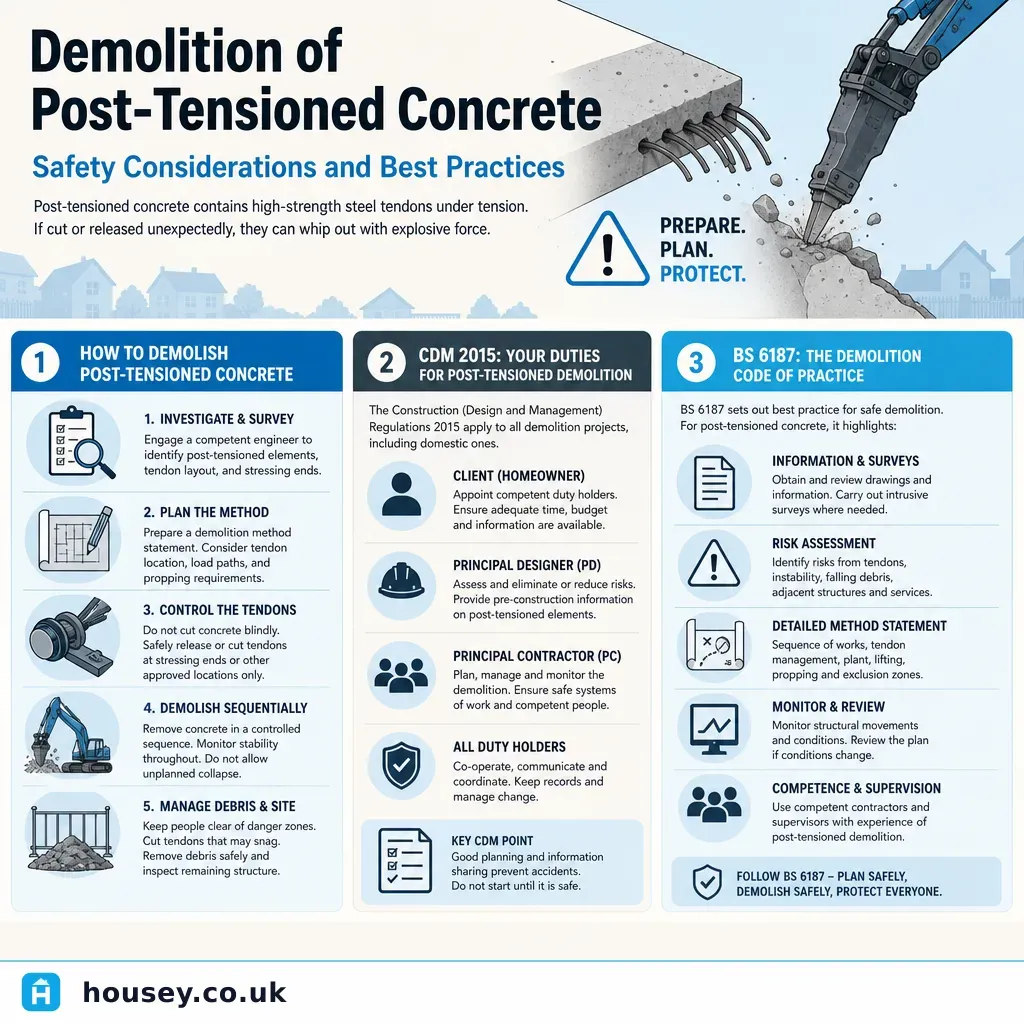
Demolition of Post-Tensioned Concrete: Safety Considerations and Best Practices
Post-tensioned concrete contains steel tendons under loads of up to 1,860 MPa.
 Improvement & Build
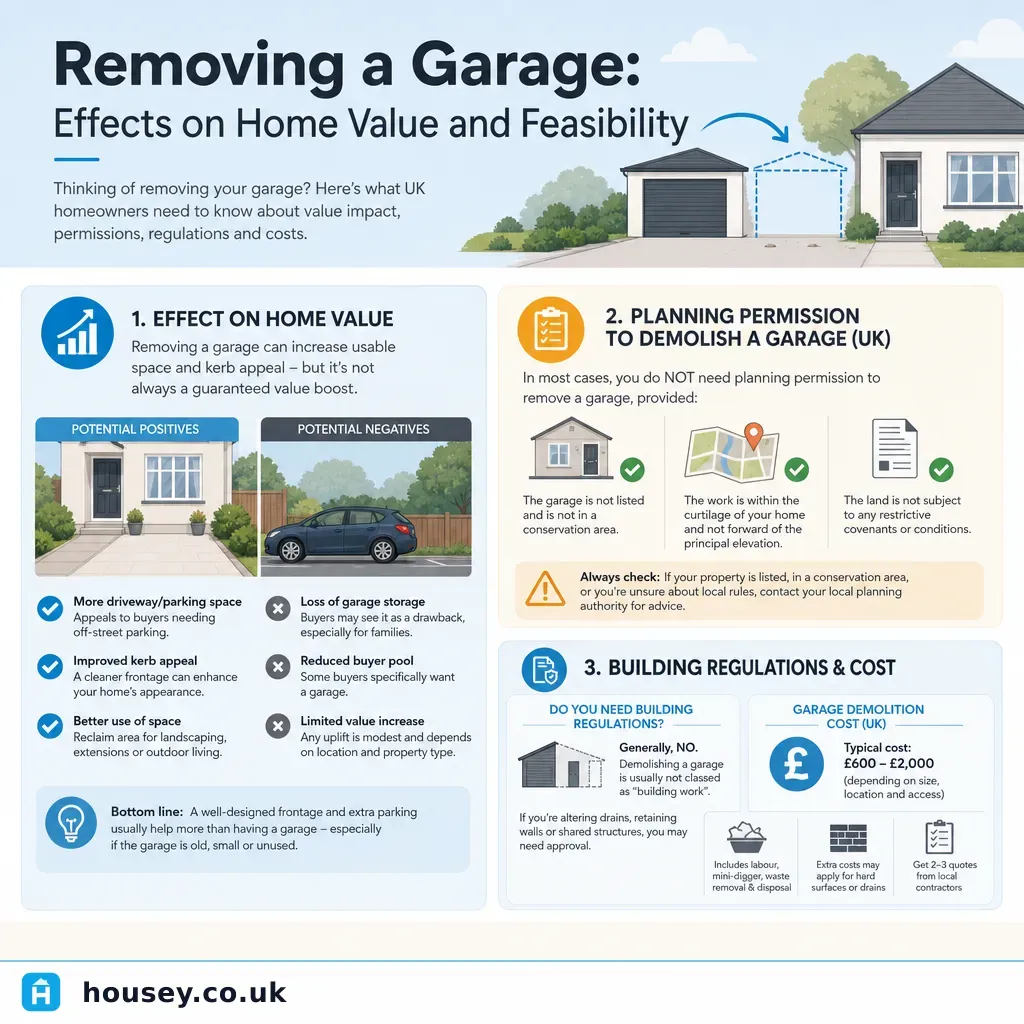
Removing a Garage: Effects on Home Value and Feasibility
Demolishing a garage in England may require prior notification to the local planning authority, and structural or building regulations assessments are often needed if the garage is attached to or integral with the house.
 Improvement & Build
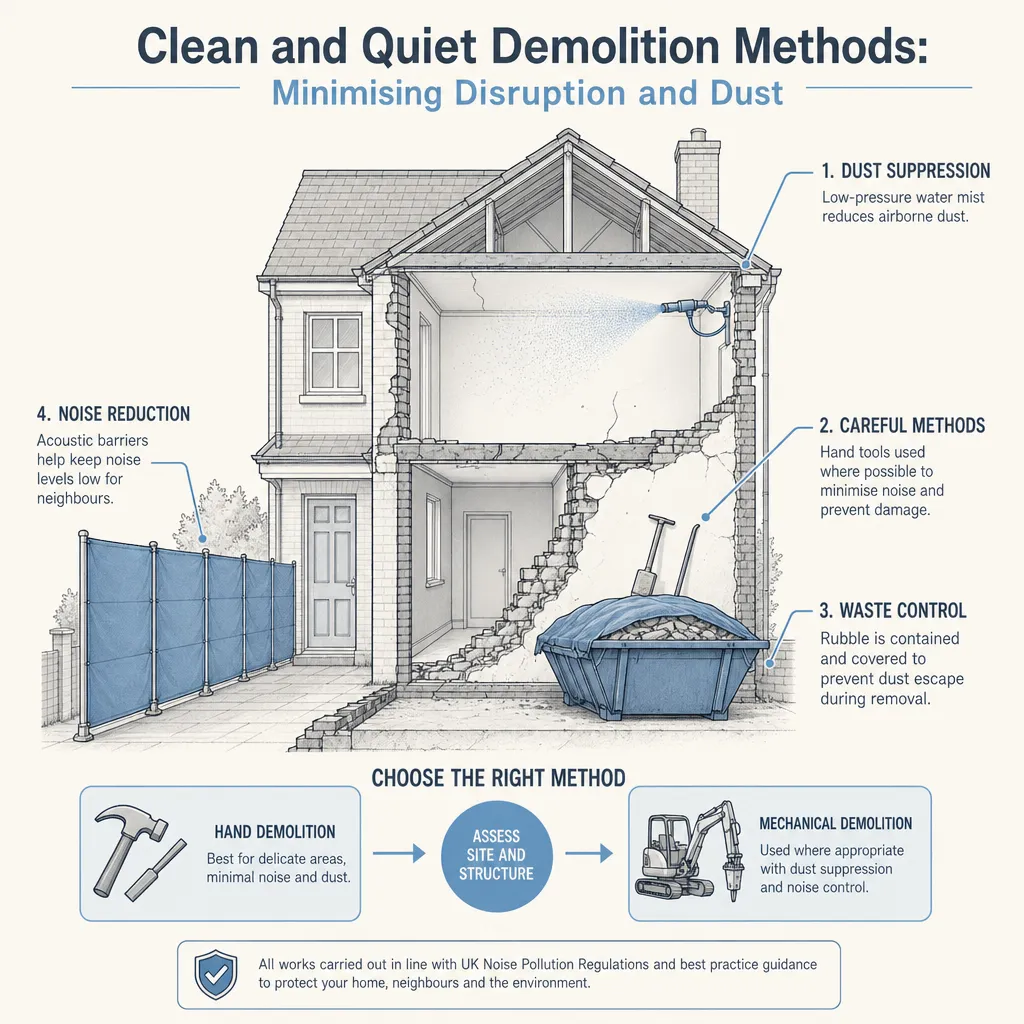
Clean and Quiet Demolition Methods: Minimising Disruption and Dust
Hand demolition and wet suppression are the primary tools for minimising disruption on UK residential sites.
 Improvement & Build
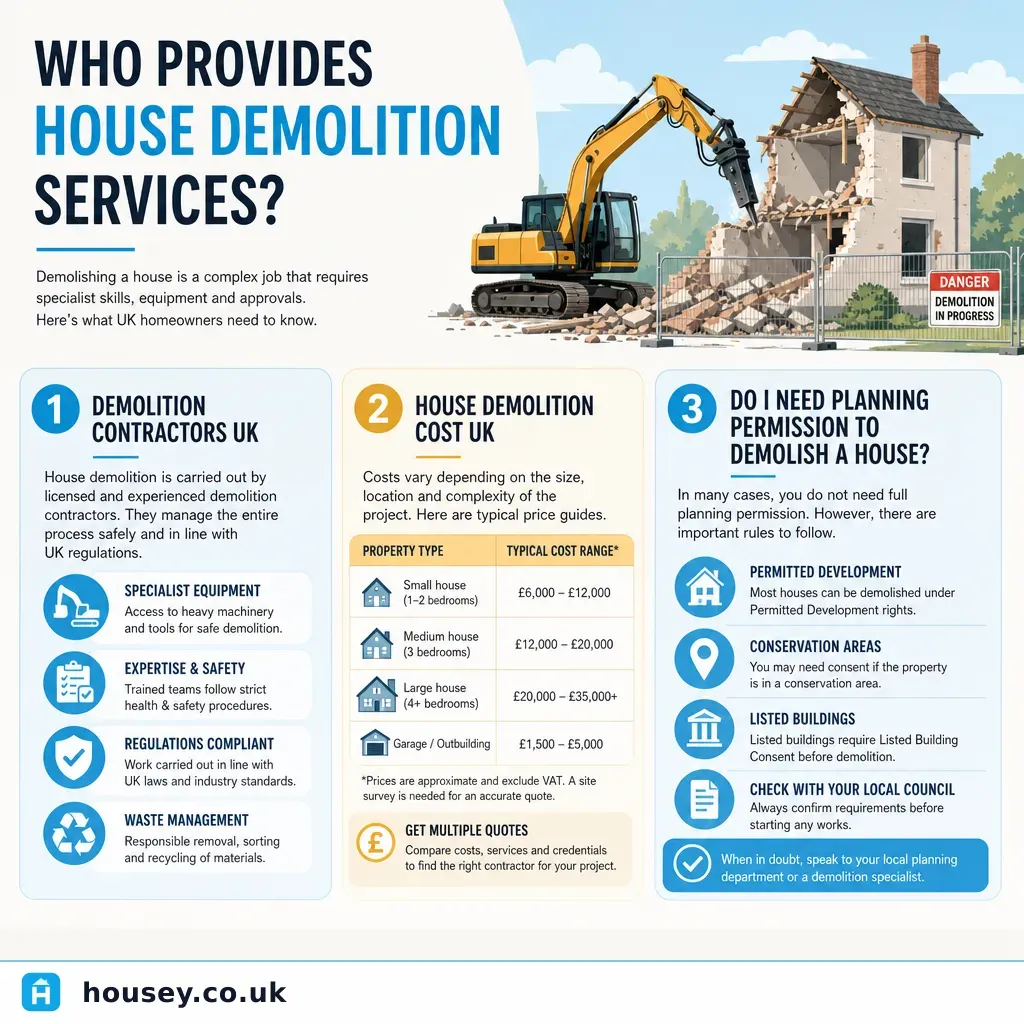
Who Provides House Demolition Services
House demolition in the UK is carried out by specialist demolition contractors, often members of the National Federation of Demolition Contractors (NFDC).
 Improvement & Build
Open Plan Living Space Conversion Costs
Opening up a living space in the UK typically costs £3,000–£15,000+ depending on whether walls are load-bearing, the beam specification required, and the extent of remodelling.