Who Provides House Demolition Services
By Housey · Last reviewed 31st of May 2026
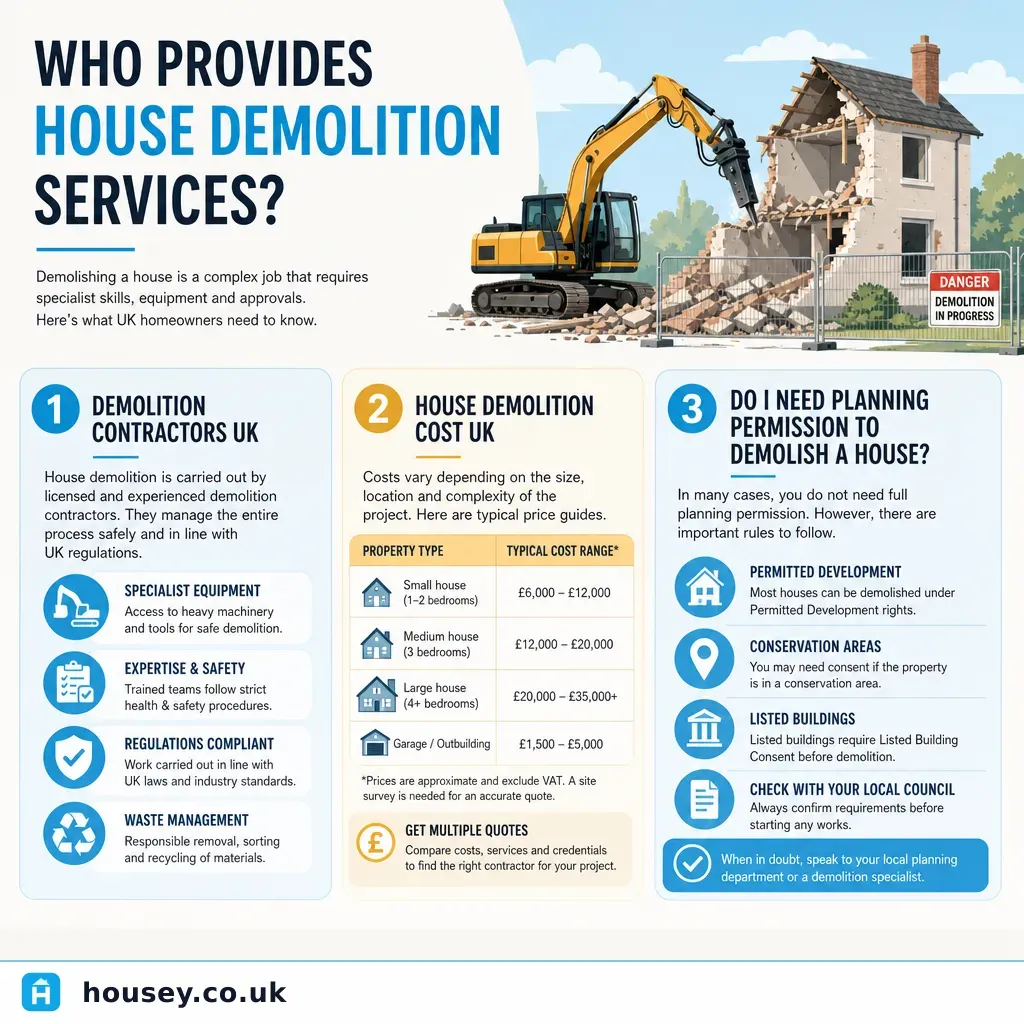
Who Provides House Demolition Services
Demolishing a whole house or a substantial part of a building is one of the most regulated — and potentially hazardous — activities in residential property. Whether you are clearing a site for a self-build, removing a structurally compromised annex, or taking down an outbuilding in poor condition, understanding who to appoint and what approvals are required before any work begins can prevent significant cost, delay, and legal exposure.
Key points
- Full demolition of a residential building in England requires prior approval from the local planning authority under Schedule 2, Part 11 of the Town and Country Planning (General Permitted Development) (England) Order 2015 — this is distinct from planning permission but equally necessary before work starts.
- An asbestos Refurbishment and Demolition (R&D) Survey is legally required before demolition of any building constructed or refurbished before 2000, under the Control of Asbestos Regulations 2012; a standard Management Survey is not sufficient.
- The Health and Safety Executive (HSE) must be notified of projects meeting CDM 2015 thresholds: more than 30 working days with more than 20 simultaneous workers, or more than 500 person-days of work in total.
- National Federation of Demolition Contractors (NFDC) membership is a widely recognised benchmark of competence, indicating a firm has been assessed against safety, technical, and environmental standards.
- Demolition waste is classified as controlled waste under the Environmental Protection Act 1990 — contractors must hold a current Environment Agency waste carrier licence and provide a waste transfer note for all material removed from site.
Who carries out demolition work?
Specialist demolition contractors
For full residential demolition, a specialist demolition contractor is the appropriate appointment. These firms employ trained operatives, carry specialist insurance, manage asbestos and waste disposal, and understand the CDM obligations that apply to most demolition projects.
The National Federation of Demolition Contractors (NFDC) is the primary trade body. NFDC membership is not legally mandatory, but member firms are assessed against safety and technical standards, making membership a practical benchmark when shortlisting.
General contractors and builders
For partial demolition — taking down a single wall, chimney breast, small outbuilding, or extension — a reputable general builder with appropriate structural experience may be suitable, particularly when the scope connects to wider building works. For any element affecting structural integrity, obtain an engineer's assessment before appointing.
Which type of contractor for which scope?
Scope | Appropriate contractor | Key requirement |
|---|---|---|
Full house demolition | Specialist demolition contractor (NFDC member preferred) | Prior approval, asbestos R&D survey, HSE notification where thresholds are met |
Large or complex site | Specialist demolition contractor | Principal Designer and Principal Contractor appointed under CDM 2015 |
Single-storey outbuilding or garage | General builder or specialist | Asbestos check if pre-2000 construction; confirm permitted development position |
Internal structural wall removal | Structural engineer plus builder | Building Regulations application (structural) |
Chimney removal | Structural engineer plus experienced builder | Building control notification required |
What permissions and notifications are required?
Demolition is regulated at every stage. Confirm the following before any contractor begins work.
Prior approval (planning): In England, demolition of a residential building generally requires prior approval from the local planning authority under Schedule 2, Part 11 of the GPDO 2015. The authority has 28 days to determine the application. Listed buildings and buildings in conservation areas may require full planning permission rather than prior approval. Scotland, Wales, and Northern Ireland operate separate planning regimes.
Building control notification: You must notify the relevant building control body before demolition begins under Section 80 of the Building Act 1984. They may issue a Section 81 notice requiring protection or making good of neighbouring structures.
Asbestos R&D Survey: Legally required under the Control of Asbestos Regulations 2012 for any building constructed or refurbished before 2000. If asbestos-containing materials are found, a licensed asbestos contractor must remove them before demolition proceeds.
HSE notification (CDM 2015): Where the project meets CDM 2015 thresholds, the HSE must be notified and a Principal Designer and Principal Contractor formally appointed.
Party Wall etc. Act 1996: If the building is attached to or shares a boundary structure with a neighbouring property, party wall notices must be served on all adjoining owners before work begins.
Utilities disconnection: Gas, electricity, water, and telecommunications supplies must be formally disconnected by the relevant network operators before demolition starts.
How to find and assess demolition contractors
- Search for NFDC member contractors via the NFDC's online directory.
- Request public liability insurance certificates (minimum £5 million for residential projects), contractors' all-risk insurance, and employers' liability insurance.
- Ask for the contractor's Environment Agency waste carrier licence number and confirm it is current.
- Request references for comparable projects completed within the past two years, and follow up on at least one.
- Confirm that the contractor will manage — or clearly identify who will manage — the asbestos R&D survey and any required licensed asbestos removal. Avoid any contractor who proposes to begin on a pre-2000 building without an R&D survey in place.
Red flags: when to proceed with caution
- A contractor quotes for demolition without mentioning prior approval, asbestos surveys, or CDM obligations.
- No insurance certificates are offered when requested.
- The contractor proposes to remove rubble without providing waste transfer notes.
- The price is substantially lower than all other quotes with no explanation of what is excluded.
- The contractor cannot demonstrate documented experience of comparable residential demolition projects.
- Work is proposed to begin before utilities have been formally disconnected.
Important limitations
This article provides general information about demolition services in the UK. Demolition regulations, permitted development rights, CDM thresholds, asbestos obligations, and environmental requirements vary by project scope, property type, location, and date of construction. Nothing in this article constitutes legal, structural, or safety advice. A qualified professional should assess your specific project before any work is planned or commenced.
When this becomes urgent
Stop relying on general guidance and seek qualified professional help immediately if:
- The building contains or is suspected to contain asbestos — do not disturb any materials before a UKAS-accredited asbestos surveyor has assessed the site.
- The structure is partially collapsed, unstable, or has been subject to a dangerous structures notice from the local authority.
- The building is attached to a neighbouring property and no party wall surveyor has been instructed.
- Any demolition work has already begun without prior approval or asbestos clearance.
- You have received an enforcement notice from the local planning authority or HSE in relation to the property.
What to ask a qualified professional
Before appointing a demolition contractor or specialist adviser, ask:
- Does this project require prior approval from the local planning authority, and will you manage that application?
- Is an asbestos Refurbishment and Demolition Survey required, and can you recommend a UKAS-accredited surveyor?
- Does this project meet CDM 2015 notification thresholds, and who will act as Principal Designer and Principal Contractor?
- Do the Party Wall etc. Act 1996 obligations apply, and when should notices be served on adjoining owners?
- How will demolition waste be classified, transported, and evidenced with waste transfer notes?
- What is your NFDC membership number, and can I verify it via the NFDC directory?
How Housey can help
Housey connects you with qualified demolition contractors who understand UK regulatory requirements — from prior approval to asbestos surveys and CDM compliance. Submit your project details to receive structured quotes from assessed local specialists.
Frequently asked questions
Do I need planning permission to demolish a house in England?
You do not usually need full planning permission, but you do need prior approval from your local planning authority before demolishing a residential building. The authority assesses contamination, flooding risk, and impact on adjoining properties. Listed buildings and conservation area properties may require full consent. Scotland, Wales, and Northern Ireland have separate planning regimes.
Is an asbestos survey required before demolition?
Yes. For any building constructed or refurbished before 2000, a Refurbishment and Demolition (R&D) Survey is legally required under the Control of Asbestos Regulations 2012 before demolition begins. This is more intrusive than a standard Management Survey and must be carried out by a competent, ideally UKAS-accredited, surveyor.
How long does residential demolition typically take?
Timescales depend on building size, the extent of hazardous material removal, and site access. The physical demolition of a standard detached house may take one to two weeks, but the pre-work phase — securing prior approval, completing the asbestos survey, serving party wall notices, and disconnecting utilities — can take several months.
What accreditations should a demolition contractor hold?
Look for NFDC membership as a baseline indicator. Also confirm current public liability and employers' liability insurance, an Environment Agency waste carrier licence, and CSCS cards for operatives on site. For projects meeting CDM 2015 thresholds, confirm who will fulfil the Principal Contractor role and that HSE notification will be submitted.
Sources and further reading
- When is planning permission required? — GOV.UK
- Control of Asbestos Regulations 2012 — legislation.gov.uk
- Construction (Design and Management) Regulations 2015 — legislation.gov.uk
- National Federation of Demolition Contractors — NFDC
- CDM 2015: guidance for clients — Health and Safety Executive
- Party Wall etc. Act 1996: guidance — GOV.UK
Useful next reads
 Improvement & Build
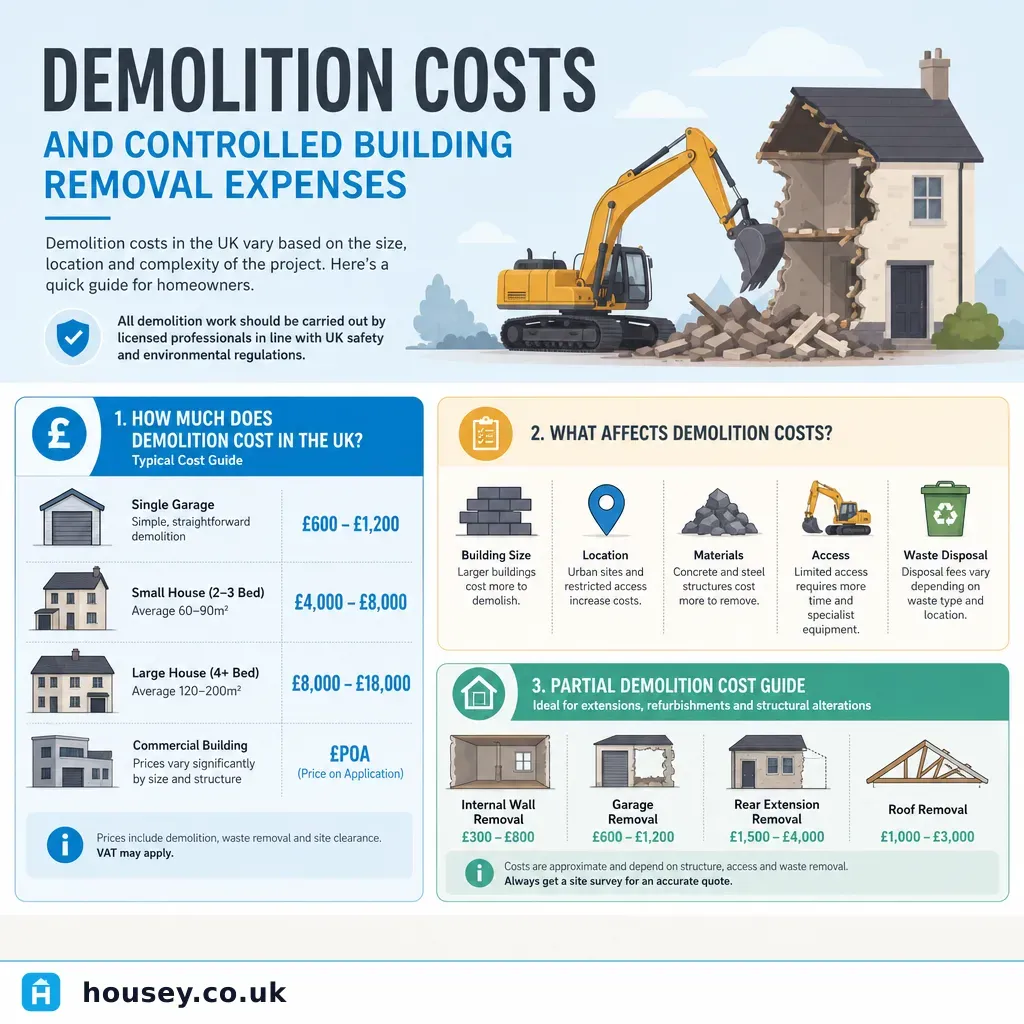
Demolition Costs and Controlled Building Removal Expenses
Full building demolition in the UK typically costs £5,000–£50,000+ depending on structure size, materials, and site access.
 Improvement & Build
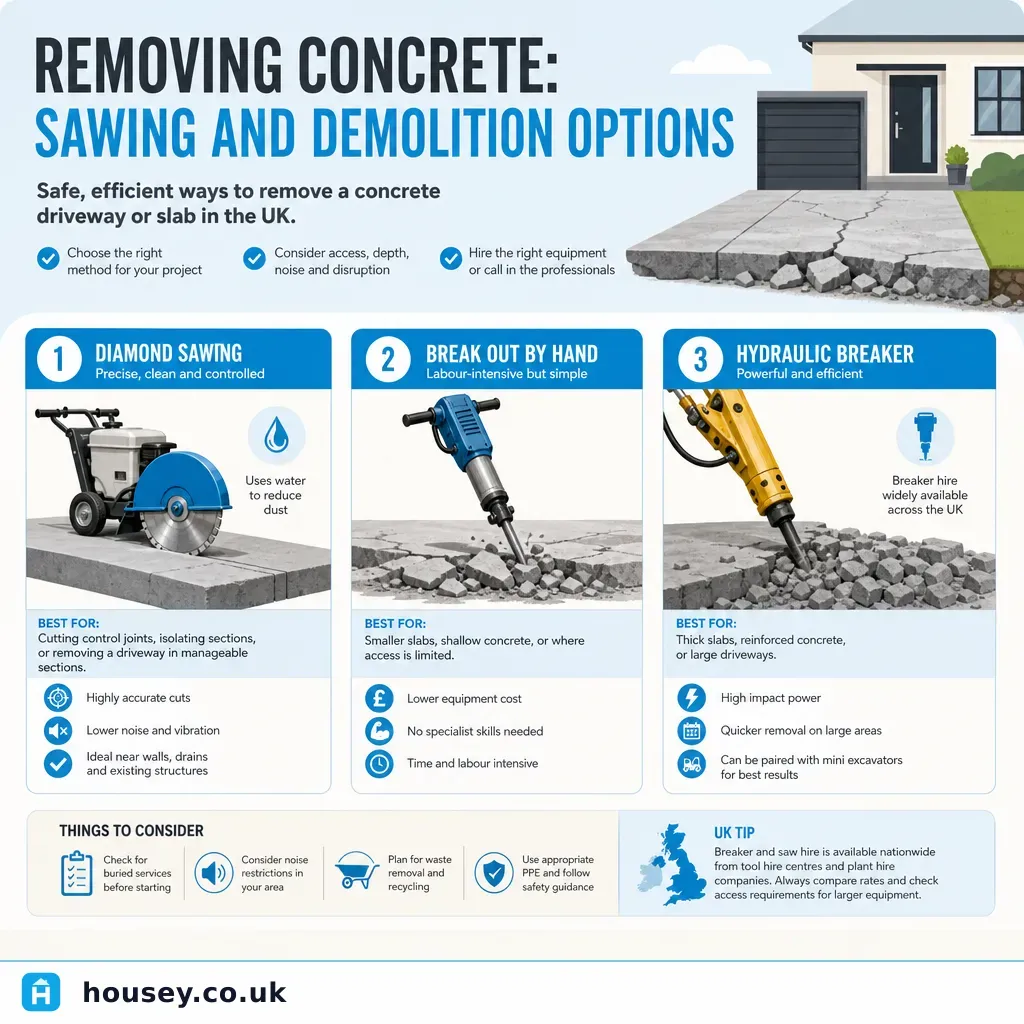
Removing Concrete: Sawing and Demolition Options
Concrete removal methods include hydraulic or electric breakers for bulk demolition, diamond disc or wire sawing for precision cuts, and hand tools for small areas.
 Improvement & Build
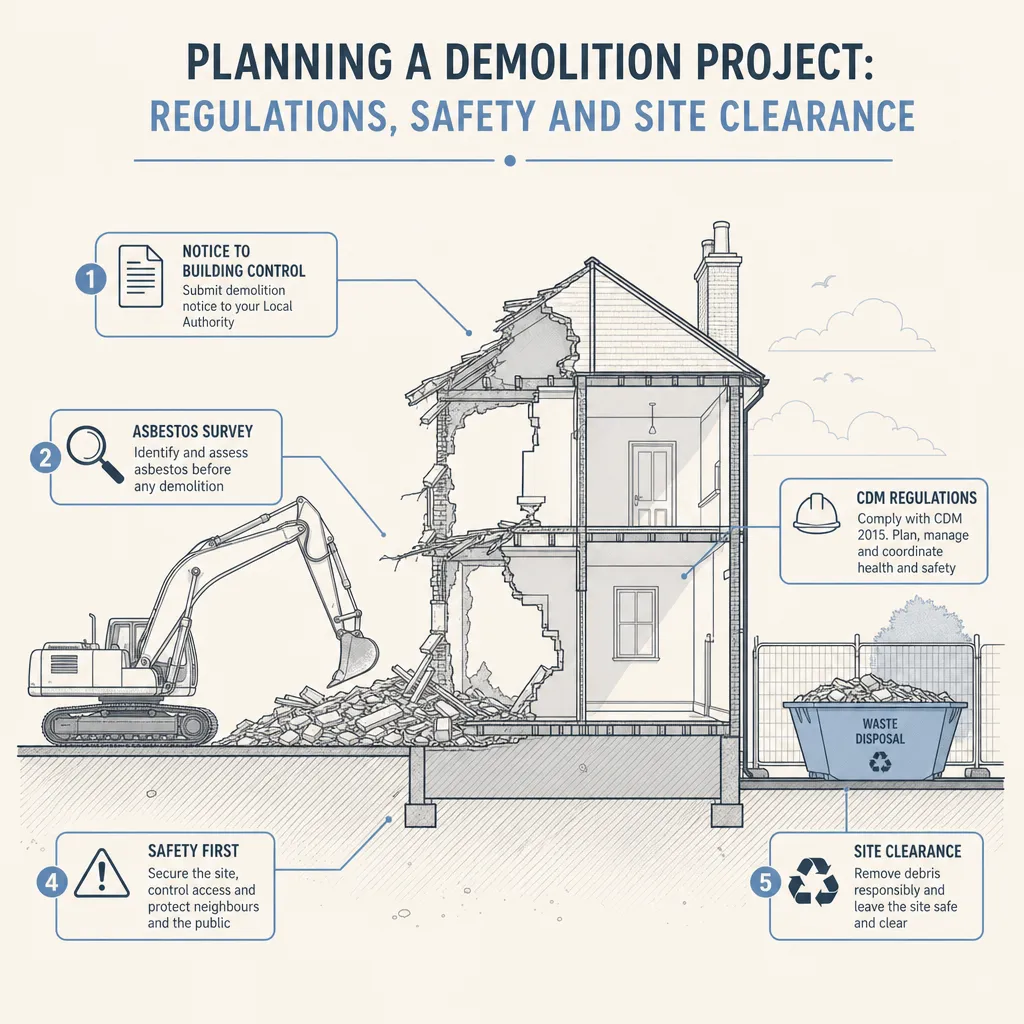
Planning a Demolition Project: Regulations, Safety and Site Clearance
Demolishing a building in England requires a Section 80 building control notice served at least six weeks before work starts, a Refurbishment and Demolition asbestos survey before any demolition begins, and compliance with CDM 2015.
 Improvement & Build
Fixing Leaking Back Doors and Water Ingress
Most leaking back doors in UK homes fail at one of three points: the threshold or door sill joint, the frame-to-masonry mastic seal, or the door weatherstrip.
 Improvement & Build
Open Plan Living Space Conversion Costs
Opening up a living space in the UK typically costs £3,000–£15,000+ depending on whether walls are load-bearing, the beam specification required, and the extent of remodelling.