Cleaning and Maintaining Your Deck: Costs and Techniques
By Housey · Last reviewed 1st of June 2026
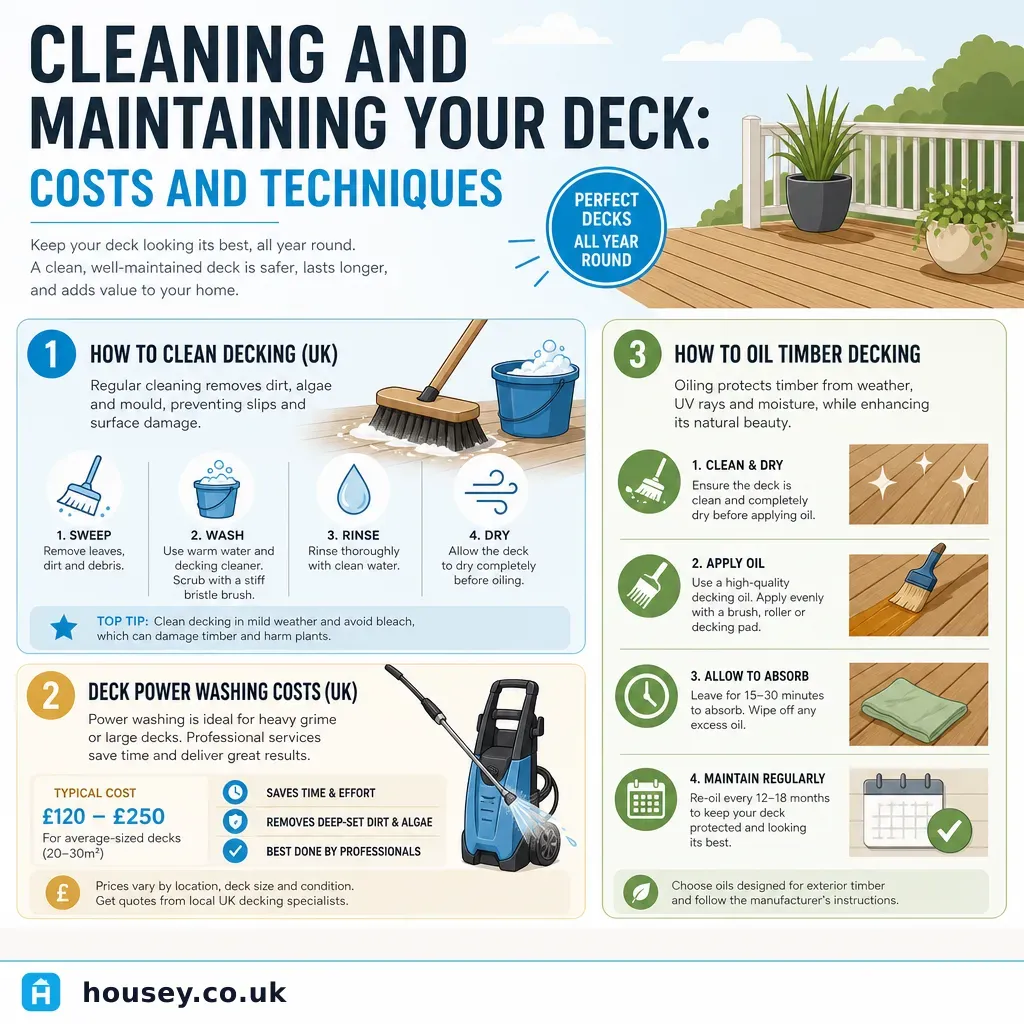
Cleaning and Maintaining Your Deck: Costs and Techniques
Timber and composite decking are exposed to rain, UV light, algae, and leaf debris year-round, so even a well-built deck will deteriorate without regular attention. The question of how and when to clean typically arises each spring, when homeowners notice green algae or greyish weathering that accumulated over winter. Left untreated, slippery surfaces become a safety hazard and the underlying structure — joists, posts, fixings — can begin to rot well before the decking boards themselves show obvious wear.
Key points
- Timber decking should be cleaned and re-treated at least once a year; composite decking needs cleaning but generally does not require oiling or sealing.
- Pressure washing above 100–130 bar can raise the grain on softwood boards, causing fibres to lift and accelerating future decay.
- A biocidal treatment containing benzalkonium chloride or sodium hypochlorite kills algae and moss more effectively than pressure washing alone.
- Decking boards that are visibly splintering, splitting along the grain, or showing dark rot patches may be beyond cleaning — replacing individual boards is often more cost-effective than whole-deck renewal.
- Decks positioned beneath a roof overhang or flat-roof gutter line are especially prone to organic growth from water run-off; addressing roof drainage can reduce the frequency of deck cleaning needed.
How often should you clean your decking?
Most timber decking benefits from a full clean and re-oil or re-stain once a year, ideally in spring after frost risk has passed and before the main outdoor season. If the deck is heavily shaded, north-facing, or beneath overhanging trees, a mid-season algaecide treatment is also worthwhile.
Composite decking manufacturers typically recommend twice-yearly cleaning — a light brush-down in spring and a more thorough wash in autumn — but oiling or sealing is usually neither required nor recommended. Always check the manufacturer's maintenance guidance: some composite products void their warranty if treated with oil-based products not formulated for composites.
A simple test for timber decking: sprinkle a small amount of water on the surface. If it beads, the existing sealant is still active. If it soaks in within a few seconds, the boards need re-oiling or re-staining.
Cleaning methods compared
Method | Best for | Risk if misused | Notes |
|---|---|---|---|
Pressure washing (80–120 bar) | General cleaning of timber and composite | Grain damage on softwood above ~130 bar | Work along the grain; keep nozzle moving |
Hand scrubbing with deck cleaner | Lighter soiling, composite, older boards | Low risk | Labour-intensive; good for targeted areas |
Biocidal or algaecide treatment | Algae, moss, lichen, green staining | Chemical splash; keep off plants and garden ponds | Allow 10–30 min dwell time before rinsing |
Sanding (belt or orbital) | Grey weathered timber, ingrained staining | Dust inhalation | Use an FFP2 dust mask; wet sanding reduces airborne dust |
Deck stripper | Removing old oil or stain before re-treating | Can dry boards if left too long | Follow product instructions carefully |
Composite decking caution: many composite boards have a capped surface that can be damaged by harsh acids, bleach-heavy cleaners, or stiff wire brushes. Use only products specified as safe for composite decking, and avoid pressure washing above approximately 100 bar (1,450 psi).
How much does professional deck cleaning cost?
Indicative UK costs, last reviewed 2026-06-01. Quotes vary by region, deck condition, access, and whether treatment is included.
Service | Typical cost range | What's included |
|---|---|---|
Pressure wash only (25–40 m²) | £100–£200 | Wash and rinse |
Pressure wash + biocidal treatment | £150–£300 | Wash, algaecide, rinse |
Full clean + sand + re-oil (timber, 25–40 m²) | £300–£600+ | Wash, sand, two coats of oil or stain |
DIY materials only | £30–£80 | Deck cleaner, algaecide, oil or stain |
These figures are indicative. Heavily soiled decks, awkward access, or additional structural repairs will affect the final price. Always obtain at least two to three quotes.
What to ask before accepting a quote
- Is pressure washing, biocidal treatment, and sanding all included, or are they quoted separately?
- What oil, stain, or sealant will be used, and is it compatible with my decking material?
- How many coats of treatment will be applied?
- Will you move garden furniture, or should I clear the deck before your visit?
- Is VAT included in the price?
- What happens if rotten boards or structural defects are discovered during cleaning?
Treating and sealing timber decking after cleaning
Cleaning alone does not protect timber from future weathering. Once the deck is clean and fully dry (at least 48 hours after washing in dry weather), apply a suitable treatment:
- Deck oil penetrates the wood and is the most common choice for hardwoods and many softwoods. Re-apply every 12–18 months.
- Deck stain (opaque or semi-transparent) provides colour, UV protection, and water resistance. It is harder to re-coat than oil, as the old layer must be stripped before re-application.
- Decking paint gives an opaque finish with the longest service life between applications, but requires full stripping before re-coating and can peel if moisture is trapped beneath.
Apply in temperatures between 10–25°C and avoid direct midday sun, which causes oil to dry at the surface before it has fully penetrated into the wood.
Annual maintenance checklist
Red flags: when cleaning is not enough
Stop and seek professional advice if you notice any of the following:
- Boards that feel soft, springy, or spongy underfoot — this may indicate joist or bearer rot beneath the surface
- Visible fungal growth (white, orange, or black mycelium) on the underside of boards or on joists
- Boards lifting at the edges or warping significantly despite previous treatment
- Fixings pushing up through the board surface, which can indicate structural swelling or movement
- The deck has not been treated in five or more years and shows deep surface cracking and pervasive grey weathering throughout
When to get professional help
Routine annual cleaning is within reach for most homeowners with the right equipment and care around pressure settings. Professional help is worthwhile when:
- The deck is large (over 30–40 m²) and full cleaning and treatment would take more than a day
- Several years of neglect mean the deck needs sanding and a full treatment programme to restore it
- You suspect rot in the joists, posts, or ledger board — a carpenter or builder should assess the structure before any cosmetic work begins
- The decking is composite and the manufacturer specifies professional maintenance to preserve the warranty
If your deck sits beneath a flat roof or parapet gutter, ensure the roof drainage is functioning correctly before the next outdoor season. Overflowing gutters are a common cause of accelerated algae growth on decking below. A vetted roofer to inspect guttering and flat-roof details can clear blockages, check drip-edge condition, and confirm that water is being directed clear of the deck surface.
How Housey can help
Housey can match you with vetted local tradespeople when your deck needs more than a DIY clean and re-oil. Where organic growth on your deck is linked to poor roof drainage above — such as a blocked gutter or a failing flat-roof drip edge — our roofer to inspect guttering and flat-roof details can combine a roof inspection with practical advice on protecting the deck surface below.
Frequently asked questions
Can I use a standard pressure washer on composite decking?
Yes, with care. Keep pressure below 100 bar (approximately 1,400 psi) and use a fan-tip nozzle rather than a pencil jet. Hold the nozzle at least 30 cm from the surface and work along the board direction. High pressure on composite can strip the capped surface layer, which cannot be repaired and typically voids the manufacturer's warranty.
How long does a professional deck clean take?
For a typical 20–30 m² garden deck, professional cleaning and treatment usually takes half a day to a full day. If sanding is included, allow a full day or longer. DIY cleaning often spans a weekend once you factor in the drying time between washing and re-oiling.
Does deck oil need to dry before it rains?
Most deck oils need at least 24–48 hours of dry weather after application. Check the specific product datasheet. Applying oil before rain can wash the product off before it has penetrated, and may stain adjacent paving or gravel.
Is it worth cleaning an old deck, or should I replace it?
If boards are structurally sound but weathered and grey, cleaning and re-oiling can make a significant difference. If the joists, bearers, or more than around 25% of boards are rotten, replacement is usually more cost-effective in the long run. A carpenter or builder can give an honest structural assessment before you commit to cleaning costs.
Sources and further reading
- Timber Decking Association: guidance on installation and maintenance — Timber Decking Association
- TRADA: technical guidance on timber in construction — TRADA (Timber Research and Development Association)
- HSE: working safely with wood dust — Health and Safety Executive
Useful next reads
 Improvement & Build
Retaining Wall Installation: Cost, Design and Maintenance
A retaining wall holds back soil on a sloped or banked site.
 Improvement & Build
Relocating a Bathroom: When to Hire a Plumber Versus a Bathroom Specialist
Relocating a bathroom usually requires both a qualified plumber for pipework and drainage and other specialist trades for electrics, tiling, and finishes.
 Improvement & Build
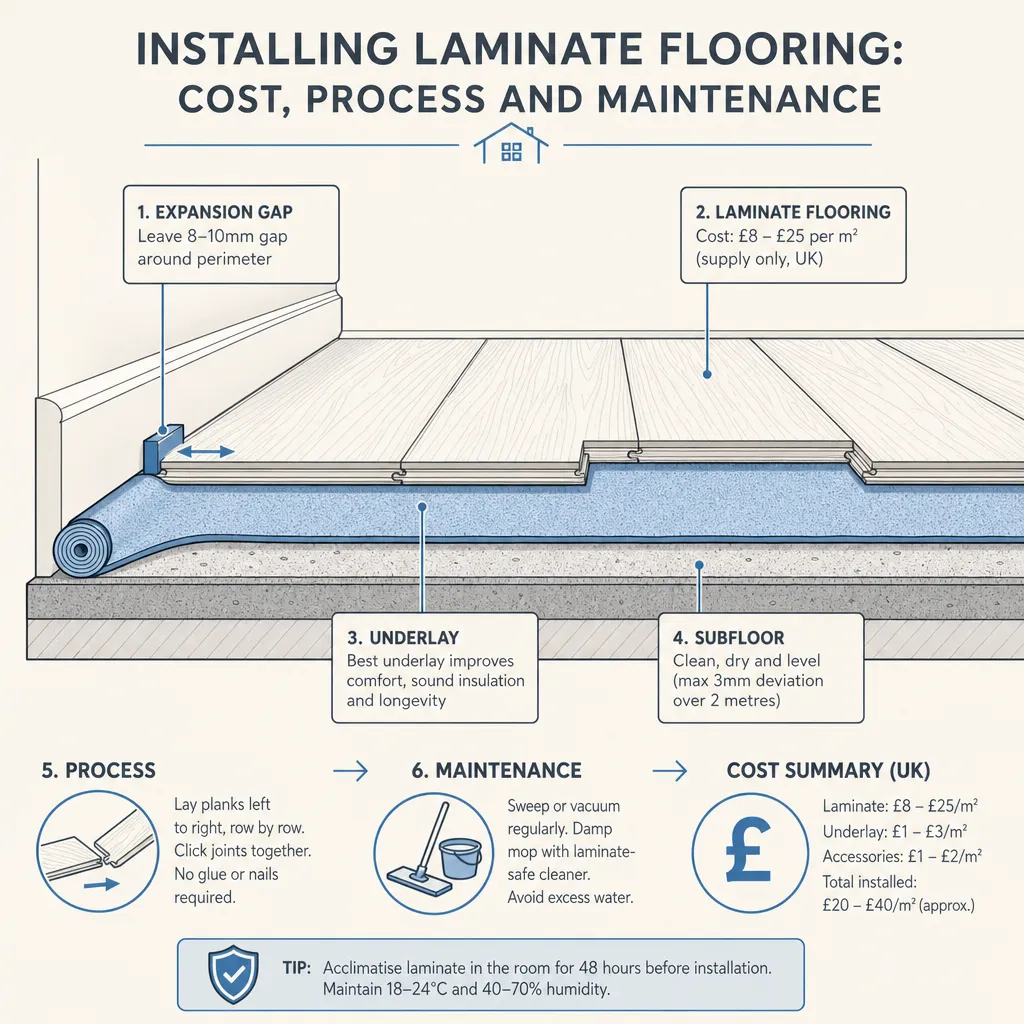
Installing Laminate Flooring: Cost, Process and Maintenance
Laminate flooring in the UK typically costs £15–40 per square metre for materials, plus £8–15 per square metre for professional fitting.
 Improvement & Build
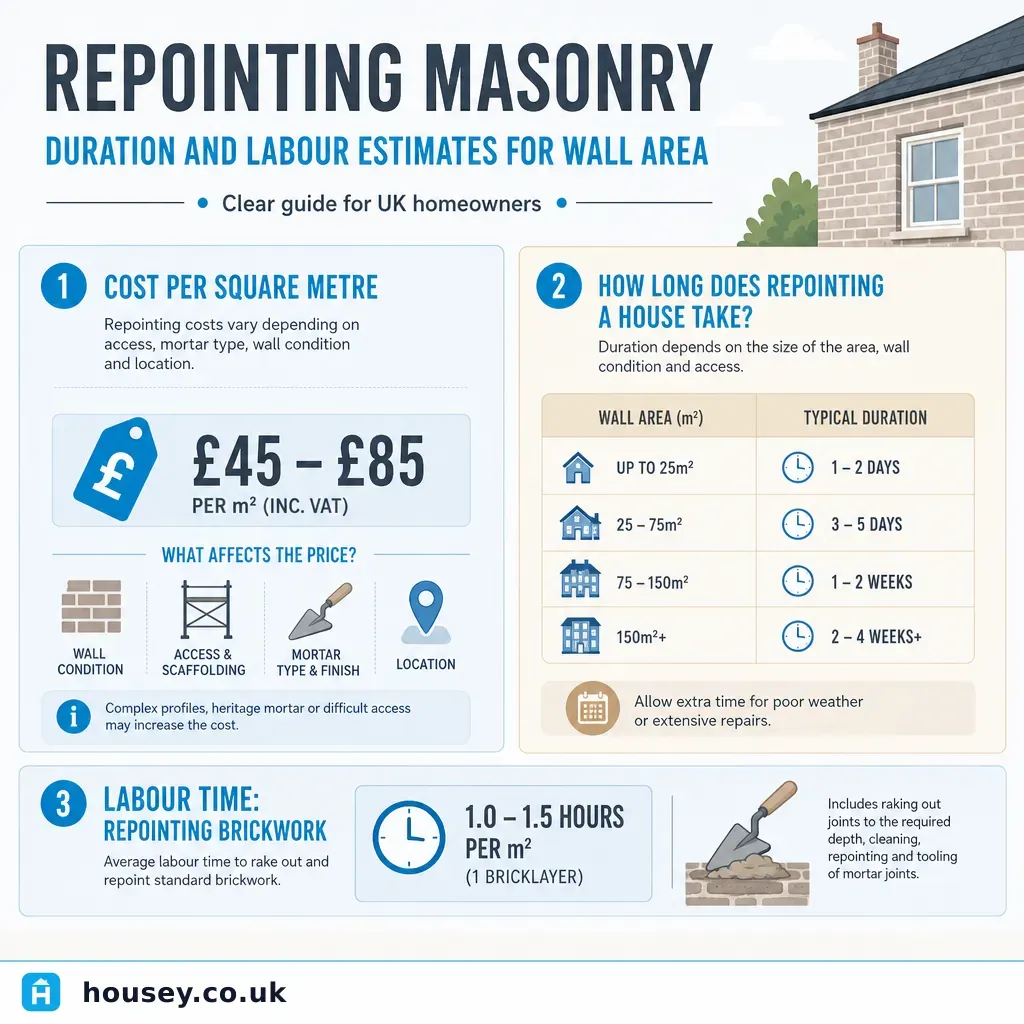
Repointing Masonry: Duration and Labour Estimates for Wall Area
A skilled bricklayer typically repoints 3–5 m² per hour when raking out and refilling joints by hand.
 Improvement & Build
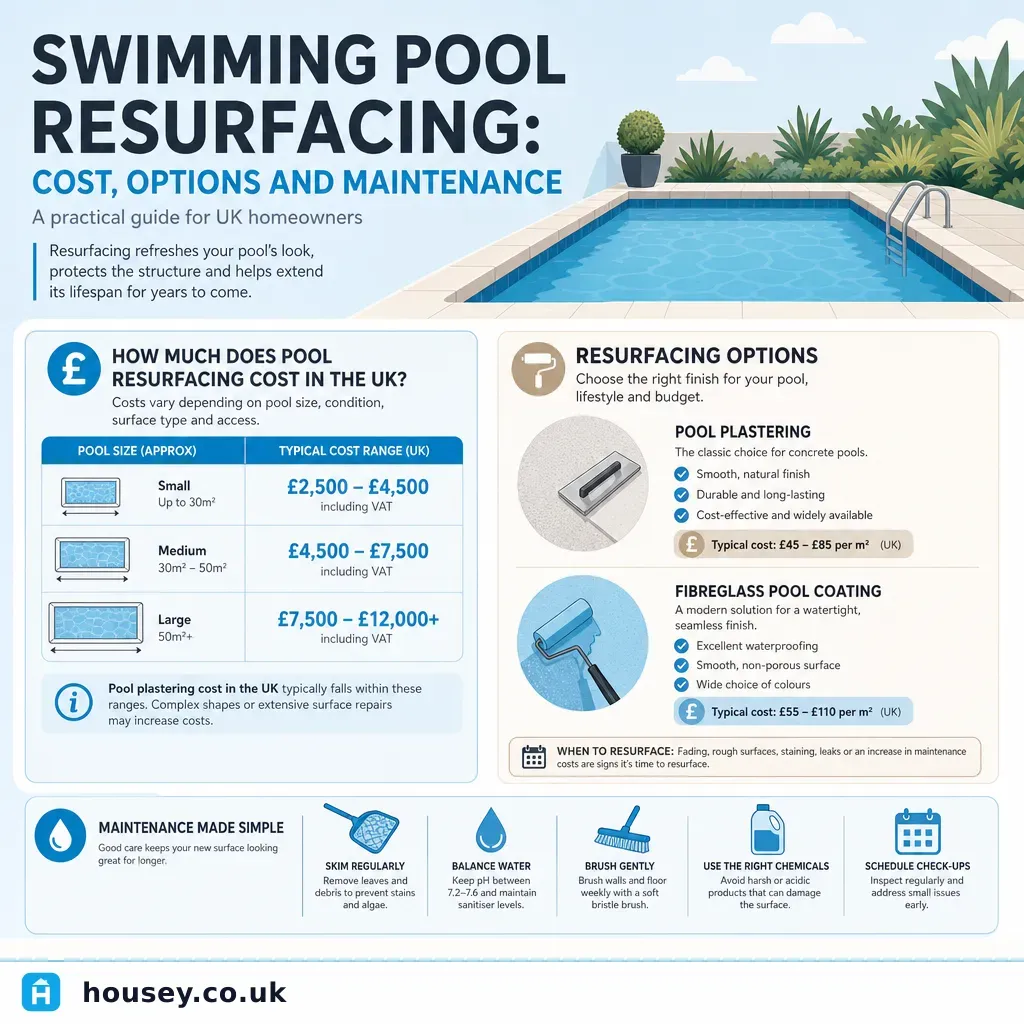
Swimming Pool Resurfacing: Cost, Options and Maintenance
Swimming pool resurfacing in the UK typically costs £3,000–£25,000+, depending on pool size, material, and condition.