Repointing Masonry: Duration and Labour Estimates for Wall Area
By Housey · Last reviewed 4th of May 2026
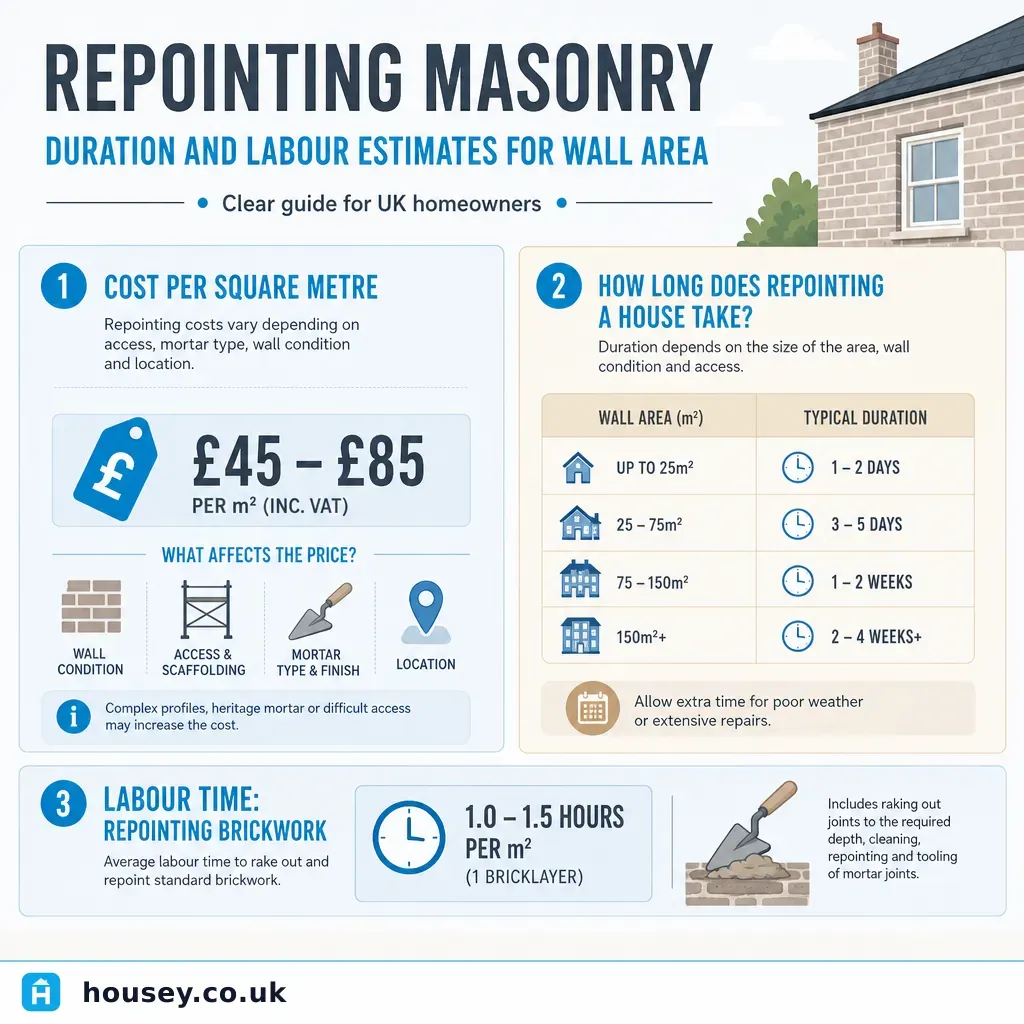
Repointing Masonry: Duration and Labour Estimates for Wall Area
Repointing questions typically arise when a survey flags deteriorating mortar joints, when a builder notices crumbling brickwork during another job, or when homeowners spot recessed and crumbling joints on an older property. Getting the labour estimate right matters because repointing is charged primarily on time and access — and underestimating the scope can leave walls partly finished or budgets overspent midway through a project.
Key points
- A skilled bricklayer typically repoints 3–5 m² per hour when raking out by hand and refilling joints; output drops to 1–2 m²/hour on heavily degraded or hard-set mortar.
- Raking out old mortar usually takes as long as the repointing itself and should be explicitly included — and costed — in any fixed-price quote.
- Listed buildings and properties in conservation areas often require natural hydraulic lime (NHL) mortar rather than ordinary Portland cement (OPC) mixes; using OPC on a lime-built wall can trap moisture and cause brick spalling.
- A full scaffold for a two-storey semi-detached house typically adds £600–£1,200 to the project cost (indicative UK costs, last reviewed 2026-05-04).
- New mortar should comply with BS EN 998-2 (specification for masonry mortar) and be applied to joints raked to a minimum depth of 15–20 mm.
How long does repointing take per square metre?
Output rates vary considerably depending on the condition of existing joints, the hardness of the original mortar, and the tools used. The following ranges give a practical starting point for estimating.
Joint condition | Approximate output (m²/hour) | Notes |
|---|---|---|
Joints recessed 5–10 mm, minimal crumbling | 3–5 m²/hour | Fastest scenario; raking-out is straightforward |
Joints heavily crumbled, 10–20 mm depth | 1–3 m²/hour | More raking time; possible debris clearance needed |
Hard OPC mortar set over original lime, stained or painted | 0.5–1.5 m²/hour | Angle grinder or specialist chisel required |
Irregular rubble stonework | 0.5–2 m²/hour | Joints vary in size; mortar mixing is more complex |
Indicative rates based on hand-tool working. Compressed-air or mechanical raking increases clearing speed but adds equipment hire costs.
The total labour time on any project includes six stages:
- Survey and set-up — usually included in the day rate or quoted separately on larger projects.
- Raking out — removing loose and failing mortar to a minimum depth of 15–20 mm.
- Damping down — wetting brickwork before applying mortar to prevent rapid suction drying.
- Applying mortar — in layers where joints are deep; single pass where they are shallow.
- Striking and finishing — shaping joints to a weathered, bucket-handle, or flush profile.
- Clean-up — brushing residue and disposing of waste mortar.
Estimating labour for a whole house
Worked UK property scenario: 1930s semi-detached
A typical 1930s semi-detached in England has approximately 80–100 m² of external brickwork, excluding window and door openings. If joints are moderately degraded — recessed around 8–12 mm with some crumbling — a reasonable estimate would be:
- Raking out: 80 m² ÷ 2.5 m²/hour = 32 hours
- Repointing: 80 m² ÷ 4 m²/hour = 20 hours
- Set-up, finishing, and clean-up: add approximately 20% = 10–12 hours
- Total: approximately 62–64 hours, or roughly 8 working days for one bricklayer
At an indicative bricklayer day rate of £180–£250/day (UK, last reviewed 2026-05-04), this equates to approximately £1,440–£2,000 in labour alone, before scaffold hire or materials. For a larger detached house with 130–160 m² of external wall, allow 12–16 working days.
These figures are for planning and comparison purposes only. Always obtain at least two or three itemised quotes from qualified bricklayers before committing to a price.
What affects repointing duration and cost?
Mortar type and mix
Choosing the wrong mortar is one of the most consequential decisions in a repointing project, affecting both working time and long-term performance. OPC-based mortars set quickly but are too rigid for older lime-built walls, trapping moisture and causing brick faces to spall over time.
Mortar type | Best for | Setting time | Not ideal for |
|---|---|---|---|
NHL 2 (soft natural hydraulic lime) | Pre-1919 solid-wall brick, very soft stone | 3–7 days before rain risk | Hard engineering brick, below DPC |
NHL 3.5 (medium natural hydraulic lime) | Inter-war brick, softer stone, general purpose | 2–5 days | Very exposed or coastal elevations |
OPC-based (1:3 to 1:5 mix) | Post-1945 hard brick, concrete block | 24–48 hours | Any lime-built wall; can cause spalling |
Hydraulic lime with aggregate (bespoke) | Conservation areas, listed buildings | 3–7 days | Fast-turnaround work or winter conditions |
If the property is listed or in a conservation area, check with your local planning authority or consult Historic England's guidance on repointing before specifying a mortar type.
Access and scaffold
Work above approximately 2 metres should use a scaffold tower or independent scaffold rather than ladders alone. Full scaffold for a complete house exterior typically adds £600–£1,200 to the project and takes roughly half a day per elevation to erect and dismantle (indicative costs, last reviewed 2026-05-04). Ask whether scaffold is included in the quote or a separate supply-and-fix item.
Weather and working conditions
Fresh mortar should not be applied below 3°C or in direct strong sunlight without shade protection. Frost within the first 48 hours of application can damage NHL mortars. This can extend the calendar duration of a project significantly in autumn and winter, even when actual working hours remain the same.
Joint profile
Weathered or bucket-handle profiles are standard on most UK brick properties and shed water effectively. Flush pointing is slightly quicker to execute but less weather-resistant on exposed elevations. Strap or ribbon pointing — overly wide struck joints — is rarely appropriate on traditional brickwork and can direct water into the wall rather than away from it.
Homeowner checklist before repointing work starts
When to get professional help
Most repointing is practical maintenance, but several situations call for specialist assessment before work starts:
- Cracking that follows a regular pattern through bed joints or perpends may indicate structural movement — a chartered surveyor or structural engineer should inspect before any repointing takes place.
- Listed buildings or conservation areas — consult your local planning authority before specifying mortar; some repointing work on listed buildings requires listed building consent under the Planning (Listed Buildings and Conservation Areas) Act 1990.
- Persistent internal damp after previous repointing may indicate that a hard OPC mortar is trapping moisture; a damp specialist should identify the cause before the work is redone.
- Bulging or delaminating brick faces (spalling) may indicate the need for brick replacement rather than repointing alone — get a specialist assessment first.
- Work above 2 metres — the Working at Height Regulations 2005 require safe working platforms; do not rely on ladders alone for whole-elevation projects.
How Housey can help
Housey helps UK homeowners compare quotes from vetted local builders and bricklayers for masonry and external repair projects. Describe your job once and receive responses from qualified tradespeople in your area, making it straightforward to compare scope, mortar specification, and price side by side.
Frequently asked questions
How long does it take to repoint a whole house?
For an average semi-detached with around 80–100 m² of external brickwork in moderate condition, expect roughly 8–12 working days for one bricklayer, or 4–6 days if two work simultaneously. Larger detached properties with 130–160 m² may take 12–16 working days. These estimates include raking out existing mortar and assume standard hand-tool working.
Can I repoint brickwork myself?
Small areas of accessible repointing below 2 metres are sometimes tackled as DIY if the correct mortar mix is used for the wall's age and construction. However, using the wrong mortar on older properties can cause moisture damage and brick spalling. For work above 2 metres, the Working at Height Regulations 2005 require safe access equipment — professional scaffold or towers are strongly advisable.
What is the difference between pointing and repointing?
Pointing refers to finishing mortar joints during original construction. Repointing is the repair process — raking out old or failed mortar to a minimum depth of 15–20 mm and refilling with fresh material to restore weathertightness and appearance. The term repointing is used exclusively for repair work on existing buildings.
How do I know what mortar mix to use for repointing?
The mortar should be matched to the original construction. Pre-1919 properties were usually built with lime and should be repointed with a natural hydraulic lime (NHL 2 or NHL 3.5) mix. Post-1945 hard brick can generally tolerate an OPC-based mix. If the property is listed or in a conservation area, check with your local planning authority or a specialist lime contractor before specifying a mortar.
Does repointing add value to a property?
Repointing primarily protects value rather than adds it. Failing mortar joints allow water ingress, leading to damp, frost damage to brick faces, and internal damage over time. A weathertight building envelope supports a better condition rating in RICS surveys and avoids costly remedial works later. Buyers and surveyors routinely flag visible joint deterioration as a maintenance or structural concern.
Sources and further reading
- Repointing Brick and Stone Walling — Historic England
- Approved Document C: Site Preparation and Resistance to Contaminants and Moisture — GOV.UK
- Working at Height Regulations 2005 — legislation.gov.uk
- Damp in Historic Buildings — Historic England
Useful next reads
 Improvement & Build
Masonry Repointing Costs and Best Practices
Masonry repointing in the UK typically costs £20–£60 per m² for labour and materials, with scaffold adding £600–£1,500 or more depending on height and access.
 Improvement & Build
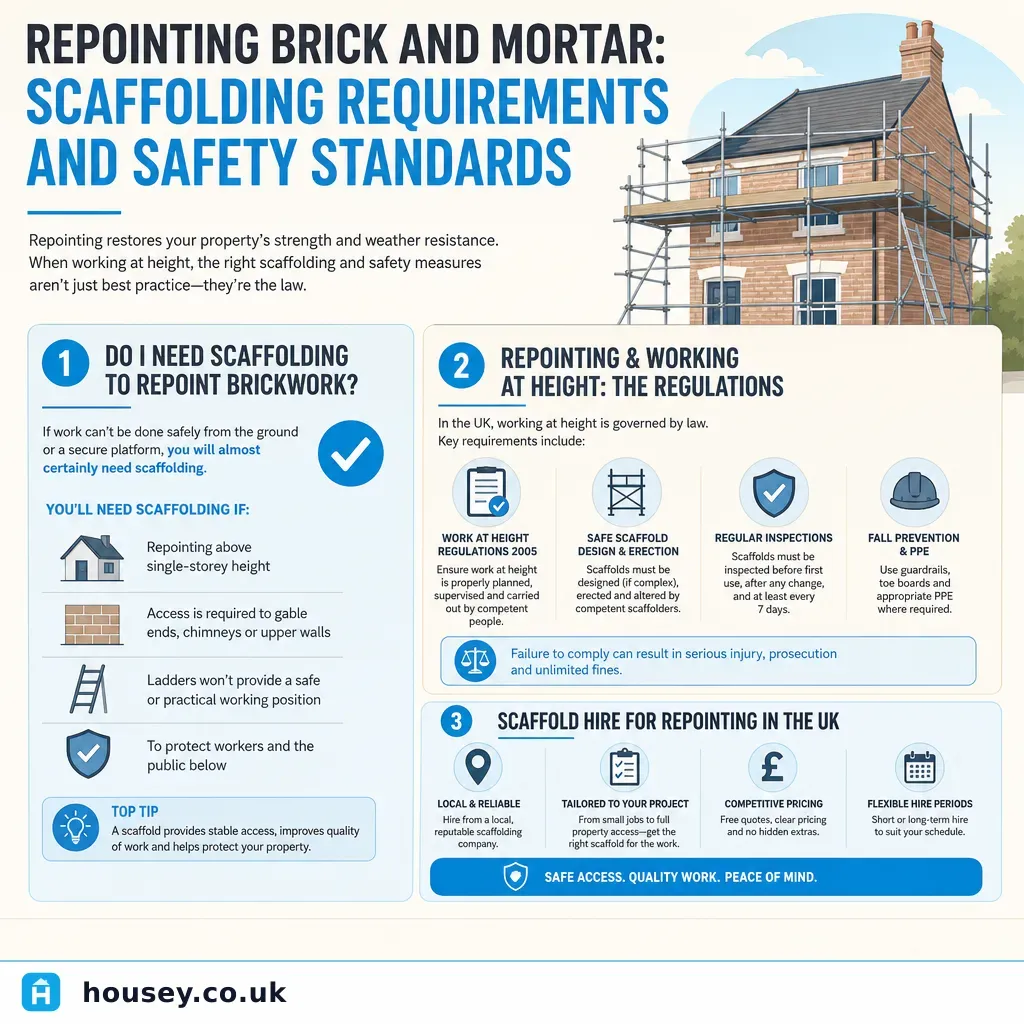
Repointing Brick and Mortar: Scaffolding Requirements and Safety Standards
Most repointing on two-storey or gable elevations requires full scaffolding under the Work at Height Regulations 2005.
 Improvement & Build
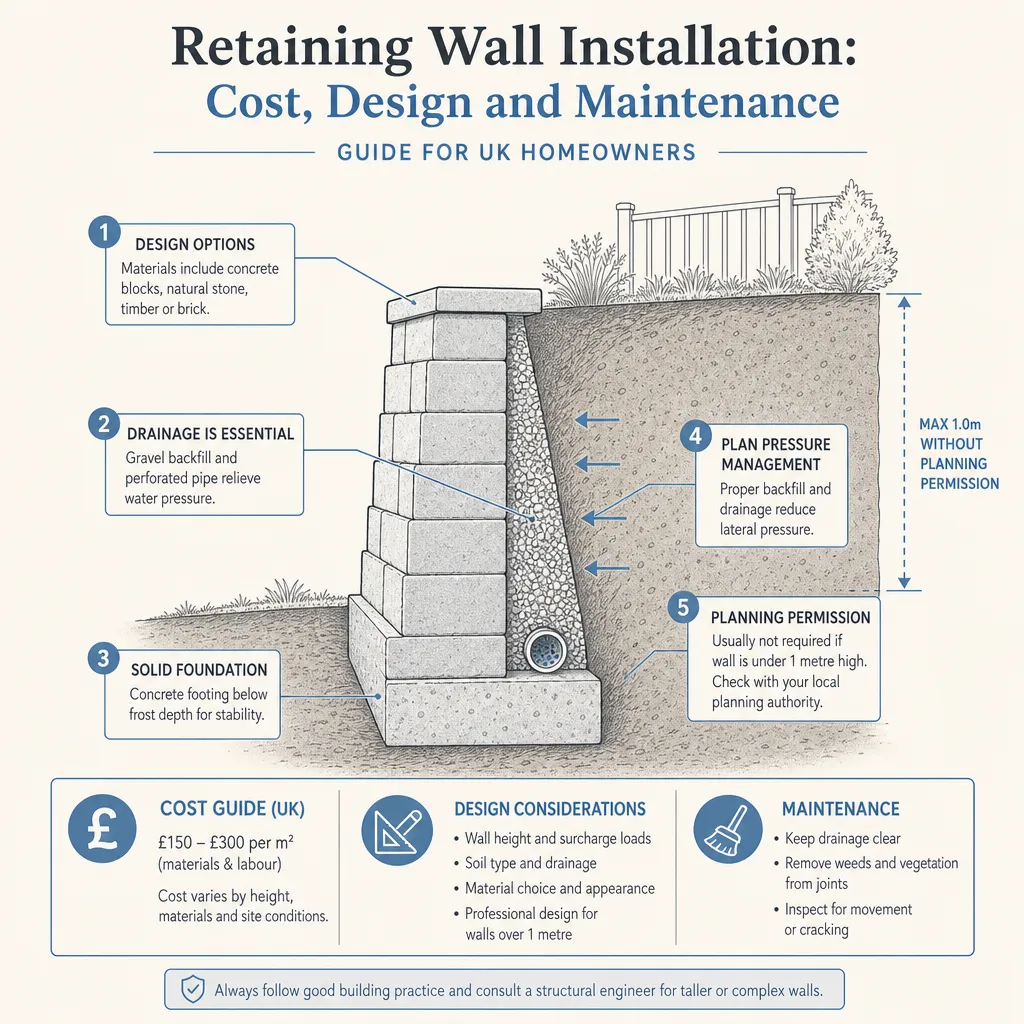
Retaining Wall Installation: Cost, Design and Maintenance
A retaining wall holds back soil on a sloped or banked site.
 Improvement & Build
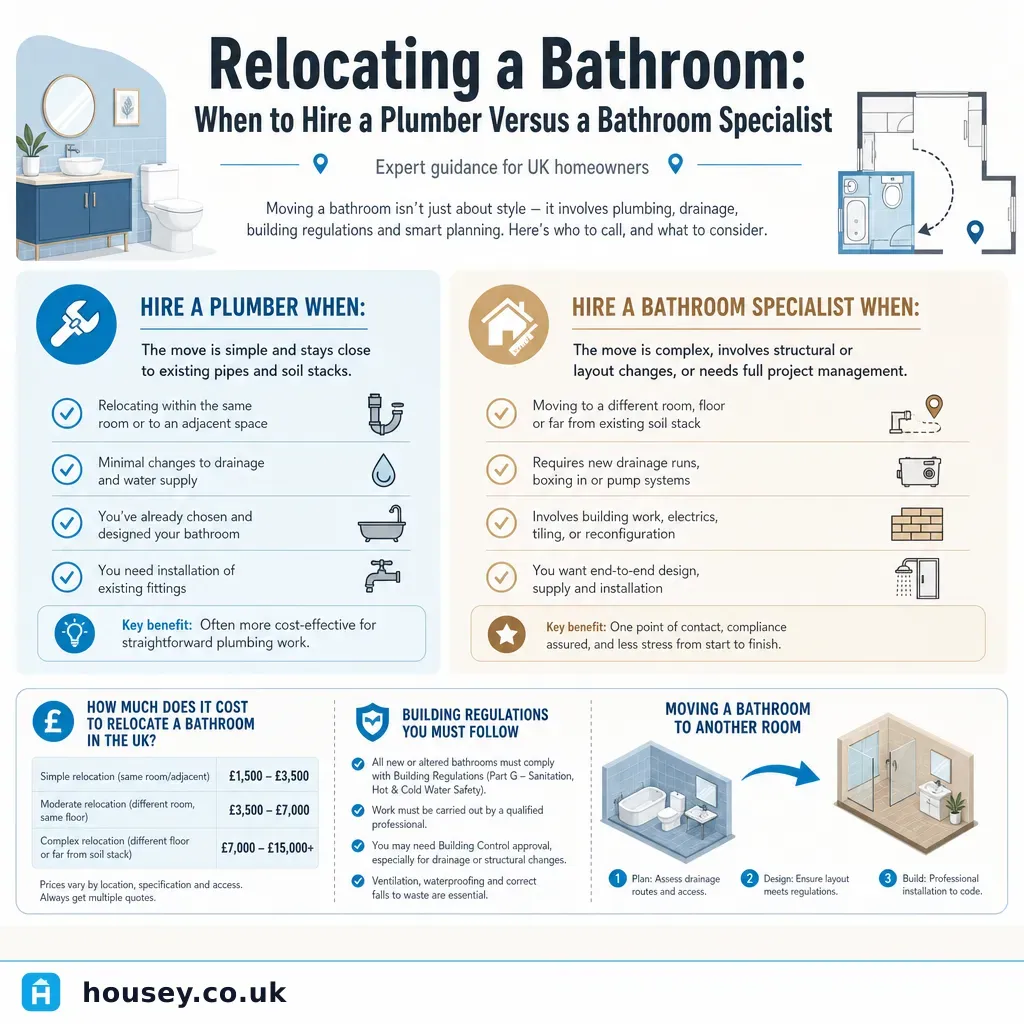
Relocating a Bathroom: When to Hire a Plumber Versus a Bathroom Specialist
Relocating a bathroom usually requires both a qualified plumber for pipework and drainage and other specialist trades for electrics, tiling, and finishes.
 Improvement & Build
Damaged Brick Facade Repair Costs
Repairing a damaged brick facade in the UK typically involves repointing mortar joints, replacing spalled bricks, or full masonry restoration.