Installing Laminate Flooring: Cost, Process and Maintenance
By Housey · Last reviewed 1st of June 2026
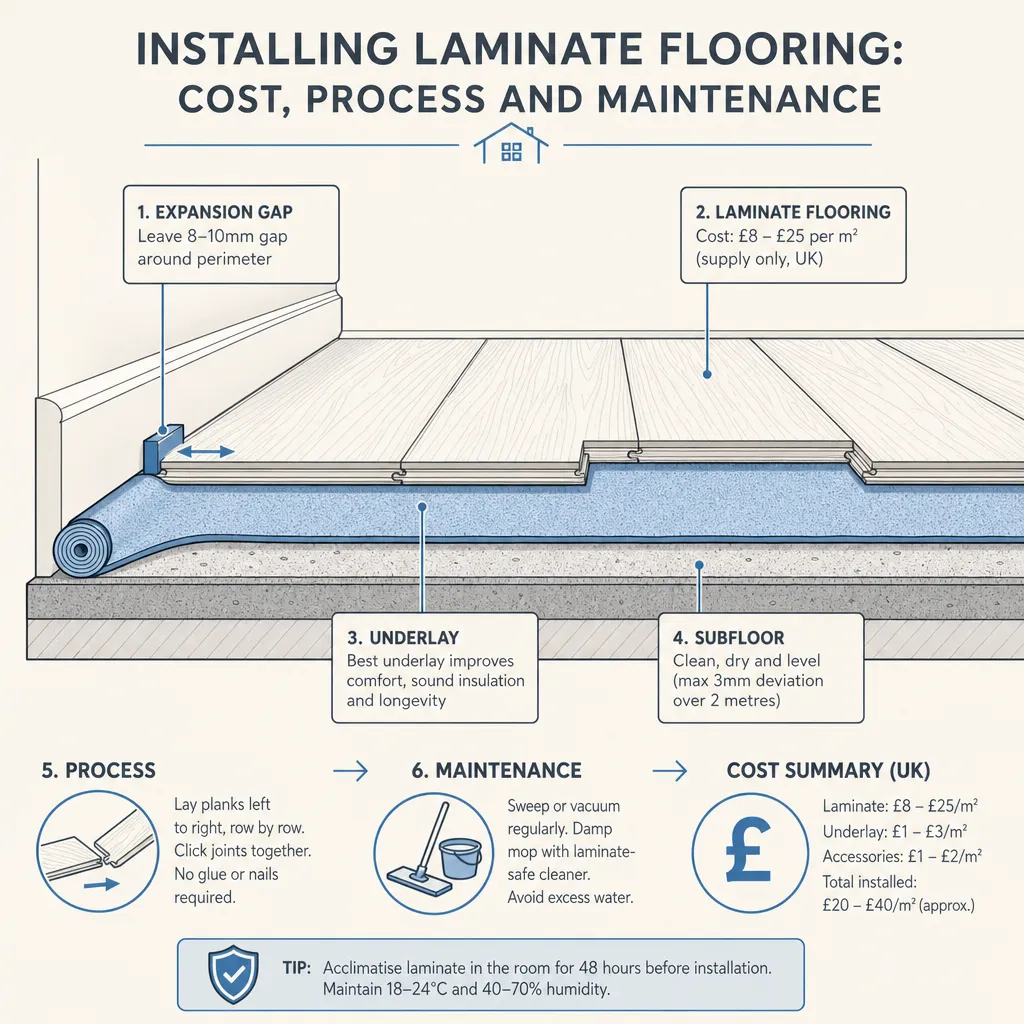
Installing Laminate Flooring: Cost, Process and Maintenance
Laminate flooring is one of the most popular floor coverings in UK homes, chosen for its durability, ease of cleaning, and wide range of wood-effect styles. Homeowners typically face this decision during a renovation, after replacing worn carpet, or when preparing a property for sale or let. Getting the choice right — from the correct AC rating to the appropriate underlay — makes the difference between a floor that lasts a decade and one that buckles, scratches, or fails the acoustic test in a flat.
Key points
- Laminate flooring carries an Abrasion Class (AC) rating from AC1 to AC5; domestic homes generally require AC3 as a minimum for living rooms and hallways, as defined under BS EN 13329.
- Most reputable brands offer a 15–25 year warranty on domestic laminate, which is typically voided by incorrect underlay, moisture ingress, or inadequate expansion gaps.
- Building Regulations Approved Document E sets acoustic performance standards for floors in flats and conversions; floating laminate floors in flats usually need a minimum Impact Sound Improvement value (ΔLw) of 17 dB.
- Standard laminate cannot be sanded or refinished — once the wear layer is gone, the board must be replaced rather than restored.
- Laminate classified for kitchens or bathrooms must carry a moisture-resistance rating; most standard products will swell irreversibly if water sits on the joints.
What does laminate flooring cost in the UK?
Costs divide into materials, underlay, and fitting. Indicative UK costs, last reviewed 2026-06-01 — costs vary by region, product specification, and subfloor condition; always obtain at least three written quotes.
Materials:
- Budget laminate (AC3, 7–8 mm thick): £15–22 per sq m
- Mid-range laminate (AC3–4, 10–12 mm): £22–35 per sq m
- Premium laminate (AC4–5, 12 mm+, wide plank): £35–55 per sq m
Professional fitting (labour only):
- Straightforward rectangular room: £8–12 per sq m
- Room with stairs, underfloor heating, or complex layout: £12–18 per sq m
Underlay:
- Basic foam: £2–4 per sq m
- Combined acoustic and thermal: £4–8 per sq m
- Underlay with integral vapour barrier (for concrete subfloors): £5–9 per sq m
Additional likely costs:
- Subfloor levelling or screeding: £5–15 per sq m
- Beading, threshold strips, and door trimming: £30–80 per room
VAT at 20% applies to labour and most materials.
Worked example: 1930s semi-detached living room
A 20 sq m living room in a 1930s semi with a solid concrete subfloor and one bay window:
- Mid-range AC3 laminate at £28/sq m: £560
- Combination underlay with vapour barrier at £6/sq m: £120
- Fitting labour at £10/sq m: £200
- Threshold strips and beading: £60
- Minor subfloor levelling (half day): £120
Estimated total: approx. £1,060 (inc. VAT at 20% on labour)
These figures are illustrative; always obtain written quotes before committing.
Which AC rating do you need?
The AC (Abrasion Class) rating, defined under BS EN 13329, measures how well the surface layer resists wear. Choosing too low a rating for your traffic level leads to premature surface degradation.
AC Rating | Best for | Not ideal for |
|---|---|---|
AC1 | Light domestic use (spare bedrooms) | Hallways, kitchens, family rooms |
AC2 | General domestic use, low footfall | High-traffic areas or homes with pets |
AC3 | All domestic rooms including hallways | Commercial or very heavy domestic use |
AC4 | Heavy domestic or light commercial | Most standard homes (rarely necessary) |
AC5 | Heavy commercial | Residential properties (overkill) |
For most UK homes, AC3 is sufficient. Hallways, open-plan kitchens, and homes with children or pets benefit from AC4.
What underlay should you choose?
Underlay smooths minor subfloor imperfections, provides thermal insulation, and reduces impact noise. For flats, acoustic performance is a legal requirement under Approved Document E of the Building Regulations.
Which underlay is right for your situation?
- Choose a foam underlay with an integral vapour barrier if your subfloor is solid concrete.
- Choose a rubber crumb or high-density foam underlay if you are in a flat and need to meet Approved Document E acoustic requirements — check the manufacturer's stated ΔLw value.
- Choose a combined thermal and acoustic underlay to improve insulation in a ground-floor room.
- Choose an underfloor-heating-compatible underlay (thermal resistance ≤0.15 m²K/W) if wet or electric underfloor heating is installed beneath the laminate.
- Never use two layers of underlay — this creates excessive flex that stresses the locking joints and can void the product warranty.
How is laminate flooring installed?
Laminate is a floating floor — planks lock together and rest over the subfloor rather than being glued or nailed. A professional installer follows this general process:
- Subfloor preparation — the subfloor must be flat (within ±3 mm over 2 m), dry, and clean. Concrete subfloors should test below 75% relative humidity.
- Acclimatisation — laminate packs should rest in the room for at least 48 hours before fitting.
- Underlay installation — laid with joints offset and taped; vapour barrier faces down on concrete.
- First row — laid against the longest wall with a 10–12 mm expansion gap along all fixed edges (walls, pipes, door frames).
- Subsequent rows — staggered by at least 300 mm to avoid H-joints, which weaken the floor structurally.
- Door frames — undercut to receive the laminate rather than notching the board around the frame.
- Finishing — threshold strips at room transitions; scotia or beading to cover the expansion gap at skirting boards.
Homeowner checklist before the fitter arrives
Laminate vs engineered wood: which suits your home?
Feature | Laminate | Engineered wood |
|---|---|---|
Surface material | Photographic print layer and wear layer | Real wood veneer |
Can be sanded or refinished? | No | Yes (1–3 times, depending on veneer thickness) |
Moisture resistance | Moderate (some products rated for kitchens) | Moderate to good (species-dependent) |
Typical materials cost | £15–55 per sq m | £30–90 per sq m |
Underfloor heating compatibility | Many products — check specification | Most products — check specification |
Indicative lifespan | 15–25 years (domestic) | 25–50+ years |
Best for | Rentals, family homes, budget renovations | Long-term investment, period properties |
For rental properties or high-footfall homes with pets, laminate is often the more practical choice. For a period property where the visual warmth of real wood matters, engineered wood may justify the higher cost.
Maintenance and longevity
Laminate is low-maintenance but not maintenance-free:
- Daily cleaning: a dry or lightly damp microfibre mop. Avoid excess water, steam mops, or soaking — moisture forced into joints causes irreversible swelling.
- Avoid: abrasive cleaners, bleach-based products, and floor polish, which leaves a haze on the wear layer.
- Protect: fit felt pads under furniture legs and use entrance mats to trap grit and moisture at doorways.
- Repairs: minor scratches can be treated with a manufacturer repair kit. Deep gouges or swollen boards usually require plank replacement — straightforward on click-lock floors if spare boards were retained.
- Warranty records: keep the product code, purchase receipt, and installer's invoice. Manufacturers require proof of correct installation to honour warranty claims.
When to get professional help
Laminate fitting is within reach of a confident DIYer for a simple rectangular room, but professional installation is advisable when:
- The subfloor needs levelling or screeding before boards can be laid.
- The room has underfloor heating — incorrect underlay choice can affect heating efficiency and void both the heating system and the floor warranty.
- You live in a flat and need to demonstrate Approved Document E acoustic compliance — a professional can provide a written specification confirming ΔLw performance.
- The layout involves awkward angles, many doorways, or stairs.
- You are fitting in a kitchen and need to co-ordinate floor height and thresholds with kitchen units.
Red flags when hiring a fitter:
- A fitter who quotes without asking about subfloor condition or type.
- No mention of expansion gaps or acclimatisation requirements.
- A quote that does not itemise underlay separately.
- No written product specification or warranty information provided at the time of quoting.
How Housey can help
Housey connects UK homeowners with vetted local tradespeople for flooring installation and wider home improvement work. Use Housey to compare written quotes, check trade credentials, and find a fitter with demonstrated experience of your subfloor type and room layout.
Frequently asked questions
Can laminate flooring be fitted in a bathroom?
Standard laminate is not suitable for bathrooms — moisture penetration swells the HDF core irreversibly. Some products are specifically manufactured and warranted for wet-room use with a moisture-resistance certification. Always check the manufacturer's warranty terms and product specification before fitting any laminate near water or in a room with persistently high humidity.
How long does it take to fit laminate flooring?
A typical 15–20 sq m room takes a professional fitter four to six hours, including subfloor preparation. Larger open-plan areas or rooms with complex layouts — such as bay windows, hearths, or many doorways — may take a full day. Boards must acclimatise in the room for at least 48 hours before fitting begins.
Do I need planning permission to install laminate flooring?
No. Fitting a new floor covering is an internal alteration and does not require planning permission. If you own a leasehold flat, check your lease — some leases require written consent from the freeholder or managing agent before replacing carpets with hard flooring, particularly where acoustic performance is a concern for neighbouring residents.
Is laminate flooring suitable for underfloor heating?
Many laminate products are compatible with underfloor heating, but you must verify the manufacturer's specification. The combined thermal resistance of the laminate and underlay should not typically exceed 0.15 m²K/W. Electric and wet underfloor heating systems have slightly different requirements — confirm compatibility with both your heating engineer and the flooring manufacturer before purchasing.
How do I protect the warranty on laminate flooring?
Keep the product packaging with the batch number and specification, your purchase receipt, and the installer's invoice. Most manufacturers require proof that a suitable underlay was used, expansion gaps were maintained, and the floor has not been exposed to excess moisture. Failure to meet these installation conditions is the most common reason warranty claims are rejected.
Sources and further reading
- Building Regulations Approved Document E: Resistance to Sound — GOV.UK
- Flooring safety guidance — Health and Safety Executive
- Floor insulation advice — Energy Saving Trust
- BS EN 13329: Laminate floor coverings — BSI
Useful next reads
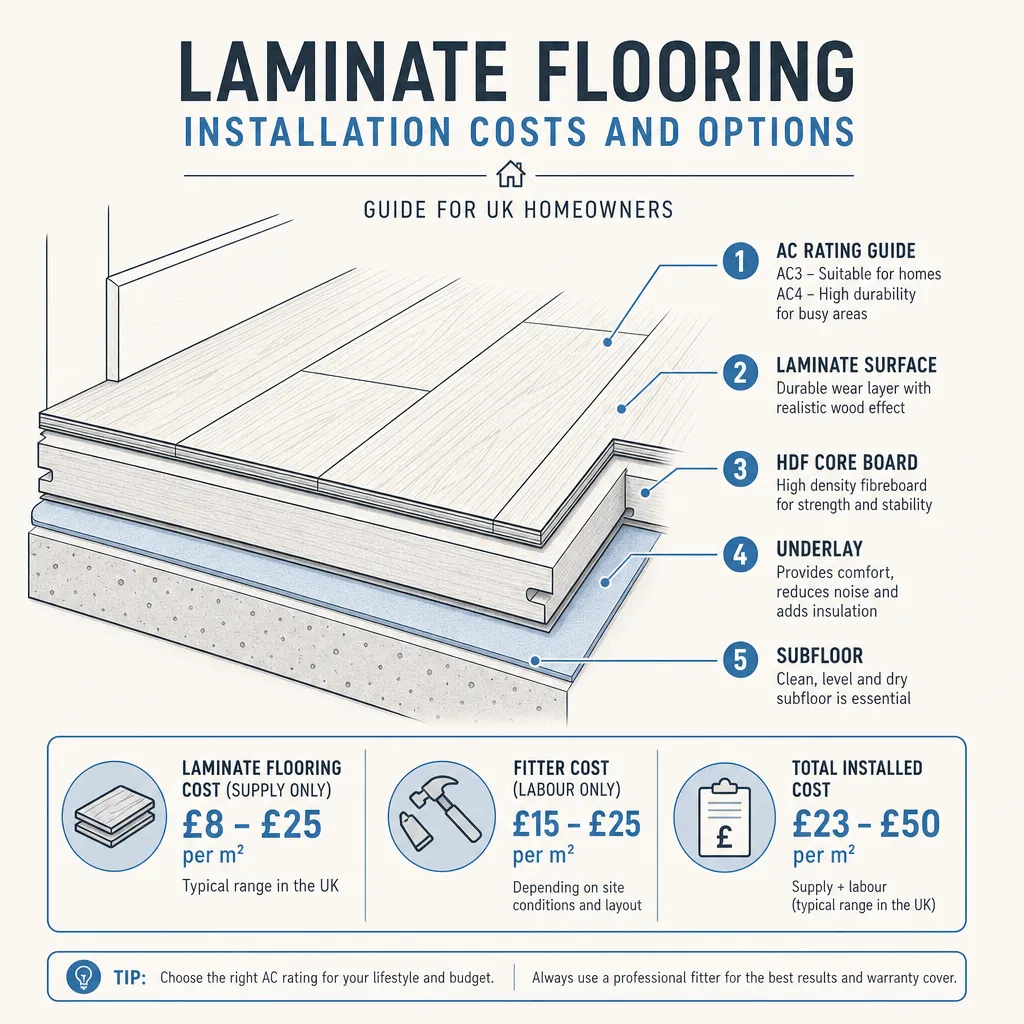 Improvement & Build
Laminate Flooring Installation Costs and Options
Laminate flooring typically costs £20–55 per square metre fully installed in the UK, including materials, underlay, and professional fitting.
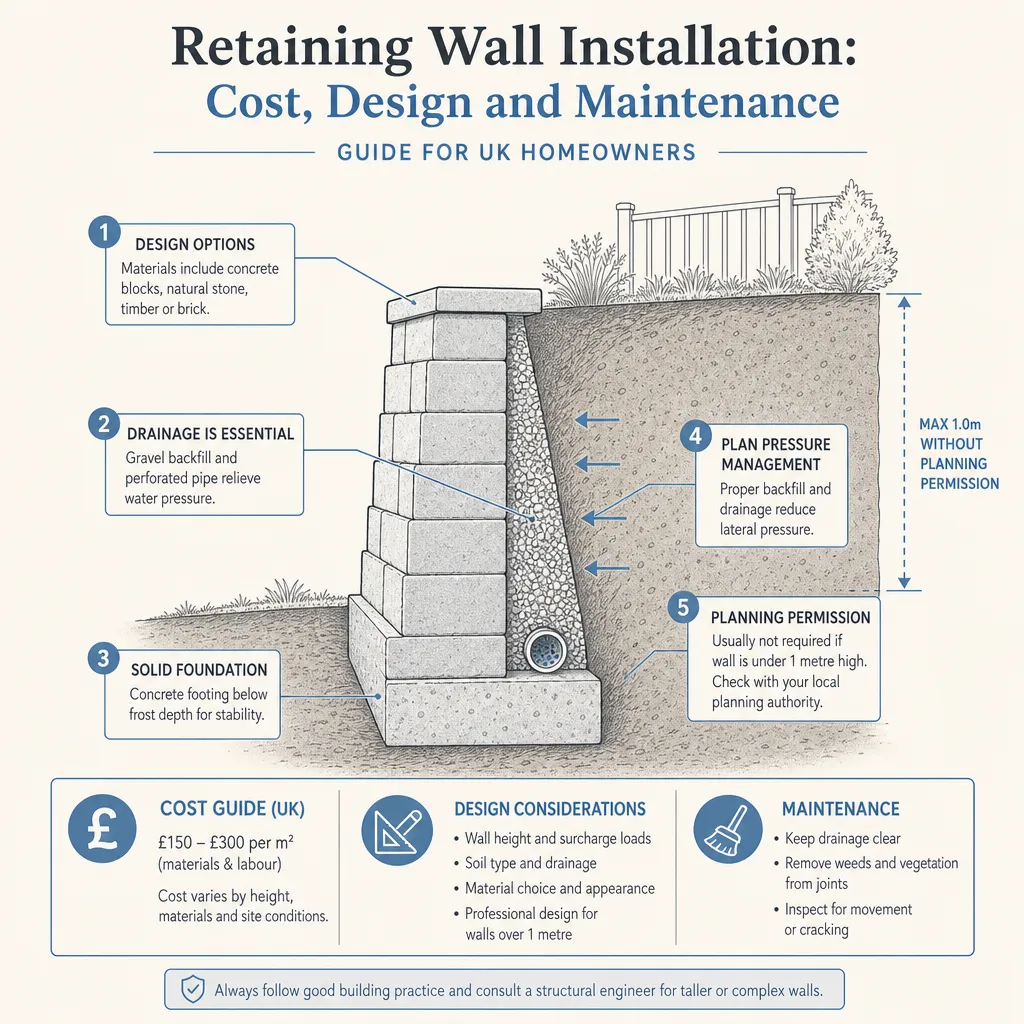 Improvement & Build
Retaining Wall Installation: Cost, Design and Maintenance
A retaining wall holds back soil on a sloped or banked site.
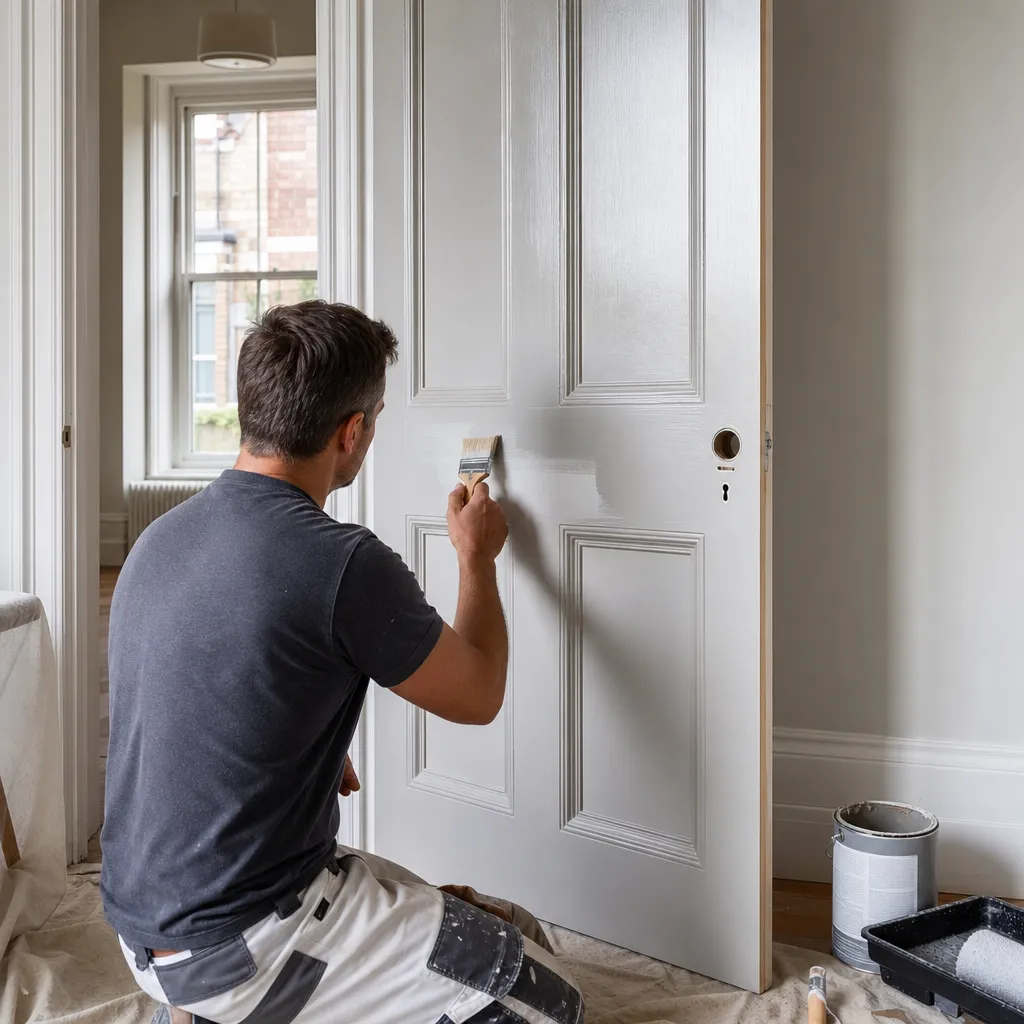 Improvement & Build
Painting Interior Doors: Preparation and Technique
Painting interior doors well depends on preparation rather than paint choice.
 Improvement & Build
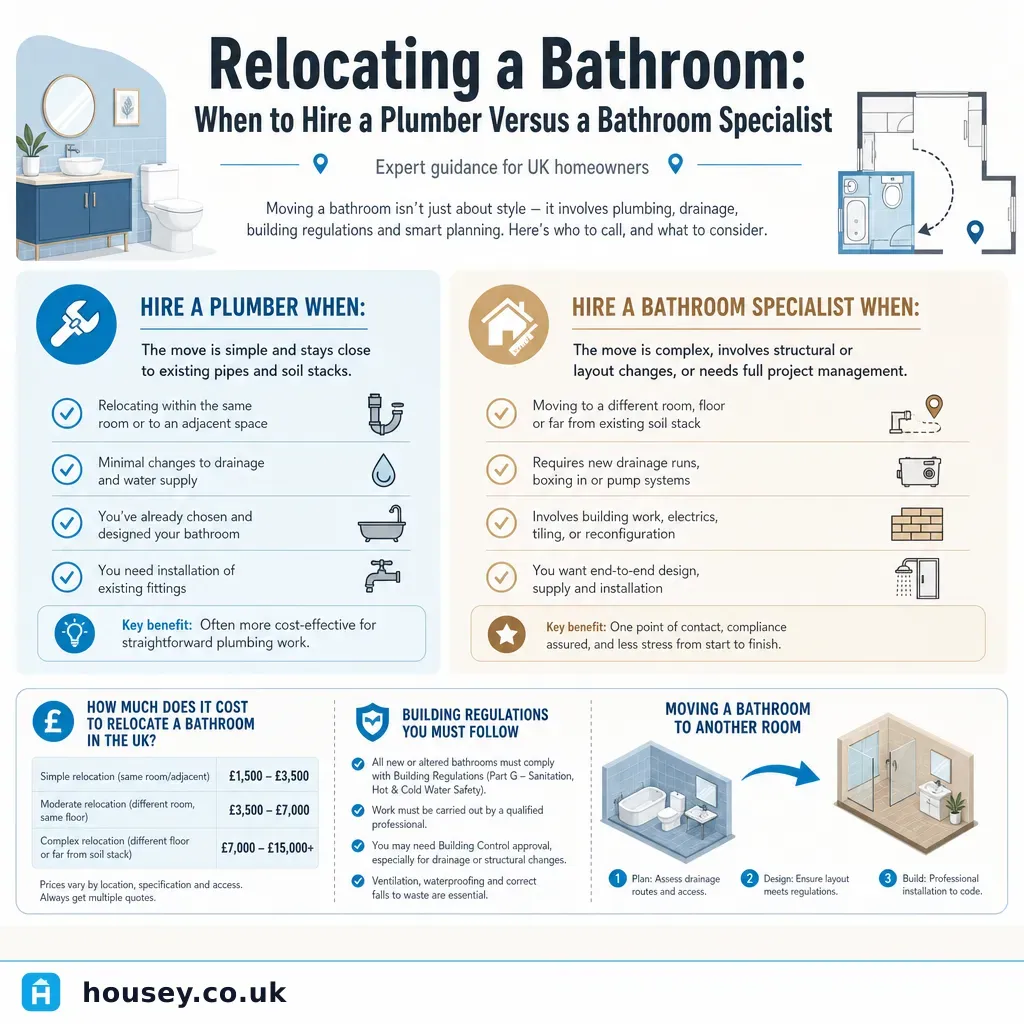
Relocating a Bathroom: When to Hire a Plumber Versus a Bathroom Specialist
Relocating a bathroom usually requires both a qualified plumber for pipework and drainage and other specialist trades for electrics, tiling, and finishes.
 Improvement & Build
Painting Brick Fireplaces: Preparation, Materials and Technique
Painting a brick fireplace requires thorough cleaning, a masonry-specific primer, and heat-resistant paint rated to at least 200°C for the firebox area.