Climbing Vines and Walls: Planning and Design Considerations for Properties
By Housey · Last reviewed 12th of May 2026
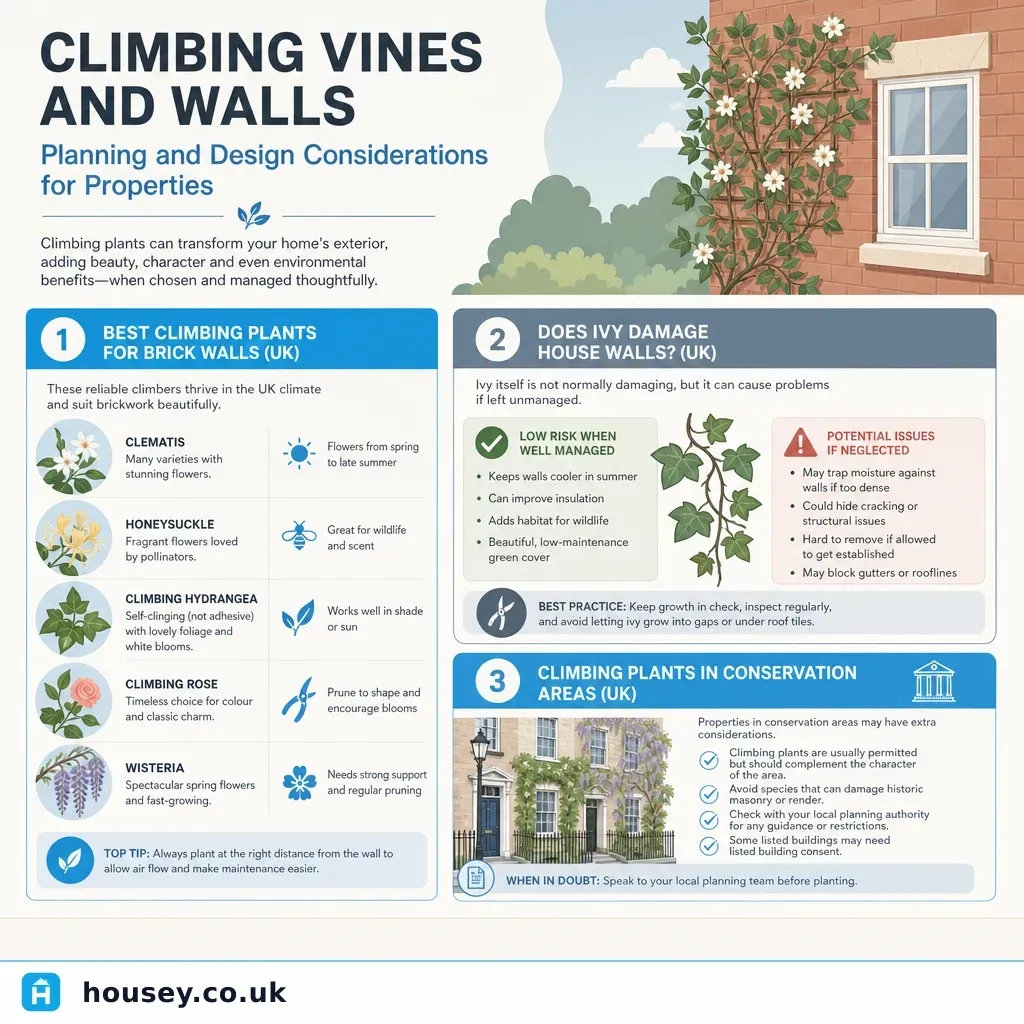
Climbing Vines and Walls: Planning and Design Considerations for Properties
Growing plants up exterior walls is a long-standing feature of British domestic architecture — from the wisteria-clad Victorian terrace to the ivy-covered country cottage. The decision to introduce climbing plants typically arises during a garden redesign, a renovation project, or when improving kerbside appeal. The stakes range from purely aesthetic to genuinely structural: the wrong plant on the wrong wall, left unmanaged, can cause costly damage and persistent moisture problems in UK properties of every era.
Key points
- Self-clinging climbers (ivy, Virginia creeper, climbing hydrangea) attach directly to masonry and can widen hairline cracks or damage already-defective mortar — sound, well-pointed modern brickwork is generally more resistant.
- Wisteria's woody stems can generate significant lateral force over time and require purpose-built wire fixings or frames rated for the load; lightweight plastic clips are not adequate.
- In conservation areas and on listed buildings, fixing trellis or wire supports to an exterior wall may require listed building consent or conservation area consent under the Planning (Listed Buildings and Conservation Areas) Act 1990 — check with your local planning authority (LPA) before drilling.
- Annual pruning to keep growth away from gutters, soffits, eaves, and window frames is essential; unchecked growth traps moisture and can block ventilation openings.
- Supported climbers trained on wires, trellis, or pergola systems generally pose lower risk to the building fabric than self-clinging species, because they do not adhere directly to masonry.
Which climber is right for your wall?
The most important variables are wall construction and condition, aspect (north, south, east, or west), the support system you can install, and how much ongoing maintenance you are prepared to commit to.
Plant | Growth habit | Best aspect | Risk to masonry | Maintenance level | Notes |
|---|---|---|---|---|---|
Ivy (Hedera helix) | Self-clinging (rootlets) | Any, tolerates north | Higher on older or defective mortar | High (fast-growing) | Check mortar condition before planting |
Virginia creeper (Parthenocissus) | Self-clinging (adhesive pads) | South or west | Moderate | Moderate | Spectacular autumn colour; heavier than ivy |
Climbing hydrangea | Self-clinging | North or east | Moderate | Low once established | Slow to establish; excellent for shaded walls |
Wisteria | Twining (needs support) | South or west | Lower (wire or frame needed) | High (twice-yearly pruning) | Heavy stems — robust fixings essential |
Clematis | Tendrils or twining (needs support) | Varies by variety | Low | Moderate | Hundreds of UK-suitable varieties |
Climbing rose | Needs tying in | South or west | Low | Moderate–high | Good for period properties; thorns deter intruders |
Pyracantha (firethorn) | Wall-trained shrub | Any | Low | Moderate | Berries for wildlife; adds security |
Do climbing plants damage walls?
This is the question UK homeowners ask most often, and the honest answer is: it depends on the plant and the wall.
Self-clinging climbers produce rootlets or adhesive pads that grip masonry directly. On modern, well-pointed brickwork with sound mortar, healthy ivy or Virginia creeper rarely causes structural damage. On older properties — a Georgian or Victorian terrace with lime-mortar pointing, or any wall where mortar is already crumbling — the rootlets exploit existing weaknesses and can widen gaps, allowing water ingress.
Supported climbers on wires or trellis fixed to battens stand slightly away from the wall, allowing air circulation and avoiding direct attachment to masonry. This is the lower-risk approach for most UK properties, particularly period homes with softer historic mortars.
Moisture is the more frequent culprit. Dense, unmanaged growth trapping moisture against a wall — especially around window reveals, soffits, and guttering — creates conditions for damp penetration and rot in timber elements. Regular pruning is not optional.
Planning and regulatory considerations
For most domestic gardens in England and Wales, planting climbers and fixing lightweight trellis or wire supports is permitted development — you do not need planning permission. However, exceptions apply:
- Listed buildings: Fixing anything to exterior walls — even screws for vine eyes — may require listed building consent under the Planning (Listed Buildings and Conservation Areas) Act 1990. Check with your LPA or Historic England before starting.
- Conservation areas: Significant alterations to the external appearance of a property can require conservation area consent; trellis structures over a certain size may be affected. Check with your LPA.
- Flats and leasehold properties: Your lease may restrict what you can fix to exterior walls. Check your lease and speak to your freeholder or managing agent before proceeding.
- Boundary walls: If the wall is shared or on a neighbour's land, you may need their consent under the Party Wall etc. Act 1996 or general property law.
Always verify with your LPA if you are uncertain — permitted development rights can be removed by Article 4 Directions in some areas.
Which climber should you choose?
- Choose a supported climber (clematis, rose, trained pyracantha) if your walls are older, mortar is in imperfect condition, or you want to minimise risk to the building fabric.
- Choose ivy or Virginia creeper only if your brickwork is modern or has been recently repointed, and you are committed to annual maintenance.
- Choose climbing hydrangea if you have a shaded north-facing wall — it is one of very few climbers that thrives reliably in low light.
- Choose wisteria only if you have a robust wire system, frame, or pergola — never rely on guttering or lightweight fixings, and plan for twice-yearly pruning.
- Ask a garden designer if your property is listed, in a conservation area, or if there are existing damp or mortar issues — the wrong choice can be expensive to reverse.
- Check with your LPA before fixing any support to the exterior wall of a listed building or a property in a conservation area.
Red flags to watch for
Once plants are established, watch for these warning signs:
- Gutters or downpipes blocked by growth — leads to damp penetration and overflow damage
- Mortar crumbling or missing around rootlet attachment points on the wall face
- Damp patches appearing on interior walls adjacent to heavily planted external faces
- Growth over window frames or sealing gaps around sills — traps moisture and encourages rot
- Roots infiltrating airbricks or ventilation openings — can cause sub-floor moisture problems in suspended timber floors
- Wisteria or heavy rose canes bridging from wall to roof structure or guttering
If you notice any of these, cut back growth immediately and inspect the underlying wall surface for damage before replanting.
When to get professional help
For most properties, planning and planting climbing plants is within the scope of a confident homeowner or a competent landscaper. Consider professional advice when:
- The property is listed or in a conservation area and planning consent may be required
- There is existing damp or mortar defects that a self-clinging species could worsen
- You want wisteria or another heavy climber trained across a large façade and need robust fixings specified to take the load
- You are unsure which plants will thrive given the aspect, soil type, and local climate
How Housey can help
Whether you need a full garden redesign incorporating wall climbers, or practical advice on the best species for your property type and aspect, Housey can connect you with experienced garden designers and landscapers who work with UK residential properties of all types and eras.
Frequently asked questions
Does ivy damage house walls in the UK?
Ivy can damage walls where mortar is already defective or crumbling — a particular concern with lime-mortar pointing on older properties. On sound, well-pointed modern brickwork, established ivy is generally stable. The greater risk is moisture retention if growth becomes dense and is not pruned back annually from gutters, downpipes, and window reveals. Inspect mortar condition before planting.
Do I need planning permission to grow climbers up my house?
In most cases, no. Planting climbers and attaching lightweight trellis or wire supports is permitted development for standard residential properties in England and Wales. However, listed buildings require listed building consent before any fixing to exterior walls, and properties in conservation areas may face additional restrictions. Always check with your local planning authority if you are in any doubt.
What is the best climbing plant for a north-facing wall in the UK?
Climbing hydrangea (Hydrangea anomala subsp. petiolaris) is widely regarded as one of the best options for north-facing walls. It is self-clinging, produces white lacecap flowers in summer, and tolerates shade and cool, damp conditions well. Ivy also performs well where mortar is sound. Pyracantha trained as a wall shrub is another reliable choice for low-light aspects.
Sources and further reading
- Permitted development rights for householders — Planning Portal
- Listed buildings guidance — Historic England
- Climbing plants — Royal Horticultural Society
- Planning (Listed Buildings and Conservation Areas) Act 1990 — legislation.gov.uk
Useful next reads
 Improvement & Build
Strategic Landscaping to Boost Property Value: Practical Tips and Ideas
Landscaping can add 5–15% to a UK property's perceived value, though the return varies by improvement type.
 Improvement & Build
Seasonal Garden Transformations and Outdoor Design Ideas
A successful garden transformation in the UK works with the seasons rather than against them — establishing structure and hard landscaping in autumn or winter, planting in spring, and enjoying the results through summer.
 Improvement & Build
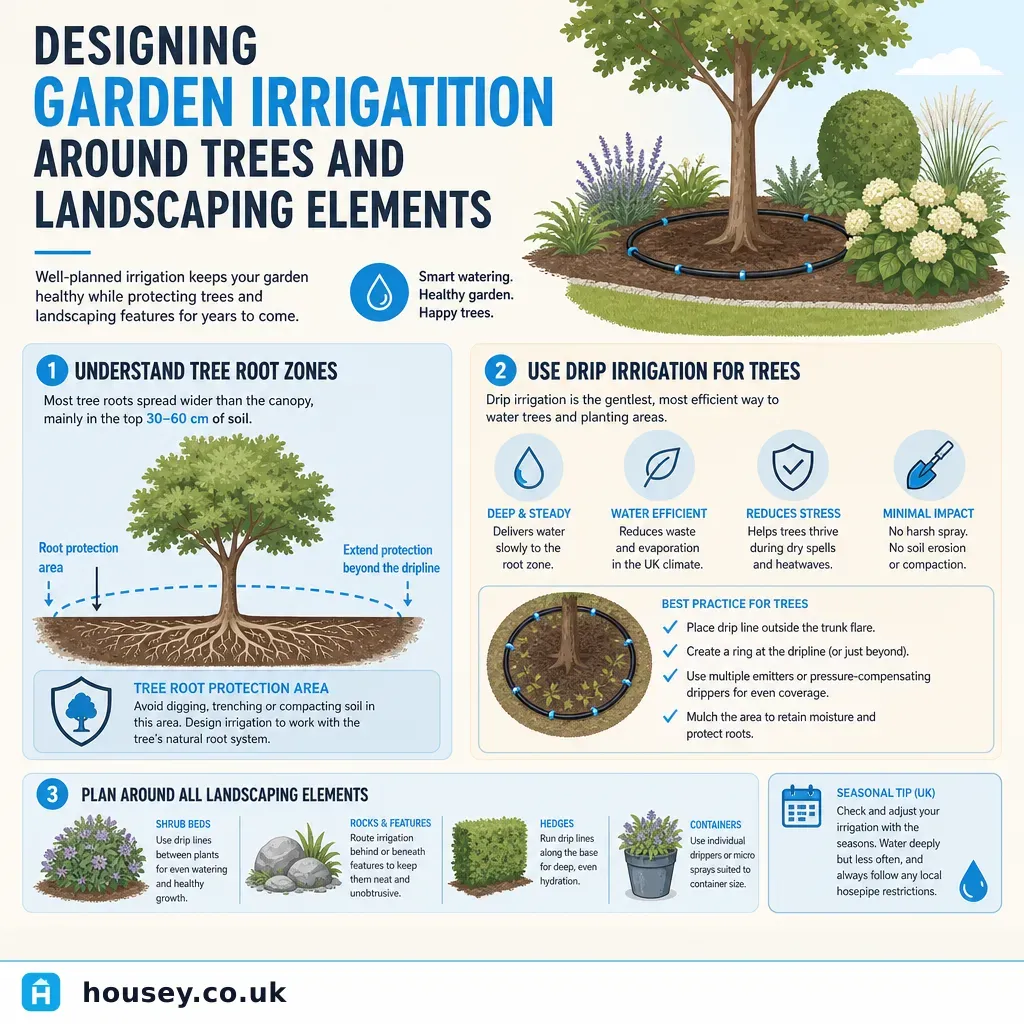
Designing Garden Irrigation Around Trees and Landscaping Elements
Design irrigation around trees by respecting the root protection area defined under BS 5837:2012, using drip or leaky pipe delivery rather than spray heads, and putting the tree zone on its own circuit.
 Improvement & Build
Garden Design Trends and Contemporary Landscaping Ideas
Contemporary UK garden design centres on low-maintenance naturalistic planting, multi-functional outdoor spaces, sustainable hard landscaping materials, and wildlife-friendly rewilded areas.
 Improvement & Build
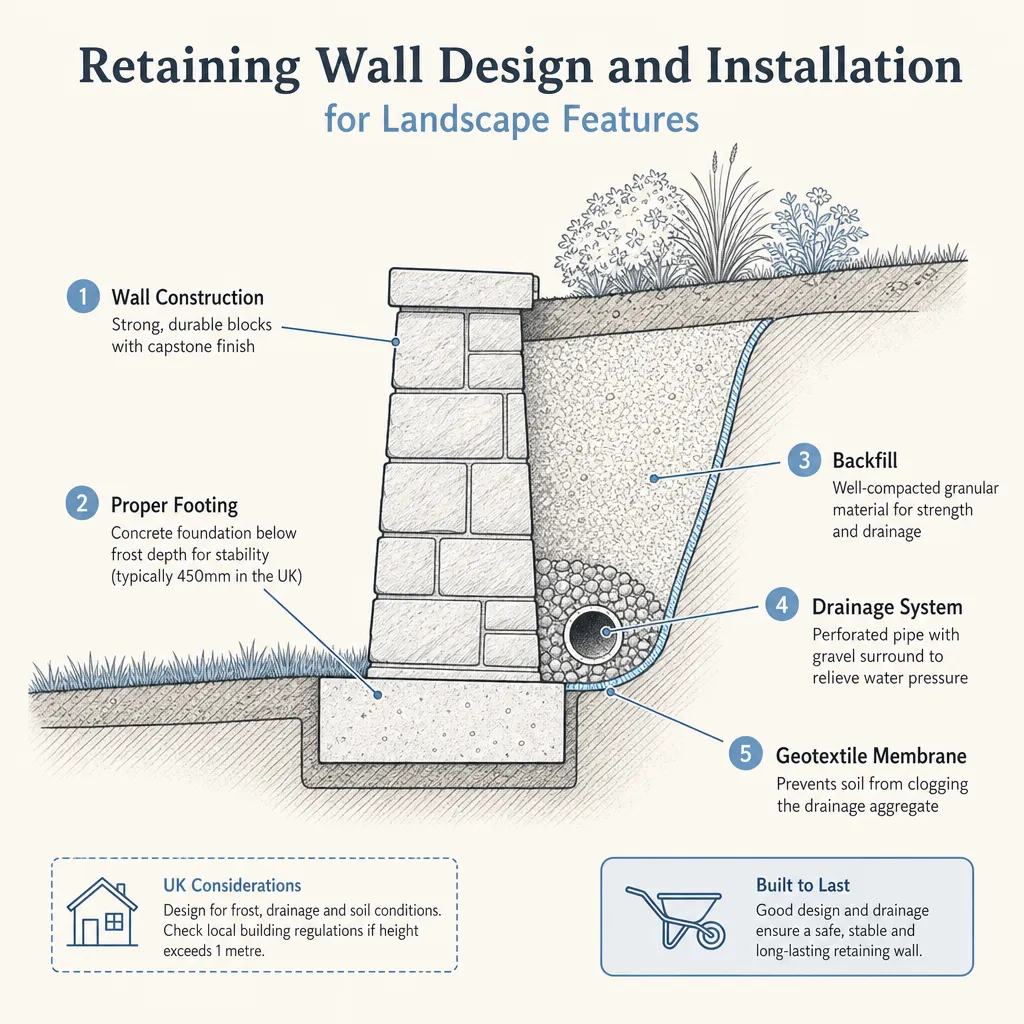
Retaining Wall Design and Installation for Landscape Features
A garden retaining wall holds back soil on a sloped plot using concrete blocks, stone, or timber.