Cold and Damp Walls: Diagnosing Condensation and Moisture Issues
By Housey · Last reviewed 11th of May 2026
Cold and Damp Walls: Diagnosing Condensation and Moisture Issues
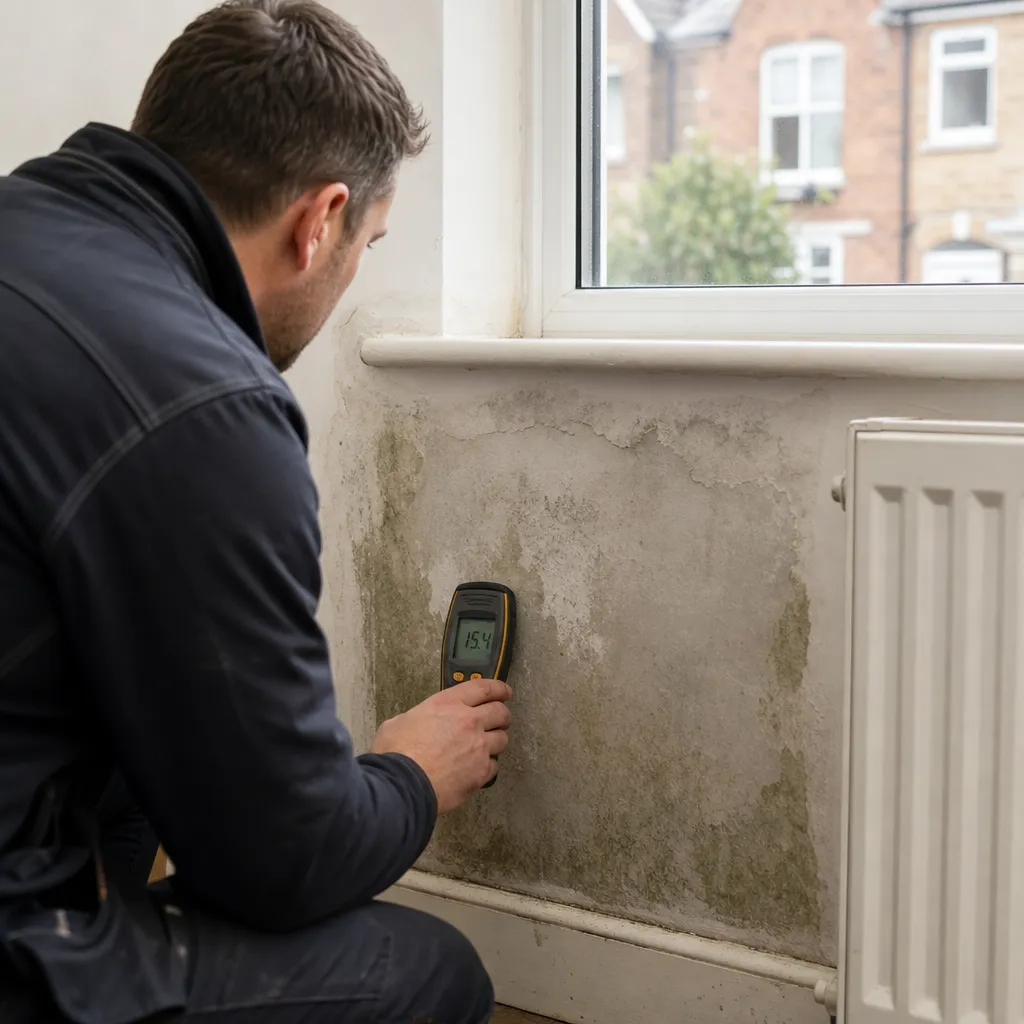
Cold, damp, or discoloured walls are among the most commonly reported defects in UK housing stock, from Georgian terraces to 1970s council builds. Whether you notice symptoms during a property purchase, after a cold spell, or when black spots appear near a window frame, identifying the correct moisture type determines whether the fix is as simple as improving ventilation or as involved as external remediation works. Getting the diagnosis wrong — or assuming one cause when another is responsible — leads to wasted money and problems that return within a season.
Key points
- Surface condensation forms when warm, humid indoor air meets a wall surface below its dew point temperature; this is the most common cause of mould near windows, in corners, and on north-facing walls.
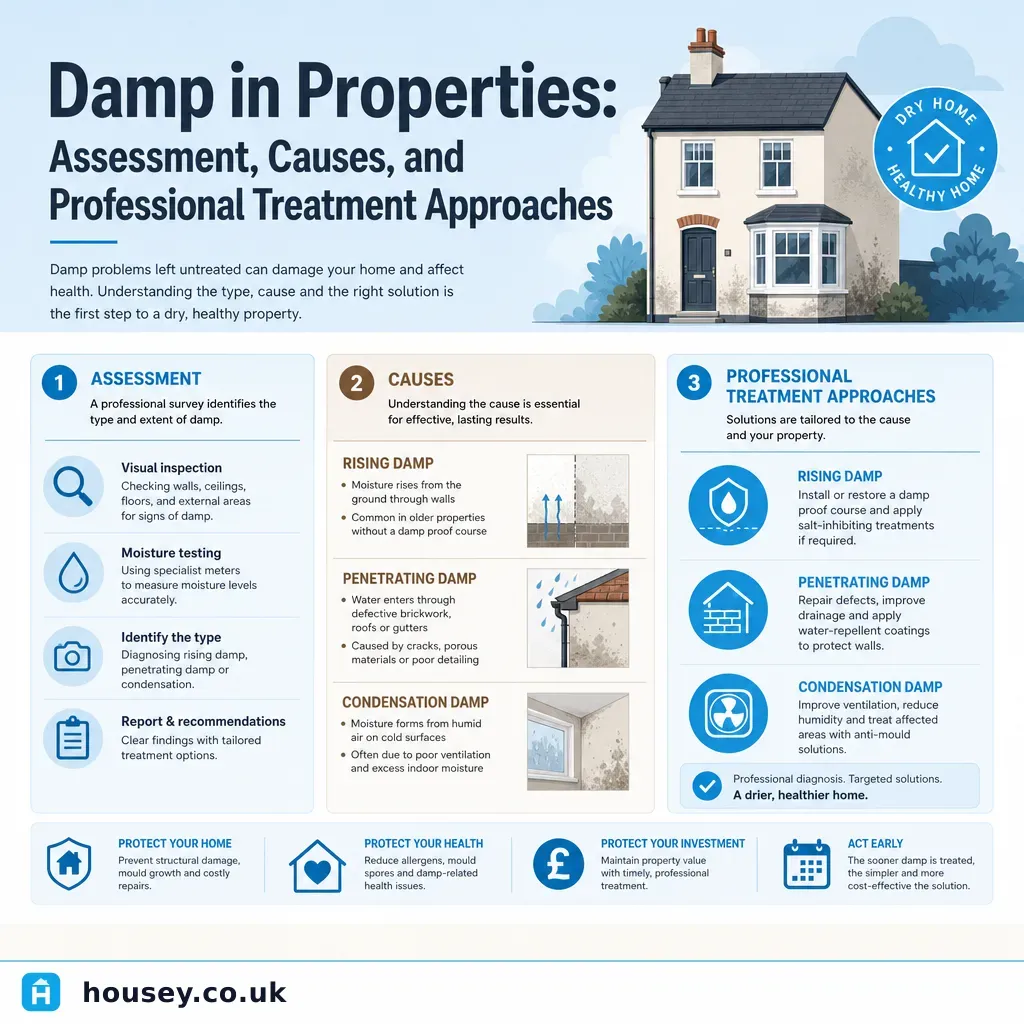
- The three main moisture types are surface condensation, penetrating damp (lateral rain ingress), and rising damp (ground moisture travelling upward through masonry); each has distinct causes, locations, and remedies.
- British Standard BS 5250:2021 provides guidance on controlling condensation in buildings and informs how surveyors and designers assess moisture risk.
- A RICS Level 3 Building Survey or specialist damp and timber survey is the appropriate route when cause is uncertain, damp is widespread, or a property transaction is at stake.
- Black mould (Cladosporium, Aspergillus niger) on wall surfaces is most commonly associated with condensation rather than penetrating or rising damp, and may have health implications for occupants with respiratory conditions.
What causes cold, damp walls?
Surface condensation and thermal bridging
Surface condensation occurs when the wall surface temperature drops below the dew point of the indoor air. It is most pronounced on:
- External wall corners where masonry is thinnest and heat loss is highest.
- Reveals around windows and doors — a detail where cavity insulation is often absent.
- Solid walls (typically pre-1920 construction) with no insulation, where the internal surface temperature tracks close to the outside temperature.
- North-facing rooms with lower solar gain and less natural drying.
Thermal bridging — points in the building envelope where heat escapes faster than through the surrounding fabric — creates localised cold spots invisible to the naked eye but detectable via a thermographic (infrared) survey. Building Regulations Approved Document C and Part L require designers to limit repeating and linear thermal bridges; older properties predate these requirements entirely.
Penetrating damp
Penetrating damp enters laterally through the external envelope. Common entry routes include:
- Defective pointing or spalling masonry on solid brick or stone walls.
- Failed cavity trays above lintels or at wall-to-roof junctions.
- Cracked or missing render on rendered external walls.
- Defective cavity wall ties that allow water to track across the cavity.
- Faulty window or door seals and poorly detailed flashings.
The pattern is typically isolated to areas near the defect, worsens in wet weather, and may leave tide marks or salt deposits (efflorescence) as water evaporates.
Rising damp
Rising damp is often misdiagnosed and over-diagnosed. Genuine rising damp occurs when groundwater is drawn upwards by capillary action in masonry where no damp-proof course (DPC) exists or where the DPC has failed. It is characterised by a tide mark up to approximately 1 m above floor level, salt contamination (hygroscopic salts) in the plaster, and concentration on lower sections of external walls rather than upper storeys.
Research by the Building Research Establishment (BRE) indicates a significant proportion of rising damp diagnoses are actually condensation or penetrating damp misidentified. A careful, independent survey is warranted before committing to chemical DPC injection.
Comparing the three moisture types
Feature | Surface condensation | Penetrating damp | Rising damp |
|---|---|---|---|
Typical location | Corners, reveals, cold surfaces | Near defects — lintel, window, wall face | Lower 1 m of external walls |
Worsens with | Cold weather, poor ventilation, high indoor humidity | Wet and windy weather | Persistent ground moisture, failed DPC |
Appearance | Black mould, streaming, grey patches | Staining, tide marks, localised patches | Tide mark, salt crystallisation, flaking plaster |
Season | Autumn/winter | Autumn/winter, heavy rain | Year-round |
Simple DIY check | Polythene tape test (moisture on room side) | Inspect pointing, flashings, render visually | Carbide or electronic moisture meter |
Professional tool | Thermal imaging, hygrometer, dew point calculation | Visual inspection plus moisture profiling | Carbide meter, salt analysis, borehole samples |
The polythene tape test
A low-tech first step: dry the wall surface, tape a 30 cm square of polythene firmly over the affected area with all edges sealed, and leave for 24–48 hours.
- Moisture on the room-side of the polythene → surface condensation (a humidity problem, not the wall itself).
- Moisture on the wall-side of the polythene → moisture coming through the wall, pointing to penetrating or rising damp.
This test gives a useful first indicator but is not a substitute for professional diagnosis, particularly where multiple mechanisms may overlap or where salt contamination is present.
What not to assume
- Black mould always means rising damp. It usually indicates condensation. Rising damp rarely appears above 1 m and does not typically produce surface mould growth.
- A newly plastered or painted wall is cured. If the underlying cause is not addressed, symptoms return within a cold season.
- All walls need chemical DPC injection. Chemical DPC is appropriate only for confirmed rising damp with no other explanation; it is frequently installed unnecessarily, at significant cost.
- Cold walls are purely an insulation problem. Cold surfaces can cause condensation even in reasonably insulated homes if ventilation is inadequate. Heat retention and moisture removal both need addressing.
- A single moisture meter reading is conclusive. Electrical resistance meters can give false-high readings in plaster with hygroscopic salt contamination. Carbide meters and salt testing provide more reliable evidence of active moisture.
Red flags: when to call a professional immediately
- Damp appears on internal walls with no obvious external source.
- Mould returns repeatedly after cleaning.
- Timber floor joists, skirting boards, or window frames show signs of rot or softness.
- Damp is present on upper-storey walls — this may indicate a roof or flashings defect rather than ground moisture.
- You are about to exchange on a property with visible damp and the survey carried out was only RICS Level 1 or Level 2.
- A child, elderly person, or someone with a respiratory condition lives in an affected room.
When to get professional help
If you cannot identify the source confidently using visual inspection and the polythene test, a specialist survey is the appropriate next step. This is especially important when you are buying a property and need independent confirmation before exchange, when multiple wall surfaces are affected with potentially overlapping causes, or when timber elements such as joists, lintels, or frames are close to damp areas.
A damp and timber survey carried out by a qualified surveyor will distinguish between moisture types, assess timber condition, and recommend targeted remediation rather than blanket treatment. Where thermal performance is also in question, a thermographic survey can map cold spots, thermal bridges, and insulation gaps across the whole envelope. If condensation is linked to inadequate ventilation, a ventilation and condensation assessment can measure air exchange rates and recommend appropriate mechanical or passive solutions.
How Housey can help
Housey connects UK homeowners with qualified surveyors and assessors who carry out damp and timber surveys, thermographic surveys, and ventilation and condensation assessments. Compare quotes from local professionals and get a clear, independent diagnosis before committing to any remediation works.
Frequently asked questions
Is condensation on walls a landlord's responsibility?
Under the Homes (Fitness for Human Habitation) Act 2018 and the Landlord and Tenant Act 1985, landlords must maintain properties in a habitable condition. Persistent mould from a structural cause may constitute an HHSRS hazard. Where condensation results primarily from tenant behaviour, liability is less clear-cut. Tenants should document the problem in writing; local Environmental Health departments can inspect and serve improvement notices where warranted.
How much does a damp survey cost in the UK?
A specialist damp and timber survey typically costs £150–£400 for a standard semi-detached or terraced property, depending on surveyor, location, and scope. Indicative UK costs, last reviewed 2026-05-11. Obtain at least two quotes and confirm the surveyor holds appropriate qualifications such as PCA membership or RICS accreditation.
Can I treat condensation mould myself?
Surface mould can be cleaned with a proprietary mould-treatment product, but this does not address the underlying cause. Without resolving excess humidity or cold surfaces, mould typically returns within a season. Improving ventilation — fitting trickle vents, adding extractor fans in kitchens and bathrooms, and maintaining background heating in cold rooms — reduces recurrence significantly.
What is interstitial condensation?
Interstitial condensation forms inside wall construction when warm humid air migrates through the fabric and reaches its dew point temperature within the structure, rather than on the internal surface. It is invisible from inside and can degrade insulation, timber, and masonry over time. It is assessed using hygrothermal modelling and is particularly relevant when retrofit insulation is being added to solid or non-standard walls.
Sources and further reading
- Approved Document C: Site preparation and resistance to moisture — GOV.UK
- Homes (Fitness for Human Habitation) Act 2018 — legislation.gov.uk
- Housing Health and Safety Rating System (HHSRS) guidance — GOV.UK
- BS 5250:2021 – Management of moisture in buildings — BSI
- BRE Good Repair Guides — Building Research Establishment
Useful next reads
 Surveys & Inspections
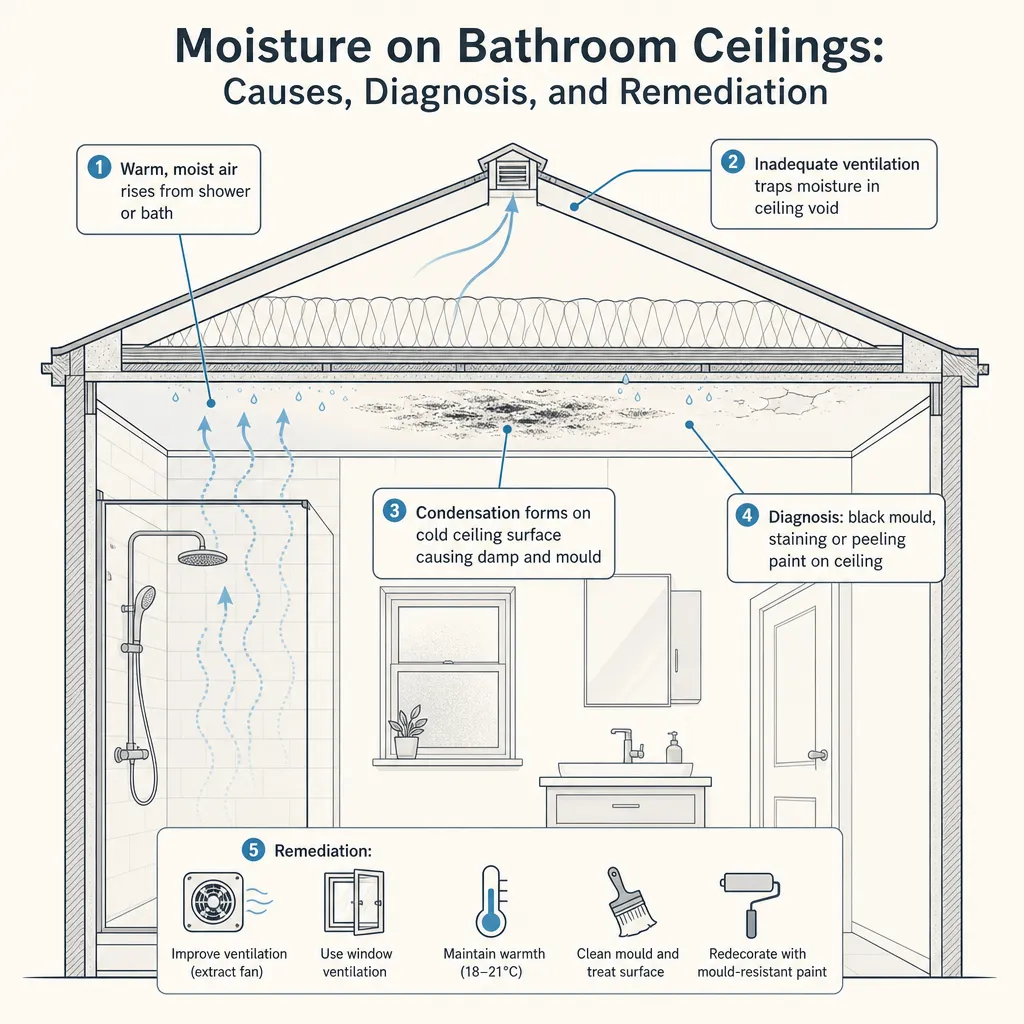
Moisture on Bathroom Ceilings: Causes, Diagnosis, and Remediation
Moisture on a bathroom ceiling is most often caused by condensation from poor ventilation, but can also indicate a leak from above or penetrating damp.
 Surveys & Inspections
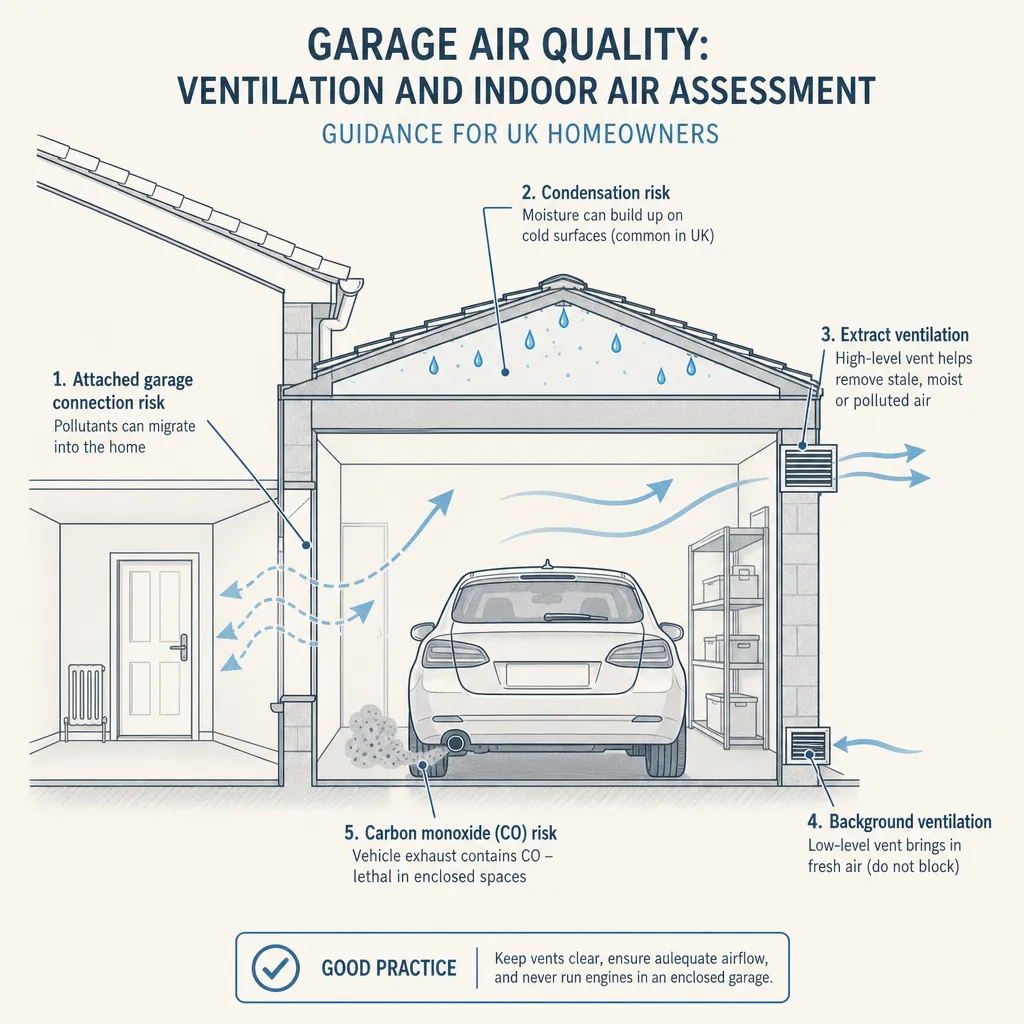
Garage Air Quality: Ventilation and Indoor Air Assessment
Poor garage ventilation can allow carbon monoxide from vehicles, VOC fumes from stored chemicals, and moisture to migrate into adjacent living spaces.
 Surveys & Inspections
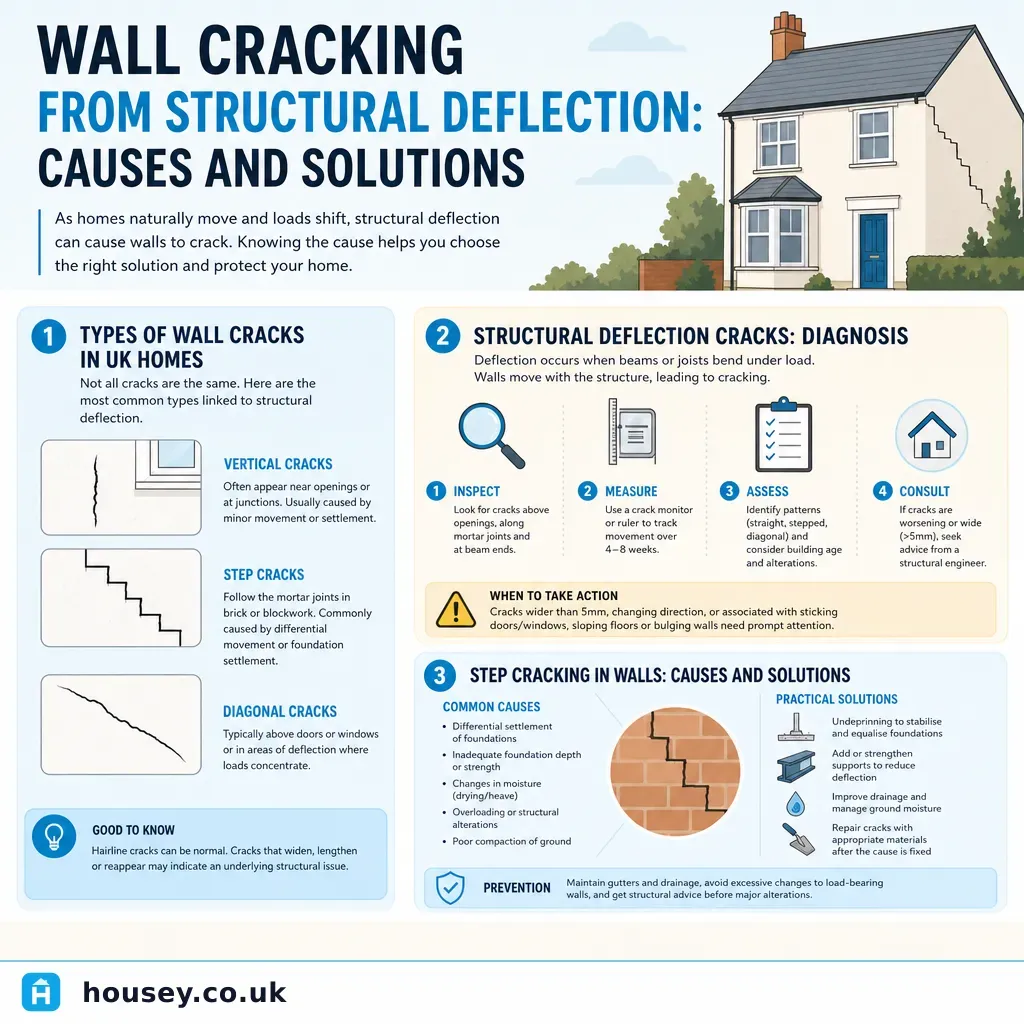
Wall Cracking from Structural Deflection: Causes and Solutions
Structural deflection occurs when a beam, floor, or lintel sags under load, transferring stress into surrounding masonry and causing characteristic cracks.
 Surveys & Inspections
Sagging Lintel Repair Costs and Structural Solutions
A sagging lintel is a structural defect requiring prompt professional assessment.
 Surveys & Inspections
Damp in Properties: Assessment, Causes, and Professional Treatment Approaches
Damp in UK homes falls into three main categories: rising damp, penetrating damp, and condensation.