Wall Cracking from Structural Deflection: Causes and Solutions
By Housey · Last reviewed 24th of May 2026
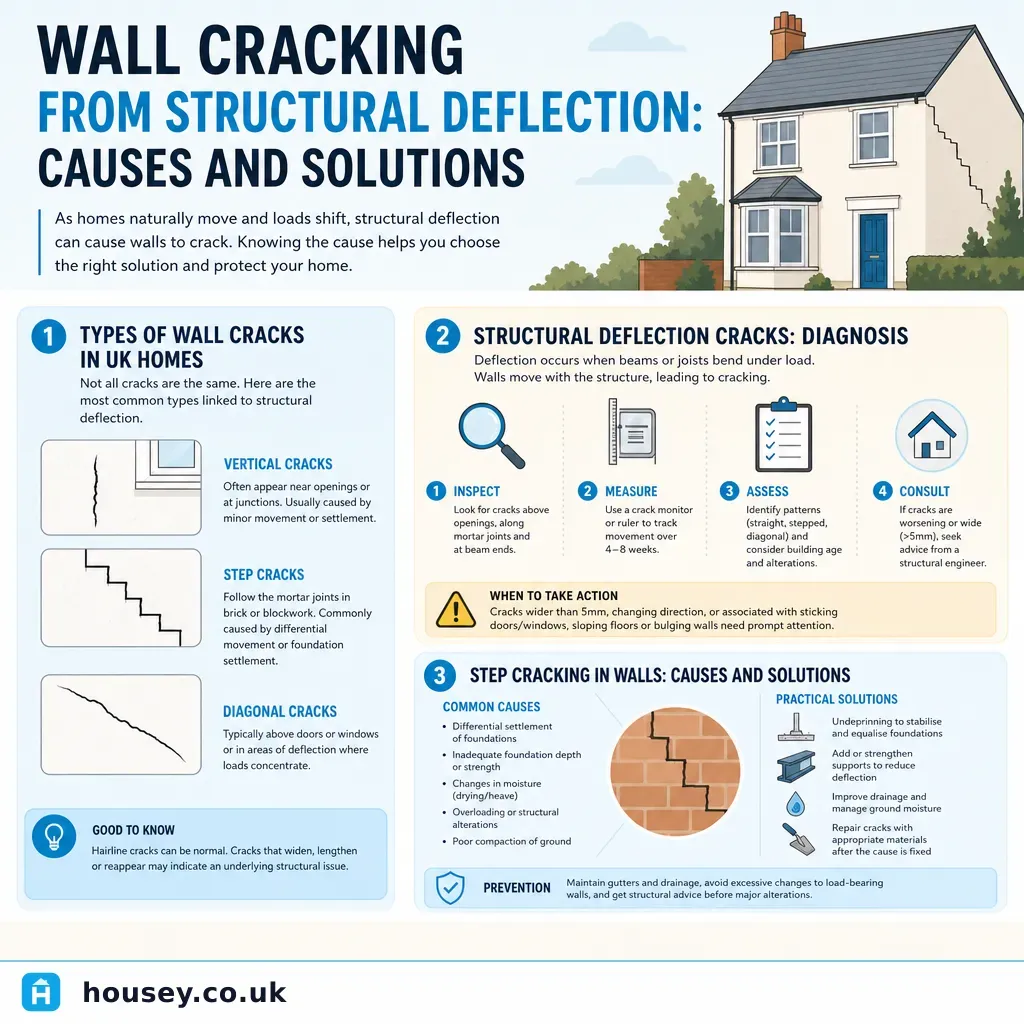
Wall Cracking from Structural Deflection: Causes and Solutions
Cracks in walls are one of the most common reasons UK homeowners contact surveyors — and one of the most frequently misunderstood. Most cracking is cosmetic, but a subset signals genuine structural movement that, left unaddressed, can worsen over time or affect property value and occupant safety. Understanding the difference between deflection-related cracking and minor thermal or shrinkage movement is the most important first step before deciding how to respond.
Key points
- Structural deflection occurs when a load-bearing element — beam, lintel, or floor joist — sags or bows under load, transferring stress into adjacent masonry and causing characteristic crack patterns at points of weakness.
- Step cracking following mortar joints in a diagonal or staircase pattern is a common indicator of differential settlement in brick or blockwork.
- Horizontal cracking in a cavity wall at regular vertical intervals may indicate wall-tie failure — a serious defect requiring specialist investigation in properties built between the 1920s and 1980s.
- RICS categorises crack severity from Category 0 (hairline, less than 0.1 mm) to Category 5 (very severe, greater than 25 mm); categories 3 and above warrant structural engineering input.
- Building Regulations Approved Document A (Structure) governs structural requirements; any remedial work affecting load-bearing elements requires building control sign-off.
What causes structural deflection in UK homes
Structural deflection describes the bending or sagging of a structural element under applied load. In residential buildings, the most common sources are:
Lintel failure or overloading. Steel or concrete lintels above windows and doors can corrode, crack, or deflect if undersized. The result is often a V-shaped crack above the opening, widening at the top.
Floor joist or beam sagging. In Victorian and Edwardian terraces — which make up a large proportion of England's housing stock — timber floor joists can deflect due to decay, notching, or overspan. The walls they bear on can crack at the junction.
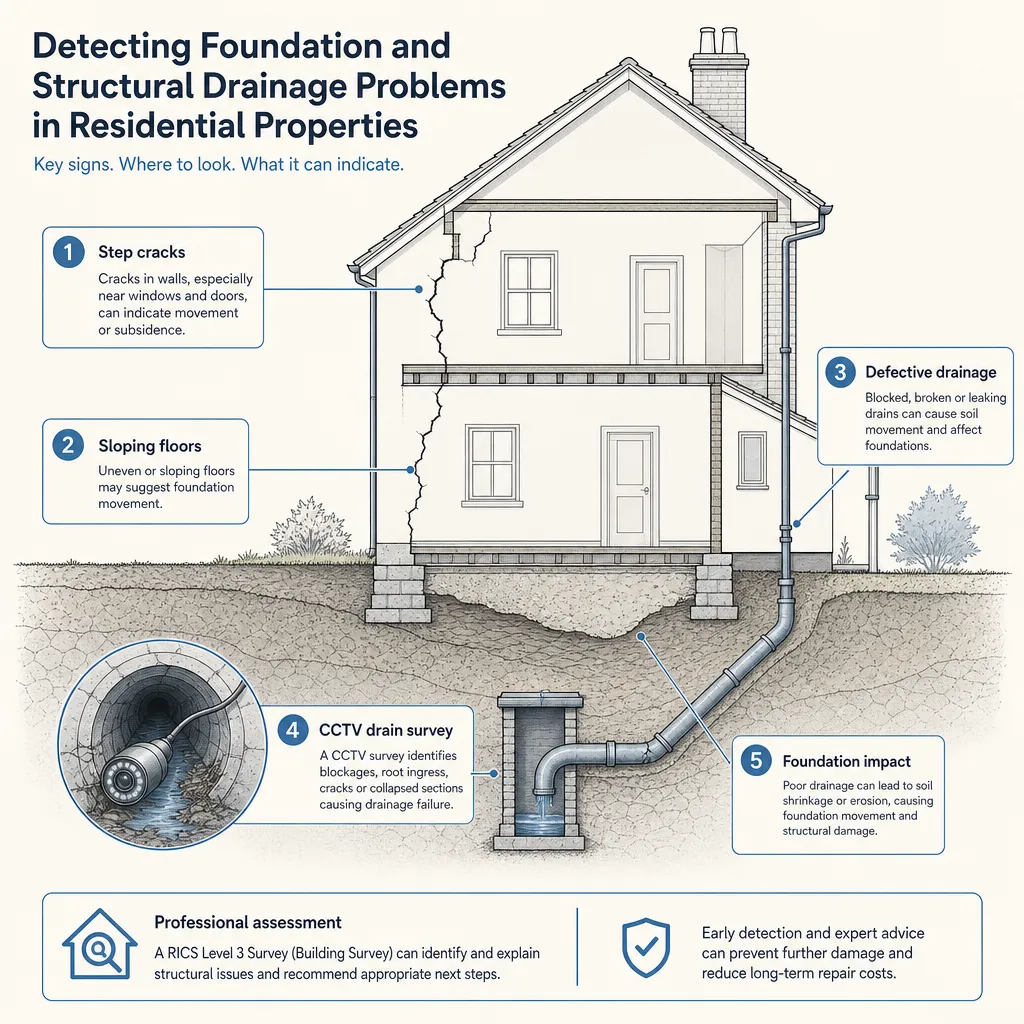
Differential settlement. When one part of a property's foundation settles more than another — due to clay shrinkage, tree root activity, leaking drains, or variable ground conditions — the structure distorts and cracks appear at the weakest points, typically corners, openings, and junction walls.
Wall-tie failure. In cavity wall construction (common from the 1920s onwards), metal ties connecting the inner and outer leaves can corrode and expand, causing horizontal cracking along the bed joints of the outer leaf at regular vertical intervals — typically every 450 mm or 600 mm, matching standard tie spacings.
Thermal movement. Large expanses of masonry or concrete expand and contract with temperature changes. This is usually managed by movement joints in new construction but can cause cracking in older buildings where no provision was made.
Understanding which mechanism is at play matters because the remedial strategy — and the specialist required — differs in each case.
Reading crack patterns: types and severity
Not all cracks indicate structural deflection. The pattern, width, location, and direction of a crack all carry diagnostic information.
Crack type | Typical appearance | Likely cause | Severity indicator |
|---|---|---|---|
Hairline shrinkage cracks | Fine, random, on plaster surface only | Drying shrinkage of new plaster or render | Usually cosmetic (Category 0–1) |
Diagonal step cracking | Staircase pattern through mortar joints | Differential settlement | Moderate to serious depending on width and whether progressing |
V-shaped cracks above openings | Wider at top, narrowing at base | Lintel deflection or failure | Serious if widening; needs professional review |
Horizontal cracking in outer leaf | Regular horizontal lines, outer brick only | Wall-tie failure or corrosion | Serious; requires specialist wall-tie survey |
Vertical cracks at returns | Straight vertical at corners | Differential movement, thermal, or settlement | Depends on width and continuity |
Horizontal cracks with bulging | Horizontal cracking plus outward lean | Lateral earth pressure or retained soil | Very serious; seek urgent structural advice |
The RICS Building Survey Level 3 report uses a 0–5 crack severity classification. Categories 0 and 1 are cosmetic. Category 2 (cracks up to 5 mm) may need monitoring or minor repair. Categories 3–5 (greater than 5 mm, widening, or affecting structural integrity) require structural engineering input.
Which professional do you need?
Situation | Recommended professional | What they provide |
|---|---|---|
Buying a property with visible cracks | RICS Level 3 surveyor | Full structural assessment, crack categorisation, advice on remediation |
Cracks appearing in a property you own | RICS Level 3 surveyor or structural engineer | Cause diagnosis, monitoring recommendation, repair specification |
Suspected wall-tie failure | Specialist wall-tie contractor (accredited) | Borescope inspection, tie count, remediation specification |
Suspected foundation movement | Chartered structural engineer | Ground investigation, structural analysis, underpinning design if needed |
Crack appearing rapidly or with structural distortion | Chartered structural engineer (urgent) | Emergency assessment, safety recommendation |
Decision tree: do I need a structural assessment?
- Choose monitoring alone if cracks are hairline (less than 0.1 mm), random, on plaster surface only, with no associated movement of frames or openings.
- Arrange a specific defect survey if cracks are greater than 1 mm, diagonal or step-patterned, located above openings, or appeared recently and you are unsure of the cause.
- Commission a RICS structural survey if you are buying a property with visible cracking or if you own a property where cracking is worsening over time.
- Contact a chartered structural engineer if cracks are wider than 5 mm, are progressing rapidly, or are accompanied by bulging, leaning, or sticking doors and windows.
- Seek urgent professional advice if a wall is visibly leaning or bowing, or if cracks appeared suddenly following an impact, flood, or nearby excavation.
Red flags that need urgent attention
The following signs indicate that immediate professional assessment is needed — do not delay to monitor:
- Cracks that have visibly widened over a period of weeks or months.
- Cracks accompanied by sticking or dropped door and window frames.
- A visible lean or bow in an external wall.
- Horizontal cracking at regular intervals in the outer leaf of a cavity wall.
- Cracks appearing after nearby excavation, construction, or large tree removal.
- Any cracking in a property built on clay soil following an unusually dry summer.
- Cracking accompanied by a sloping floor or ceiling.
What remedial options exist
Remedial approaches vary considerably by cause and should always be specified by a competent professional. Common approaches include:
Stitching and repointing. For minor step cracking caused by past, stabilised settlement, cracks are raked out and repointed with appropriate mortar. Stainless-steel helical bar stitching across the crack adds tensile reinforcement where needed.
Wall-tie replacement. Corroded ties are replaced with new stainless-steel ties drilled through the outer leaf and chemically anchored into the inner leaf. The outer leaf may need partial rebuilding in severe cases.
Lintel replacement. A defective or undersized lintel is replaced with a correctly specified structural lintel. This requires temporary propping, building control approval, and skilled contractors.
Underpinning. Where foundation movement is the cause, traditional mass concrete underpinning or more modern resin injection systems may be used. This is a significant structural intervention requiring a structural engineer's design and building control approval under Approved Document A.
Important limitations
This article provides general information to help UK homeowners understand wall cracking and structural deflection. It does not constitute structural or engineering advice. Crack severity, cause, and appropriate remediation depend on the specific property, its construction history, ground conditions, and many other factors that can only be assessed by a qualified professional inspecting the building in person. Do not rely on this guide alone to make decisions about structural safety, property purchase, or remediation.
When this becomes urgent
Stop monitoring and seek professional help immediately if:
- A crack has appeared suddenly, widened rapidly, or is accompanied by visible structural distortion.
- Doors or windows have dropped, jammed, or are no longer square in their frames.
- An external wall appears to be leaning or bowing outward.
- You hear cracking or creaking sounds from the structure at rest.
- You are approaching exchange of contracts on a property with visible cracking and have not yet commissioned a Level 3 survey.
What to ask a qualified professional
Before instructing a surveyor or structural engineer, ask:
- What type of survey or assessment are you carrying out, and what will it cover?
- Are you RICS-accredited, and at what level will the survey be carried out?
- Will you categorise cracks using the RICS 0–5 scale and explain the implications of each category?
- If further structural engineering input is needed, will your report make that recommendation clearly?
- What monitoring period, if any, do you recommend before remediation?
- Will your report be suitable for sharing with a mortgage lender or insurer?
- What is excluded from the survey scope?
When to get professional help
Cracks wider than around 1–2 mm, or any crack that has appeared recently and is in an unexpected location, warrant professional assessment rather than DIY monitoring alone. If you are buying a property, a RICS Level 3 Building Survey is the appropriate starting point. If you already own the property and are concerned about progression, a specific defect survey focused on the crack and its structural context is often the most cost-effective first step. Do not attempt to remediate structural cracking without professional diagnosis — masking symptoms without addressing the cause will result in recurrence.
How Housey can help
Housey connects UK homeowners with accredited surveyors and structural specialists. Whether you need a RICS structural survey to understand movement in a property you are buying, or a specific defect survey focused on a particular crack or area of concern, you can compare quotes from qualified local professionals and get the information you need to make a confident decision.
Frequently asked questions
Are cracks in walls always a sign of structural problems?
No. Most wall cracks in UK homes are cosmetic — caused by plaster shrinkage, thermal movement, or minor settlement that has long since stabilised. The key indicators of structural concern are crack width greater than 2 mm, a diagonal or step pattern through brickwork, progressive widening over time, and associated movement of door or window frames.
How much does a structural survey cost in the UK?
Indicative UK costs, last reviewed 2026-05-24. A RICS Level 3 Building Survey typically costs £500–£1,500 depending on property size, type, and location. A specific defect survey or structural engineer's inspection may cost £300–£700. Always obtain itemised quotes and confirm exactly what the survey scope includes before instructing.
Can I just fill in a crack and redecorate?
For hairline cracks in plaster (Category 0–1), cosmetic repair is usually acceptable. For any crack wider than 2 mm, or one with a structural cause, filling without addressing the underlying problem means the crack will recur. A structural crack should be professionally assessed before any repair is attempted, to avoid masking a worsening defect.
What is a wall-tie survey and when do I need one?
A wall-tie survey uses borescope inspection and sometimes an electromagnetic scan to assess the condition of metal ties connecting the inner and outer leaves of a cavity wall. It is recommended when horizontal cracking appears at regular intervals in the outer brick leaf, particularly in properties built between the 1920s and 1980s where mild-steel ties may have corroded.
Sources and further reading
- RICS Building Survey Guidance — RICS
- Approved Document A: Structure — GOV.UK
- Technical Advice on Historic Buildings — Historic England
- NHBC Standards — NHBC
Useful next reads
 Surveys & Inspections
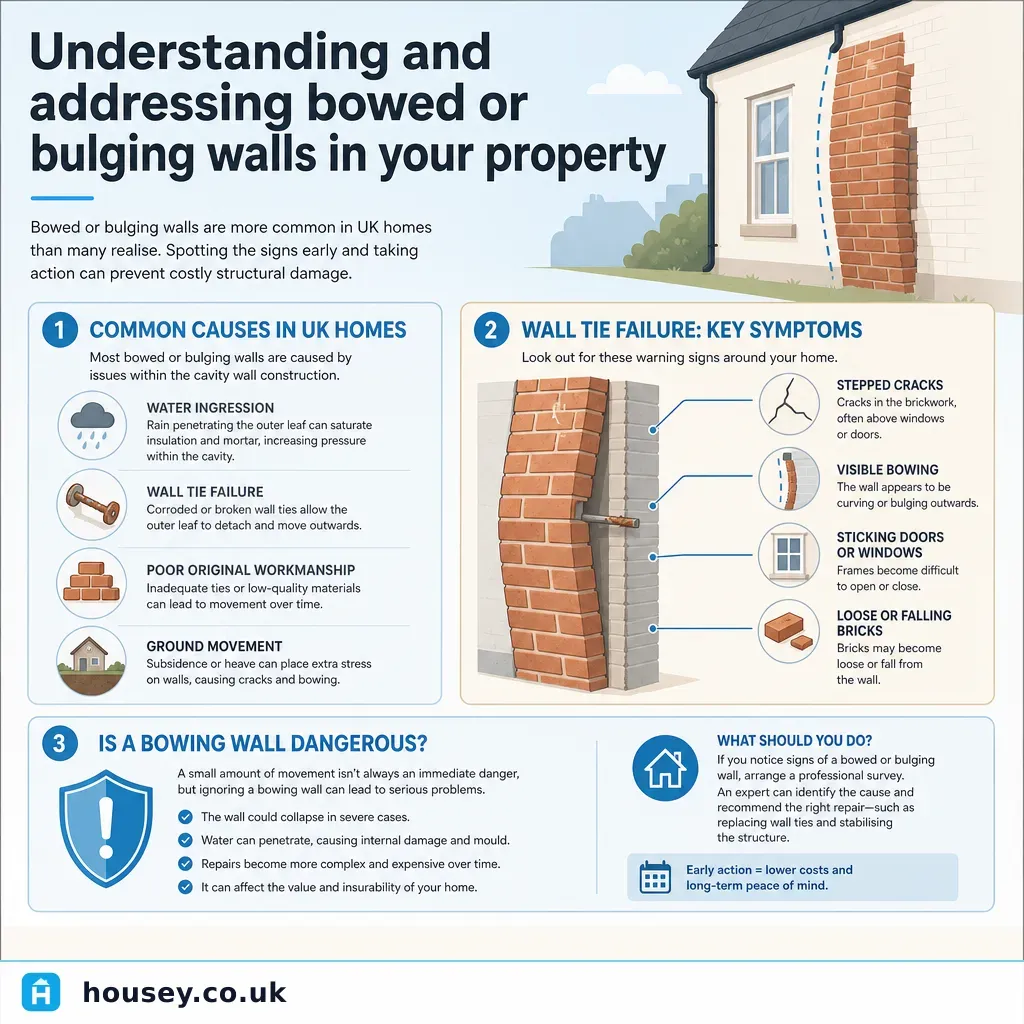
Understanding and addressing bowed or bulging walls in your property
A bowed or bulging wall may indicate wall tie failure, foundation movement, or overloading.
 Surveys & Inspections
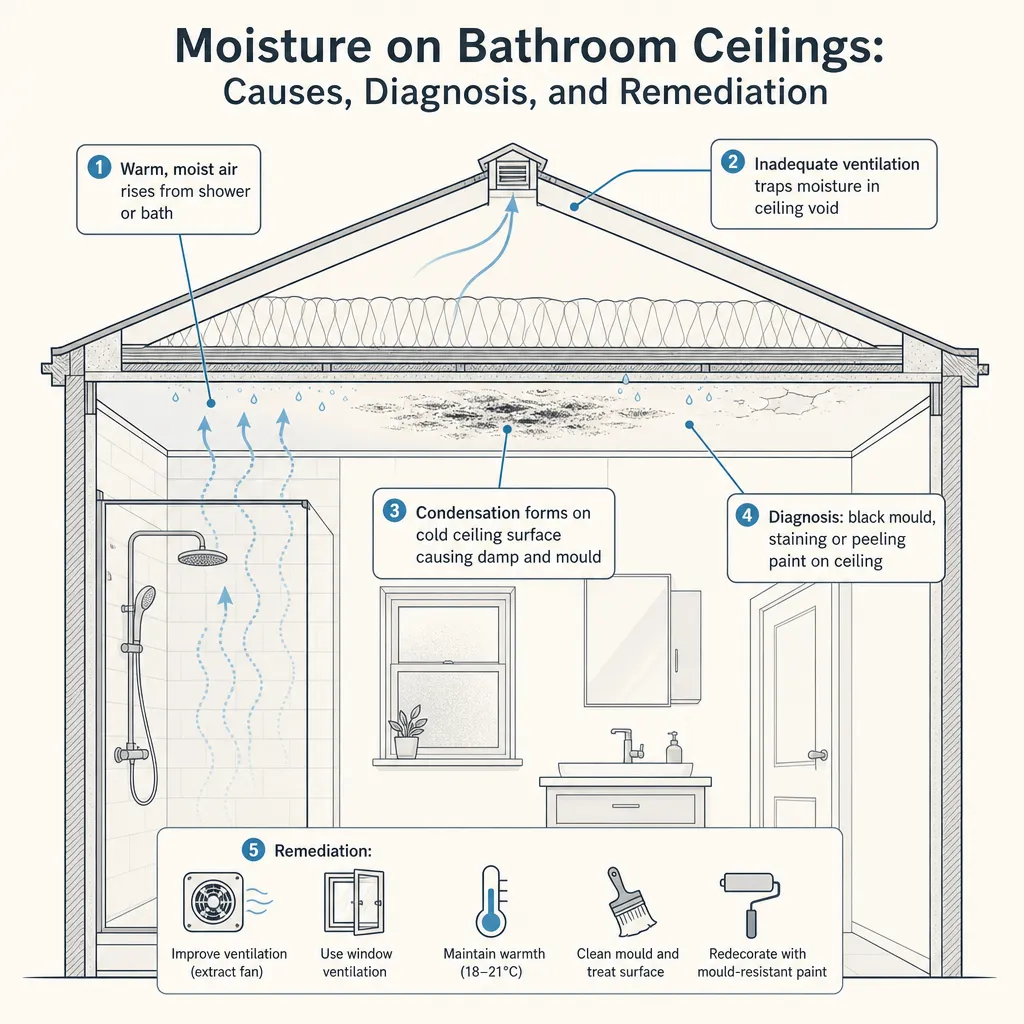
Moisture on Bathroom Ceilings: Causes, Diagnosis, and Remediation
Moisture on a bathroom ceiling is most often caused by condensation from poor ventilation, but can also indicate a leak from above or penetrating damp.
 Surveys & Inspections
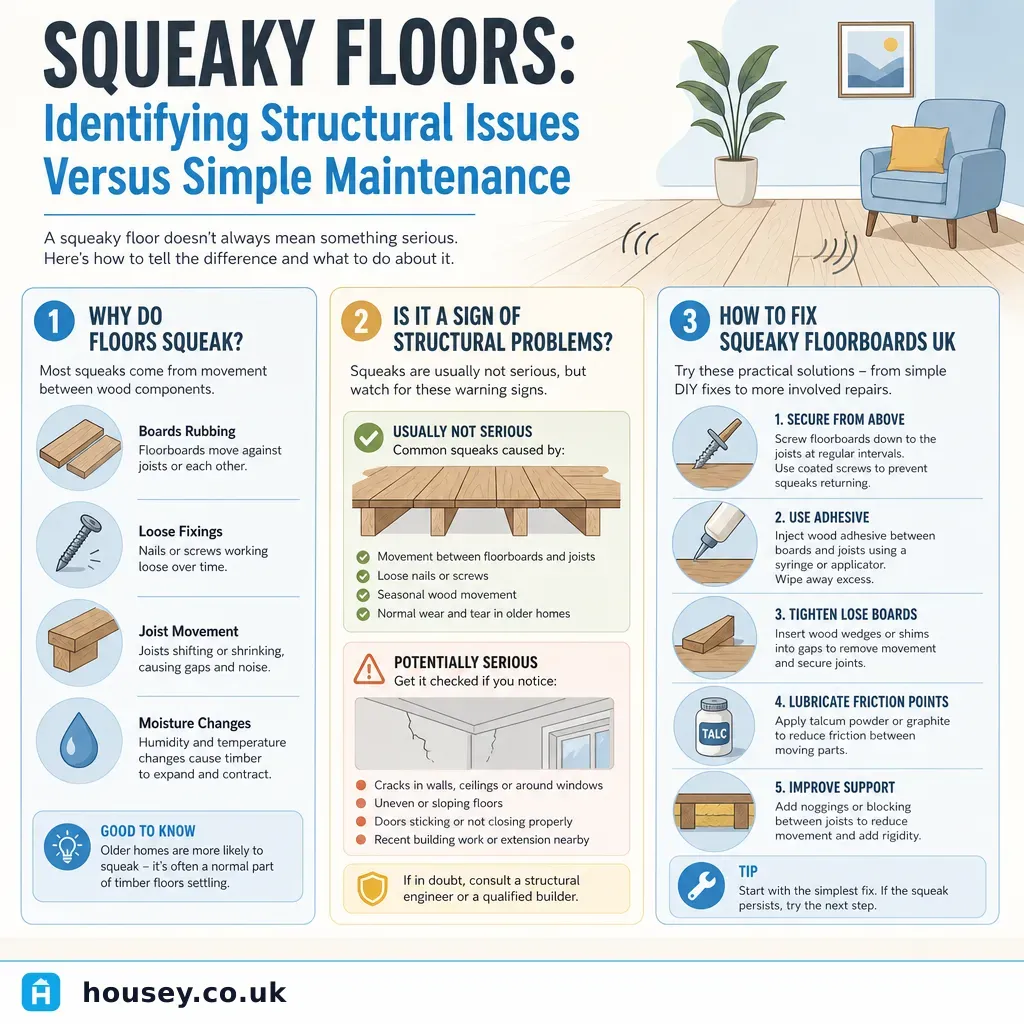
Squeaky Floors: Identifying Structural Issues Versus Simple Maintenance
Most squeaky floors in UK homes are caused by floorboards rubbing against each other or against fixings as they expand and contract — a maintenance issue rather than a structural one.
 Surveys & Inspections
Identifying Unpleasant Odours in Your Home
Unpleasant smells in a UK home often point to damp, mould, a drainage fault, or — in the most urgent cases — a gas leak.
 Surveys & Inspections
Detecting Foundation and Structural Drainage Problems in Residential Properties
Foundation and drainage problems in UK homes often appear as stepped cracks in brickwork, sticking doors, or slow-draining fixtures.