Damp in Properties: Assessment, Causes, and Professional Treatment Approaches
By Housey · Last reviewed 19th of May 2026
Damp in Properties: Assessment, Causes, and Professional Treatment Approaches
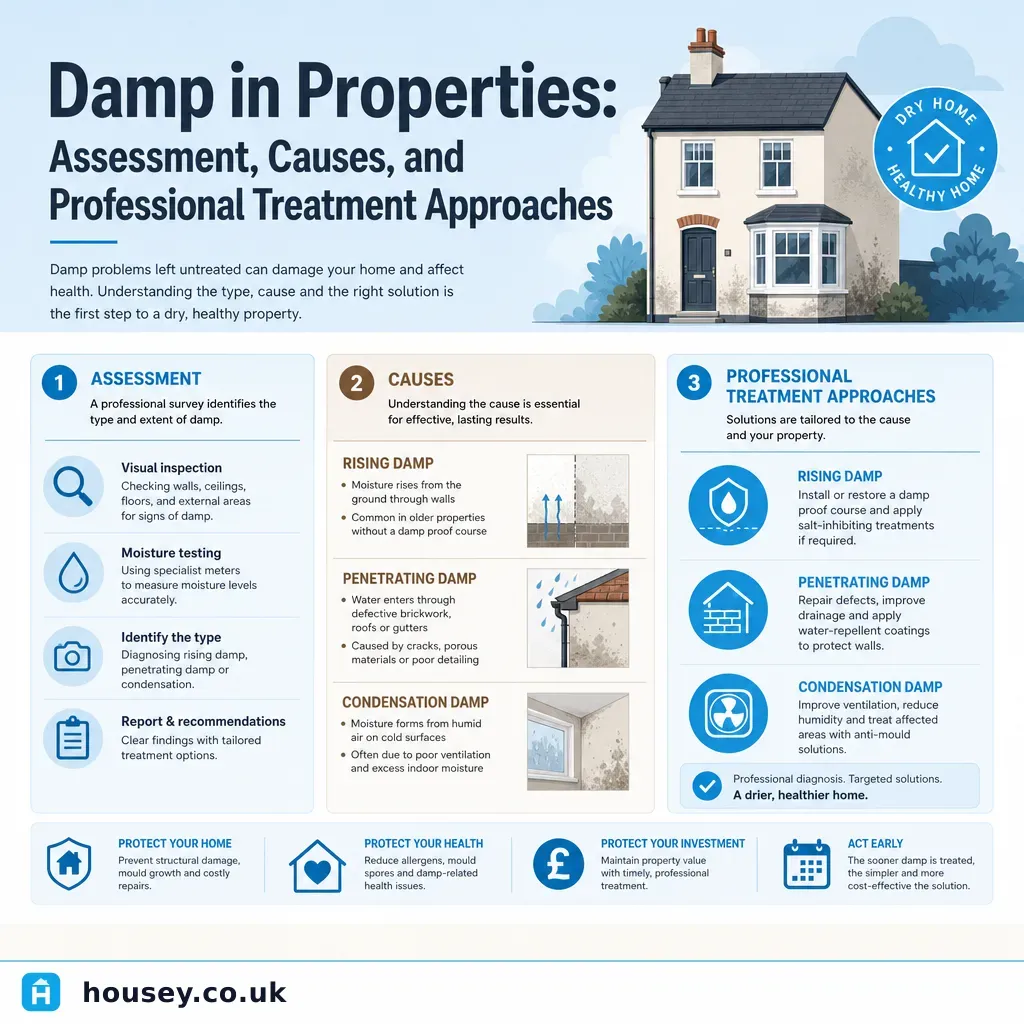
Damp is one of the most frequently flagged issues in UK home surveys, appearing across all property eras from Victorian terraces to modern new-builds. Whether you have spotted a tide mark on a wall, noticed a persistent musty odour, or seen it mentioned in a surveyor's report, understanding the type of damp present is the essential first step — because different causes require fundamentally different remedies, and applying the wrong treatment wastes money without resolving the problem.
Key points
- There are three principal types of damp in UK homes: rising damp, penetrating damp, and condensation — each has a different cause, evidence pattern, and treatment approach.
- A professional damp and timber survey by a specialist holding CSRT or CSSW credentials from the Property Care Association (PCA) will distinguish true rising damp from condensation, which is frequently misdiagnosed.
- Rising damp travels at most approximately 1 metre above floor level — tide marks higher than this almost always indicate penetrating damp or condensation-related moisture, not capillary rise.
- Building Regulations Approved Document C sets out the requirements for resistance to moisture in new and converted buildings in England and Wales.
- Guaranteed damp-proofing works from PCA-registered contractors typically carry a 20-year guarantee backed by the PCA guarantee scheme.
What type of damp is it?
Accurate diagnosis is critical. Many damp treatment programmes have failed — sometimes at considerable cost — because the wrong type of damp was identified at the outset. The three main categories behave differently and respond to different interventions.
Type | Where it typically appears | Key evidence | Common in |
|---|---|---|---|
Rising damp | Ground-floor walls near floor level | Tide mark at 0.5–1 m height, salt efflorescence, failed or absent damp-proof course | Older pre-1920s properties without a functioning damp-proof course |
Penetrating damp | Any external wall, roof junction, or window reveal | Damp patch that follows rain, localised staining, wet to the touch | Properties of any age with roof, pointing, window, or drainage defects |
Condensation | Cold surfaces — corners, behind furniture, north-facing walls | Black mould patches, water droplets, mould on soft furnishings | All property types; the most common form of damp in UK homes |
A professional damp and timber survey uses a combination of visual inspection, moisture meters, and — where rising damp is genuinely suspected — carbide testing to measure actual moisture content in wall materials rather than surface moisture alone.
How damp assessments work
A damp survey carried out by a qualified specialist typically involves the following stages:
- Initial visual inspection — identifying tide marks, mould, staining, efflorescence, damaged plaster, and failed pointing.
- Moisture meter readings — surface resistance meters give a relative reading; a trained surveyor interprets these alongside wall construction type and conditions on the day.
- Carbide (calcium carbide) testing — a more accurate test used when rising damp is genuinely suspected, measuring actual moisture content in wall materials.
- Timber assessment — damp conditions frequently lead to wet rot or dry rot in adjacent timbers; a combined damp and timber survey checks floor joists, window frames, and skirting boards.
- Written report with recommendations — a good report distinguishes diagnosis from treatment recommendation and should not default to chemical injection as the answer to all moisture readings.
Look for surveyors who hold the Certificate of Surveying Practice (CSRT) or Certificate in Remedial Treatment (CSSW), both awarded by the Property Care Association.
What not to assume about damp
Common misunderstandings lead homeowners to spend money on the wrong treatment.
- Do not assume all damp is rising damp. Rising damp is considerably less common than condensation or penetrating damp, yet chemical damp-proof course injection is frequently sold as the universal solution. An independent survey before agreeing to any treatment is strongly advisable.
- Do not assume a bridged DPC requires chemical injection. In some cases, clearing soil, render, or external paving that bridges the existing damp-proof course resolves the problem without invasive treatment.
- Do not assume new plaster will cure damp. Replastering with a salt-resistant render may form part of a treatment programme but will not address the underlying moisture source.
- Do not assume modern buildings are immune. New-builds can suffer from defective cavity trays, failed window seals, or condensation resulting from airtight construction without adequate mechanical ventilation.
Treatment options by damp type
Rising damp
Where genuine damp-proof course failure is confirmed by assessment, treatment options include:
- Chemical DPC injection — a water-repellent cream or liquid injected into mortar courses; effective when correctly diagnosed and installed by a PCA-registered contractor.
- Physical DPC replacement or bridging removal — removing soil, render, or paving that bridges an existing DPC.
- Electro-osmotic systems — less common; sometimes used in listed buildings or where injection is impractical.
All works should be carried out by a PCA-registered contractor to qualify for guarantee scheme backing.
Penetrating damp
Treatment targets the source defect, not the internal wall:
- Repair or repoint failed mortar joints.
- Replace damaged roof tiles, flashing, or valley lead.
- Re-seal around windows and doors.
- Clear, repair, or realign gutters, downpipes, and drainage.
- Install or repair cavity trays above openings.
Condensation
Condensation is primarily managed through a combination of:
- Improved ventilation — trickle vents, background vents, mechanical extract ventilation (MEV), or mechanical ventilation with heat recovery (MVHR) for more airtight properties.
- Consistent background heating — maintaining a minimum temperature in less-used rooms reduces cold-bridge condensation on surfaces.
- Insulation improvements — reducing cold-bridge temperature differences limits condensation-prone surface areas.
- Reducing moisture generation — using pan lids when cooking, drying clothes outdoors where possible, and promptly extracting moisture from bathrooms and kitchens.
Red flags that need urgent professional attention
The following signs suggest damp may have progressed to a point where professional assessment should not be delayed:
- Dry rot — fruiting bodies (bracket shapes on walls or timber), cracked cuboidal timber decay, or a strong mushroom-like smell.
- Wet rot in structural timbers — soft, discoloured, or crumbling floor joists, lintels, or roof timbers adjacent to damp areas.
- Crumbling masonry or spalling brickwork — suggests long-term moisture saturation of the wall material.
- Rising damp apparent above 1 metre — indicates a moisture source beyond capillary rise, requiring further investigation.
- Persistent mould despite ventilation improvements — warrants investigation of a penetrating moisture source behind finishes.
When to get professional help
If you are buying a property and damp is flagged in a RICS survey or visible during viewings, commission an independent damp and timber survey before exchange of contracts. If you already own the property, seek professional assessment before agreeing to any treatment programme.
Do not proceed with invasive works — chemical injection, re-plastering, or timber treatment — based solely on a free survey from a damp-proofing contractor. There is an inherent conflict of interest in that arrangement. An independent paid assessment provides an objective diagnosis before any treatment decision is made.
How Housey can help
Housey connects homeowners with qualified, vetted specialists for damp and timber surveys and damp proofing works. Submit your requirements, compare quotes from local professionals, and review credentials before instructing anyone.
Frequently asked questions
How much does a damp survey cost in the UK?
An independent damp and timber survey typically costs between £150 and £400 for a standard residential property, depending on size, location, and assessment depth. Indicative UK costs, last reviewed 2026-05-19. Always commission a survey from an independent specialist rather than relying on a free survey offered by a damp-treatment contractor, where a conflict of interest exists.
Can I treat damp myself?
Minor condensation issues can be managed with improved ventilation and consistent background heating. However, diagnosing and treating rising damp or penetrating damp without professional assessment risks applying the wrong treatment. PCA-backed guarantees on chemical damp-proof course injection are only valid when the works are carried out by a registered contractor.
Does damp affect a property's value?
Significant untreated damp — particularly where it has caused timber damage — is likely to be flagged in surveys and may affect mortgage valuations and buyer offers. Treated damp with documented guarantees from a PCA-registered contractor is generally viewed more favourably by buyers and lenders.
Is rising damp covered by home insurance?
Most standard UK home insurance policies exclude damp damage caused by gradual deterioration or lack of maintenance. Sudden and unforeseen water ingress — for example, from a burst pipe or storm damage — may be covered. Check your policy wording carefully, and consult your insurer before making a claim.
Sources and further reading
- Building Regulations Approved Document C: Site preparation and resistance to moisture — GOV.UK
- Property Care Association — Professional body for damp-proofing and remedial treatment specialists
- RICS Building Surveying Professional Standards — Royal Institution of Chartered Surveyors
- Energy Saving Trust: ventilation advice — Guidance on reducing condensation through improved ventilation
Useful next reads
 Surveys & Inspections
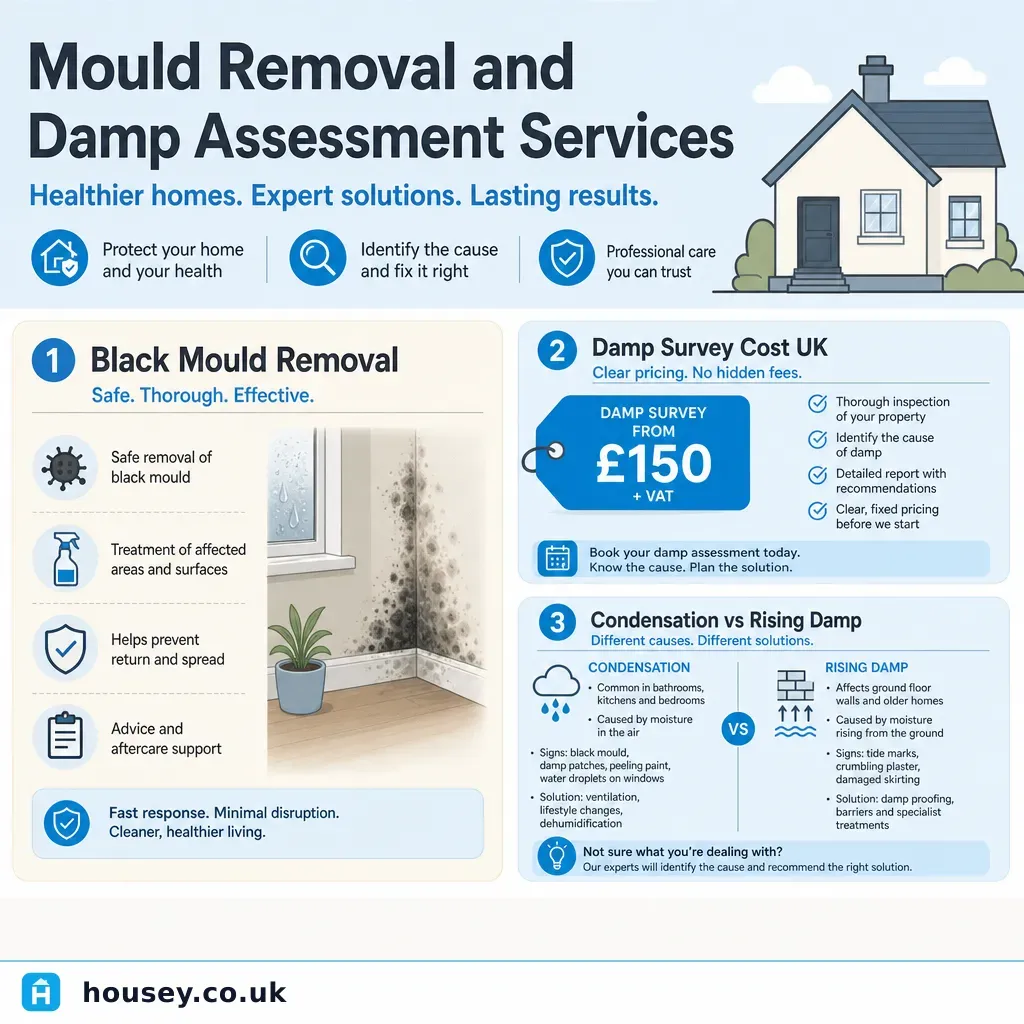
Mould Removal and Damp Assessment Services
Professional mould removal and damp assessment starts with identifying the moisture source—condensation, rising damp, or penetrating damp—before any treatment begins.
 Surveys & Inspections
Damp Surveys: Purpose, Types, and What to Expect
A damp survey is a specialist inspection to identify the source, type, and extent of moisture in a property.
 Surveys & Inspections
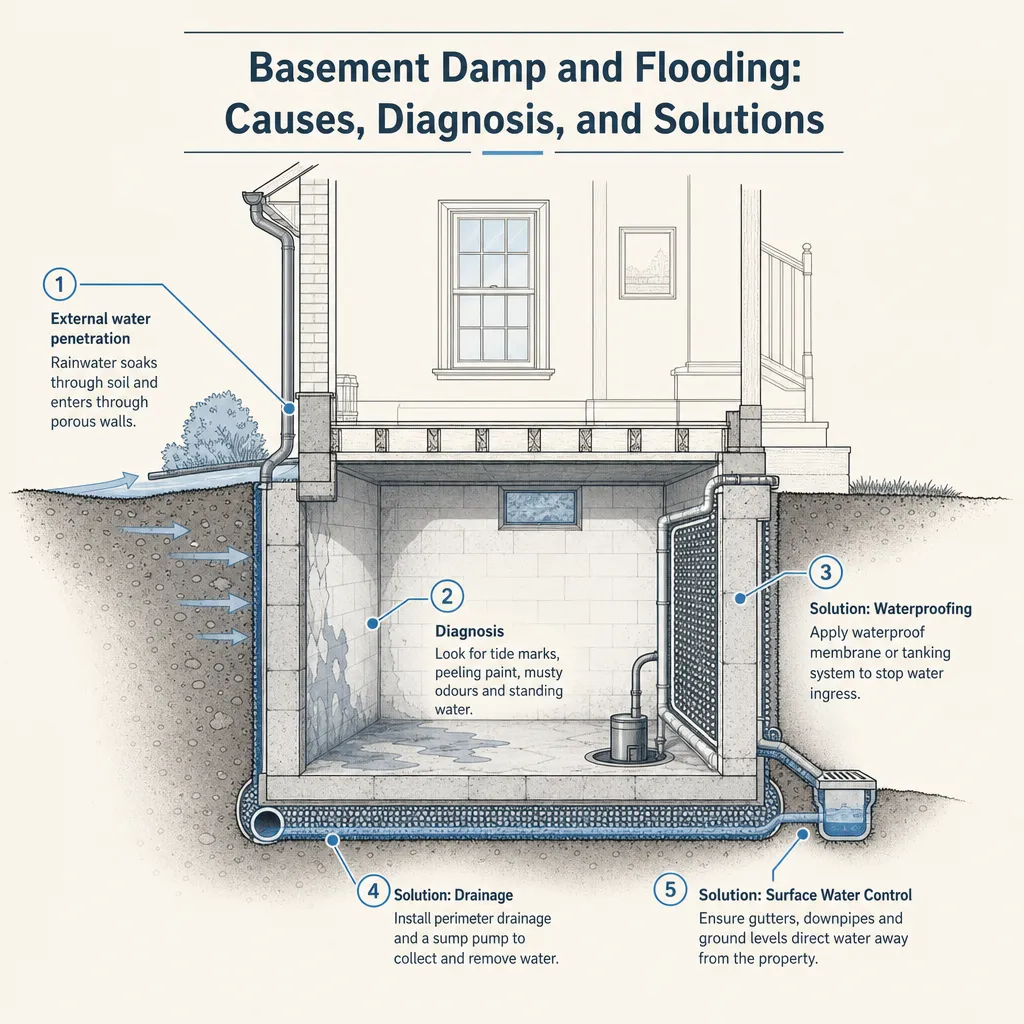
Basement Damp and Flooding: Causes, Diagnosis, and Solutions
Basement dampness and flooding in UK homes typically stems from one of three sources: groundwater under hydrostatic pressure, surface water from drainage failure, and condensation on cold masonry surfaces.
 Surveys & Inspections
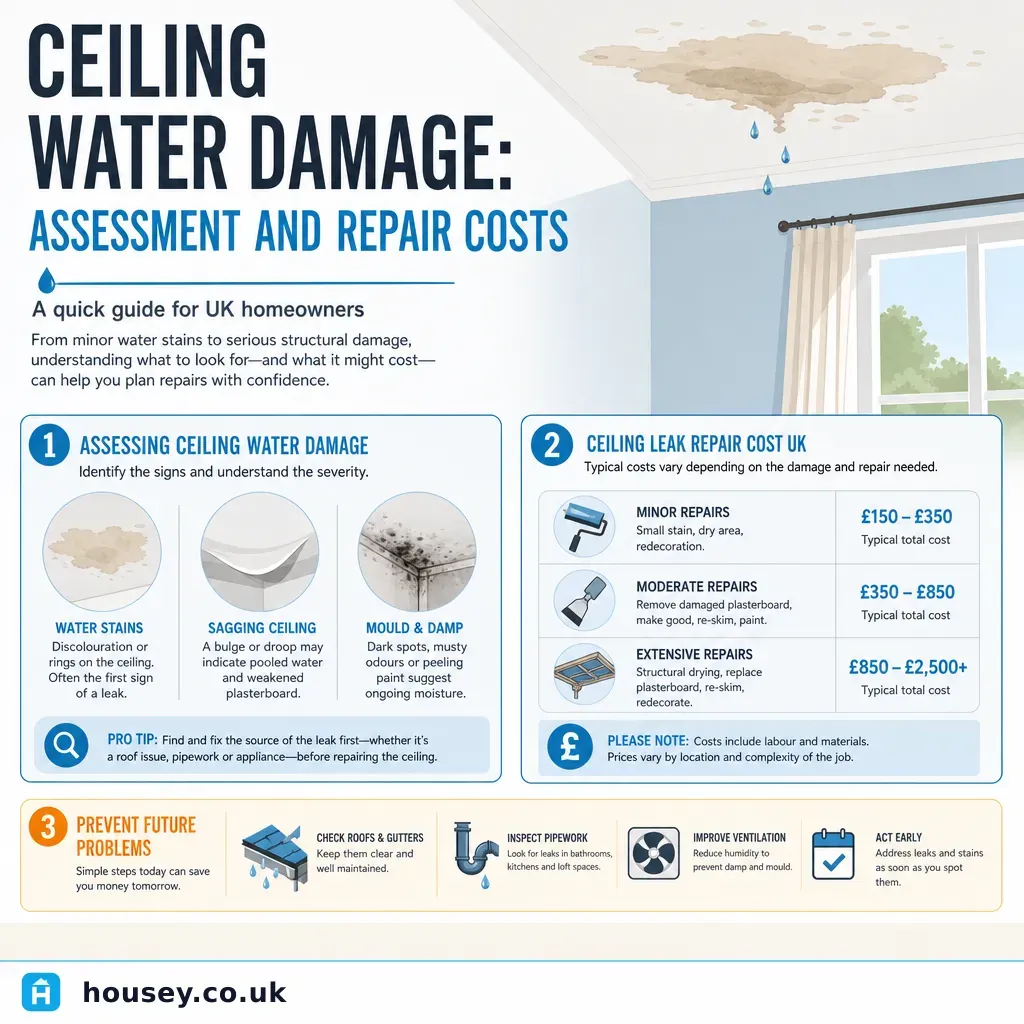
Ceiling Water Damage: Assessment and Repair Costs
Ceiling water damage is assessed by tracing the leak source, measuring moisture content in the ceiling substrate and any exposed timber, and checking for structural softening.
 Surveys & Inspections
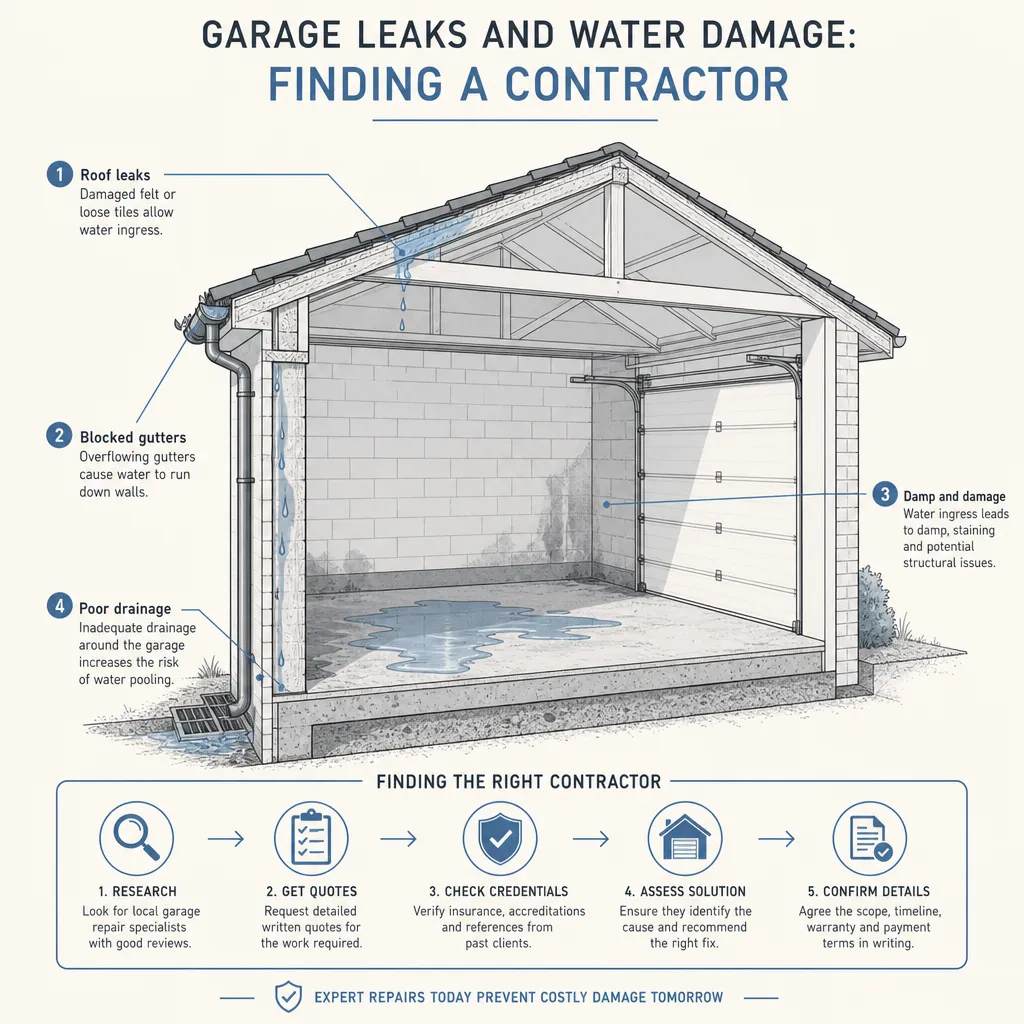
Garage Leaks and Water Damage: Finding a Contractor
Garage leaks and water damage can stem from a failed roof, blocked gutters, rising damp, poor drainage, or cracked walls.