Combi boiler not producing hot water: troubleshooting guide
By Housey · Last reviewed 11th of May 2026
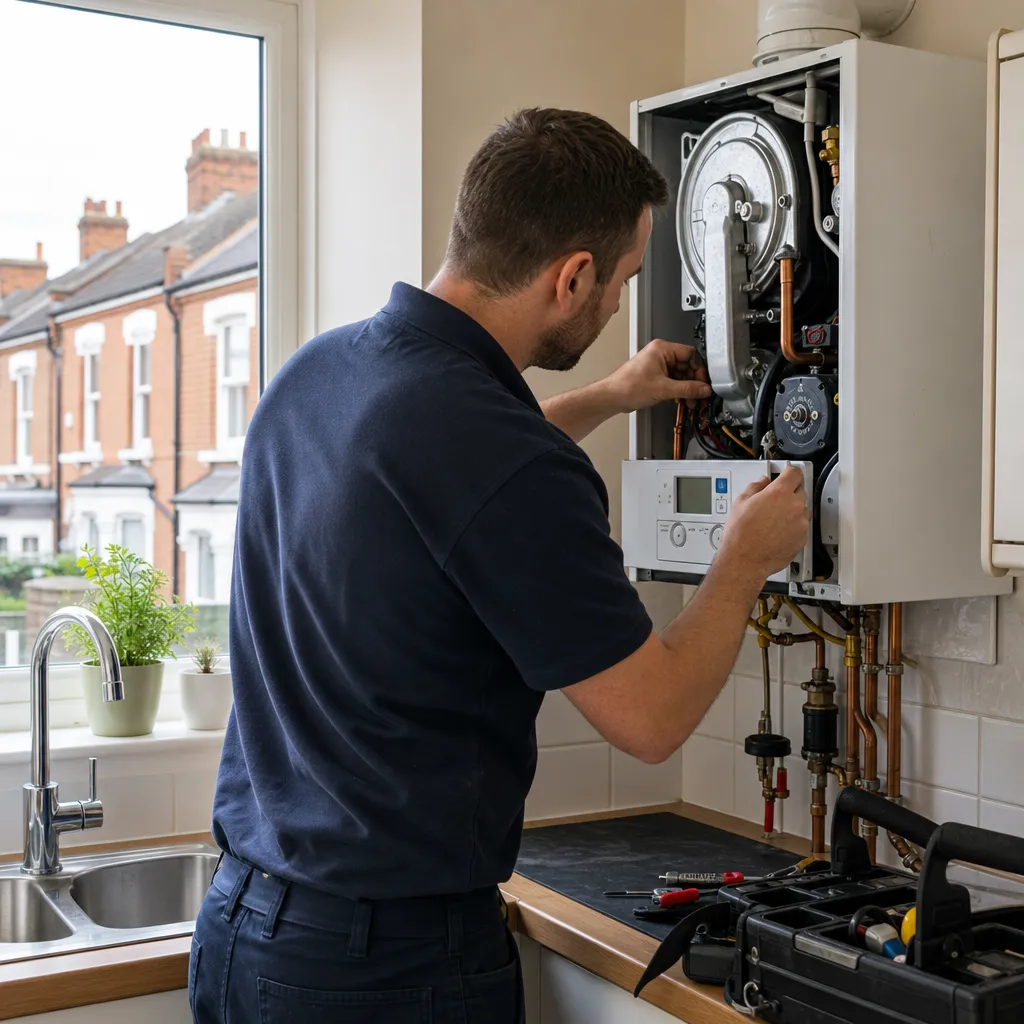
Combi boiler not producing hot water: troubleshooting guide
Many UK households rely on a combination boiler for both central heating and domestic hot water, which means a single fault can affect both at once. The problem often has a straightforward explanation — low pressure, a stuck valve, or a blocked pipe — but identifying the right cause safely matters as much as resolving it. Gas appliances present serious risks if approached without the correct training and Gas Safe registration.
Key points
- Low boiler pressure (below 1 bar on the pressure gauge) is one of the most common causes of no hot water from a combi boiler.
- A faulty diverter valve can prevent hot water delivery even when central heating continues to function normally.
- Only Gas Safe registered engineers are legally permitted to carry out gas boiler repairs in Great Britain under the Gas Safety (Installation and Use) Regulations 1998.
- If you smell gas at any point, leave the property immediately, avoid all switches, and call the National Gas Emergency Service on 0800 111 999.
- Condensing combi boilers can lock out due to a frozen condensate pipe during cold weather — a fault homeowners can often clear safely themselves.
Why is your combi boiler not producing hot water?
A combi boiler serves two functions: heating the central heating circuit and delivering domestic hot water on demand directly from the mains. When hot water fails, the fault can sit anywhere along that path. Whether central heating also stops is itself a useful diagnostic signal.
Common causes include:
- Low boiler pressure — below 1 bar causes most modern combis to reduce output or lock out completely.
- Faulty diverter valve — this internal valve switches the boiler between heating and hot water modes; if it sticks, one function is lost.
- Frozen condensate pipe — in cold weather, the plastic waste pipe that drains condensate can freeze and trigger a lockout.
- Failed thermistor or flow sensor — sensors that read water temperature or flow can fail and prevent the domestic hot water circuit from activating.
- Blocked or scaled heat exchanger — limescale build-up (especially in hard-water areas of England) reduces heat transfer and hot water output over time.
- No gas supply — check other gas appliances such as a hob or gas fire are working before assuming the fault is inside the boiler.
- Fault code on display — most modern combis show a manufacturer-specific error code on lockout; consult your boiler manual for the meaning.
How to check and restore boiler pressure
The pressure gauge is usually a circular dial or digital readout on the front panel. Normal operating pressure is typically 1–1.5 bar when cold; check your boiler manual for the exact range for your model.
If pressure is below 1 bar:
- Locate the filling loop — a short flexible braided hose with two small valves, usually found beneath the boiler or at the pipework connections.
- Slowly open both valves to allow mains water into the system; watch the gauge closely.
- Stop when pressure reaches approximately 1.2 bar, or the level your manufacturer recommends.
- Close both valves firmly and restart the boiler.
If pressure drops again within a few days or weeks, this indicates a leak somewhere in the system. Persistent pressure loss is not a safe DIY repair — contact a Gas Safe registered engineer.
Could it be a frozen condensate pipe?
Condensting combi boilers produce a small quantity of acidic liquid condensate that drains through a plastic pipe, usually exiting through an external wall. In temperatures below around -2°C this pipe can freeze and trigger a boiler lockout, often signalled by a fault code such as EA or E133 (codes vary by manufacturer — check your manual).
Thawing a frozen condensate pipe is one of the few boiler-related actions a homeowner can safely attempt:
- Identify the white or grey plastic pipe (typically 22–32 mm diameter) exiting the property near the boiler.
- Apply warm water using a jug, or place a warm cloth or hot water bottle against the frozen section. Do not use boiling water.
- Once thawed, reset the boiler following the manufacturer's instructions.
Do not use a heat gun or blowtorch on the pipe.
Decision tree: which fault is most likely?
Work through these checks in order:
- Smell gas anywhere in the property → Stop immediately. Leave the building, avoid all switches, and call 0800 111 999.
- Heating works but no hot water → Most likely a faulty diverter valve. Call a Gas Safe registered engineer for inspection and replacement.
- Neither heating nor hot water, pressure below 1 bar → Try repressurising (see above). If pressure holds, restart the boiler. If it drops again, call an engineer.
- Fault code on the display → Look up the code in your manual. Many codes indicate a lockout needing a reset; others point to component failure requiring professional attention.
- Cold overnight, lockout this morning → Check for a frozen condensate pipe before calling an engineer out.
- No gas to any appliance in the home → Contact your gas supplier or call National Gas Emergencies on 0800 111 999.
- None of the above resolves it → Book a Gas Safe registered engineer. Do not attempt further investigation yourself.
Limescale and hard-water areas
In hard-water areas — much of South East England, East Anglia, and the East Midlands — limescale deposits inside the heat exchanger gradually reduce the boiler's ability to heat water. Symptoms include slower hot water delivery, a lower maximum temperature at the tap, or intermittent failure. A Gas Safe or heating engineer can chemically descale the heat exchanger or recommend a scale reducer or water softener to prevent recurrence.
Red flags: when to stop troubleshooting and call an engineer
Do not attempt further checks if any of the following apply:
- You can smell gas anywhere in or around the property.
- The boiler is making unusual banging, popping, or persistent kettling sounds.
- There is visible corrosion, rust staining, or signs of a water leak at the boiler casing or pipework.
- The boiler repeatedly locks out shortly after resetting.
- A fault code refers to the gas valve, heat exchanger, or burner assembly.
- The boiler is more than 10–12 years old and faults are recurring — repair costs may outweigh replacement.
- You are a tenant without a current Gas Safety Record (CP12) from your landlord — this is a legal requirement under the Gas Safety (Installation and Use) Regulations 1998.
Important limitations
This article provides general information about common causes of combi boiler hot water faults. Individual boiler models vary significantly; fault codes, diverter valve designs, filling loop locations, and condensate pipe routing differ across manufacturers including Worcester Bosch, Vaillant, Ideal, Baxi, and Viessmann. Nothing in this article constitutes a gas safety assessment or a recommendation to carry out gas work. Always consult your boiler's installation manual and, where in doubt, instruct a Gas Safe registered engineer.
When this becomes urgent
Seek immediate professional help if:
- You can smell gas — call 0800 111 999 without delay.
- A carbon monoxide detector is sounding or displaying a warning.
- The boiler casing is unusually hot to the touch or shows signs of scorching.
- You have repressurised the boiler and pressure drops again within 24 hours.
- You are a tenant whose landlord has not provided a valid CP12 Gas Safety Record — raise this with your landlord and, if unresolved, contact the Health and Safety Executive.
What to ask a qualified professional
Before instructing a Gas Safe engineer, prepare these questions:
- Are you Gas Safe registered, and may I check your registration number on the Gas Safe Register website?
- What is your diagnosis, and which parts need replacing?
- Do you carry spare parts for my boiler make and model, or will there be a delay sourcing them?
- Given the boiler's age, is repair cost-effective or would replacement be a better option?
- Will you provide written confirmation of the work carried out?
- If replacement is recommended, will you advise on the correct boiler size and efficiency rating for my property?
How Housey can help
Housey connects UK homeowners with local, vetted Gas Safe registered engineers for boiler diagnostics, repairs, and full replacements. You can compare engineer credentials and quotes in one place, helping you act quickly when a fault leaves you without hot water.
Frequently asked questions
Why does my combi boiler heat the radiators but not produce hot water?
This is a classic symptom of a faulty diverter valve. The valve switches the boiler's output between central heating and domestic hot water. If it sticks in the heating position, radiators work but taps stay cold. A Gas Safe registered engineer can test and replace the valve — it is not a DIY repair.
Can I reset my combi boiler myself?
Yes, pressing the reset button (usually marked with a flame symbol) is safe for homeowners. However, if the boiler locks out again shortly after resetting, do not keep pressing reset. Repeated lockouts indicate an underlying fault that needs a Gas Safe registered engineer to diagnose properly.
How do I check and fix low boiler pressure?
Check the pressure gauge on the boiler front panel — most combis need 1 to 1.5 bar when cold. If below 1 bar, locate the filling loop beneath the boiler, open both valves slowly until the gauge reads around 1.2 bar, then close both valves and restart. If pressure drops again within days, call an engineer to find the leak.
Why is my combi boiler producing only lukewarm water?
Possible causes include scale build-up on the heat exchanger (common in hard-water areas), a failing thermistor or flow sensor, or the hot water temperature set too low on the boiler controls. Check the temperature setting first. If it is correct and the problem persists, a Gas Safe engineer should inspect the heat exchanger and sensors.
Sources and further reading
- Gas Safe Register — Find a registered engineer — Gas Safe Register
- Gas Safety (Installation and Use) Regulations 1998 — legislation.gov.uk
- Gas safety in the home — Health and Safety Executive
- Boilers and heating systems — Energy Saving Trust
- National Gas Emergency Service — Cadent Gas
Useful next reads
 General property advice
Troubleshooting common problems with Glow-worm boilers
Glow-worm boiler faults are usually displayed as F or E codes.
 General property advice
Why is your boiler leaking water and how to fix it?
A boiler leak is most often caused by excessive system pressure activating the pressure relief valve, a failing pump seal, or a corroded heat exchanger.
 General property advice
How to relight a boiler pilot light
Most modern boilers use electronic ignition and do not have a standing pilot light — only older appliances, typically installed before the mid-1990s, have one.
 General property advice
Boiler not working after a power cut: troubleshooting steps
After a power cut, most gas boilers enter a protective lockout because their electronic controls detect an abnormal shutdown — the gas supply is unaffected.
 General property advice
What to do when your boiler stops working
When your boiler stops working, check the pressure gauge (should read 1–1.