Troubleshooting common problems with Glow-worm boilers
By Housey · Last reviewed 11th of May 2026
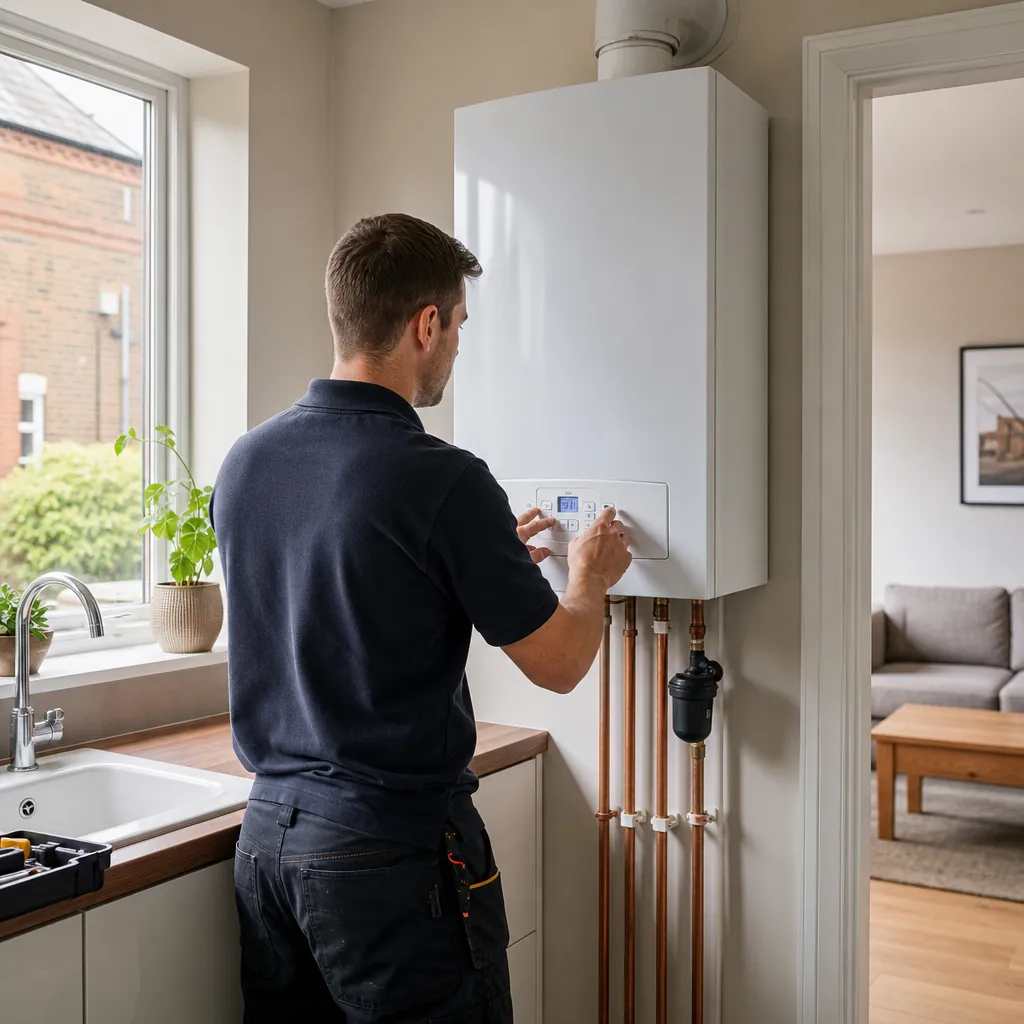
Troubleshooting common problems with Glow-worm boilers
Glow-worm is one of the UK's established boiler manufacturers, with models such as the Flexicom, Betacom, Ultracom, and Ultimate found in homes built or refurbished from the 1990s onwards. When a Glow-worm boiler displays a fault code, loses pressure, or stops producing hot water, the on-screen code gives you a starting point — but knowing which actions are safe for a homeowner and which require a Gas Safe registered engineer is essential before touching anything.
Key points
- Glow-worm fault codes beginning with F (e.g. F.22, F.28, F.29) trigger a lockout that a homeowner can reset using the reset button; codes beginning with E indicate a locked error state that usually requires an engineer to clear.
- F.22 (low water pressure) is the most frequently reported Glow-worm fault in UK homes and can often be resolved by repressurising the system to 1–1.5 bar using the filling loop — consult your boiler manual before attempting this.
- F.28 and F.29 both relate to ignition and flame failure; these should not be reset repeatedly and require investigation by a Gas Safe registered engineer.
- A frozen condensate pipe — a seasonal hazard in UK winters — is one of the few boiler faults a homeowner can safely address, by applying warm (not boiling) water to the frozen section of external pipe.
- Under the Gas Safety (Installation and Use) Regulations 1998, any gas work beyond basic maintenance such as repressurising or condensate thawing must be carried out by a Gas Safe registered engineer; this is a legal requirement.
Understanding Glow-worm fault codes
Glow-worm boilers display fault codes on a digital screen or via flashing LEDs, depending on the model. The table below covers the most commonly reported codes across popular ranges including the Flexicom, Betacom, and Ultracom. Always cross-reference with your specific boiler's installation manual, as codes can vary between models and production runs.
Fault code | What it means | Likely cause | Who can act? |
|---|---|---|---|
F.22 | Low water pressure | System pressure below 0.5 bar | Homeowner (repressurise only) |
F.28 | Ignition failure | Gas not lighting on start-up | Gas Safe engineer |
F.29 | Flame loss during operation | Flame extinguished mid-cycle | Gas Safe engineer |
F.73 | Pressure sensor fault | Faulty sensor or wiring | Gas Safe engineer |
F.75 | No pressure change on pump start | Pressure sensor or pump fault | Gas Safe engineer |
E9 | Safety thermostat tripped | Overheating condition | Gas Safe engineer |
F.1 | NTC sensor fault (some models) | Thermistor or wiring issue | Gas Safe engineer |
If your display shows a code not listed above, consult the Glow-worm product documents page or your boiler manual. Older models may use different code formats.
How to repressurise a Glow-worm boiler (F.22 fault)
Low system pressure is the most common Glow-worm problem reported by UK homeowners. If your boiler displays F.22 and the pressure gauge reads below 1 bar, the steps below apply to most Glow-worm combi and system boilers — but always verify the filling loop arrangement in your specific boiler manual first.
- Switch the boiler off and allow it to cool for at least 30 minutes.
- Locate the filling loop — usually a braided flexible hose with one or two valves beneath the boiler.
- Open both filling loop valves slowly until you hear water entering the system.
- Watch the pressure gauge and stop when it reads 1–1.5 bar.
- Close both valves fully.
- Switch the boiler back on and press the reset button to clear the F.22 code.
- Check for drips around the filling loop connections after repressurising.
If pressure drops again within days or weeks, a leak elsewhere in the system is likely. Contact a Gas Safe registered engineer for a leak investigation — do not keep refilling the system indefinitely, as this can dilute corrosion inhibitor and mask a developing problem.
Dealing with a frozen condensate pipe
In cold UK winters, the condensate pipe — the plastic pipe that carries acidic condensate from the boiler to an outside drain — can freeze solid. This typically causes a gurgling noise and a lockout fault. The pipe usually exits through an external wall close to the boiler and is visible on the outside of the property.
To thaw a frozen condensate pipe safely:
- Pour warm (not boiling) water over the frozen section of external pipe.
- Work from the boiler end outwards.
- Once water flows freely, press the reset button on the boiler.
To reduce the risk of freezing in future, ask a Gas Safe engineer to insulate the exposed external section of pipe with foam lagging.
Boiler noises: what they may indicate
Noise | Likely cause | Recommended action |
|---|---|---|
Kettling (low rumbling gurgle) | Limescale on heat exchanger | Descaling treatment; engineer inspection |
Loud bang on start-up | Delayed ignition | Stop using boiler; call Gas Safe engineer |
Gurgling from pipes or boiler | Trapped air or frozen condensate | Bleed radiators; check condensate pipe |
Whistling | Low pressure or pump fault | Check gauge; call engineer if pressure is normal |
Clicking without ignition | Ignition fault (F.28) | Gas Safe engineer required |
Radiators not heating evenly
If radiators are cold at the top and warm at the bottom, trapped air is the usual cause. You can bleed individual radiators using a radiator bleed key — turn it anti-clockwise until water appears, then close the valve. Check the boiler pressure gauge afterwards and repressurise if it has dropped below 1 bar.
If radiators are cold at the bottom but warm at the top, magnetite sludge build-up is more likely. This requires a power flush or chemical flush carried out by a qualified heating engineer — not a DIY task.
Important limitations
This guide covers general fault identification for Glow-worm boilers based on published documentation and is for informational purposes only. It does not constitute gas safety advice. Fault behaviour, component layouts, and reset procedures vary between boiler models and installation configurations. Never open the boiler casing, interfere with the gas supply valve, or attempt to repair internal components. If in any doubt, switch the boiler off at the programmer and call a Gas Safe registered engineer.
When this becomes urgent
Stop using the boiler immediately and seek professional help if you notice any of the following:
- Smell of gas at any point — leave the property immediately and call the National Gas Emergency Service on 0800 111 999 (available 24 hours, 7 days a week). Do not use light switches or electrical appliances.
- A loud bang or backfire sound on ignition.
- The fault code returns immediately after every reset attempt.
- Visible corrosion, water pooling around the boiler casing, or signs of flue damage or blockage.
- Carbon monoxide alarms sound — evacuate the property immediately and call 999.
What to ask a qualified professional
Before instructing a Gas Safe registered engineer to attend a Glow-worm fault, it helps to have the following information ready and to ask these questions:
- What is my boiler model and serial number? (Printed on the label inside the front panel.)
- Can I verify the engineer's Gas Safe registration before they start work? (Ask to see their Gas Safe ID card or check at gassaferegister.co.uk.)
- Does the fault code point to a specific component, or is a full diagnostic inspection needed?
- Is the repair likely to be covered by my boiler warranty or home emergency insurance policy?
- What is the estimated cost of parts and labour, and will I receive a written quote before any work begins?
- Is the boiler worth repairing, or has it reached the end of its serviceable life?
- When was the boiler last serviced? Annual servicing is recommended and may be a warranty condition.
How Housey can help
Housey helps UK homeowners find vetted local heating engineers and tradespeople. If your Glow-worm boiler needs professional attention, you can use Housey to compare quotes from Gas Safe registered engineers in your area before committing to a repair or replacement.
Frequently asked questions
Can I reset my Glow-worm boiler myself?
Yes — pressing the reset button after a lockout fault (codes beginning with F) is generally safe for homeowners. However, if the boiler locks out repeatedly, or if the fault relates to gas ignition (F.28, F.29), do not continue resetting without having the fault investigated by a Gas Safe engineer. Repeated resets can mask a developing problem and may invalidate your warranty.
Why does my Glow-worm boiler keep losing pressure?
Regular pressure loss — needing to repressurise more than once every few weeks — usually indicates a leak somewhere in the system, such as a radiator valve, pipe joint, or the boiler's heat exchanger. A one-off pressure drop in cold weather is less concerning. Ask a Gas Safe registered engineer to carry out a leak check rather than continuing to top up the pressure indefinitely.
How do I find my Glow-worm boiler model number?
The model name and serial number are printed on a label inside the boiler casing, visible when the front panel is opened. Some models also display this on the outside of the unit. Having both ready before calling an engineer helps them source the correct parts and bring relevant documentation, potentially reducing the number of visits needed.
How often should a Glow-worm boiler be serviced?
Glow-worm recommends an annual service by a Gas Safe registered engineer. Regular servicing helps maintain efficiency, prolongs the boiler's life, and is often a condition of the manufacturer's warranty. Many home emergency and boiler cover policies also require annual servicing to remain valid. A service typically takes one to two hours and should include a flue gas analysis and safety check.
Sources and further reading
- Gas Safe Register — find a registered engineer — Gas Safe Register
- Gas Safety (Installation and Use) Regulations 1998 — legislation.gov.uk
- Carbon monoxide poisoning — domestic gas safety — Health and Safety Executive (HSE)
- Glow-worm product documents and manuals — Glow-worm UK
Useful next reads
 General property advice
Combi boiler not producing hot water: troubleshooting guide
The most common causes of a combi boiler not producing hot water are low system pressure (below 1 bar), a stuck diverter valve, or a frozen condensate pipe.
 General property advice
Why is your boiler leaking water and how to fix it?
A boiler leak is most often caused by excessive system pressure activating the pressure relief valve, a failing pump seal, or a corroded heat exchanger.
 General property advice
How to relight a boiler pilot light
Most modern boilers use electronic ignition and do not have a standing pilot light — only older appliances, typically installed before the mid-1990s, have one.
 General property advice
Boiler not working after a power cut: troubleshooting steps
After a power cut, most gas boilers enter a protective lockout because their electronic controls detect an abnormal shutdown — the gas supply is unaffected.
 General property advice
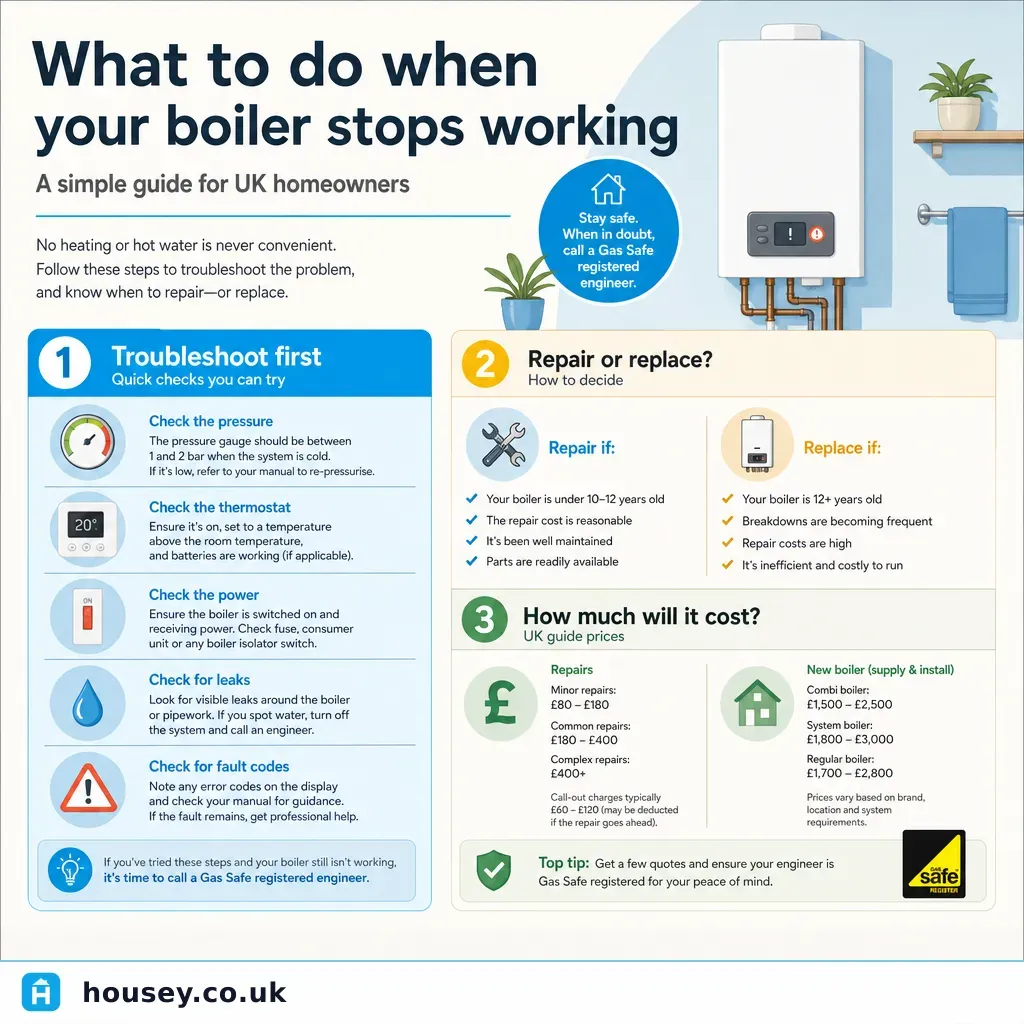
What to do when your boiler stops working
When your boiler stops working, check the pressure gauge (should read 1–1.