Why is your boiler leaking water and how to fix it?
By Housey · Last reviewed 11th of May 2026
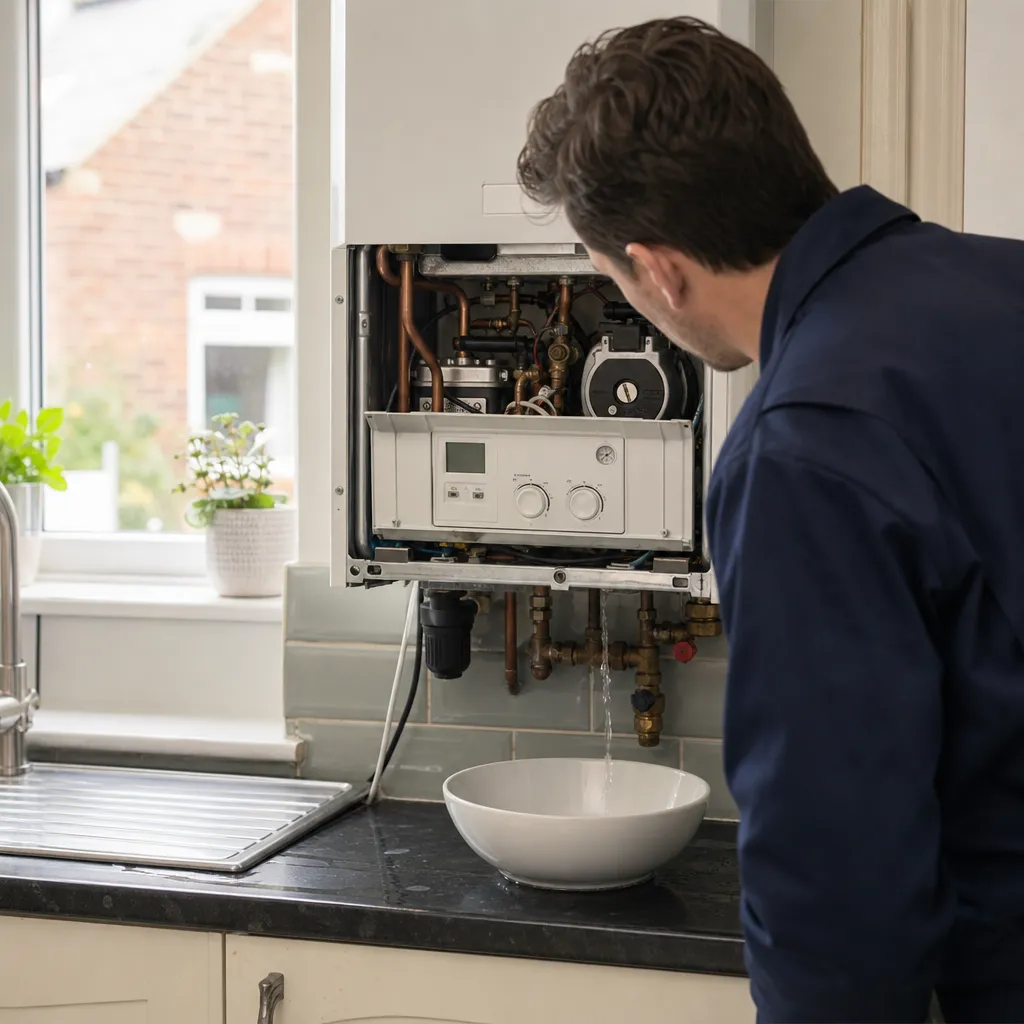
Why is your boiler leaking water and how to fix it?
A leaking boiler is one of the more unsettling faults a homeowner can encounter — not just because of the risk of water damage, but because gas boilers contain pressurised systems and, in some cases, components adjacent to gas pathways. Most boiler leaks are caused by recognisable mechanical failures with established remedies, but correctly diagnosing the source — and knowing which actions are safe for a homeowner and which require a professional — is essential before touching anything.
Key points
- Only a Gas Safe registered engineer is legally permitted to work on gas boiler internals in Great Britain — unregistered gas work is illegal under the Gas Safety (Installation and Use) Regulations 1998.
- A pressure relief valve (PRV) dripping or discharging continuously indicates system pressure above the safe limit (typically 3 bar) and must be investigated by a Gas Safe engineer.
- A heat exchanger leak — usually a crack or corrosion failure — almost always requires boiler replacement or a major repair; it is not a simple fix.
- A drip from a compression fitting on pipework outside the boiler casing may be addressed by a plumber if there is no gas involvement, but isolate the water supply first.
- If the leak is accompanied by a gas smell, leave the building immediately without operating any switches and call the Gas Emergency Service on 0800 111 999.
Common causes of a leaking boiler
Understanding the likely source helps you describe the fault accurately to an engineer and make faster, safer decisions.
Excessive system pressure
The most common cause of water appearing from a boiler is the pressure relief valve (PRV) discharging. This safety device releases water when system pressure exceeds the safe threshold — usually 3 bar. A PRV dripping occasionally after the heating runs is a warning sign; a PRV running continuously signals persistent over-pressurisation. The most common underlying cause is a failed expansion vessel, though a faulty PRV itself is also possible. Both must be assessed by a Gas Safe registered engineer.
Corroded or cracked heat exchanger
The heat exchanger is the internal component where combustion heats the water. Over time — particularly in hard-water areas — limescale accumulates and the heat exchanger can crack or corrode. A leak here typically appears from inside the boiler casing and may also produce banging noises or reduced heating efficiency. Heat exchanger replacement is expensive; on boilers more than 8–10 years old, replacing the entire unit is often the more economical route.
Pump seal failure
The circulating pump moves hot water around the central heating circuit. Seals around the pump degrade over time, particularly in systems carrying sludge or debris. A gradual drip from the pump area may appear slowly before becoming more significant. A Gas Safe engineer can replace pump seals or the pump itself.
Loose pipe joints or fittings
Compression fittings and solder joints on pipework entering and leaving the boiler can loosen through vibration and thermal cycling. If a drip is clearly coming from a fitting on the cold water supply or heating return pipes immediately outside the boiler casing — not from within the casing — a competent plumber may be able to re-make the joint. Always isolate the water first and be certain the source is external pipework, not the boiler body.
Faulty temperature and pressure (T&P) relief valve
Similar to the PRV, a T&P relief valve monitors both temperature and pressure. If this valve is discharging, the boiler has exceeded safe limits on one or both parameters. Do not block or cap the discharge pipe — contact a Gas Safe engineer promptly.
What to do based on where the leak is and how severe it is
- Gas smell present: Leave the building immediately. Do not touch any switches. Call the Gas Emergency Service on 0800 111 999.
- Water pooling rapidly (flood risk): Turn off the water supply to the boiler via the isolation valve on the cold feed and switch off the boiler at the programmer. Call a Gas Safe engineer urgently.
- Small drip from the PRV discharge pipe: Switch off the boiler. Note the pressure gauge reading. Call a Gas Safe engineer to assess the expansion vessel and PRV condition — do not attempt to re-pressurise or bleed the system as a fix.
- Small drip from an external pipe fitting, not the casing: Isolate the water supply, confirm no gas involvement, and contact a plumber or Gas Safe engineer to re-make the joint.
- Drip originating from inside the boiler casing: Do not open the casing. Call a Gas Safe engineer.
- Boiler displaying a fault code alongside the leak: Note the code, switch off the boiler, and report both the code and the leak to your engineer.
What not to assume
- Do not assume the boiler can keep running. A minor-looking leak can indicate a failing heat exchanger that may deteriorate rapidly.
- Do not assume a plumber can fix it. Any work on gas components inside a boiler must be carried out by a Gas Safe registered engineer — a general plumber is not qualified or legally permitted to do this.
- Do not assume reducing the pressure yourself resolves the problem. Bleeding a radiator to temporarily lower system pressure does not address a failed expansion vessel; the PRV will discharge again.
- Do not cap or block the discharge pipe. PRV and T&P discharge pipes are safety devices. Blocking them is dangerous and may be illegal.
- Do not assume a small drip is harmless long-term. Persistent water contact with electrical components, flue fittings, and structural elements causes cumulative damage.
Important limitations
This article provides general information about common causes of boiler leaks in UK residential properties. It is not a substitute for a qualified assessment by a Gas Safe registered engineer. Boiler designs, fault symptoms, and appropriate remedies vary significantly between makes, models, and ages. If you are in any doubt about the safety of your boiler, switch it off and seek professional advice before restarting it.
When this becomes urgent
- Any gas smell — call 0800 111 999 immediately and leave the building
- Rapidly accumulating water around the boiler or flooding risk
- The pressure gauge reading is above 3 bar or the boiler is in lockout
- Continuous discharge from the PRV or T&P pipe (usually a white plastic pipe leading outside or to a drain)
- A burning smell or visible discolouration around the boiler casing
- The boiler has already shut itself off and water is still appearing
What to ask a qualified professional
- Is the leak source inside the boiler casing or from external pipework?
- What is the current condition of the expansion vessel — does it need re-pressurising or replacing?
- Is the PRV or T&P valve faulty in itself, or is it responding correctly to a pressure problem?
- Is there evidence of internal corrosion or sludge that suggests a system flush is needed?
- Given the boiler's age and condition, is repair or replacement the more cost-effective option?
- Are there any interim safety precautions I should follow before the repair is completed?
When to get professional help
All boiler faults involving gas components require a Gas Safe registered engineer. You can verify any engineer's current registration at gassaferegister.co.uk before work begins. Do not instruct an unregistered individual to carry out gas work — it is illegal and potentially life-threatening. Seek help immediately if there is any gas smell, rapid water accumulation, burning odours, or if you are uncertain about the severity of the fault.
How Housey can help
Housey connects homeowners with Gas Safe registered engineers and heating specialists across the UK. Whether you need an urgent boiler inspection, a system flush, or an honest assessment of whether repair or replacement makes more sense for your property, Housey makes it straightforward to request quotes from qualified local professionals.
Frequently asked questions
Can I fix a boiler leak myself?
Work on gas boiler components is restricted by law to Gas Safe registered engineers under the Gas Safety (Installation and Use) Regulations 1998. You must not open the boiler casing or attempt to repair internal components. You can safely switch off the boiler, isolate the water supply, and note the pressure gauge reading while you wait for a qualified engineer.
How much does it cost to repair a leaking boiler?
Indicative UK costs, last reviewed 2026-05-11. A pump seal or minor fitting repair might cost £100–£300 including call-out. Heat exchanger replacement typically runs £300–£600+ and on older boilers often makes full replacement more economical. Expect a call-out charge of £60–£120 regardless of outcome. Always request a written quote before work proceeds.
Should I turn off my boiler if it is leaking?
Yes — as a precaution, switch off the boiler at the programmer and, if water is pooling, isolate the water supply via the isolation valve on the cold feed. This reduces the risk of water damage and electrical faults. Do not turn off the gas supply yourself unless instructed to do so by the emergency services.
How do I check if an engineer is Gas Safe registered?
Visit gassaferegister.co.uk and use the Check a Gas Engineer tool with the engineer's name or Gas Safe ID number. Every registered engineer carries a photo ID card showing their licence number and the types of gas work they are qualified to carry out. Always check before allowing any work to begin.
Sources and further reading
- Gas Safe Register: About Gas Safety — Gas Safe Register
- Gas Safety (Installation and Use) Regulations 1998 — legislation.gov.uk
- HSE: Gas Safety in the Home — Health and Safety Executive
- Boilers and Heating Systems — Energy Saving Trust
- Problems with Your Energy Supply — Citizens Advice
Useful next reads
 General property advice
Troubleshooting common problems with Glow-worm boilers
Glow-worm boiler faults are usually displayed as F or E codes.
 General property advice
Combi boiler not producing hot water: troubleshooting guide
The most common causes of a combi boiler not producing hot water are low system pressure (below 1 bar), a stuck diverter valve, or a frozen condensate pipe.
 General property advice
How to relight a boiler pilot light
Most modern boilers use electronic ignition and do not have a standing pilot light — only older appliances, typically installed before the mid-1990s, have one.
 General property advice
Boiler not working after a power cut: troubleshooting steps
After a power cut, most gas boilers enter a protective lockout because their electronic controls detect an abnormal shutdown — the gas supply is unaffected.
 General property advice
What to do when your boiler stops working
When your boiler stops working, check the pressure gauge (should read 1–1.