Common Boiler Faults: Identification and Remedies
By Housey · Last reviewed 11th of May 2026
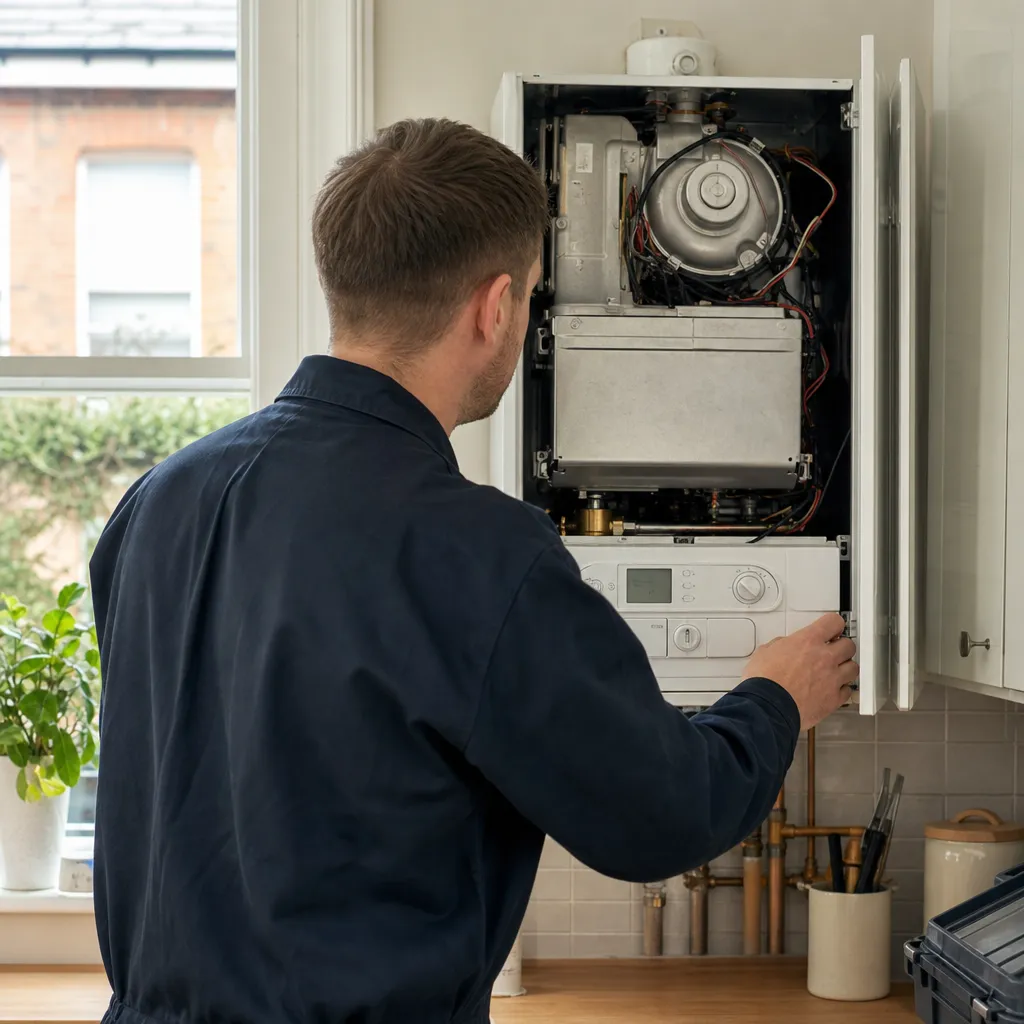
Common Boiler Faults: Identification and Remedies
Boiler breakdowns are among the most disruptive household events, typically striking during cold spells when demand on the system is highest. Whether your home has a combi, system, or regular heat-only boiler, faults range from a simple pressure drop you can safely address yourself to gas-related issues that require a Gas Safe registered engineer. Understanding what the warning signs mean — and which checks are appropriate for a homeowner to carry out — helps you respond quickly, avoid unnecessary call-out fees, and stay safe.
Key points
- Under the Gas Safety (Installation and Use) Regulations 1998, only a Gas Safe registered engineer may legally carry out gas-related repairs or adjustments in a UK home.
- Most boiler manufacturers recommend an annual service to maintain warranty validity and detect developing faults before a breakdown occurs.
- Boiler operating pressure should typically sit between 1 and 1.5 bar when the system is cold; a reading below 1 bar usually triggers a pressure fault or lockout.
- A frozen condensate pipe — common during cold snaps — is one of the few boiler faults homeowners can safely remedy themselves, by thawing it with warm (not boiling) water.
- Kettling — a low rumbling resembling a boiling kettle — is most prevalent in hard-water areas and is usually caused by limescale restricting flow through the heat exchanger.
Common boiler faults and what causes them
Most boiler faults fall into a small number of categories. Identifying which category your symptoms point to helps an engineer diagnose the problem more efficiently.
Pressure loss
A pressure gauge reading below 1 bar will typically trigger a warning or fault code and prevent the boiler from firing. Common causes include a small water leak somewhere in the heating system, radiators having been bled without the system being re-pressurised afterwards, or a failing pressure relief valve. Homeowners can safely re-pressurise using the filling loop — a process described in the boiler manual. If pressure drops repeatedly after topping up, a leak requires professional investigation.
No heating or hot water
If the boiler appears to be running but neither heating nor hot water is being produced, possible causes include:
- Room thermostat or programmer settings (check these and replace batteries before calling an engineer).
- A faulty diverter valve on a combi boiler, which directs hot water to either radiators or taps.
- A failed circulating pump.
- On older boilers, a pilot light that has gone out (many modern boilers use electronic ignition with no standing pilot).
Unusual noises
Noise | Likely cause | Suggested action |
|---|---|---|
Kettling (low rumble) | Limescale or sludge in heat exchanger | Call engineer; system flush or descale may be needed |
Banging on start-up | Delayed ignition or trapped air | Call engineer |
Gurgling | Trapped air in the system | Bleed radiators; call engineer if it persists |
Whistling | Restricted water flow or pump issue | Call engineer |
Loud clunking | Pump or component failure | Stop using boiler; call engineer promptly |
Frozen condensate pipe
Condensing boilers — mandatory for new gas boiler installations in England and Wales since 2005 — produce acidic condensate that drains through a plastic pipe, often routed outside the property. In temperatures below approximately −2 °C this pipe can freeze and cause the boiler to lock out. Thawing with warm water is a safe homeowner action. Insulating the exposed section of pipe before winter helps prevent recurrence.
Boiler lockout and error codes
A lockout is a safety mechanism: the boiler shuts itself down when it detects an abnormal condition. Each manufacturer uses its own fault code system. Common triggers include low gas pressure, overheat thermostat activation, ignition failure, and flue or air intake blockage. Pressing the reset button clears the lockout but does not resolve the underlying fault. Repeated lockouts indicate the boiler needs professional assessment.
Which faults can homeowners safely address?
Use this decision tree to determine whether to act yourself or call a professional.
- Pressure below 1 bar? → Re-pressurise using the filling loop per your boiler manual. If pressure drops again within a few days, call a Gas Safe engineer.
- No heating or hot water but boiler appears to be running? → Check thermostat settings, programmer clock, and battery levels. If the issue persists, call an engineer.
- Frozen condensate pipe during cold weather? → Thaw with warm water, insulate the pipe, and reset the boiler once thawed.
- Unusual noise but boiler still running? → Bleed radiators to remove trapped air. If noise continues, call an engineer.
- Fault code displayed? → Check your boiler manual for the code's meaning. If the code relates to gas supply, combustion, or the flue, call a Gas Safe engineer. Do not reset the boiler repeatedly without investigation.
- Gas smell anywhere in the property? → Do not reset or operate any electrical switch. Open windows, leave the building, and call the Gas Emergency Helpline on 0800 111 999.
Important limitations
This article provides general guidance on boiler fault symptoms and is not a substitute for professional assessment. Gas systems carry serious risks including carbon monoxide (CO) poisoning, gas leaks, and fire. Fault codes and correct remedies vary significantly by boiler make and model. A Gas Safe registered engineer should assess and repair any gas-related fault. Fit a carbon monoxide alarm on every floor where a gas appliance or flue is present, as recommended by the Health and Safety Executive.
What to ask a qualified professional
When booking a Gas Safe engineer, ask:
- Are you Gas Safe registered? Can I verify your registration number on the Gas Safe Register website?
- What does the fault code on my boiler indicate, and what is the root cause?
- Is a repair cost-effective given the boiler's age, or is replacement more appropriate?
- What is included in the call-out fee, and will parts and labour be quoted separately?
- Does a repair come with a guarantee, and for how long?
- Should I have an annual service carried out at the same time?
When to get professional help
Call a Gas Safe registered engineer without delay if:
- You smell gas near the boiler or anywhere in the property.
- You or others experience unexplained headaches, nausea, or dizziness (possible carbon monoxide — call 999 immediately).
- The boiler displays a combustion, flue, or gas-pressure fault code.
- The boiler locks out repeatedly despite being reset.
- There is visible damage to the flue, gas pipework, or boiler casing.
- The boiler's annual service is overdue by more than a few months.
How Housey can help
Housey helps UK homeowners find and compare local heating engineers and property service professionals. Use Housey to request quotes from qualified Gas Safe registered engineers for boiler servicing and repairs in your area.
Frequently asked questions
How often should a gas boiler be serviced?
Most manufacturers and industry bodies recommend an annual service by a Gas Safe registered engineer. Regular servicing maintains warranty validity, keeps the boiler running efficiently, and allows developing faults to be identified early. Landlords have a legal duty to arrange annual gas safety checks under the Gas Safety (Installation and Use) Regulations 1998.
Can I bleed my own radiators?
Yes. Bleeding radiators to remove trapped air is a standard homeowner task that does not involve the gas supply. You will need a radiator bleed key, widely available from DIY retailers. After bleeding, check the boiler pressure gauge and re-pressurise using the filling loop if pressure has dropped below 1 bar, following your boiler manual.
What should I do if my boiler keeps losing pressure?
Re-pressurise using the filling loop as described in your boiler manual and monitor pressure over the following days. If it drops repeatedly, this indicates a leak somewhere in the system — in the pipework, radiator valves, or the boiler itself. A Gas Safe engineer can carry out a leak detection check to identify the source.
How old is too old for a boiler?
Most gas boilers have a practical lifespan of 10 to 15 years, though some last longer with consistent annual servicing. Replacement becomes more cost-effective when repair costs mount, spare parts become difficult to source, or efficiency has fallen well below that of a modern A-rated condensing boiler. A Gas Safe engineer can advise on repair versus replacement.
Sources and further reading
- Gas Safe Register — verify a registered engineer — Gas Safe Register
- Carbon monoxide alarms in the home — Health and Safety Executive
- Gas safety in the home — GOV.UK
- Boiler and heating system guidance — Energy Saving Trust
Useful next reads
 General property advice
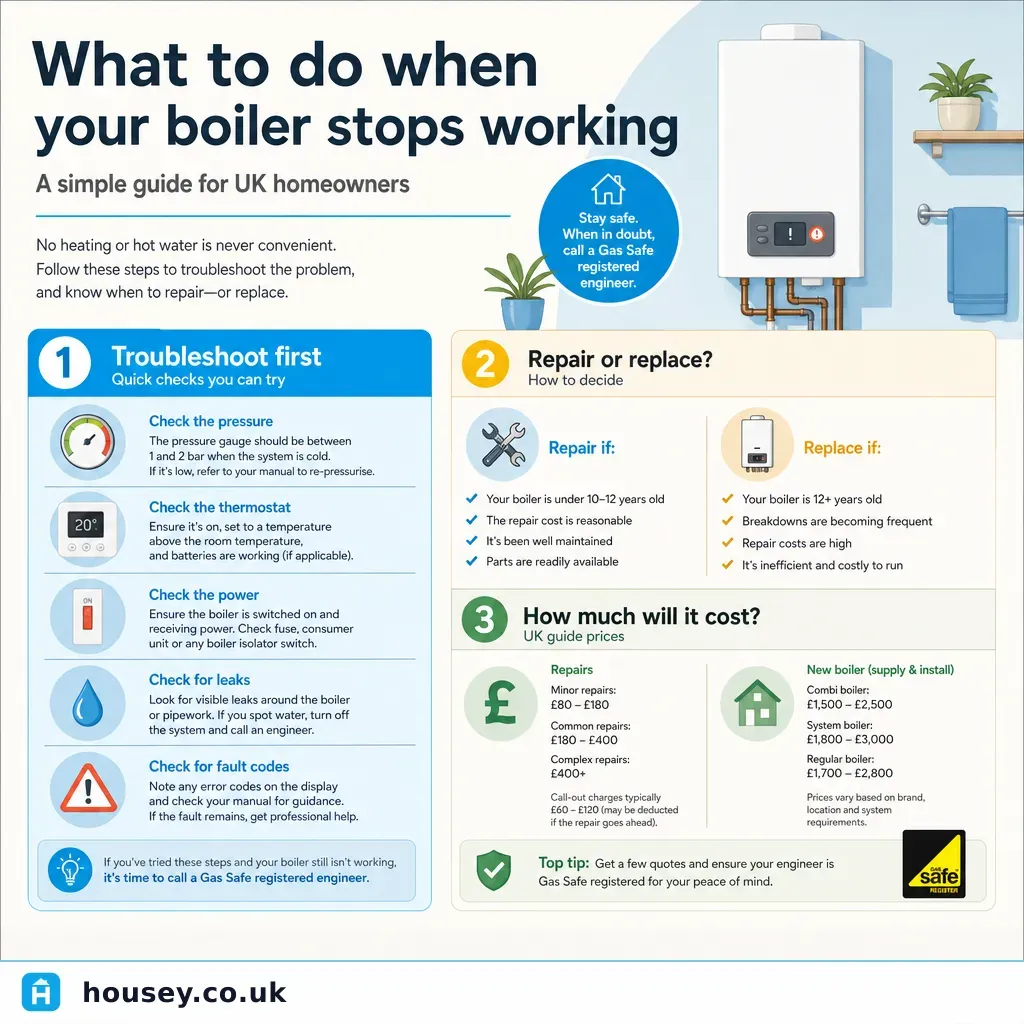
What to do when your boiler stops working
When your boiler stops working, check the pressure gauge (should read 1–1.
 General property advice
Common problems with Baxi boilers and how to fix them
Most Baxi boiler faults show a numeric error code on the front panel.
 General property advice
What to do when your boiler is making unusual noises
Boiler noises most often indicate limescale build-up (kettling), trapped air, or system sludge — all addressable by a Gas Safe engineer.
 General property advice
Property Market Trends: Activity Growth and Price Movements
UK property market activity is measured through completed sale registrations (HM Land Registry), lender mortgage data, and transaction volumes from HMRC.
 General property advice
Installing a water main shut-off valve for your property
A water main shut-off valve — commonly called a stopcock — controls all water entering your home from the mains.