Common problems with Baxi boilers and how to fix them
By Housey · Last reviewed 11th of May 2026
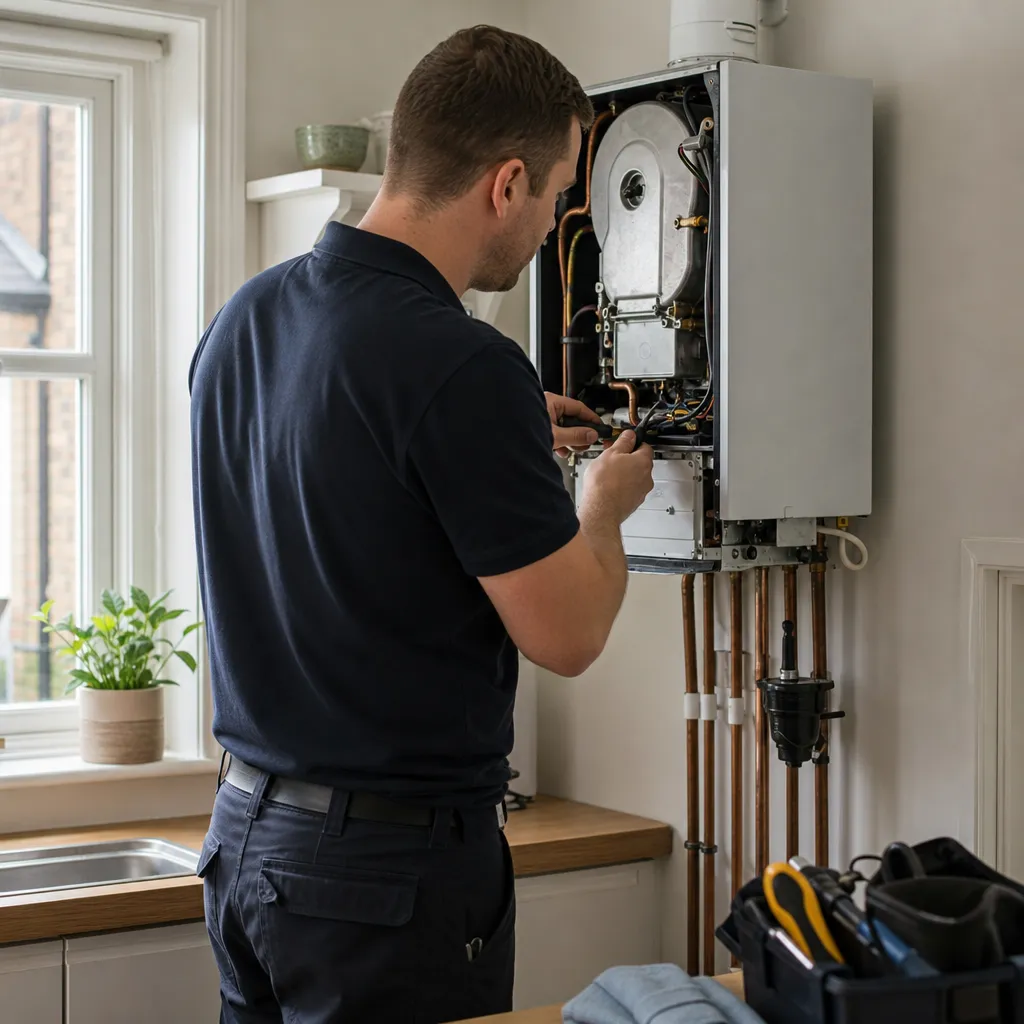
Common problems with Baxi boilers and how to fix them
Baxi boilers are installed across a large number of UK homes, with current models including the Baxi 800, 600, and 400 series and older models such as the Duo-tec found in properties built from the 1990s onwards. When a fault develops, the boiler typically displays a numeric error code indicating the general nature of the problem. Understanding what these codes mean — and knowing which ones you can address yourself — helps you decide quickly between re-pressurising the system and calling a Gas Safe registered engineer.
Key points
- Low system pressure (fault code E119, or a gauge reading below 1.0 bar) is the most common Baxi fault and can often be resolved by the homeowner via the filling loop — no engineer is needed for a single occurrence of low pressure.
- Codes relating to ignition (E133), the flue or fan (E168, E160), or overheating (E125) must be attended to by a Gas Safe registered engineer; do not attempt to diagnose or repair gas components yourself.
- The Gas Safety (Installation and Use) Regulations 1998 require all gas appliance work to be carried out by a Gas Safe registered engineer — working on gas fittings without registration is illegal.
- Kettling (a rumbling or banging noise from the boiler) is common in hard water areas such as south-east England and is usually caused by limescale accumulation on the heat exchanger.
- Landlords have a statutory duty under the Gas Safety (Installation and Use) Regulations 1998 to arrange annual Gas Safe inspections and to provide tenants with a valid Gas Safety Record.
How to read Baxi fault codes
Most current Baxi models display a fault code as "E" followed by a number on the digital display. The code persists until the fault is cleared or the reset button is pressed. Common codes across the Baxi 400, 600, and 800 series are listed below.
Fault code | Meaning | Common cause | Who can fix it |
|---|---|---|---|
E119 | Low water pressure | System pressure below ~0.5 bar; minor leak or dissolved gas loss | Homeowner can re-pressurise; engineer if pressure drops repeatedly |
E133 | Ignition failure | No gas supply, faulty ignition electrode, or faulty gas valve | Gas Safe registered engineer only |
E168 | Fan or flue fault | Blocked flue terminal, faulty fan, frozen condensate pipe | Gas Safe engineer; homeowner can check condensate pipe |
E160 | Fan fault | Fan not reaching operating speed | Gas Safe registered engineer only |
E125 | Overheating / thermal cutout | Low water flow, pump fault, blocked heat exchanger | Gas Safe registered engineer only |
E28 | Flue gas thermostat fault | High flue temperatures or possible flue obstruction | Gas Safe registered engineer only |
Fault code behaviour and display format can vary between Baxi models and production years. Always cross-reference with the manual for your specific unit — manuals are available from the Baxi technical library at baxi.co.uk.
Low boiler pressure: what a homeowner can do
Low system pressure is the most common Baxi complaint and one of the few faults a homeowner can safely resolve. Normal cold system pressure is 1.0–1.5 bar; below 0.8 bar most Baxi boilers will refuse to fire.
How to re-pressurise a Baxi boiler:
- Allow the boiler to cool fully before re-pressurising.
- Locate the filling loop — a braided hose with one or two isolating valves, usually beneath the boiler.
- Slowly open the filling valve(s) and watch the pressure gauge.
- Stop when the gauge reads 1.0–1.5 bar.
- Close the filling valve(s) and confirm the gauge reading is stable.
- Press the reset button if the boiler is in lockout; it should restart normally.
If pressure drops again within a few days, there is a leak somewhere in the system. Look for damp patches near radiator valves, pipework joints, or underneath the boiler. A Gas Safe engineer should trace and repair the source — do not repeatedly top up without identifying the cause.
Ignition and gas faults: always call a professional
Fault codes E133 and similar ignition-related codes indicate a problem that only a Gas Safe registered engineer should diagnose and repair. Possible causes include:
- No gas supply reaching the boiler — check whether other gas appliances are working. If not, contact your gas supplier.
- A faulty or contaminated ignition electrode.
- A faulty gas valve or printed circuit board (PCB).
Under the Gas Safety (Installation and Use) Regulations 1998, carrying out gas work without Gas Safe registration is illegal and potentially life-threatening. If you smell gas at any point, evacuate the property immediately, do not operate any switches or naked flames, and call the National Gas Emergency Service on 0800 111 999.
Kettling and noise
Kettling — a low rumbling, banging, or whistling from the boiler body — is particularly common in hard water areas of England, including much of the south-east, east of England, and parts of the Midlands. Limescale accumulates on the heat exchanger, restricts water flow, and causes localised boiling.
Possible remedies, all of which require a qualified heating or Gas Safe engineer:
- Corrosion and scale inhibitor: products such as Fernox F1 or Sentinel X100, added to the central heating circuit, slow further scale formation.
- Power flush: removes sludge and scale from the system; recommended before adding inhibitor where scale build-up is significant.
- Magnetic filter: a filter fitted to the return pipe captures ferrous debris before it reaches the boiler; most manufacturers require one for warranty compliance.
Kettling alone does not usually prevent operation, but will accelerate heat exchanger wear if left untreated.
Frozen condensate pipe
Baxi condensing boilers discharge mildly acidic condensate water through a white plastic pipe that often runs through an external wall. In freezing weather this pipe can ice up, causing a lockout — often accompanied by a gurgling sound and an ignition-related fault code.
A homeowner can thaw a frozen condensate pipe by pouring warm — not boiling — water along the external section. Once thawed, press the reset button. If freezing recurs each winter, a heating engineer can lag or re-route the external section to reduce the risk.
Annual maintenance checklist
Using this checklist each year reduces the likelihood of the most common Baxi faults:
Important limitations
This article provides general guidance on common Baxi boiler symptoms and fault codes as at the date of last review. Fault codes and boiler design vary between models and production years — always refer to your specific model's manual. This guide does not replace a Gas Safe registered engineer's assessment. Gas appliances carry risks including carbon monoxide poisoning and fire. If you smell gas at any time, evacuate immediately and call the National Gas Emergency Service on 0800 111 999.
What to ask a Gas Safe registered engineer
Before instructing an engineer for a Baxi fault:
- Can I verify your Gas Safe registration number before you begin work?
- What does this fault code indicate, and what diagnostic steps will you follow?
- Is this fault potentially covered by a manufacturer warranty or an existing service plan?
- Will you check for carbon monoxide and inspect the flue condition as part of this visit?
- Is repair cost-effective given the boiler's age, or would you recommend considering replacement?
- What is the estimated cost of parts and labour before you proceed?
When to get professional help
Call a Gas Safe registered engineer promptly if:
- The boiler displays E133, E168, E160, E125, E28, or any code relating to ignition, gas supply, flue, or overheating.
- You smell gas anywhere in the property — evacuate and call 0800 111 999 first.
- The carbon monoxide alarm activates — leave the property immediately and call 999.
- System pressure drops repeatedly within days of re-pressurising, indicating a leak in the system.
- The boiler is more than 10–12 years old and experiencing recurring faults.
- You are a landlord — annual Gas Safe inspection and a current Gas Safety Record are legal requirements under the Gas Safety (Installation and Use) Regulations 1998.
How Housey can help
Housey connects homeowners and landlords with Gas Safe registered engineers and heating professionals for boiler servicing, fault diagnosis, and replacement. Use Housey to request and compare quotes from qualified professionals in your area.
Frequently asked questions
How do I reset a Baxi boiler after a fault?
Most Baxi models have a reset button — marked with a flame or reset symbol — on the front panel. Press and hold it for three to five seconds; the boiler will attempt to restart. If it locks out again immediately, the underlying fault has not been resolved and a Gas Safe registered engineer should investigate.
Why does my Baxi boiler keep losing pressure?
A gradual pressure drop over several months is normal as dissolved gases escape the system. If pressure drops noticeably within a few days of re-pressurising, there is likely a leak — check visible radiator valves, pipework connections, and the pressure relief valve outlet. A Gas Safe engineer can carry out a full pressure test to locate the source.
How long should a Baxi boiler last?
A well-maintained Baxi boiler typically lasts 10–15 years. Annual servicing, a system inhibitor, and a magnetic filter all help extend operational life. If the boiler is approaching 12–15 years old and faults are becoming frequent, replacement may be more cost-effective than continued repair.
Is it safe to use my boiler if a fault code is showing?
It depends on the code. A resolved pressure fault (E119) cleared by re-pressurising is generally safe to reset. Codes relating to ignition, gas, flue, or overheating should not be cleared without investigation — doing so may mask a safety-critical problem. If uncertain, switch the boiler off and call a Gas Safe registered engineer.
Sources and further reading
- Gas Safe Register — find a registered engineer — Gas Safe Register
- Gas Safety (Installation and Use) Regulations 1998 — legislation.gov.uk
- Carbon monoxide: the silent killer — Gas Safe Register
- Landlord gas safety responsibilities — HSE
- Boiler maintenance and servicing advice — Energy Saving Trust
Useful next reads
 General property advice
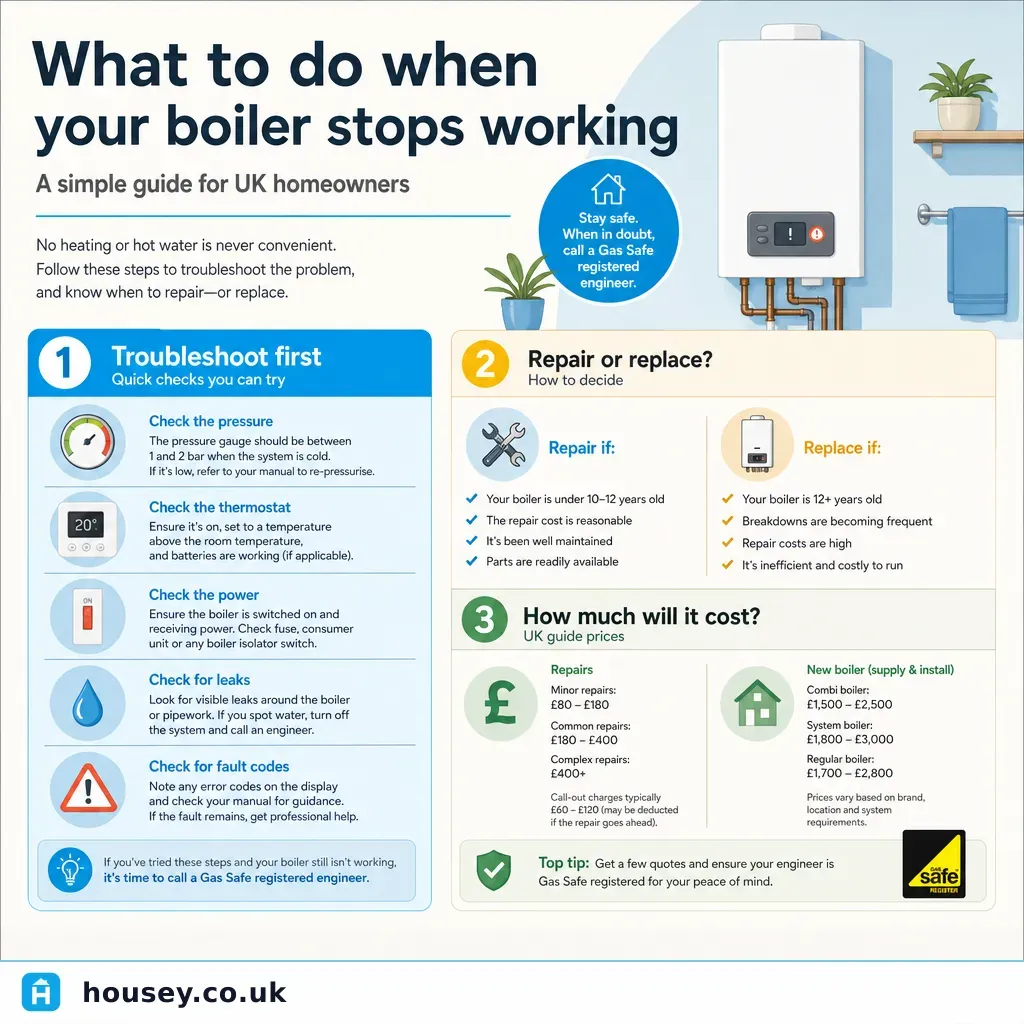
What to do when your boiler stops working
When your boiler stops working, check the pressure gauge (should read 1–1.
 General property advice
Common Boiler Faults: Identification and Remedies
The most common boiler faults in UK homes are pressure loss, no heating or hot water, unusual noises such as kettling or banging, a frozen condensate pipe, and repeated lockouts.
 General property advice
What to do when your boiler is making unusual noises
Boiler noises most often indicate limescale build-up (kettling), trapped air, or system sludge — all addressable by a Gas Safe engineer.
 General property advice
Property Market Trends: Activity Growth and Price Movements
UK property market activity is measured through completed sale registrations (HM Land Registry), lender mortgage data, and transaction volumes from HMRC.
 General property advice
Installing a water main shut-off valve for your property
A water main shut-off valve — commonly called a stopcock — controls all water entering your home from the mains.