Common Issues Identified During Home Surveys: What Fails Inspection
By Housey · Last reviewed 25th of May 2026
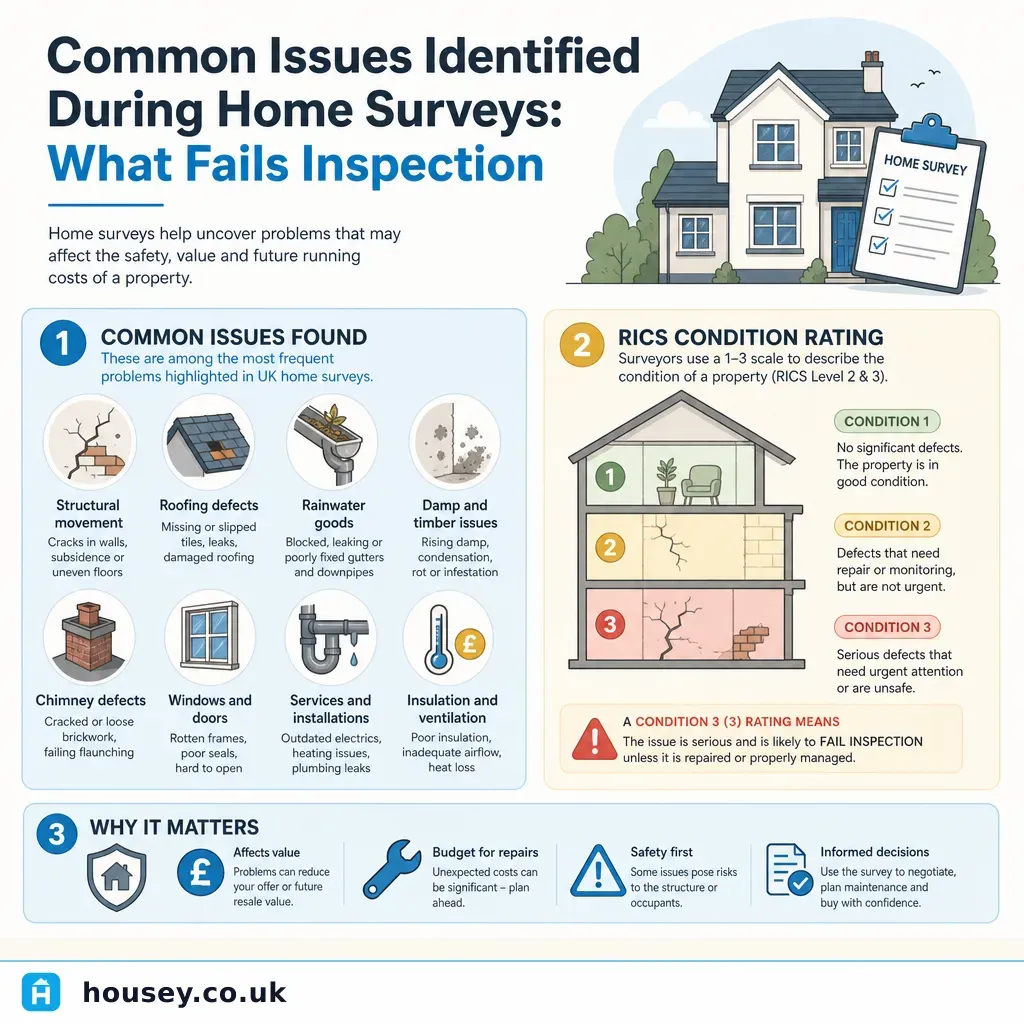
Common Issues Identified During Home Surveys: What Fails Inspection
A home survey is the stage in the buying process where optimism meets reality. Surveyors assess condition, not value, and their findings can range from minor maintenance items to structural concerns that reshape a buyer's negotiating position or timeline. Knowing which defects appear most frequently in UK properties — and what they mean for your purchase — puts you in a far stronger position at the critical stages before exchange.
Key points
- Damp and moisture penetration is the most commonly flagged defect in UK home survey reports, particularly in pre-1919 and post-war solid-wall properties.
- RICS Home Surveys use a three-tier condition rating: Condition 1 (no action needed), Condition 2 (repair or replacement required in due course), Condition 3 (urgent or significant, requires further investigation).
- Roof defects — failing flashings, missing or slipped tiles, deteriorated felt underlays — are reported in a high proportion of surveys on properties built before 1990.
- Structural movement flags in a survey report (stepped cracks, lintel failure, subsidence indicators) typically require a follow-up structural engineer's report before exchange.
- Electrical installations in properties older than 25 years are frequently noted as requiring an Electrical Installation Condition Report (EICR) from a Part P-registered or NICEIC-registered electrician.
Which survey level is right for detecting problems?
Survey type | Best for | Depth of inspection | What it will and won't cover |
|---|---|---|---|
RICS Level 1 Condition Report | New builds, modern flats in good condition | Visual only, traffic-light ratings | Flags obvious Condition 3 items; limited narrative |
RICS Level 2 Home Survey | Conventional homes in broadly sound condition | Visual; opens hatches, checks services | Identifies most common defects; cannot open up or test drainage |
RICS Level 3 Building Survey | Older, larger, altered, or visibly defective properties | Most thorough; describes construction; comments on options | Best for pre-1919, unusual construction, or suspected hidden defects |
Specific Defect Survey | Known concern (single crack, damp patch, roof area) | Focused investigation of one element | Deep analysis of one issue; not a whole-property report |
The most common defects found in UK surveys
Damp and moisture
Damp is the perennial finding in UK surveys, partly because the British climate provides ample opportunity for water to find a way in, and partly because the housing stock is old. Surveyors distinguish between three main forms:
- Rising damp — capillary moisture rising through masonry from the ground, often indicated by tide-marks, salt deposits (efflorescence), or damaged plaster near floor level. Rising damp is less common than the damp-proofing industry often suggests; many cases reported as rising damp are actually condensation or penetrating damp.
- Penetrating damp — water entering through defective roofing, failed flashings, blocked gutters, cracked render, or poor pointing. This is the most common form in older properties, including Victorian terraces and 1930s semis.
- Condensation — internal moisture condensing on cold surfaces; particularly common in poorly ventilated bathrooms, kitchens, and north-facing rooms.
A good surveyor will identify the likely source rather than simply noting that moisture is present. Be cautious if a survey report notes damp but cannot identify its cause — this may indicate the surveyor was unable to inspect fully, or that further specialist investigation is needed.
Roof defects
Roof inspection is one of the highest-value elements of any survey. Common findings include:
- Missing, slipped, or broken tiles or slates.
- Failed mortar at ridge or hip.
- Lead or felt flashings at chimney stacks that have lifted, cracked, or separated from the masonry.
- Deteriorated felt underlay, particularly on roofs over 30 years old where the original bitumen-based underlay has become brittle.
- Blocked or poorly fixed rainwater guttering causing water ingress at eaves.
A Level 2 or Level 3 survey will include roof void access (if safely accessible) to inspect structural timbers, sarking felt condition, and any signs of water damage to rafters or ceiling joists.
Structural movement
Structural concerns in a survey report should always be read carefully. Not all movement is active or dangerous — most older masonry buildings show some degree of historic settlement — but the following warrant serious attention:
- Stepped cracks in external brickwork (following the mortar joint in a stair-step pattern) can indicate differential settlement or subsidence.
- Horizontal cracks in masonry or at DPC level may suggest wall tie failure in cavity walls built between the 1930s and 1980s.
- Cracked or sagging lintels above windows or doors.
- Doors or windows that have recently started sticking, particularly across multiple rooms, which may indicate active movement.
A RICS Level 3 Building Survey is more likely to provide a working diagnosis than a Level 2. A Level 2 survey will flag the concern at Condition 3 and recommend further investigation by a structural engineer.
Electrical installations
Older electrical systems are routinely flagged in surveys. Common concerns include:
- Original fuse boards without RCD (Residual Current Device) protection.
- Aluminium wiring (common in some 1960s–70s properties), which can be incompatible with modern accessories and carries higher fire risk.
- Round-pin outlets, rubber-insulated wiring (pre-1960s), or rewirable fuses indicating a system that has not been updated for decades.
- Lack of adequate earthing continuity.
The surveyor cannot test the electrical installation — that requires an Electrical Installation Condition Report (EICR) from a registered electrician (NICEIC, NAPIT, or equivalent Part P-registered body). The survey will note visible concerns and recommend the EICR as a condition of purchase if deficiencies are apparent.
Drainage and guttering
Drainage defects are common, often low-cost to fix, but capable of causing significant structural water damage if neglected over time:
- Blocked, cracked, or poorly jointed rainwater gutters and downpipes causing water to saturate walls at high level.
- Failed underground drainage — older clay-pipe systems can crack and root ingress is common in properties with mature trees nearby.
- Soil pipes or waste pipes that are visibly poorly secured, corroded, or show evidence of previous leaks.
A drainage CCTV survey is worth commissioning as an add-on, particularly for pre-1970s properties where the underground drains have not been inspected recently.
Red flags in a survey report that need immediate attention
The following findings should lead to specialist investigation before exchange, not after:
- Any Condition 3 rating for structural movement or suspected subsidence — instruct a structural engineer before proceeding.
- Evidence of Japanese knotweed in the grounds — lenders may refuse a mortgage on affected properties without a professional management plan in place.
- Chimney stacks noted as unstable, leaning, or in need of rebuilding.
- Flat-roof areas with failed coverings and confirmed water ingress to the structure beneath.
- Any mention of possible asbestos-containing materials in a property built before 2000 — do not disturb suspected materials; commission an asbestos survey before any investigation or works.
- Evidence that extensions or loft conversions have been carried out without building regulations approval — the surveyor cannot confirm compliance but will note where evidence of sign-off is absent, and this can affect mortgage offers and future sales.
What to ask your surveyor before instruction
- What level of survey is appropriate for this property's age, size, and apparent condition?
- Will you access the roof void, sub-floor void, and inspect the drainage externally?
- If you recommend further investigation, who should I instruct, and how soon before exchange should I commission it?
- Can I attend during the inspection?
- Will your report distinguish between historic (stable) and active (ongoing) movement?
When to get professional help
If a survey report includes Condition 3 ratings for structural issues, electrical systems, or drainage, commission specialist investigations before exchange — not after. Situations requiring immediate professional input include:
- Suspected subsidence or active structural movement: instruct a chartered structural engineer.
- Any asbestos-related concern: contact a licensed asbestos surveyor and do not disturb the suspected material.
- Electrical installations not tested within the past 5–10 years: commission an EICR from a NICEIC or NAPIT-registered electrician.
- Evidence of Japanese knotweed: commission a specialist survey and management plan.
- Absence of building regulations completion certificates for any extensions or conversions: speak to your solicitor and the relevant local authority.
How Housey can help
Housey helps buyers commission the right level of inspection before exchange. Whether you need a RICS Home Survey, a more detailed structural survey, or a specific defect survey focused on a known concern, Housey connects you with accredited professionals and makes it easy to compare and choose.
Frequently asked questions
What is a Condition 3 rating in a RICS survey?
A Condition 3 rating means the surveyor has identified a defect or risk they regard as significant — either requiring urgent attention or further specialist investigation before exchange. It does not necessarily mean the property is unsellable, but buyers should not proceed without understanding the nature and likely cost of the issue.
Can a house fail a survey?
A home survey does not result in a pass or fail. Surveyors assess and report on condition; it is then the buyer's decision — ideally with their solicitor's input — how to respond. Common responses include renegotiating the price, requesting remedial works before exchange, obtaining specialist reports, or in rare cases withdrawing.
Should I get a survey on a new build?
Yes. A RICS Level 1 Condition Report or a snagging survey from a new-build specialist is worthwhile on any newly built property. New builds are not immune to defects, and the NHBC Buildmark warranty (or equivalent) requires defects to be reported within two years of legal completion.
How long does a home survey take?
A RICS Level 2 survey on a standard semi-detached property typically takes 2–3 hours on site. A Level 3 Building Survey on a large or complex property can take a full day. Reports are usually delivered within 3–5 working days of the inspection.
Sources and further reading
- RICS Home Survey Standard — RICS
- GOV.UK — Buying or selling your home — GOV.UK
- Electrical Safety First — EICR guidance — Electrical Safety First
- HSE — Asbestos guidance for homeowners — Health and Safety Executive
Useful next reads
 Surveys & Inspections
Spring Property Inspection Checklist: Essential Checks Before Summer
Each spring, UK homeowners should check the roof covering, gutters, flashings, drainage, external walls, and window seals for signs of winter damage.
 Surveys & Inspections
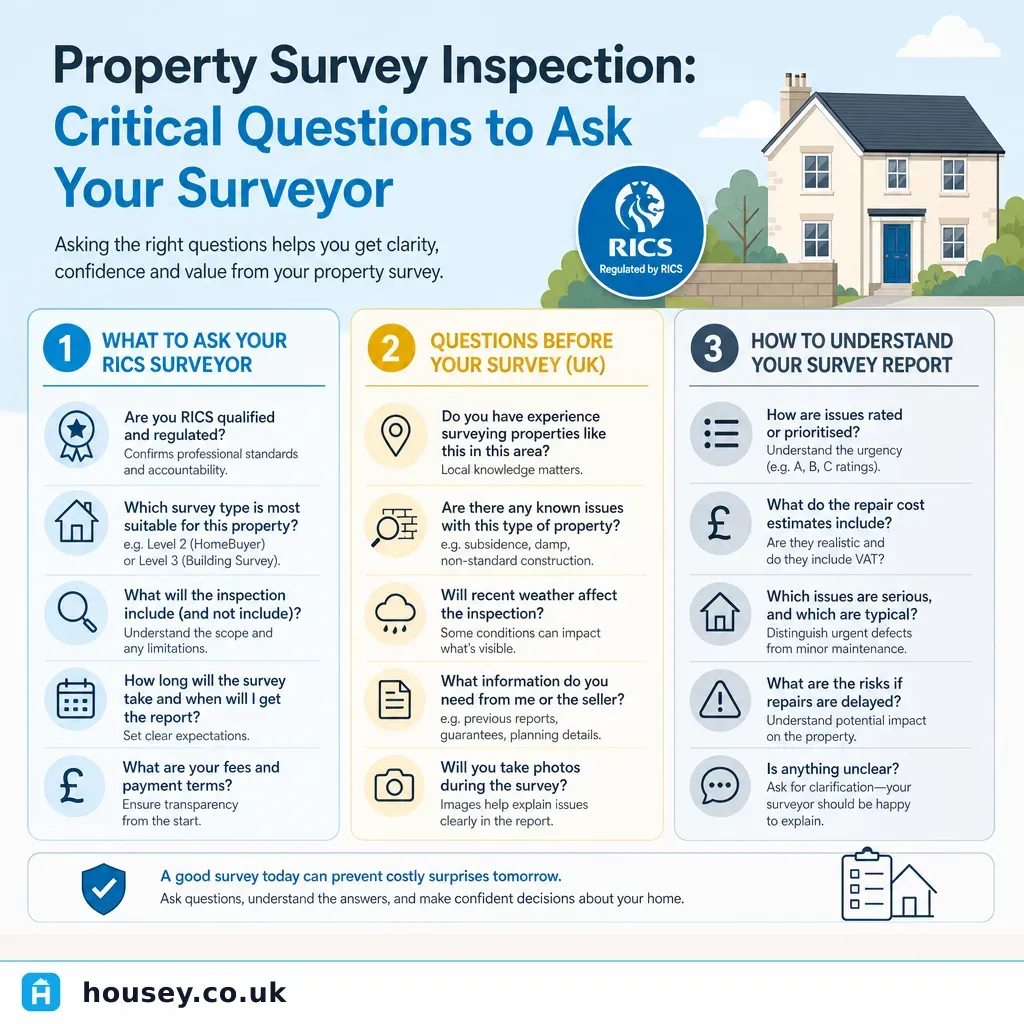
Property Survey Inspection: Critical Questions to Ask Your Surveyor
Before instructing a surveyor, ask which RICS level suits your property and what the report will and will not cover.
 Surveys & Inspections
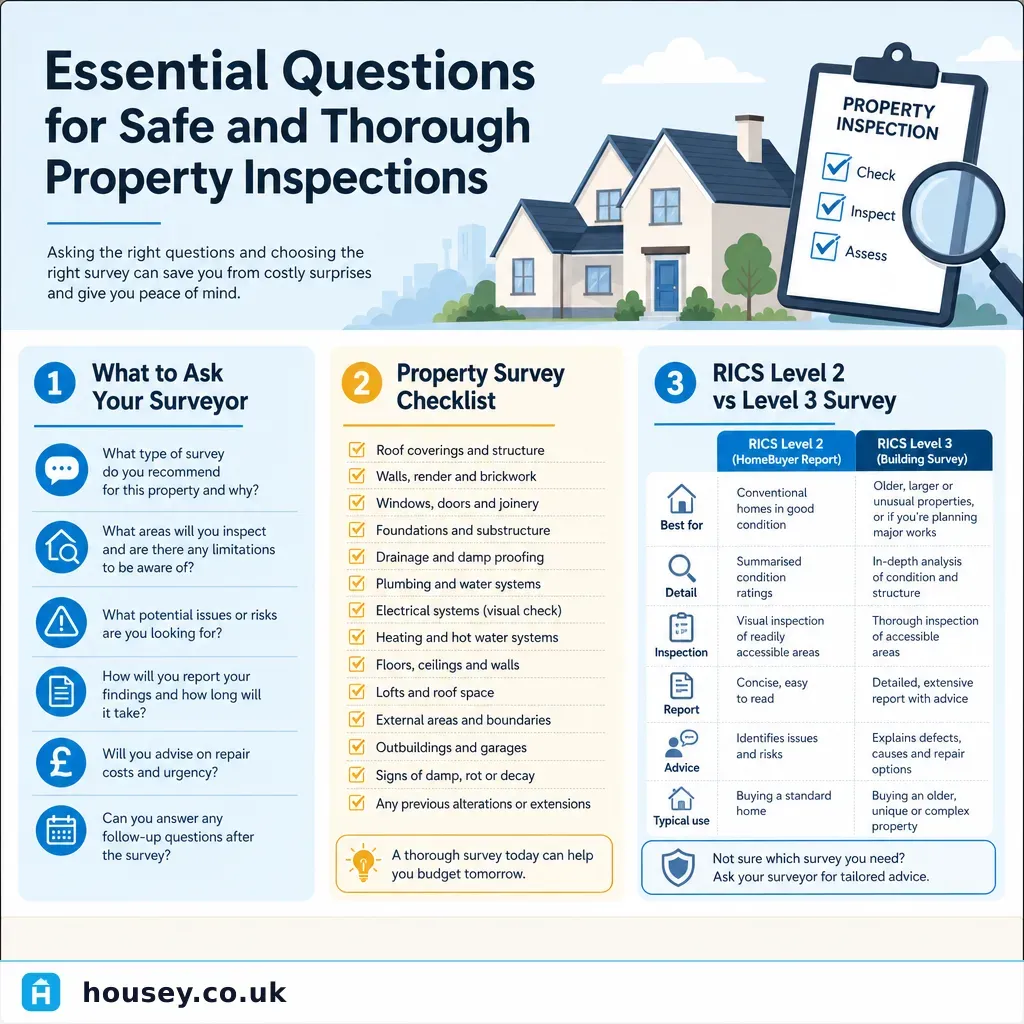
Essential Questions for Safe and Thorough Property Inspections
Before commissioning a property survey, confirm what type of inspection suits your property's age and condition, ask the surveyor what defects they will and will not assess, and understand what the report will recommend.
 Surveys & Inspections
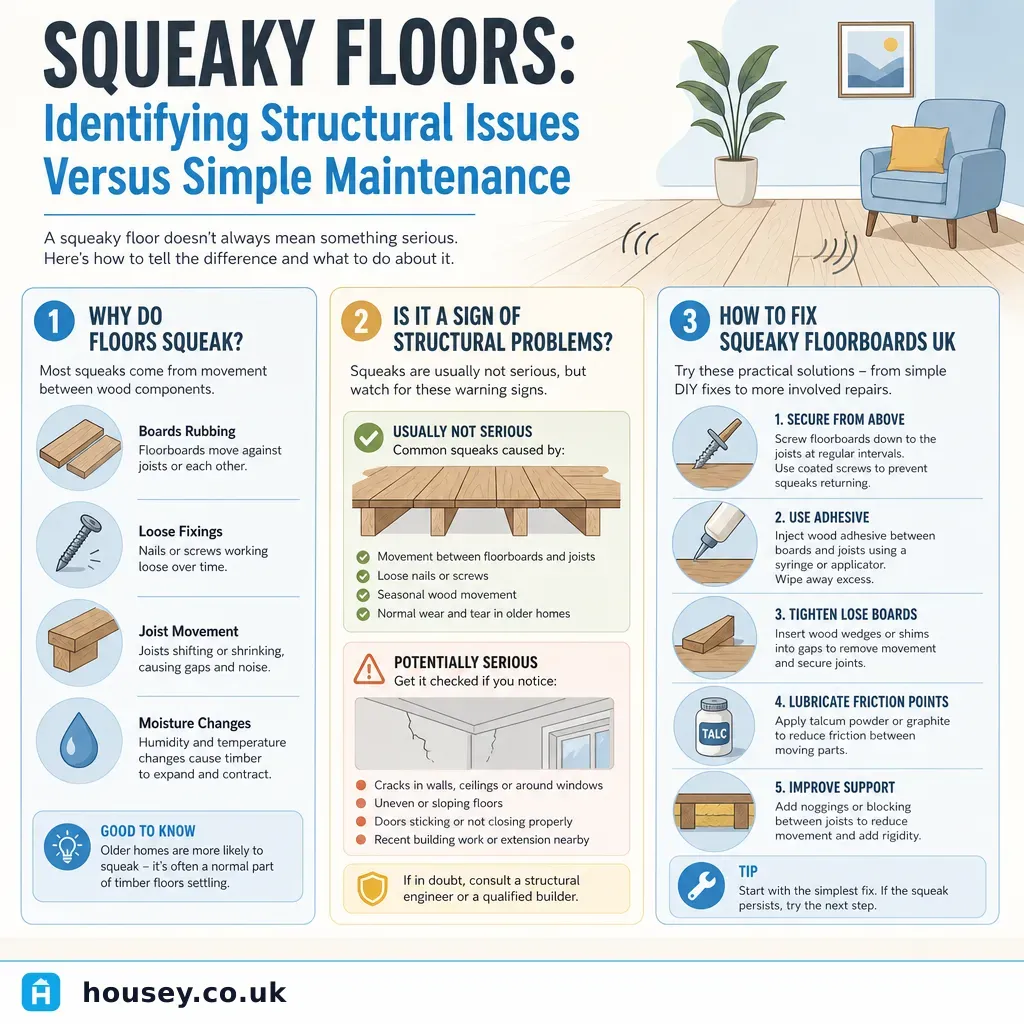
Squeaky Floors: Identifying Structural Issues Versus Simple Maintenance
Most squeaky floors in UK homes are caused by floorboards rubbing against each other or against fixings as they expand and contract — a maintenance issue rather than a structural one.
 Surveys & Inspections
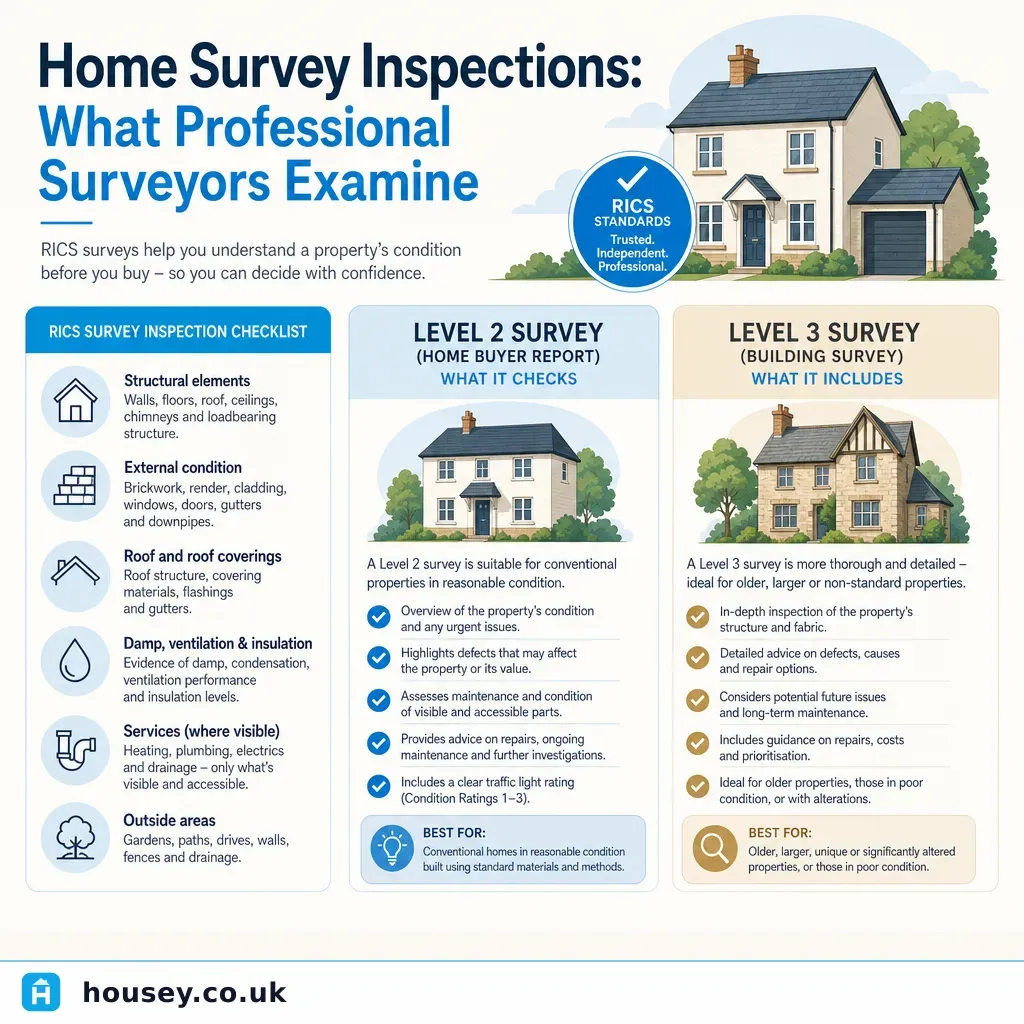
Home Survey Inspections: What Professional Surveyors Examine
A RICS home survey involves a visual inspection of a property's structure, roof, walls, floors, and services.