Spring Property Inspection Checklist: Essential Checks Before Summer
By Housey · Last reviewed 12th of May 2026
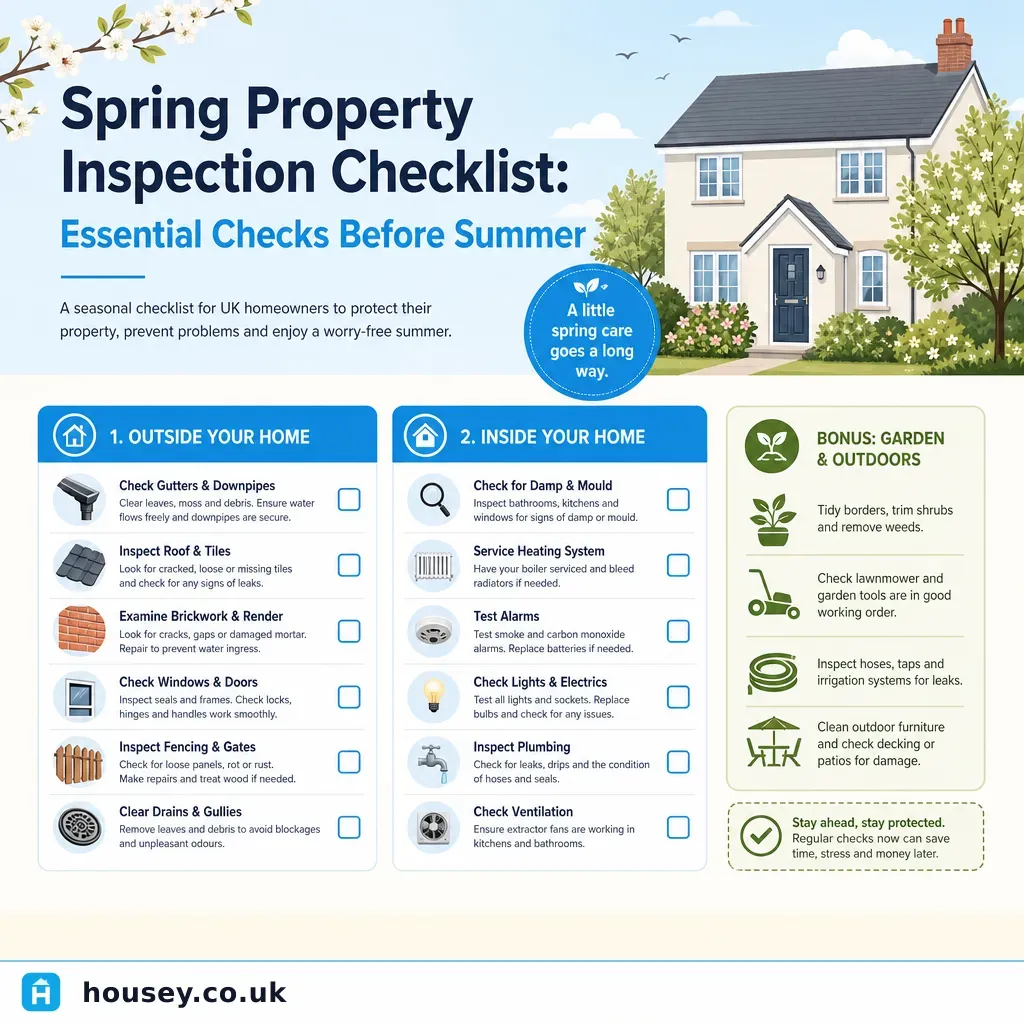
Spring Property Inspection Checklist: Essential Checks Before Summer
The months immediately after winter are the best opportunity to catch damage before it deepens through wetter spring weather and into summer. Freeze-thaw cycles, wind-driven rain, and sustained low temperatures stress UK building fabric — particularly in older properties — and many faults become visible only once conditions stabilise. A systematic spring walkthrough costs nothing and can prevent small maintenance issues from becoming significant repair bills later in the year.
Key points
- The UK's freeze-thaw cycle causes mortar joints, render, and leadwork flashings to crack more aggressively than continuous cold alone; post-winter is the first opportunity to assess accumulated damage after a typical British heating season.
- Blocked gutters are among the most common causes of damp ingress in UK homes; the Association of British Insurers consistently lists water damage among the most frequently claimed property losses each year.
- RICS Home Survey condition ratings classify defects as Category 1 (no action needed), Category 2 (repair or monitor), and Category 3 (urgent attention required); knowing which category a defect falls into helps you prioritise.
- Signs of structural movement — stepped cracking through masonry, diagonal cracks that follow mortar joints, or new difficulty operating doors and windows — warrant professional assessment rather than self-monitoring.
- Energy Saving Trust guidance indicates that poorly sealed windows and doors can add meaningfully to annual heating bills; spring is an efficient time to renew weatherstripping and draught seals before the next heating season.
The spring homeowner inspection checklist
Work through each area methodically. Most checks can be completed safely from ground level; use binoculars for roofline detail. Do not access the roof without appropriate equipment and training — working at height above 2 m carries serious risk and should be left to professionals.
Roof and roofline
Gutters and drainage
External walls
Windows and doors
Internal indicators of external problems
Which professional do you need?
Defect found | First call | What to check |
|---|---|---|
Missing or slipped roof tiles | Roofing contractor | NFRC membership; public liability insurance |
Cracking in masonry | RICS surveyor or structural engineer | Pattern and width — see decision guide below |
Persistent damp ingress | RICS surveyor or independent damp specialist | Avoid firms that diagnose and sell remediation products |
Failing flat roof | Flat-roofing specialist | NFRC membership; written specification before works |
Blocked or failing drains | Drainage contractor | CCTV survey recommended for persistent problems |
Window or door replacement | FENSA-registered installer | FENSA certification is required for replacement windows in England and Wales |
Blocked chimney or flue | HETAS-registered sweep | Annual sweep recommended for solid-fuel appliances |
When to escalate: a decision guide
- Monitor yourself if cracks are hairline (under 1 mm), follow no particular pattern, and have been stable and unchanged for several years.
- Book a maintenance contractor if gutters, mortar pointing, flashings, or draught seals need straightforward repair and there are no signs of structural movement.
- Commission a RICS Home Survey if multiple defects appear together, the property is over 50 years old, or you are planning to buy or sell within the next 12 months.
- Arrange a roof survey if you have spotted tile movement or staining at roofline level, or if the roof has not been inspected in the past 10 years.
- Request a specific defect survey if a single concern — such as damp in one room or cracking on one elevation — needs targeted professional diagnosis.
- Instruct a structural survey if cracks are wider than 5 mm, stepped diagonally through masonry, or accompanied by leaning walls, sagging floors, or doors that will not close.
- Call an emergency contractor if the roof is actively leaking into habitable space or there is any visible risk of imminent structural failure.
When to get professional help
A homeowner inspection identifies where to look — it cannot diagnose severity or root cause. If your spring walkthrough has revealed cracks you cannot classify, damp you cannot trace, or roof damage that is unclear from ground level, a professional assessment is the appropriate next step. A qualified RICS surveyor can assign condition ratings, identify root causes, and produce a prioritised repair plan backed by professional indemnity insurance.
Properties built before 1919, those with significant alterations, and those approaching a sale or purchase particularly benefit from a formal RICS Home Survey rather than reliance on a homeowner inspection alone.
How Housey can help
Housey connects homeowners across the UK with qualified surveyors, roof specialists, and inspection professionals. If your spring inspection has raised questions that go beyond routine maintenance, a RICS Home Survey provides a formal condition report, prioritised recommendations, and the detail you need to plan this year's repairs with confidence.
Frequently asked questions
How often should I carry out a property inspection?
Once a year — ideally in spring — is a reasonable baseline for most UK homes. Properties over 50 years old, those in exposed coastal or upland locations, and those that have had extensions or loft conversions may benefit from a second check in autumn, particularly after summer works or before the heating season begins when draught issues become apparent.
Can I carry out a property inspection myself?
Yes, a ground-level visual walkthrough is achievable by any homeowner and is a useful first step. You should not access the roof without appropriate safety equipment; for roofline detail, use binoculars from a safe vantage point. A professional survey is not a substitute for regular homeowner vigilance, and a homeowner check is not a substitute for a professional report when defects are found.
What does a RICS condition rating mean?
RICS Home Surveys use a traffic-light condition rating system. Category 1 (green) means no immediate repair needed. Category 2 (amber) means defects that should be repaired or monitored. Category 3 (red) means serious defects requiring urgent attention — and, in a purchase context, attention before exchange. Understanding the category helps you prioritise budget and urgency correctly.
What is the difference between a roof survey and a general home survey?
A RICS Home Survey covers the whole property and gives condition ratings for all main elements. A specialist roof survey focuses exclusively on the roof covering, structure, flashings, and drainage, and may include a closer inspection from roof level or via drone. A roof survey is appropriate when the main concern is the roofline and you need more detail than a general survey can provide.
Sources and further reading
- RICS Home Survey Standard — Royal Institution of Chartered Surveyors (RICS)
- Draught-proofing your home — Energy Saving Trust
- FENSA: competent persons scheme for windows and doors — FENSA
- Find a roofing contractor — National Federation of Roofing Contractors (NFRC)
- Approved Document C: site preparation and resistance to contaminants and moisture — GOV.UK
Useful next reads
 Surveys & Inspections
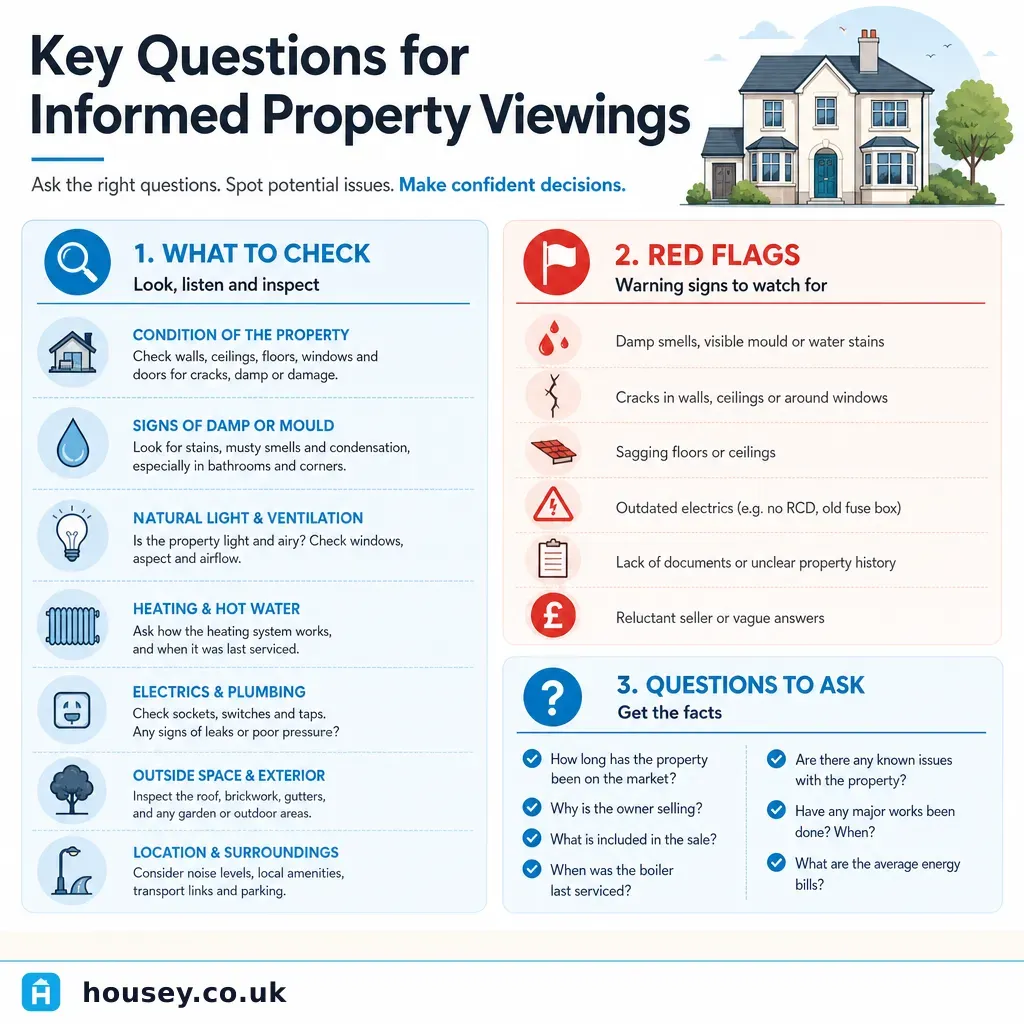
Key Questions for Informed Property Viewings
At a property viewing, ask specifically about structural movement, damp or water ingress, the age and service history of the boiler and electrics, whether any extensions obtained building regulations sign-off, and the seller's chain position.
 Surveys & Inspections
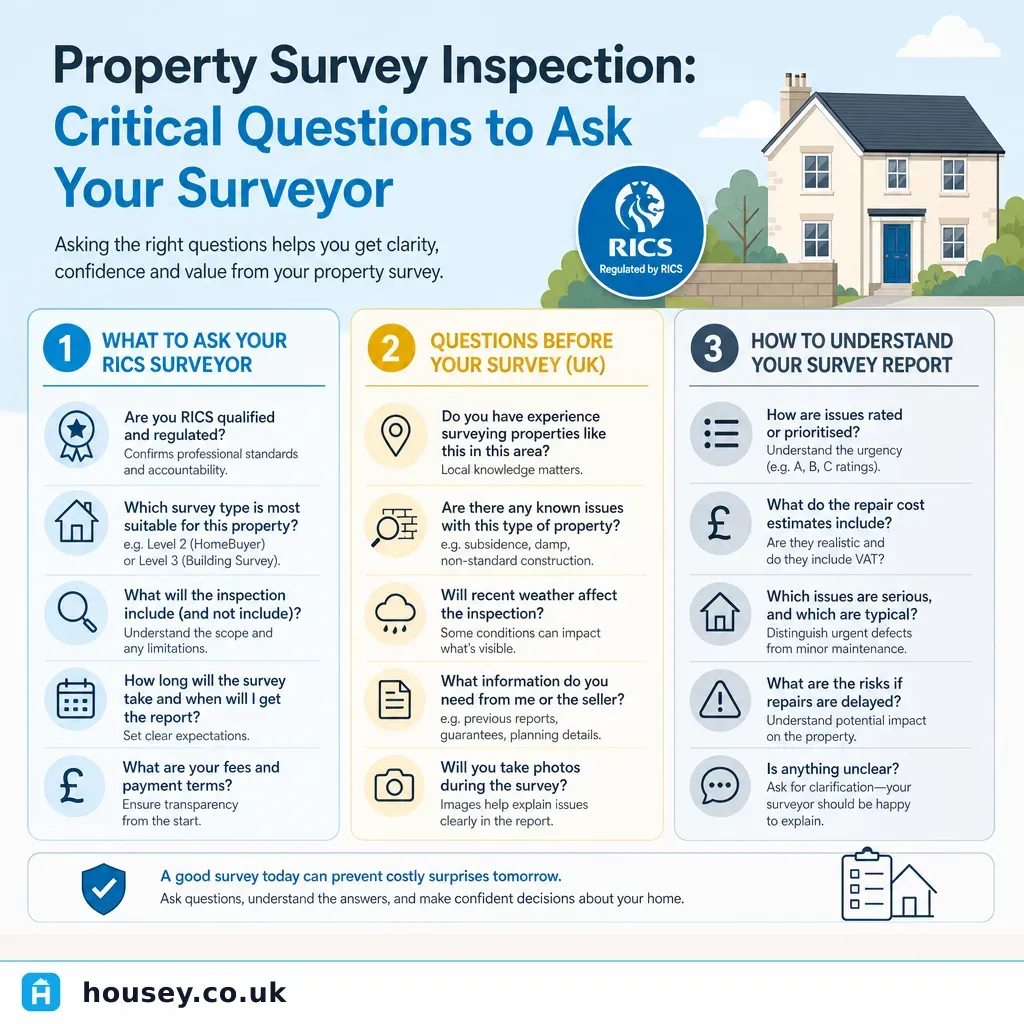
Property Survey Inspection: Critical Questions to Ask Your Surveyor
Before instructing a surveyor, ask which RICS level suits your property and what the report will and will not cover.
 Surveys & Inspections
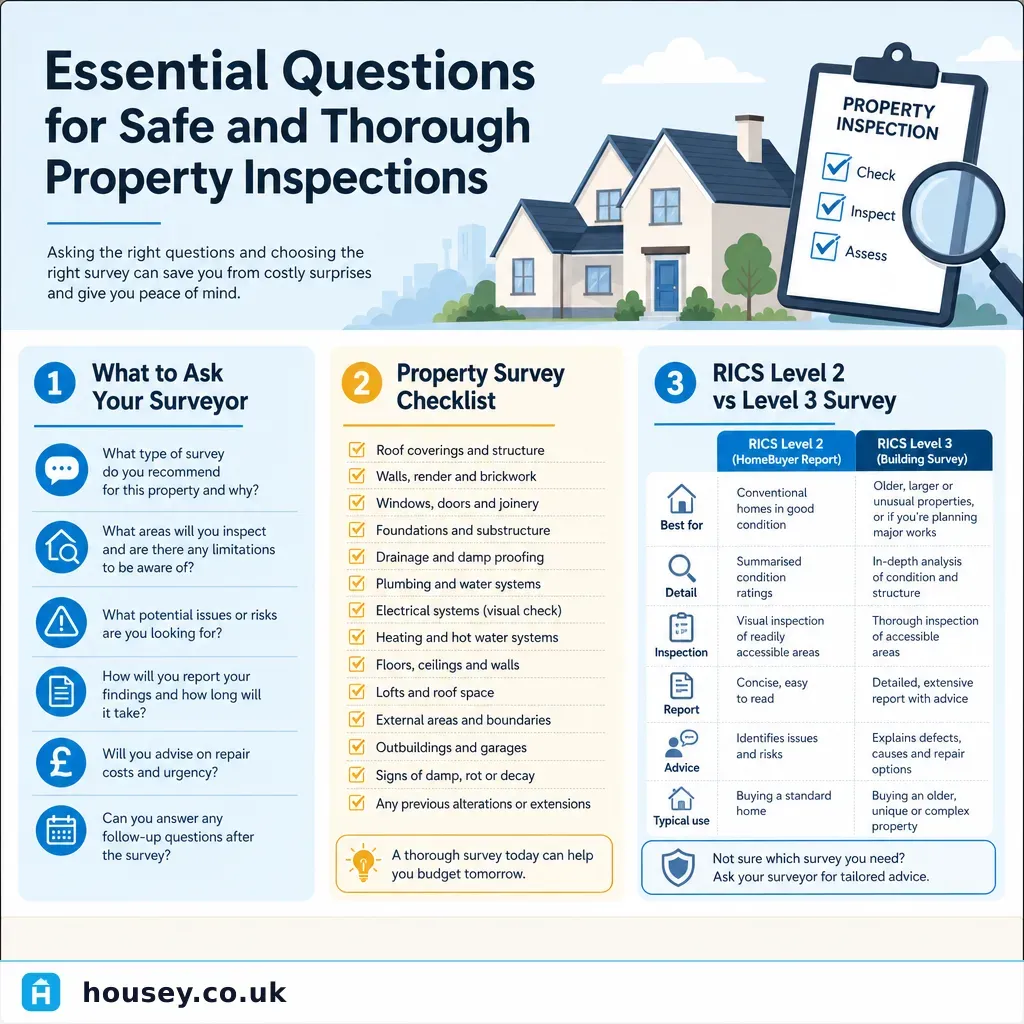
Essential Questions for Safe and Thorough Property Inspections
Before commissioning a property survey, confirm what type of inspection suits your property's age and condition, ask the surveyor what defects they will and will not assess, and understand what the report will recommend.
 Surveys & Inspections
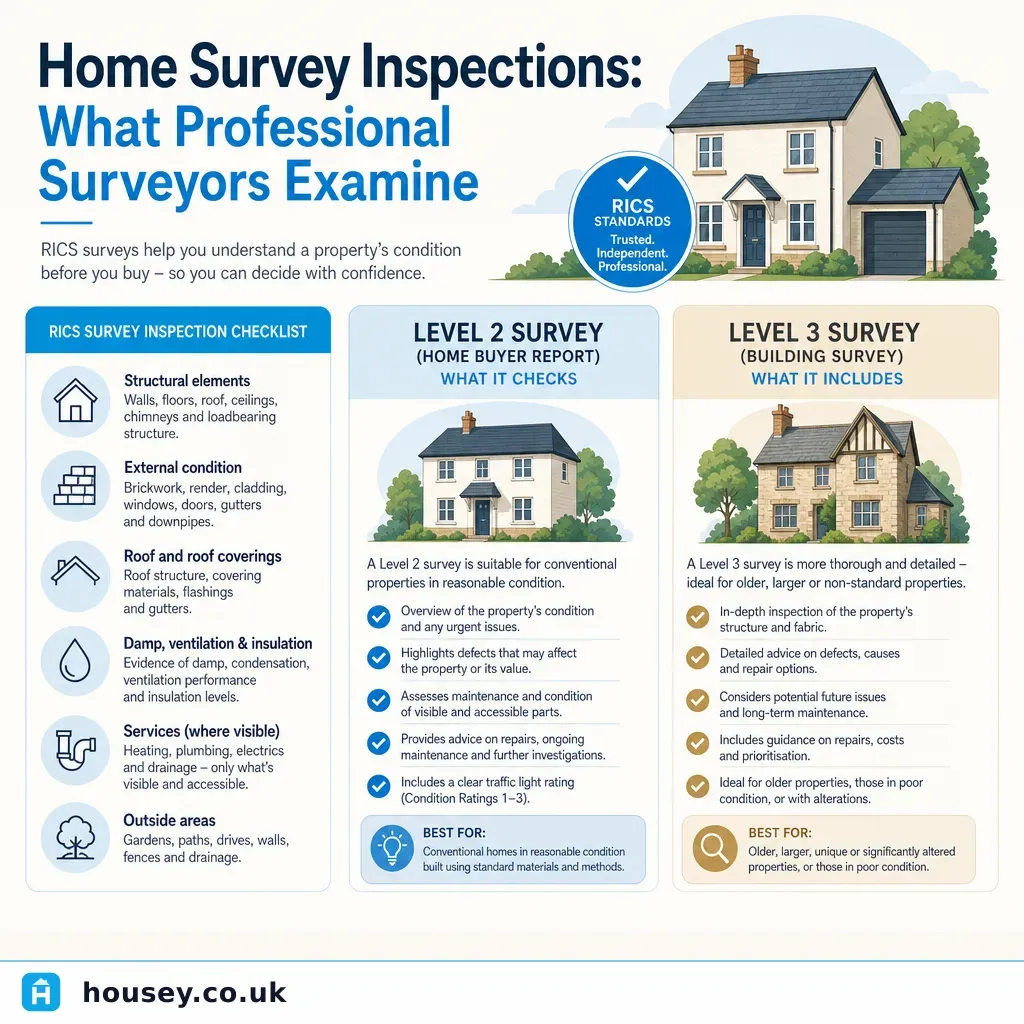
Home Survey Inspections: What Professional Surveyors Examine
A RICS home survey involves a visual inspection of a property's structure, roof, walls, floors, and services.
 Surveys & Inspections
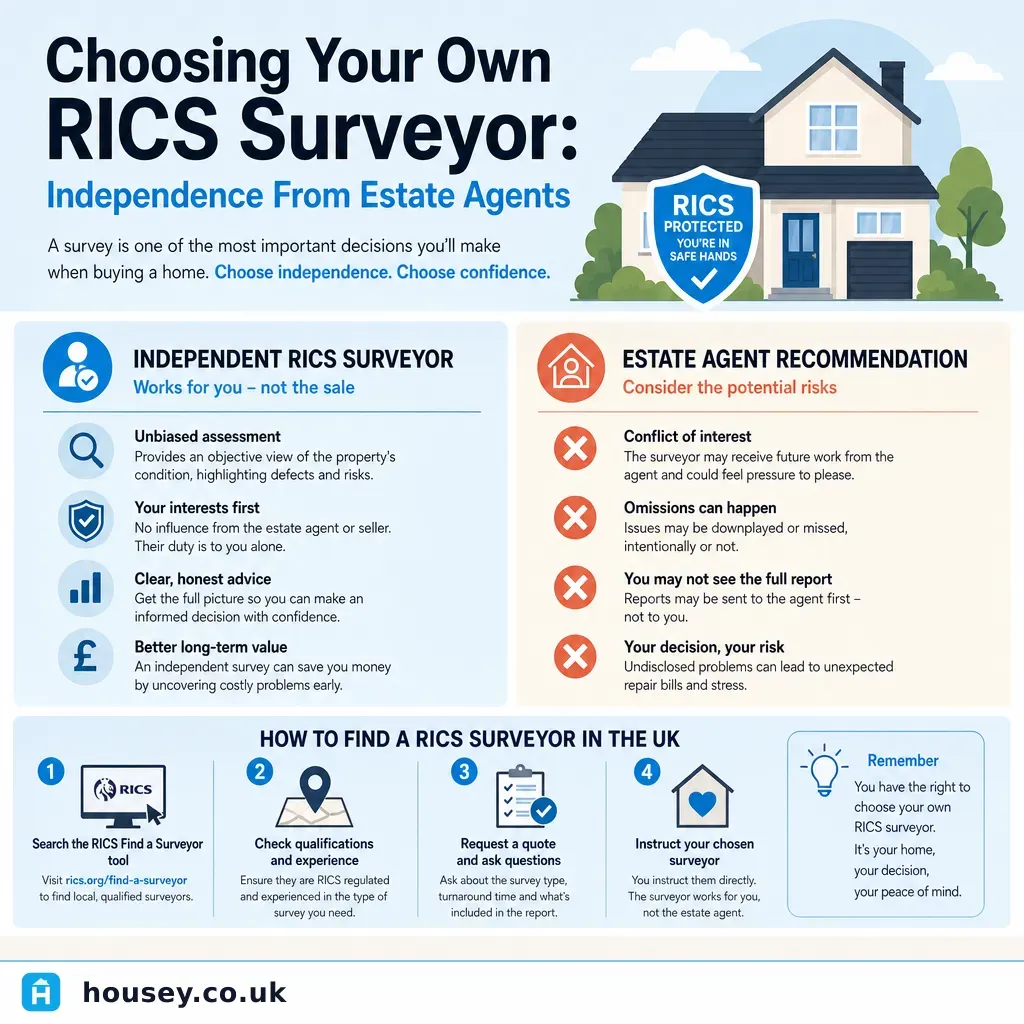
Choosing Your Own RICS Surveyor: Independence From Estate Agents
You have every right to choose your own RICS surveyor independently of your estate agent's recommendation.