Squeaky Floors: Identifying Structural Issues Versus Simple Maintenance
By Housey · Last reviewed 12th of May 2026
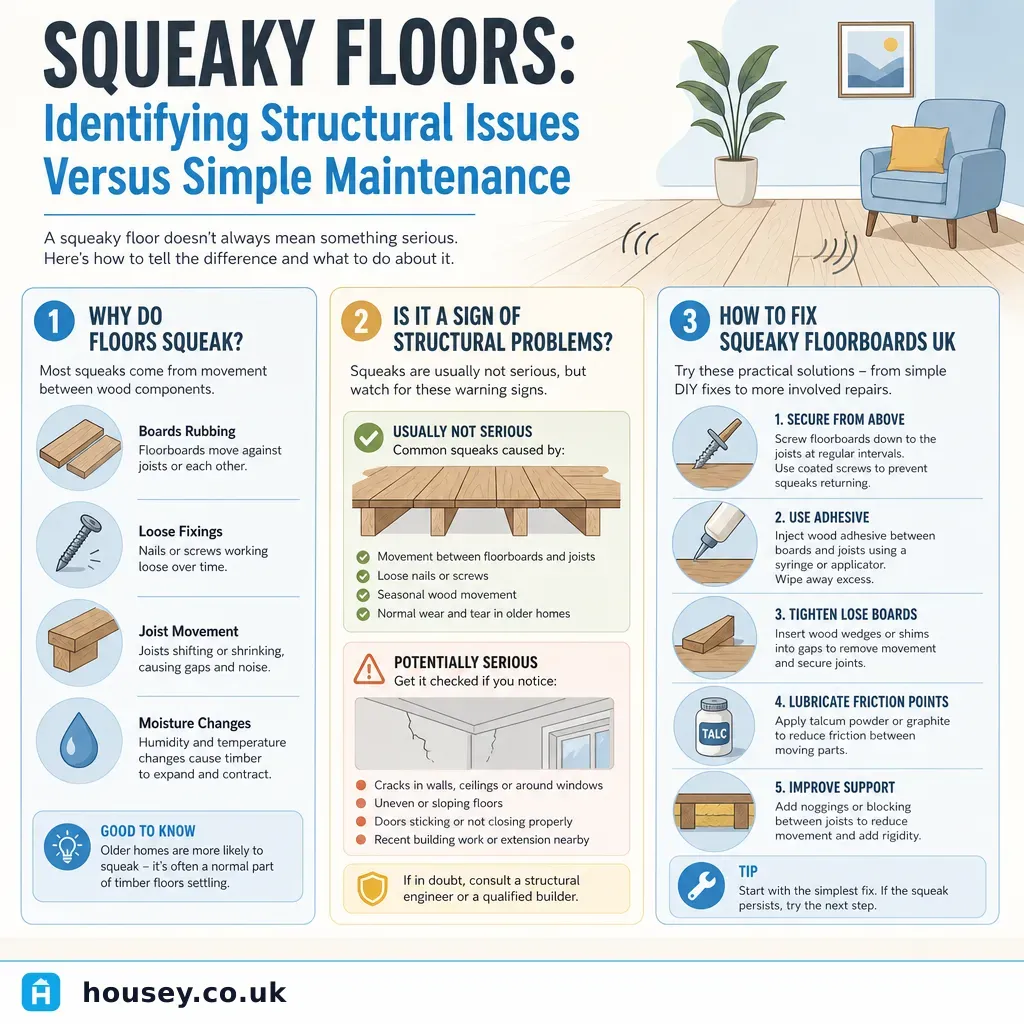
Squeaky Floors: Identifying Structural Issues Versus Simple Maintenance
A squeaky floor is one of the more unsettling sounds a UK home can produce — particularly in Victorian terraces, Edwardian semis, and other properties with suspended timber floors now approaching 100 years old or more. Most squeaks are harmless and reflect the natural movement of timber as it responds to seasonal humidity and temperature shifts. However, some squeaking patterns — particularly those accompanied by visible deflection, soft spots underfoot, or a sudden change in character — can indicate something more serious that warrants a professional assessment.
Key points
- The majority of squeaky floors in UK homes are caused by floorboards or joists rubbing against each other, against fixings, or against pipe and cable penetrations — a maintenance issue rather than a structural one.
- Suspended timber ground floors in pre-1919 UK housing depend on adequate subfloor ventilation; blocked or insufficient air bricks are among the most common contributors to joist decay and subsequent floor movement.
- A floor that gives underfoot, feels springy over a localised area, or shows visible deflection when walked on is more likely to indicate structural concern than one that simply squeaks at a fixed point.
- A RICS Level 3 Building Survey is the appropriate professional report when structural floor defects are suspected; a specific defect survey is a targeted alternative for an isolated problem area.
- Joist decay caused by wet rot — commonly linked to poor subfloor ventilation, rising damp, or undetected plumbing leaks — can remain invisible from above until significant structural capacity has already been lost.
What causes squeaky floors?
Boards rubbing on boards
As timber dries and shrinks over decades, small gaps open between boards. When weight is applied, adjacent boards flex and rub against each other at these contact points. This is extremely common in pre-war properties with original softwood boards and is almost never a structural concern on its own.
Board-to-fixing movement
In older UK homes, the square-cut nails used to fix floorboards can work progressively loose as the timber moves seasonally. The board lifts fractionally with each step and drops back onto the nail shank, producing a repetitive creak. The squeak is often more pronounced in winter when central heating dries the air and the timber contracts.
Joist bridging and pipe contact
Boards that rest against a pipe, cable conduit, or a poorly fitted noggin (a blocking timber fitted between joists) can produce a creak at one very specific point. This type of squeak typically remains consistent in the same location with each step and does not spread.
Structural causes: joist decay or movement
These are less common but more significant. Signs that differentiate a structural cause from a cosmetic one include:
- The floor surface visibly deflects as you walk across it, beyond a slight bounce.
- A localised area feels noticeably soft or spongy compared with adjacent boards.
- A strong musty or earthy smell accompanies the movement, particularly in ground-floor rooms above a suspended void.
- The squeak has changed markedly in character, frequency, or affected area over a short period.
- Cracking has appeared at ceiling level in the room below, corresponding geographically with the affected floor.
Decision guide: maintenance issue or structural concern?
- Likely maintenance if the squeak is limited to specific boards, has been present for years without changing, and the floor is firm and solid underfoot with no visible deflection.
- Investigate further if the squeak is widespread across a room, has worsened noticeably over recent months, or occurs across an area that also feels slightly springy when walked on.
- Instruct a surveyor if any part of the floor feels soft underfoot, if there is visible sag or deflection, if a musty smell accompanies the movement, or if you are buying or selling the property and want formal documented assurance.
- Instruct a structural engineer if floor sag is pronounced, if cracking at ceiling level below corresponds with the area of concern, or if a surveyor has already identified joist decay and you need a detailed remediation specification.
- Act immediately if there is any reason to suspect an active plumbing leak beneath the floor — moisture ingress is the leading cause of rapid joist deterioration in UK suspended timber floor construction and can progress quickly.
Comparing causes: maintenance fix versus structural investigation
Situation | Likely cause | Recommended action | Professional needed? |
|---|---|---|---|
Isolated squeak, floor firm underfoot | Loose board or worn nail | Screws through boards into joists | No — homeowner or carpenter |
Widespread squeak, floor solid | Seasonal timber movement | Monitor; improve room humidity control | No |
Soft or spongy area, ground floor | Possible joist decay or wet rot | Lift a board to inspect; commission professional assessment | Yes — RICS surveyor or structural engineer |
Squeak with visible floor sag | Joist failure or undersized joists | Professional structural assessment | Yes — structural engineer |
Squeak plus musty smell in subfloor | Active rot or inadequate ventilation | Check and clear air bricks; commission professional assessment | Yes — surveyor and builder |
New squeak following plumbing work | Pipe contact or moisture damage | Trace to pipework; check for active leak | Yes if damp is suspected |
Indicative guidance, last reviewed 2026-05-12. Specific situations vary — professional assessment recommended where any structural concern exists.
Red flags: when a squeaky floor needs professional attention
These signs indicate you should move beyond monitoring and seek a professional inspection promptly:
- Visible deflection — the floor surface visibly dips or waves as you walk across it, not just a slight bounce.
- Soft spot — any localised area where the floor gives more than adjacent boards, particularly on ground floors over a suspended void.
- Musty or earthy smell — especially in ground-floor rooms with suspended timber construction; this often indicates active wet rot in the subfloor joists.
- Blocked or absent air bricks — external ventilation bricks are inadequate in number, visibly blocked by soil or paving, or missing altogether; good subfloor ventilation is critical and often neglected.
- Associated ceiling cracks — cracking in the ceiling of the room below corresponds geographically with the area of floor concern.
- Plumbing history — a known leak, past flooding, or recent plumbing works in or near the affected area raises the risk of undetected moisture damage to joists.
- Property transaction — if you are buying or selling and a squeaky or soft floor has been noted, a formal inspection provides documented assurance or appropriate caveats for negotiation.
When to get professional help
If your floor shows any of the red flags above, the appropriate first call is a qualified building surveyor rather than a building contractor. A specific defect survey gives a targeted assessment of the affected area, including recommendations on whether a carpenter's repair, a structural engineer's input, or full joist replacement is warranted. For older properties or where the concern is widespread, a structural survey provides a comprehensive assessment of the floor and any connected structural elements.
Do not delay if you suspect active rot or an ongoing plumbing leak. Moisture damage to timber can progress quickly once established, and the cost of professional investigation is substantially lower than the cost of extensive joist replacement discovered too late.
How Housey can help
Housey connects UK homeowners with qualified surveyors who can diagnose floor problems accurately. If you are unsure whether a squeak is cosmetic or structural, a specific defect survey gives you a targeted professional opinion. Where a wider assessment is appropriate, our structural survey service connects you with chartered engineers and building surveyors across the UK.
Frequently asked questions
Are squeaky floors always a sign of a problem?
Not always. Most squeaks in UK homes — particularly in Victorian and Edwardian properties with suspended timber floors — are caused by normal board and joist movement as timber responds to seasonal humidity changes. A squeak that has been present for years, is limited to specific boards, and is accompanied by a firm, solid floor underfoot is usually a maintenance issue rather than a structural concern.
What is a suspended timber floor and why is subfloor ventilation important?
A suspended timber floor is a ground floor built from joists spanning between wall plates, with boards fixed above and a void beneath. That void must be ventilated through air bricks in the external walls to prevent moisture build-up. Poor ventilation allows humidity to accumulate below, promoting fungal growth and wet rot in the joists — a common root cause of structural floor problems in pre-war UK housing.
How much does a specific defect survey cost for a floor problem?
Costs vary by property size, location, and the complexity of access needed. As a rough guide, specific defect surveys typically cost £200–£500 (Indicative UK costs, last reviewed 2026-05-12). A structural engineer's inspection and report tends to cost more, particularly where calculations or a remediation specification are needed. Always ask what the report will cover and what access is required before instructing.
Can I fix squeaky floorboards without lifting them?
For superficial board-to-board squeaks, some approaches — such as dry lubricant worked into the joint, or screws driven into joists at an angle — can help without full board removal. However, these address symptoms rather than causes. If the squeak is caused by joist movement, decay, or loose fixings at depth, lifting the relevant boards is the only reliable way to diagnose and properly repair the underlying problem.
Sources and further reading
- RICS Home Survey Standard — Royal Institution of Chartered Surveyors (RICS)
- Approved Document A: structure — GOV.UK (Building Regulations)
- BRE: dampness in buildings — Building Research Establishment (BRE)
- Maintaining traditional buildings — Historic England
Useful next reads
 Surveys & Inspections
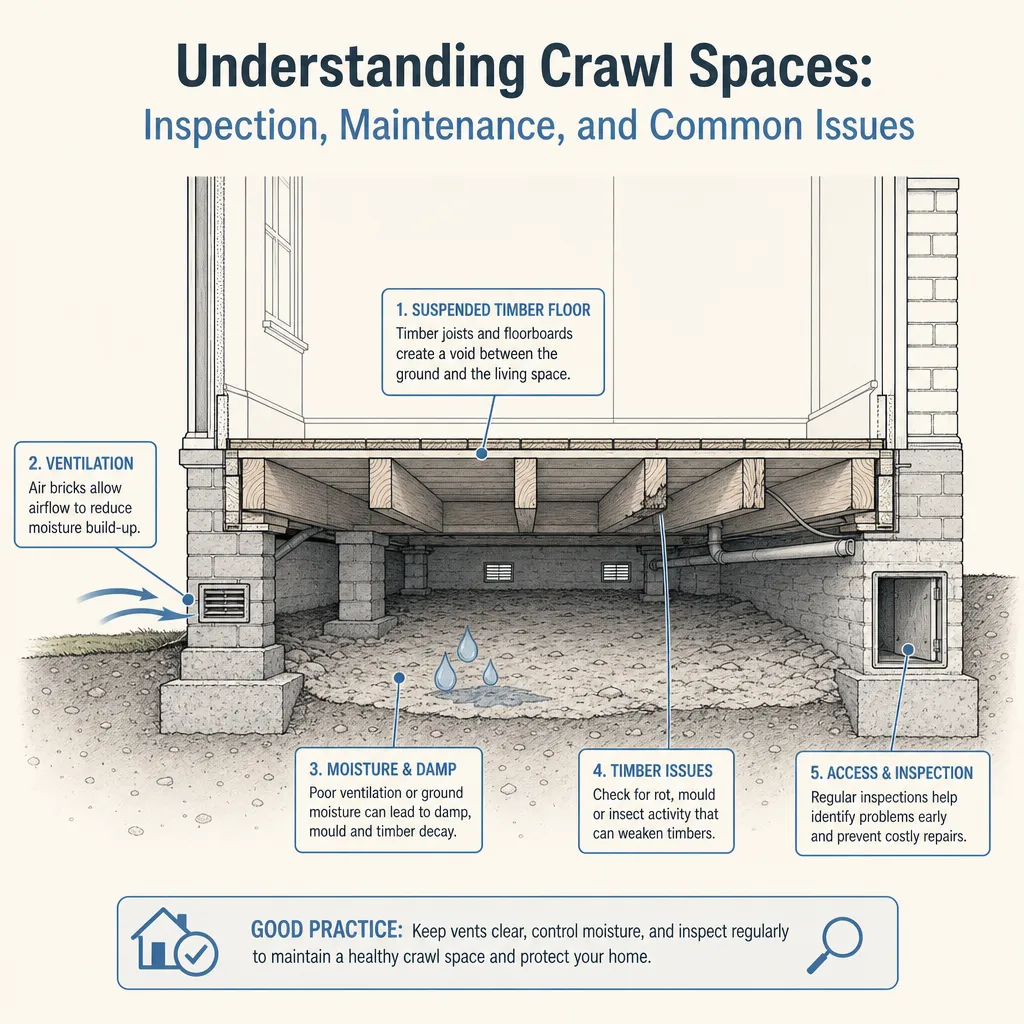
Understanding Crawl Spaces: Inspection, Maintenance, and Common Issues
Sub-floor voids beneath suspended timber ground floors in pre-1960 UK homes need cross-ventilation through airbricks to prevent dry rot and wet rot in floor timbers.
 Surveys & Inspections
Flat Roof Leaks: Identification, Diagnosis, and Repair
A flat roof leak rarely enters directly above the visible damp patch — water typically tracks along the roof deck before it appears inside.
 Surveys & Inspections
Annual Home Maintenance Checklist and Schedule
A structured annual maintenance schedule helps UK homeowners catch small problems before they become costly repairs.
 Surveys & Inspections
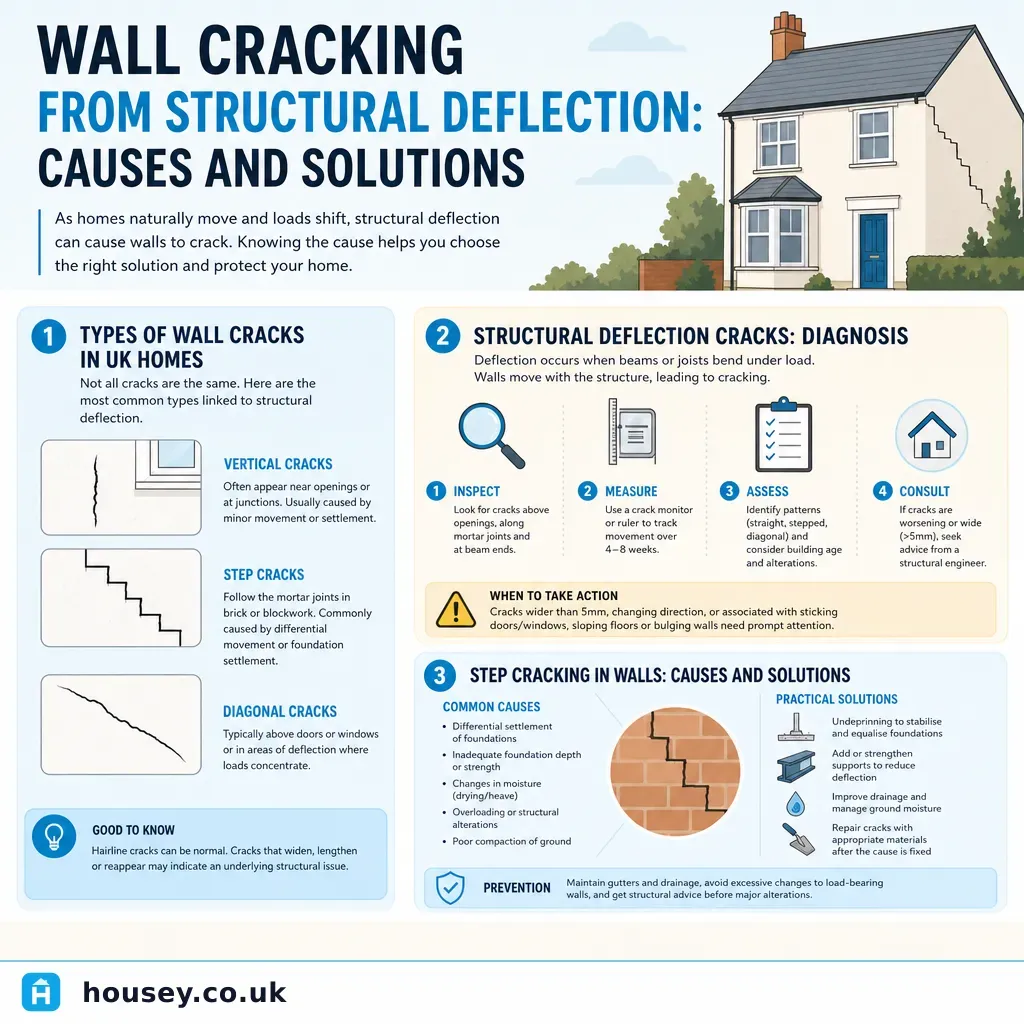
Wall Cracking from Structural Deflection: Causes and Solutions
Structural deflection occurs when a beam, floor, or lintel sags under load, transferring stress into surrounding masonry and causing characteristic cracks.
 Surveys & Inspections
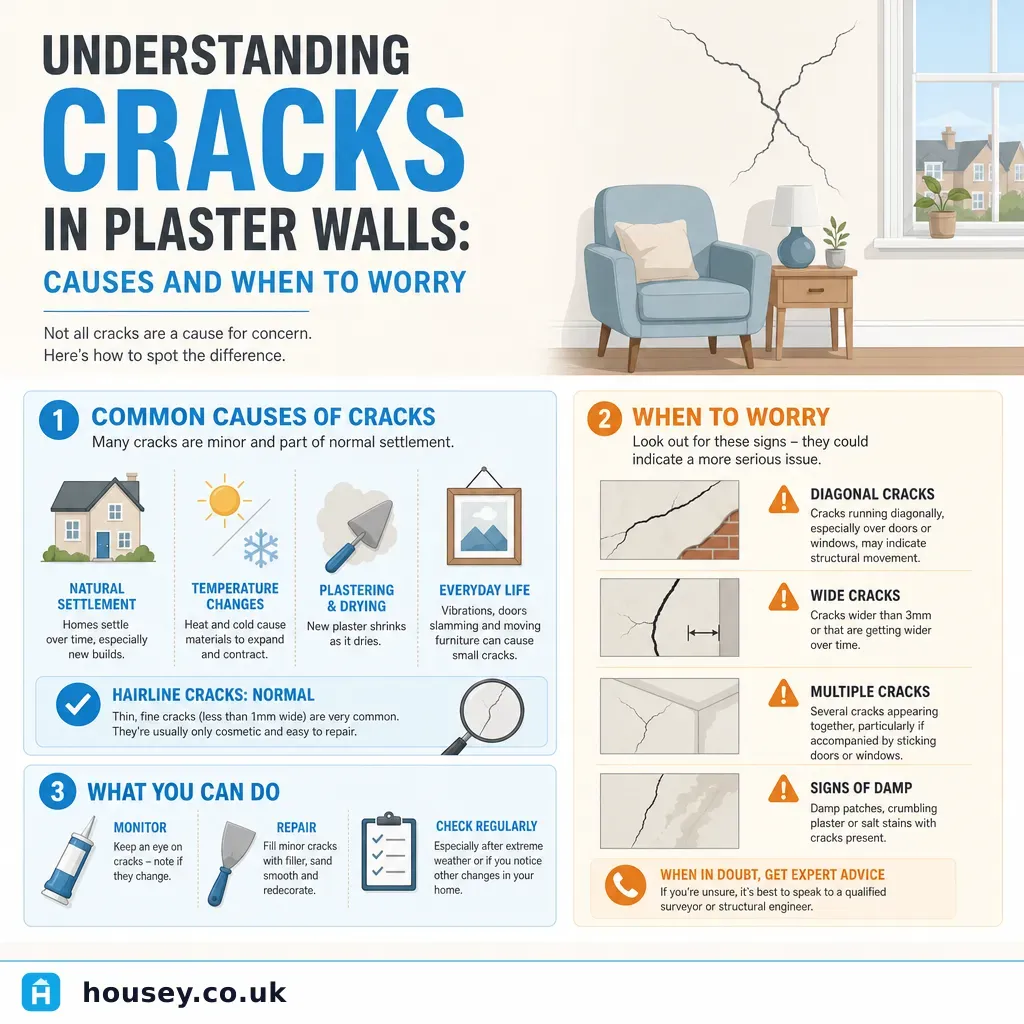
Understanding Cracks in Plaster Walls: Causes and When to Worry
Most hairline plaster cracks are cosmetic, caused by seasonal shrinkage or minor settlement.