Common Legal Questions From Property Purchasers and Legal Advisors
By Housey · Last reviewed 30th of May 2026

Common Legal Questions From Property Purchasers and Legal Advisors
The conveyancing process generates more questions than almost any other stage of a property purchase — and understandably so. Between instructing a solicitor and receiving the keys, buyers must navigate title investigations, property searches, contract negotiations, mortgage conditions, and the co-ordination of exchange and completion. Knowing which questions to ask, and when to ask them, helps prevent delays, financial surprises, and legal disputes after you move in.
Key points
- Conveyancing in England and Wales typically takes 8–16 weeks from instruction to completion; complex chains, leasehold transactions, or title issues can extend this significantly.
- Your solicitor must carry out a minimum set of property searches — including local authority, drainage and water, and environmental searches — before exchange of contracts.
- Exchange of contracts creates a legally binding obligation to complete; withdrawing after exchange typically forfeits the buyer's deposit, usually 10% of the purchase price.
- Leasehold properties require additional due diligence: service charge history, ground rent terms, lease length, and management company obligations all need checking before exchange.
- Property information is disclosed mainly through the TA6 Property Information Form and TA10 Fittings and Contents Form — misleading answers by a seller can give rise to a misrepresentation claim.
What does a conveyancing solicitor actually do?
A conveyancing solicitor (or licensed conveyancer) acts on your behalf to investigate the legal title to the property, carry out searches, raise enquiries with the seller's solicitor, review the contract, and manage the financial transactions at exchange and completion.
Key tasks your solicitor will handle:
- Checking the title register and title plan at HM Land Registry to confirm the seller's ownership and that boundaries match the description in the contract.
- Raising formal enquiries on matters arising from the title, the TA6 Property Information Form, or search results.
- Reporting findings to your mortgage lender (if applicable) and obtaining authority to draw down the mortgage advance on completion day.
- Preparing a completion statement setting out exactly how much money is required on the day.
- Registering the transfer of ownership and any new mortgage at HM Land Registry after completion.
Your solicitor must be regulated by the Solicitors Regulation Authority (SRA) or, if a licensed conveyancer, by the Council for Licensed Conveyancers (CLC).
What property searches are carried out and why?
Property searches are formal enquiries sent to third parties about matters affecting the property that would not be apparent from the title register alone.
Standard property searches
Search type | What it reveals | Who provides it |
|---|---|---|
Local authority search | Planning permissions, enforcement notices, road adoption, conservation or listed status, tree preservation orders | Local planning authority |
Drainage and water search | Whether the property drains to public sewer; location of public sewers on or near the site | Regional water company |
Environmental search | Flood risk, ground contamination, landfill proximity, radon levels | Commercial providers using Environment Agency data |
Chancel repair search | Potential liability to contribute to parish church repairs in historic areas | Commercial providers |
Mining search | Coal, tin, clay, or brine subsidence risk — location-dependent | The Coal Authority or specialist providers |
Additional searches — including highway adoption, HS2 proximity, commons registration, and specialist flood searches — may be recommended depending on the property's location and type.
Freehold vs leasehold: what buyers need to check
Around 4.6 million dwellings in England are leasehold, according to government figures from the Ministry of Housing, Communities and Local Government. Leasehold purchases require additional due diligence that freehold transactions do not.
Freehold vs leasehold comparison
Issue | Freehold | Leasehold |
|---|---|---|
Land ownership | Owner holds the land outright | Freeholder (landlord) retains ownership of the land |
Ongoing obligations | Maintenance of own property only | Ground rent, service charge, buildings insurance via freeholder |
Alterations | Subject to planning and building regulations only | May require a landlord's licence to alter |
Lease length | Not applicable | Lenders typically require 70–85 years remaining after the mortgage term; below 80 years triggers a premium on extension |
Resale considerations | No leasehold-specific constraints | Future buyers' solicitors will check lease length and charges |
Your solicitor should obtain a management information pack from the freeholder or managing agent, covering service charge accounts for the last three years, details of any planned major works, and the buildings insurance schedule.
Exchange and completion explained
Exchange of contracts is the point at which both buyer and seller sign identical contracts, which are then formally exchanged between solicitors. After exchange:
- The transaction is legally binding on both parties.
- The buyer pays a deposit (usually 10%, though this is negotiable).
- A fixed completion date is agreed and written into the contract.
Completion is the day legal ownership transfers. Your solicitor sends the purchase funds — including your mortgage advance — to the seller's solicitor. Once receipt is confirmed, the seller's solicitor authorises release of keys.
Decision tree: what happens if exchange or completion goes wrong?
- Seller withdraws before exchange: No legal remedy; either renegotiate or walk away. Consider requesting an exclusivity agreement in a competitive situation.
- Buyer withdraws before exchange: No financial penalty beyond solicitor fees and search costs already incurred.
- Seller withdraws after exchange: Buyer is entitled to return of the deposit plus interest, and may pursue specific performance or damages through the courts.
- Buyer withdraws after exchange: Seller may forfeit the deposit and sue for further losses if the property resells at a lower price.
- Completion is delayed: The contract specifies daily interest charges; a notice to complete can ultimately allow the non-defaulting party to rescind.
What to ask your solicitor: a checklist
Before instructing:
- Are you on my mortgage lender's approved panel?
- Who will handle my file day-to-day, and how will you keep me updated?
- Is your fee fixed, and which disbursements (search fees, Land Registry fees, Stamp Duty Land Tax filing) are additional?
- What is your estimated timescale given the current chain?
During the transaction:
- Have you received the draft contract pack from the seller's solicitor?
- Are there any title defects, restrictions, or covenants I should know about before exchange?
- What have the searches revealed, and are there any adverse findings?
- For leasehold: how long is the remaining lease, and what are the current service charge and ground rent terms?
What not to assume: common misunderstandings
- "My offer has been accepted — the deal is done." Until contracts are exchanged, either party can withdraw without legal penalty. Gazumping — where a seller accepts a higher offer from another buyer after agreeing yours — remains legal in England and Wales.
- "The survey and the solicitor's checks cover the same things." A surveyor assesses the physical condition of the building; a solicitor investigates the legal title, obligations, and search results. Both are necessary and entirely separate exercises.
- "The EPC tells me about energy running costs." An Energy Performance Certificate rates the property's energy efficiency but does not assess whether insulation has been correctly installed, whether a heating system is near end-of-life, or the likely actual running costs.
- "Leasehold is always inferior to freehold." Many leasehold properties are well-managed with long leases and reasonable charges. The quality of legal due diligence matters more than the tenure itself.
- "Completion means I can move in immediately." Keys are released once the seller's solicitor confirms receipt of funds, which can sometimes be mid-afternoon. Co-ordinate your removal company accordingly.
Important limitations
This article provides general information about the conveyancing process in England and Wales only. Property law, practice, search results, and local authority records vary significantly by property, location, tenure, and transaction. Nothing here constitutes legal advice. Always instruct a solicitor or licensed conveyancer regulated by the SRA or CLC, who can advise on the specifics of your purchase. The conveyancing process in Scotland and Northern Ireland differs materially.
When to get professional help
Instruct a solicitor or licensed conveyancer as soon as your offer is accepted — not at exchange. Delays in instructing push back search order dates and slow the whole chain. Seek specific professional advice without delay if:
- A title defect, restriction, or caution is registered at HM Land Registry.
- An environmental search shows contamination or confirmed flooding within the property boundary.
- The lease has fewer than 85 years remaining.
- Works have been carried out without building regulations approval — particularly structural, drainage, or electrical works.
- The seller is an estate and a grant of probate has not yet been obtained.
What to ask a qualified professional
Before instructing your solicitor:
- Are you regulated by the SRA or CLC?
- Do you regularly handle leasehold transactions, if the property is leasehold?
- What is your approach if the transaction stalls or significant issues arise in the searches?
If title or search problems emerge:
- Can an indemnity insurance policy resolve this issue, or does the seller need to remedy it?
- What does this restrictive covenant prevent me from doing, and is enforcement realistic in practice?
- What are my options if building regulations sign-off for previous works cannot be produced?
How Housey can help
Housey makes it straightforward to compare conveyancing solicitors and licensed conveyancers across the UK. Submit a brief for your transaction type and receive quotes from SRA- or CLC-regulated professionals who can guide you from offer acceptance to completion.
Frequently asked questions
What is the difference between exchange and completion?
Exchange is the moment when both parties sign and swap identical contracts, making the transaction legally binding and fixing the completion date. Completion is the day ownership actually transfers: your solicitor sends the purchase funds, the seller vacates, and keys are released. The gap between exchange and completion is typically one to four weeks, though same-day exchange and completion does occur — usually only in chain-free transactions.
How long does conveyancing take in England and Wales?
Most straightforward freehold transactions complete within 8–12 weeks of instruction. Leasehold purchases, properties in a long chain, or those with title complications often take 12–16 weeks or more. The most common causes of delay are slow responses to legal enquiries, missing documents, and mortgage offer conditions that require additional time to satisfy.
What is gazumping and is it legal?
Gazumping occurs when a seller accepts a higher offer from a different buyer after already agreeing yours, but before exchange of contracts. It is legal in England and Wales because no binding agreement exists until exchange. Buyers can seek some protection by requesting an exclusivity or lock-out agreement, though sellers are not obliged to grant one.
Does my solicitor act for me or for my mortgage lender?
Usually both. Most solicitors are permitted to act for buyer and lender in the same transaction, provided there is no conflict of interest. They have a duty to report material information about the property to the lender. If the lender is not on the solicitor's approved panel, you may need to fund a separate solicitor for the lender, which adds cost.
Sources and further reading
- Buying or selling your home — GOV.UK
- Solicitors Regulation Authority: using a solicitor — Solicitors Regulation Authority
- Council for Licensed Conveyancers — CLC
- Leasehold Advisory Service (LEASE) — LEASE
- Citizens Advice: buying a home — Citizens Advice
- HM Land Registry — HM Land Registry
Useful next reads
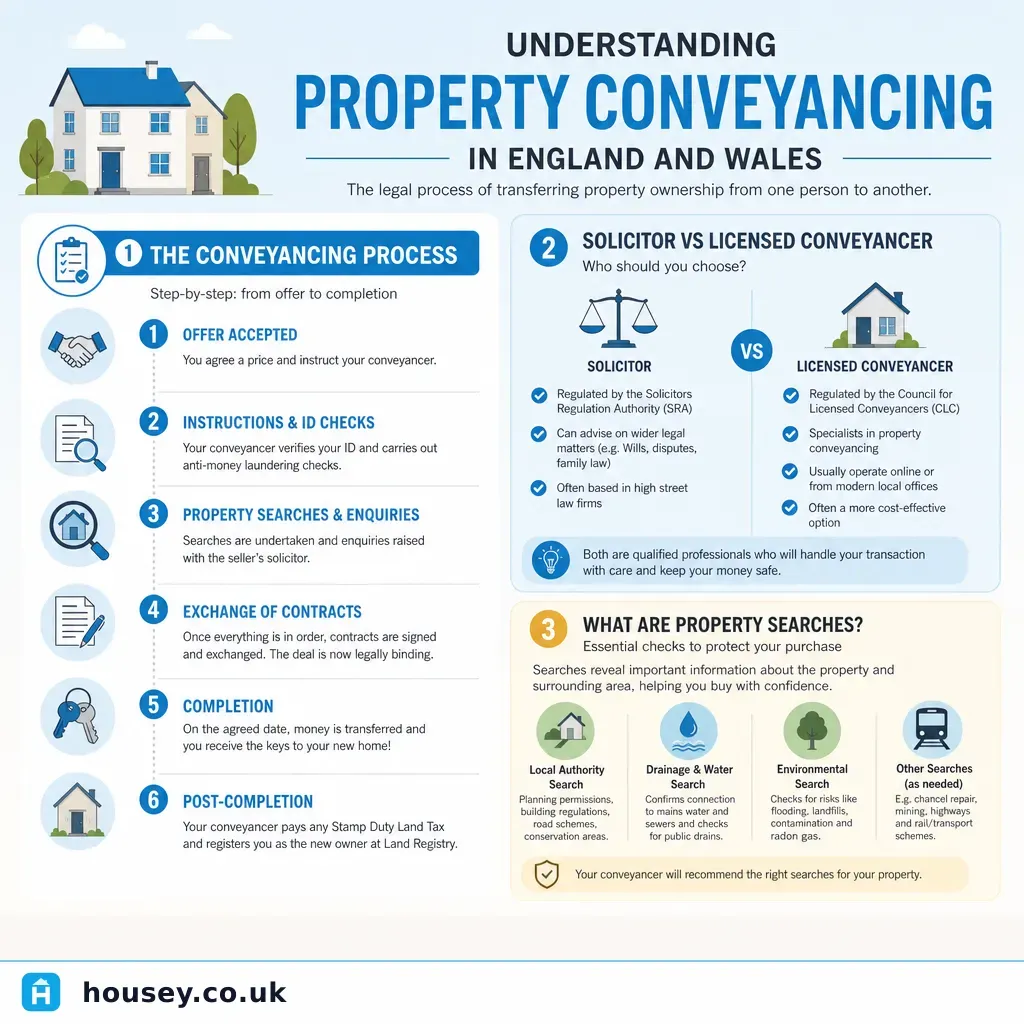 Buying & Moving
Understanding Property Conveyancing in England and Wales
Conveyancing is the legal process of transferring property ownership in England and Wales.
 Buying & Moving
Property Covenants: Legal Restrictions You May Encounter When Buying
Property covenants are legally binding obligations tied to land and registered at HM Land Registry.
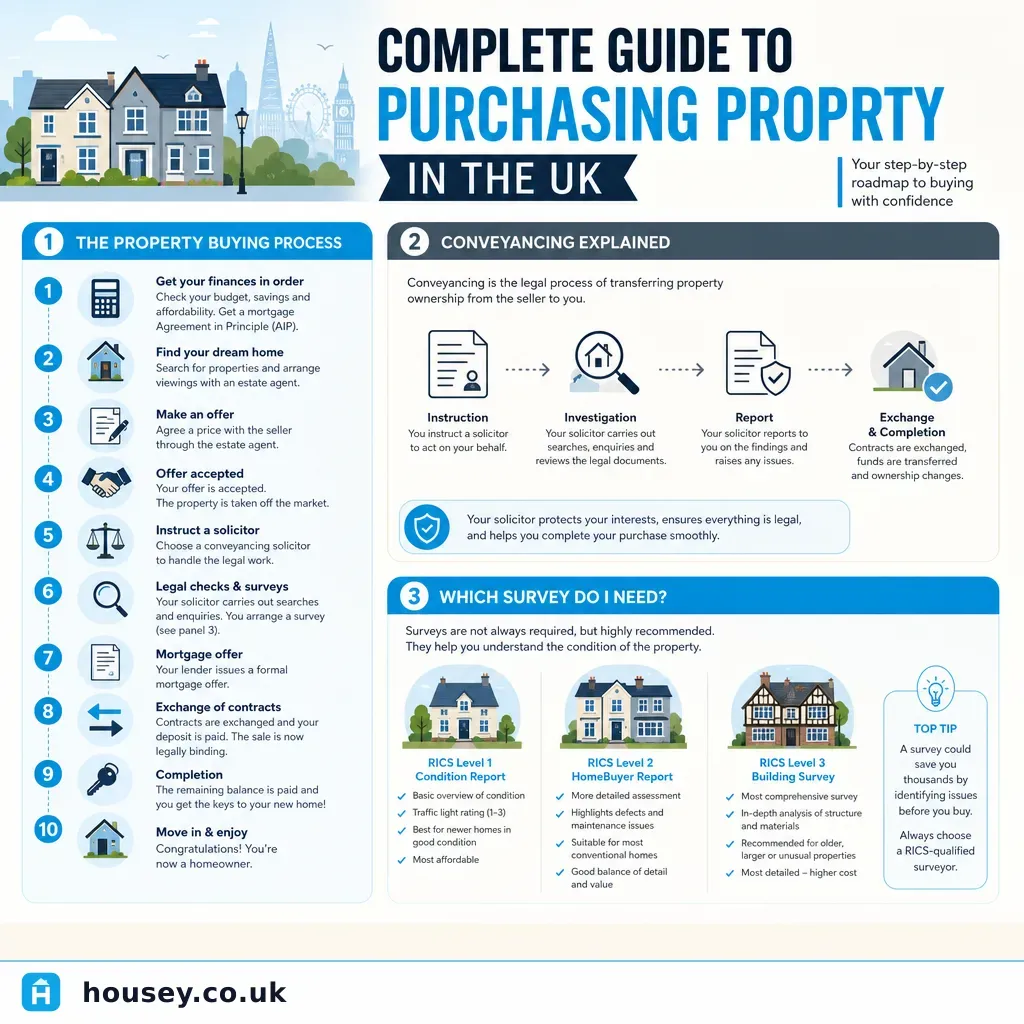 Buying & Moving
Complete Guide to Purchasing Property in the UK
Buying property in England and Wales typically takes 12 to 16 weeks from offer acceptance to completion.
 Buying & Moving
Shared Ownership: Building Your Path To Property Ownership
Shared ownership lets you buy a share of a home — typically 10% to 75% — from a housing association and pay subsidised rent on the remainder.
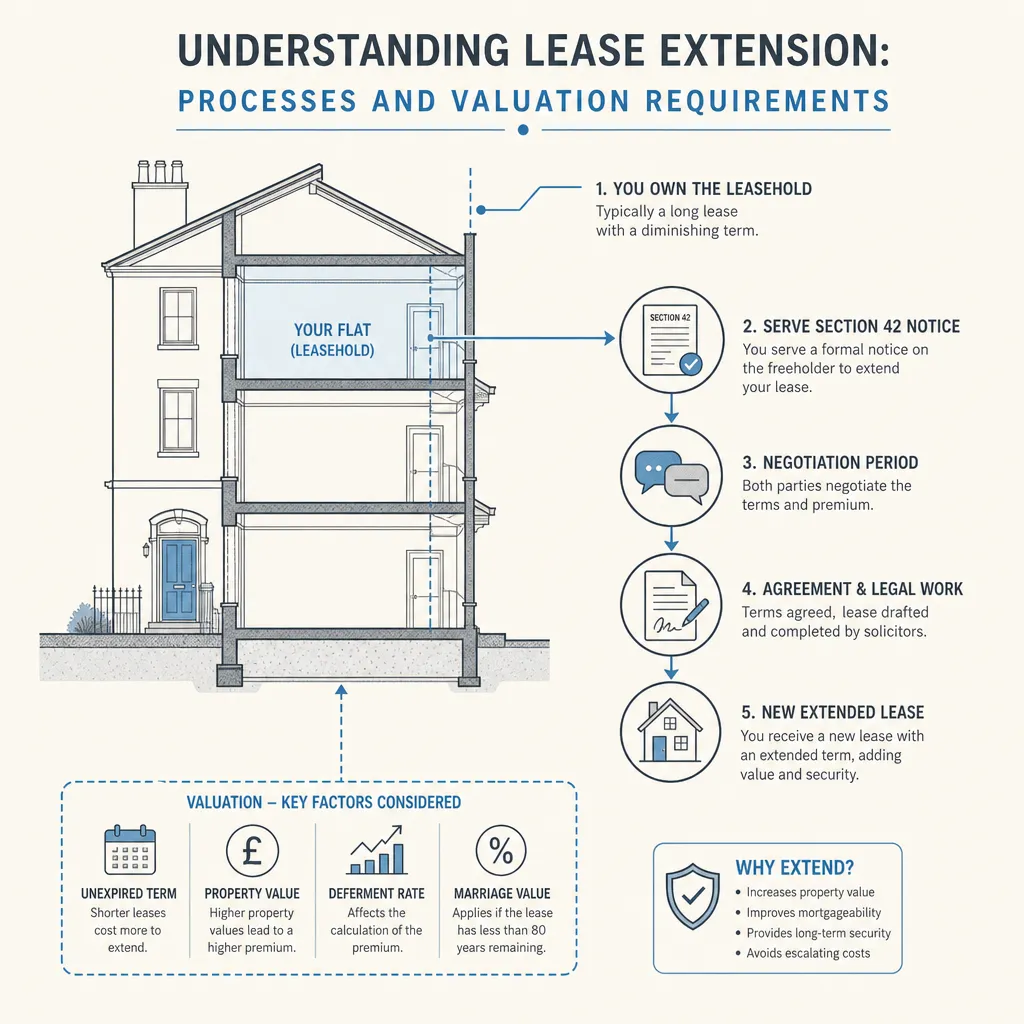 Buying & Moving
Understanding Lease Extension: Processes and Valuation Requirements
Qualifying flat owners in England and Wales can extend their lease by 90 years under the Leasehold Reform, Housing and Urban Development Act 1993, provided they have owned the property for at least two years.