Property Covenants: Legal Restrictions You May Encounter When Buying
By Housey · Last reviewed 24th of May 2026

Property Covenants: Legal Restrictions You May Encounter When Buying
Property covenants surface during conveyancing and can affect what you are legally permitted to do with a home both now and in the future. They do not show up on a viewing, they do not appear on a local authority search, and they may not be flagged until your solicitor returns the results of the title register investigation. Understanding what you may find — and what it means for your purchase — can prevent expensive surprises after exchange of contracts.
Key points
- Restrictive covenants are registered in the Charges Register of the title at HM Land Registry and bind every future owner, regardless of when the covenant was originally created.
- Positive covenants require the owner to take action — for example, maintaining a shared driveway or boundary fence — and are typically passed forward to each new buyer via a deed of covenant at the point of sale.
- Your conveyancer will examine the Official Copy Entries (also called Office Copies) to identify any covenants registered against the title and will obtain the underlying filed deed where further detail is needed.
- If a covenant appears to have been breached, covenant indemnity insurance is a common practical solution during a purchase, but it does not remove the covenant — it insures against the financial risk of enforcement.
- You can apply to discharge or modify a restrictive covenant through the Upper Tribunal (Lands Chamber) under section 84 of the Law of Property Act 1925, but applications can take many months and success is not guaranteed.
What types of covenant will your solicitor find?
Covenants fall into two main categories in English and Welsh property law.
Restrictive covenants prevent an owner from doing something with the land. Common examples include:
- Not building additional structures without consent from the original developer or the beneficiary of the covenant.
- Not using the property for commercial or business purposes.
- Not subdividing the property or letting individual rooms separately.
- Not making alterations to the external appearance or roof profile.
Positive covenants require the owner to do something — typically contribute to the upkeep of shared infrastructure such as a private road, drain, or boundary feature. Positive covenants are harder to enforce against successors in title under common law, so most developers require every buyer to enter into a deed of covenant at the point of sale, passing the obligation forward contractually on each subsequent sale.
Covenant type | What it does | Runs with the land? | Common examples |
|---|---|---|---|
Restrictive covenant | Prevents certain uses or works | Yes — binds future owners automatically | No extensions, no commercial use, no subdivision |
Positive covenant | Requires maintenance or contribution | Not automatically — usually via deed of covenant | Maintain boundary fence, contribute to road upkeep |
Building scheme covenant | Mutual restrictions across a development | Yes — each plot owner can enforce against others | Estate rules on aesthetics, parking, external aerials |
Where covenants appear in the title register
Your solicitor will obtain Official Copy Entries from HM Land Registry. Covenants are usually found in:
- Section C (Charges Register): restrictive covenants and other encumbrances are listed here, often with reference to a filed copy of the original transfer deed or conveyance.
- Filed documents: the actual wording of a covenant appears in a historic deed, which your solicitor can request separately from HM Land Registry.
For pre-registration titles and very old covenants — often Victorian or Edwardian — the restriction may be worded broadly (for example, "not to erect any building without consent") with the beneficiary difficult to trace. Where no one can be identified as holding the benefit, the practical risk of enforcement is often low, though this is a matter of professional judgment rather than legal certainty.
What happens if a covenant has been breached?
If works have already been carried out that appear to breach a covenant, the options typically available during a conveyancing transaction are:
- Covenant indemnity insurance — available from specialist legal indemnity insurers and routinely arranged during conveyancing. It protects you and your mortgage lender against the financial consequences of an enforcement action. Premiums are usually a one-off payment, typically a few hundred pounds for a low-risk breach, though this varies considerably with the nature of the risk. Indicative UK costs, last reviewed 2026-05-24.
- Obtaining retrospective consent — if the beneficiary of the covenant can be traced and contacted, you may be able to seek a formal consent or deed of release. This adds time and cost to the transaction and is not always achievable before exchange.
- Applying to the Upper Tribunal (Lands Chamber) — under section 84 of the Law of Property Act 1925, you can apply to have a restrictive covenant discharged or modified on grounds including obsolescence, impediment to reasonable use, or agreement from the beneficiaries. Tribunal applications typically take six to twelve months and involve legal and expert fees.
What should you do when a covenant is found?
- Proceed with indemnity insurance if the breach is minor, the covenant is old, the beneficiary cannot be identified, and your solicitor advises the enforcement risk is low.
- Seek retrospective consent if the beneficiary is known and traceable, the covenant is recent (within the last 20–30 years), and the nature of the breach is significant.
- Consider a Tribunal application if you already own the property, the covenant materially restricts plans you need to pursue, and professional advice suggests reasonable prospects of success.
- Pause the transaction if your solicitor identifies a covenant that restricts a use you consider essential — such as working from home, running a business, or building an extension — and no clear resolution is available before exchange.
- Check with your mortgage lender early, as lenders vary in what they will accept and your conveyancer must report to them under the UK Finance Lenders' Handbook.
Important limitations
This article provides general background on how property covenants work in England and Wales. It is not legal advice. The specific covenants on any individual property, their enforceability, and the appropriate course of action depend on the precise wording of the original deed, the history of the land, whether a building scheme exists, and current case law. Rules differ in Scotland, where property law is distinct. Always seek advice from a qualified conveyancing solicitor before exchanging contracts.
What to ask a qualified professional
- Can you show me the exact wording of the covenant as it appears in the title register or the underlying filed deed?
- Who currently has the benefit of this covenant, and are they likely to enforce it?
- Has the covenant been breached, and if so, for how long and by whom?
- Is covenant indemnity insurance available for this situation, and what are the precise terms and premium?
- Would this covenant prevent me from carrying out the works I am planning?
- Does my mortgage lender have specific requirements regarding this covenant, and how must you report it to them?
When to get professional help
Always instruct a qualified conveyancing solicitor or licensed conveyancer before exchanging contracts on any property. Seek additional specialist advice if:
- A covenant restricts a use or development you are specifically planning, such as a loft conversion, home extension, annexe, or business use.
- The title reveals multiple overlapping covenants, particularly on a former estate or development site.
- Your mortgage lender raises concerns about a specific covenant or requires something beyond standard indemnity insurance.
- You are purchasing a listed building or a property in a conservation area, where covenants may interact with separate planning and heritage obligations.
How Housey can help
If you need a conveyancing solicitor to review the title register and advise on any covenants before exchange, Housey can connect you with qualified professionals who carry out full title investigations as part of their conveyancing service.
Frequently asked questions
Can a property covenant from the 1800s still be enforced?
Yes, in principle. Restrictive covenants do not expire simply due to age. However, a very old covenant may be practically unenforceable if the beneficiary cannot be traced, the land it was intended to protect has since been developed, or the restriction's purpose no longer makes sense. A solicitor can assess enforceability in context before exchange.
Does a covenant appear on a standard property search?
Not on a local authority search. Covenants are private law obligations revealed through the title register at HM Land Registry, which your conveyancer obtains as part of the Official Copy Entries. Local authority searches and the title register together provide a fuller picture of the legal position on any given property.
Will my mortgage lender be concerned about a covenant?
Lenders vary. Some accept covenant indemnity insurance; others require evidence of formal consent or may decline to lend where a significant covenant has been breached. Your conveyancer must report to your lender as required under the UK Finance Lenders' Handbook, so the lender's requirements should be clarified early in the transaction.
Can I sell a property that has a known covenant breach?
Usually yes, but you will typically need to provide covenant indemnity insurance to the buyer and their lender. Your solicitor must disclose any known breach in the replies to enquiries via the TA6 property information form. Failing to disclose a known breach could constitute misrepresentation.
Sources and further reading
- HM Land Registry: Search for land and property information — GOV.UK
- Law of Property Act 1925, section 84 — legislation.gov.uk
- Upper Tribunal (Lands Chamber) — GOV.UK
- UK Finance Lenders' Handbook — UK Finance
Useful next reads
 Buying & Moving
What Property Covenants Are and How They Affect Your Home
A property covenant is a legally binding promise attached to land rather than to a specific owner, recorded in the title deeds and registered at HM Land Registry.
 Buying & Moving
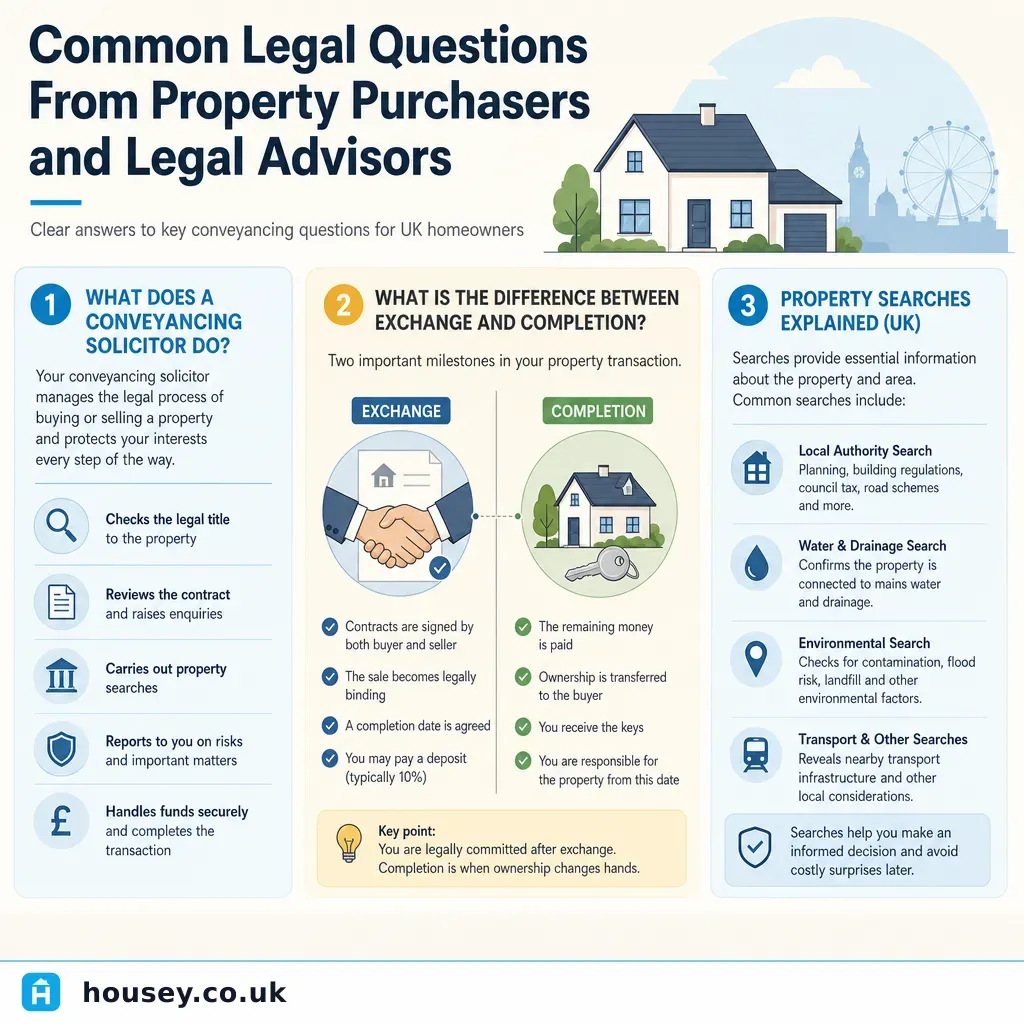
Common Legal Questions From Property Purchasers and Legal Advisors
Conveyancing in England and Wales typically takes 8–16 weeks.
 Buying & Moving
Understanding Leasehold Property Terminology and Rights
Leasehold means owning occupation rights for a fixed term, not the land or structure.
 Buying & Moving
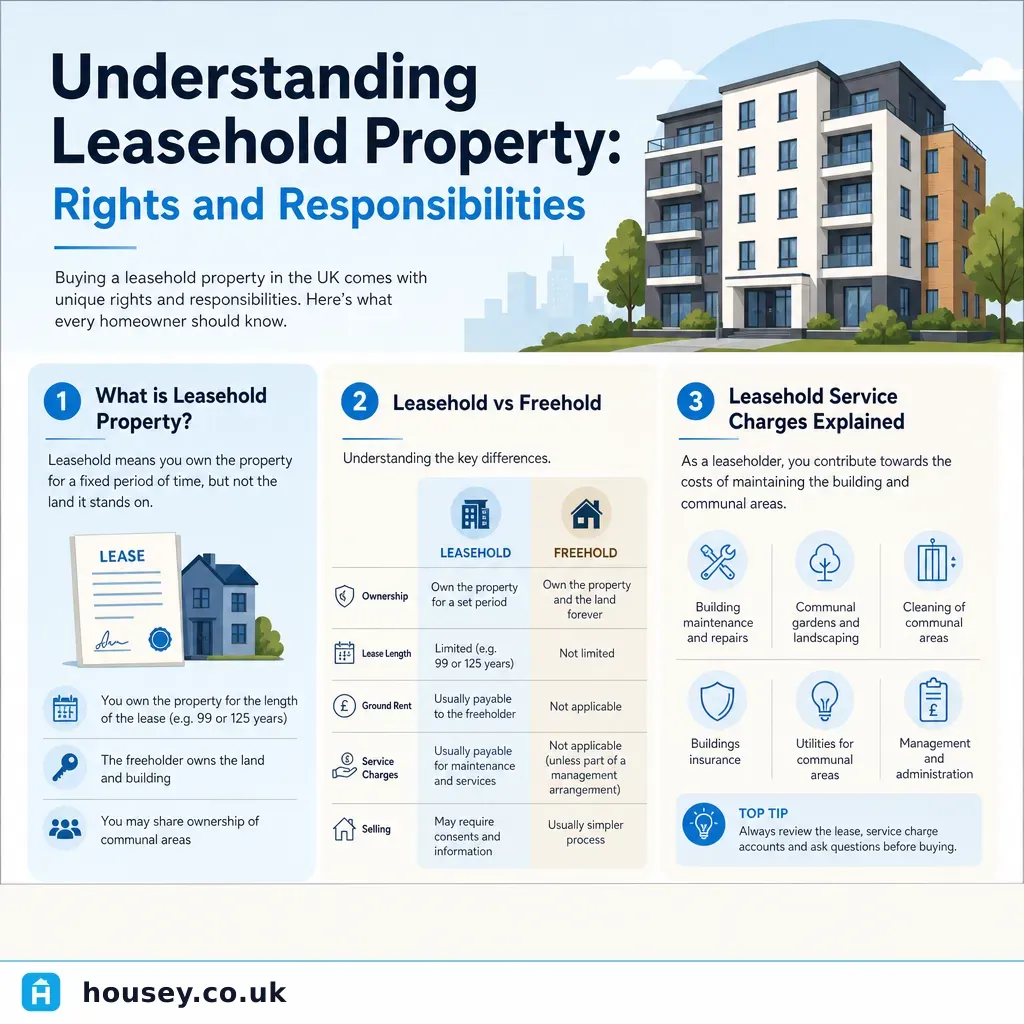
Understanding Leasehold Property: Rights and Responsibilities
Leasehold means you own a time-limited interest in a property while the freeholder owns the land and building.
 Buying & Moving
Navigating Simultaneous Purchase and Sale of Property
When buying and selling simultaneously in England and Wales, both sets of contracts are exchanged on the same day — this is called simultaneous exchange.