Dispelling Common Misconceptions About Solar Energy Systems
By Housey · Last reviewed 30th of May 2026
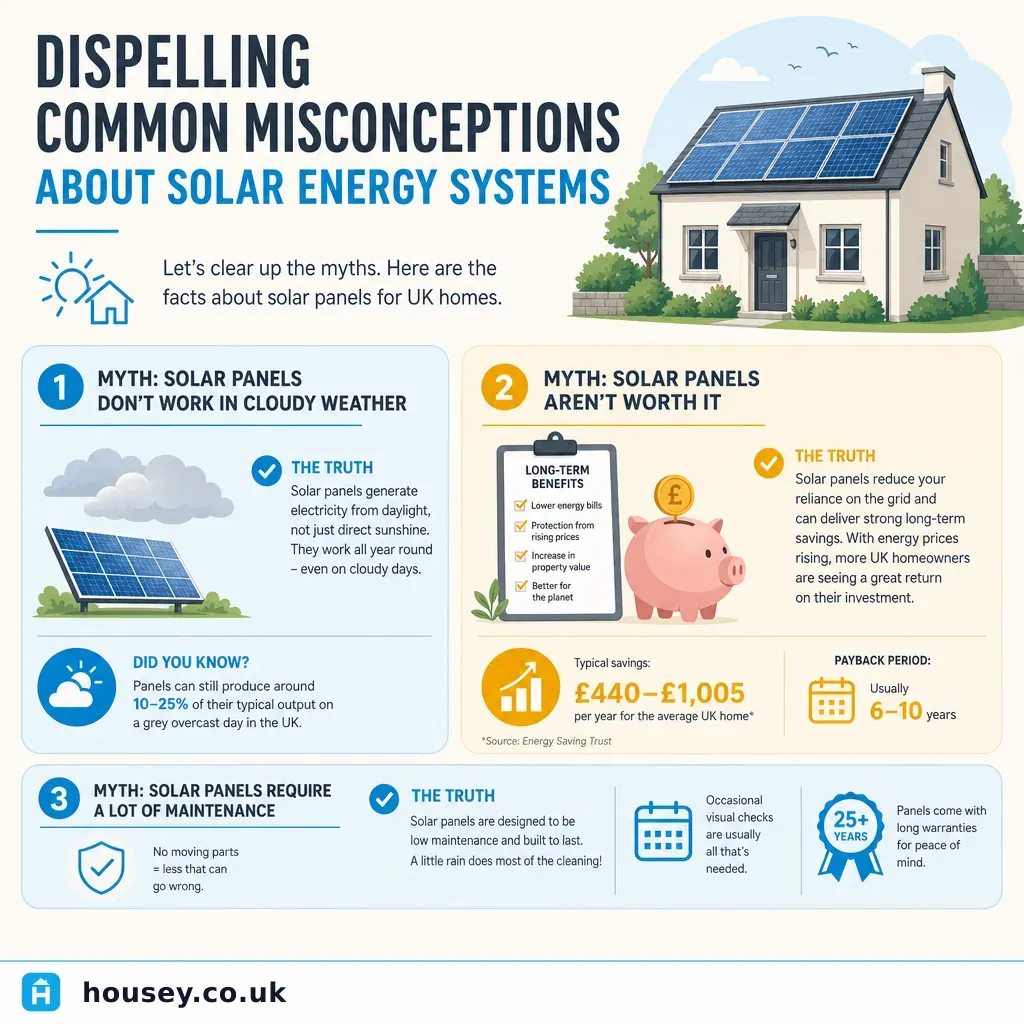
Dispelling Common Misconceptions About Solar Energy Systems
Solar panels are now among the most widely installed renewable technologies in UK homes, yet a persistent set of myths continues to delay purchasing decisions, undermine confidence in quotes, and lead homeowners towards poorly informed comparisons. Whether you are weighing up a first installation on a 1930s semi or reconsidering a stalled retrofit project, understanding what the evidence actually shows makes for a clearer, more confident decision.
Key points
- UK solar irradiance is comparable to Germany's, which leads Europe in installed solar capacity — diffuse daylight on overcast days still activates photovoltaic cells and generates usable electricity.
- A typical 4 kWp domestic system costs approximately £5,000–£8,000 (Indicative UK costs, last reviewed 2026-05-30) and commonly pays back within 6–10 years depending on usage patterns and electricity tariff.
- The carbon payback period for a crystalline silicon panel is typically 1–4 years against a 25–30 year operational lifespan — panels generate net-zero-carbon electricity for the vast majority of their working life.
- MCS (Microgeneration Certification Scheme) certification is required for both the installer and the products for a system to qualify for the Smart Export Guarantee (SEG); verify any installer against the MCS installer database before signing a contract.
- Panel product warranties typically cover 10–12 years; performance guarantees usually run to 25–30 years and specify that the panel will retain at least 80% of its rated output at year 25.
Myth 1: Solar panels don't work in the UK because it's too cloudy
Photovoltaic cells respond to photons in daylight — both direct and diffuse — rather than to direct sunshine alone. Diffuse light on an overcast day still activates PV cells and generates electricity, albeit at a reduced rate compared with bright sunshine.
The UK receives between 900 and 1,400 kWh of solar irradiation per square metre per year depending on location. Germany, which has lower average irradiance than much of southern England, has installed more solar capacity per capita than almost any other country globally. The performance difference between a clear day and an overcast day is real, but it does not mean panels are idle under cloud cover.
A 4 kWp south-facing system in London typically generates around 3,400–3,800 kWh annually. A comparable system in Scotland may generate 2,800–3,200 kWh. Both figures represent a meaningful reduction in grid electricity consumption for most households.
Myth 2: Solar panels are not financially worthwhile
The financial return on a solar installation depends on several variables: system cost, roof orientation and shading, daytime self-consumption rate, current electricity unit price, and whether battery storage is included. At electricity prices of around 24–25p/kWh (Ofgem price cap, 2025–26), every unit of solar electricity consumed directly in the home has a clear and measurable monetary value.
Factor | Faster payback | Slower payback |
|---|---|---|
Roof orientation | South-facing | East- or west-facing |
Daytime electricity use | High (home workers, EV charging) | Low (occupants absent all day) |
System cost | Competitive quotes, standard install | Complex roof, premium components |
Battery storage | Increases self-consumption | Battery adds significant upfront cost |
SEG export tariff | Higher supplier rate | Minimum statutory rate only |
Homeowners who work from home, charge an electric vehicle during the day, or run high daytime loads typically see the fastest payback. The Smart Export Guarantee ensures unused generation is not wasted — surplus electricity is exported to the grid and paid for, though at rates below the standard import price.
Myth 3: Solar panels require constant maintenance
In practice, solar panels require very little routine maintenance. Rain washes most accumulated dust and bird debris from panel surfaces. Annual output monitoring via an inverter app or portal is usually sufficient to identify any underperformance.
Occasional cleaning — typically every 1–2 years in most UK locations, more frequently near agricultural land or busy roads — can restore full output if panels are visibly soiled. Professional cleaning costs approximately £50–£150 for a typical domestic array (Indicative UK costs, last reviewed 2026-05-30).
Inverters are the component most likely to require replacement during the system's lifespan. Most string inverters carry 5–10 year warranties with an expected operational life of 10–15 years. Panel performance guarantees typically run to 25–30 years.
Myth 4: Manufacturing solar panels causes more emissions than they save
The lifecycle carbon analysis of solar PV is well-established. A crystalline silicon panel manufactured in Asia — the most carbon-intensive manufacturing scenario — has an energy payback period of 1–4 years and a carbon payback period of similar length. Against a 25–30 year operational lifespan generating near-zero-carbon electricity, the net carbon saving is substantial.
The carbon intensity of UK grid electricity continues to fall, but remains high enough that displacing grid consumption with solar generation represents a meaningful household carbon reduction. If an installer or comparison site makes specific carbon claims, ask which lifecycle boundary and manufacturing origin is assumed.
What not to assume
- Don't assume south-facing is the only viable orientation. East- and west-facing roofs are both workable. A split east–west array on a pitched roof often produces a flatter generation profile across the day, which can suit households with morning and evening consumption peaks.
- Don't assume a larger system always returns more value. Oversizing relative to daytime self-consumption means a greater proportion of generation is exported at low SEG rates. A system sized to match household usage typically returns more value than one sized purely to maximise output.
- Don't assume all MCS-certified installers propose equivalent systems. MCS certification confirms minimum standards, not panel brand, inverter quality, or design rigour. Obtain at least three quotes with equivalent specifications before committing.
- Don't assume battery storage always improves the economics. Battery storage adds meaningful upfront cost and suits households with low daytime occupancy. For homeowners already at home during the day, self-consumption may already be high without a battery.
- Don't assume the cheapest quote uses compliant components. Confirm both the installer and the proposed products appear on the MCS Product Directory before signing.
Red flags to watch for
- A quote that does not include shading analysis or a formal site survey.
- Predicted annual savings quoted without reference to your actual electricity tariff and consumption figure.
- Pressure to sign before a promotional finance offer expires.
- An installer not verifiable on the MCS installer database.
- Warranties that do not clearly separate the product warranty from the performance guarantee.
- Generation estimates provided as a single national figure rather than a site-specific calculation.
When to get professional help
An independent solar survey or an MCS-certified installer assessment will give you a site-specific generation estimate, a shading report, and a system design matched to your property and usage patterns. If you have received quotes with widely varying predicted outputs for the same roof, an independent professional can help you evaluate which figures are credible and whether a particular system design is genuinely appropriate for your home.
How Housey can help
Housey connects you with qualified professionals who can carry out an independent solar survey, giving you an objective, site-specific assessment before you commit to any installation. A solar survey can validate installer quotes, identify shading issues, and confirm whether your roof structure and orientation genuinely support the system size and performance claims you have been offered.
Frequently asked questions
Do solar panels work in winter in the UK?
Yes. Solar panels generate electricity year-round. Winter output is lower because days are shorter and the sun sits at a lower angle, but panels still generate electricity on clear winter days. A south-facing 4 kWp system typically generates around 10–15% of its annual output during December and January combined.
Will solar panels void my roof warranty?
This depends on your installer's method and your existing roof warranty terms. A reputable installer uses appropriate mounting hardware and flashings to maintain weathertightness. Many roof tile manufacturers have approved solar mounting systems. Review your existing roof warranty documentation before work begins and confirm your installer's approach in writing.
Can I get solar panels on a leasehold property?
Leasehold properties usually require landlord or freeholder consent before solar panels are installed, as the work involves structural changes to the building. Check your lease carefully and consult a solicitor if the terms are unclear. Shared freehold buildings may require consent from other leaseholders depending on the lease and building type.
Is solar PV the same as solar thermal?
No. Solar photovoltaic (PV) panels generate electricity from sunlight. Solar thermal panels use sunlight to heat water, typically for domestic hot water or space heating support. They are different technologies with different components, costs, and applications. Most UK solar installations discussed in this guide refer to PV.
Sources and further reading
- Solar panels advice and guidance — Energy Saving Trust
- MCS installer database — Microgeneration Certification Scheme
- Smart Export Guarantee (SEG) — Ofgem
- When is planning permission required? — GOV.UK
Useful next reads
 Energy & Retrofit
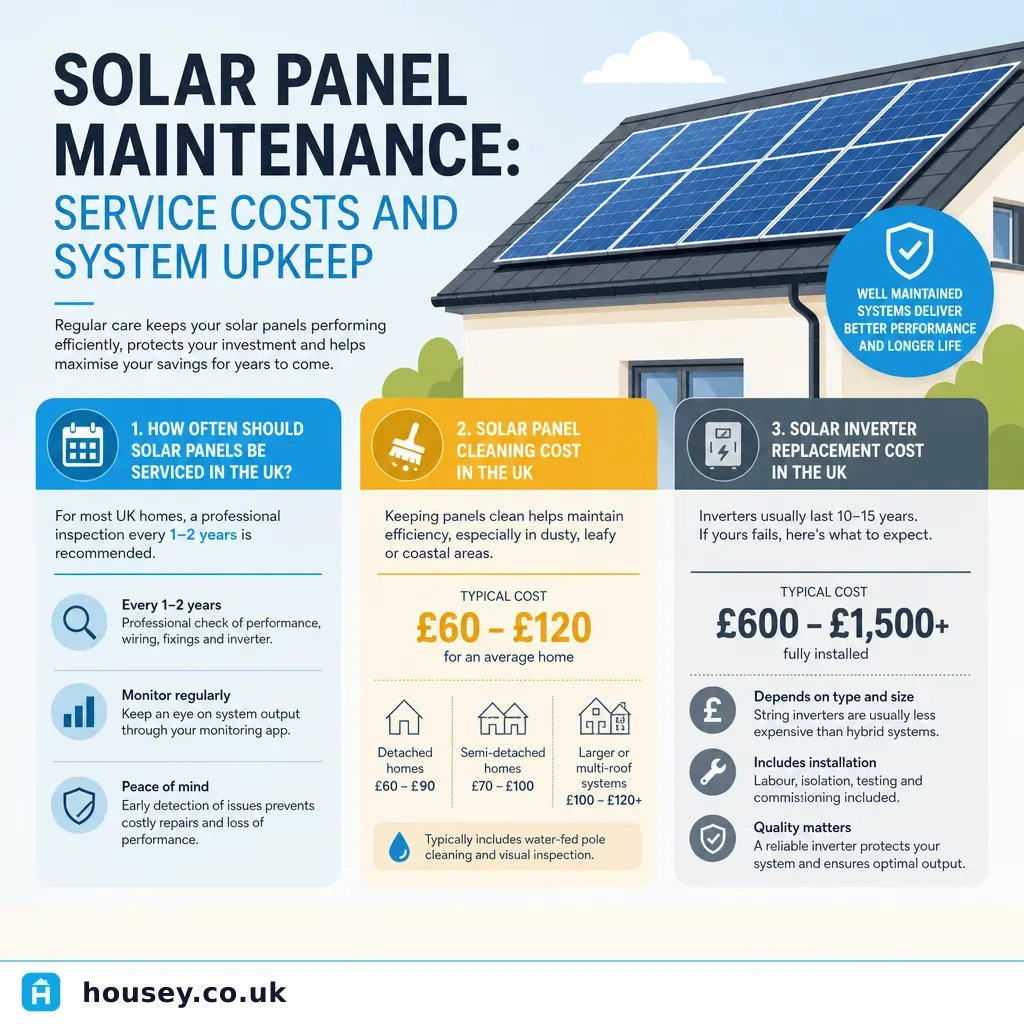
Solar panel maintenance: service costs and system upkeep
Solar panels need a professional inspection every one to three years and cleaning every one to two years, costing roughly £100–£200 for a service visit and £60–£150 to clean a standard 3–4 kWp system.
 Energy & Retrofit
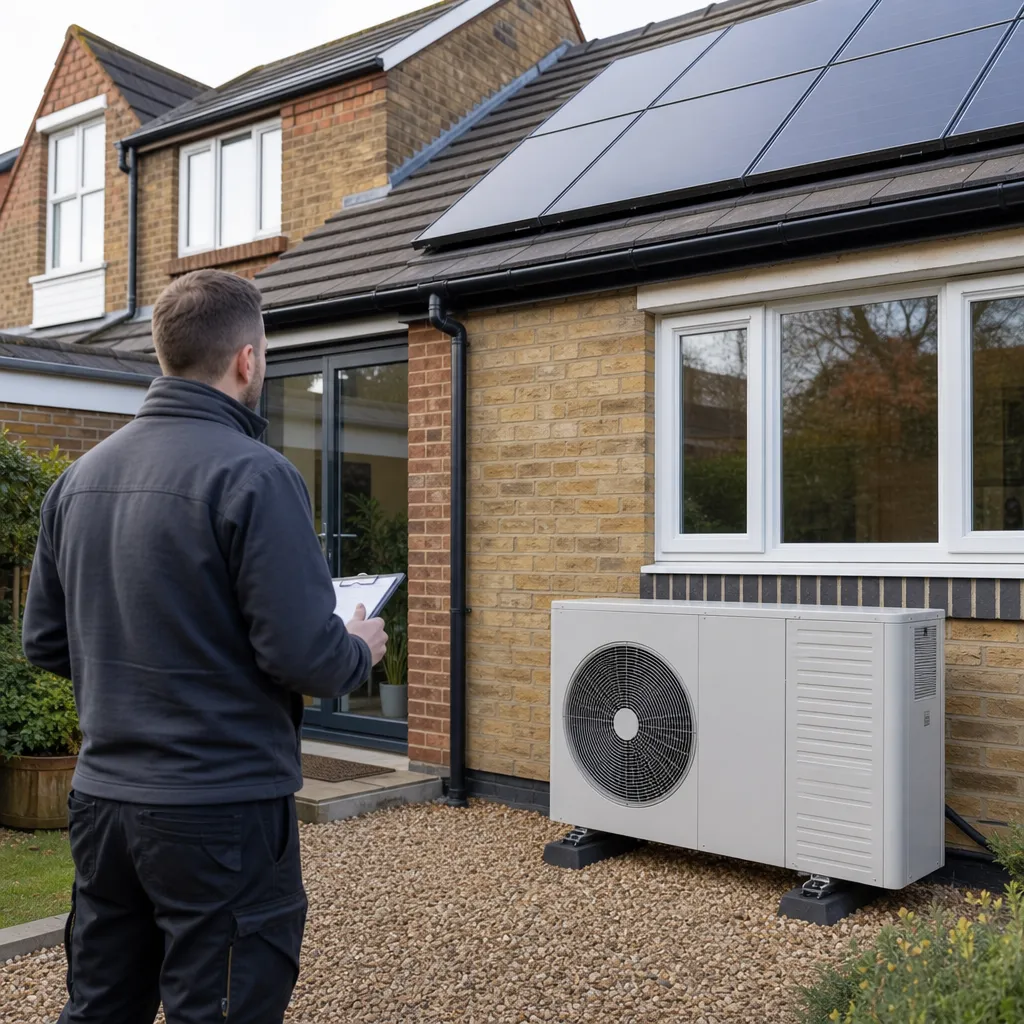
Renewable Energy Systems and Property Value: Solar Panels and Heat Pumps
Solar panels can add a modest 1–4% to UK property values in the right conditions, particularly when they improve the EPC rating.
 Energy & Retrofit
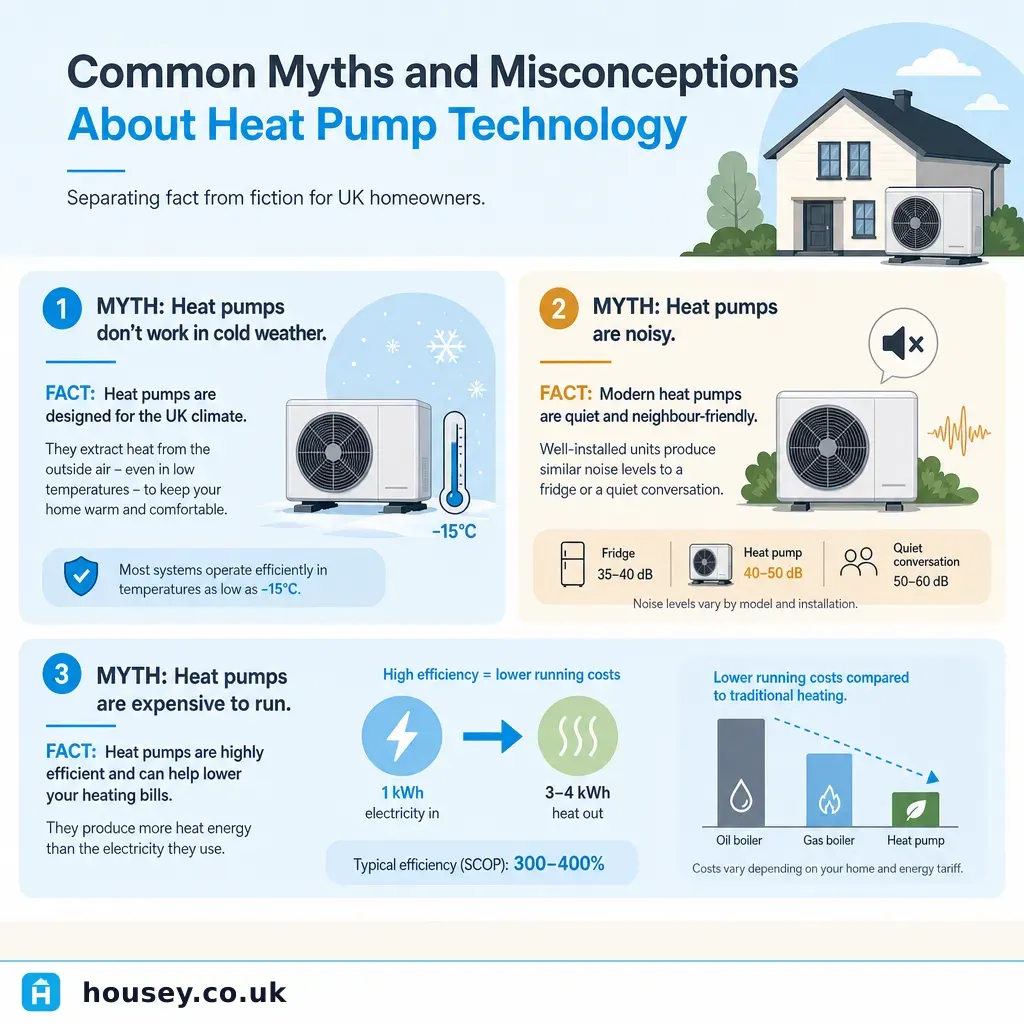
Common Myths and Misconceptions About Heat Pump Technology
Many common beliefs about heat pumps are inaccurate.
 Energy & Retrofit
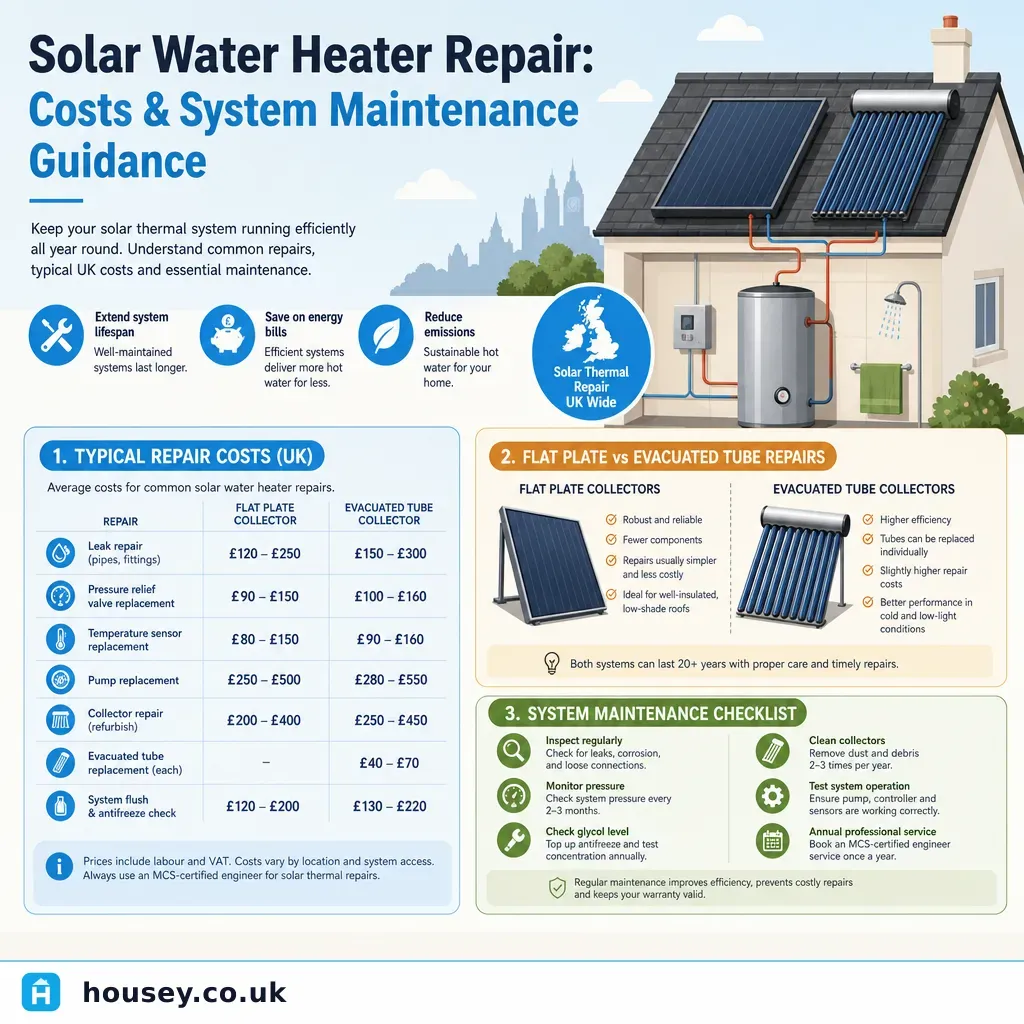
Solar water heater repair: costs and system maintenance guidance
Solar thermal hot water systems need a professional service every 3–5 years, covering glycol fluid condition, system pressure, and pump operation.
 Energy & Retrofit
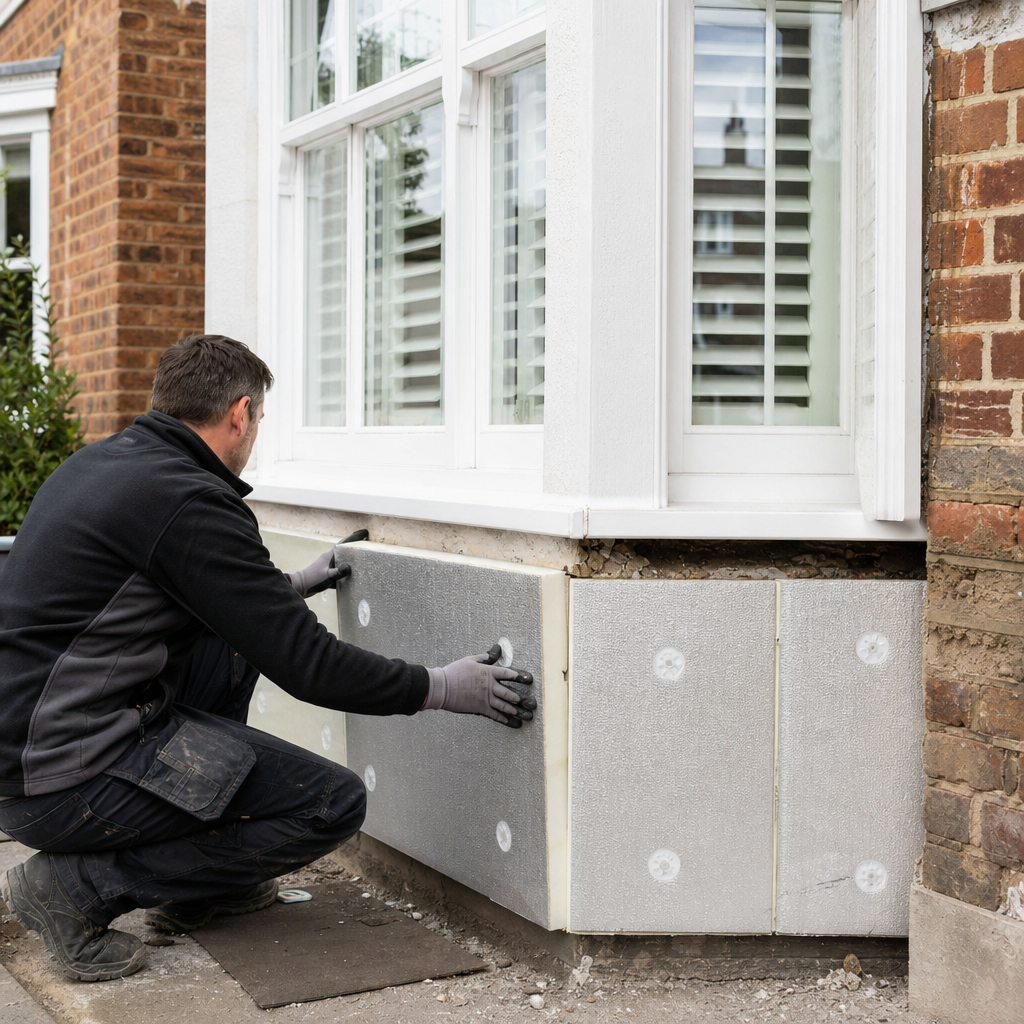
Insulating Solid Masonry Walls Under Bay Windows: Technical Guidance
Insulating solid masonry walls under bay windows requires specialist detailing at angled wall faces, window reveals, and the bay floor and ceiling junctions.