Solar water heater repair: costs and system maintenance guidance
By Housey · Last reviewed 12th of May 2026
Solar water heater repair: costs and system maintenance guidance
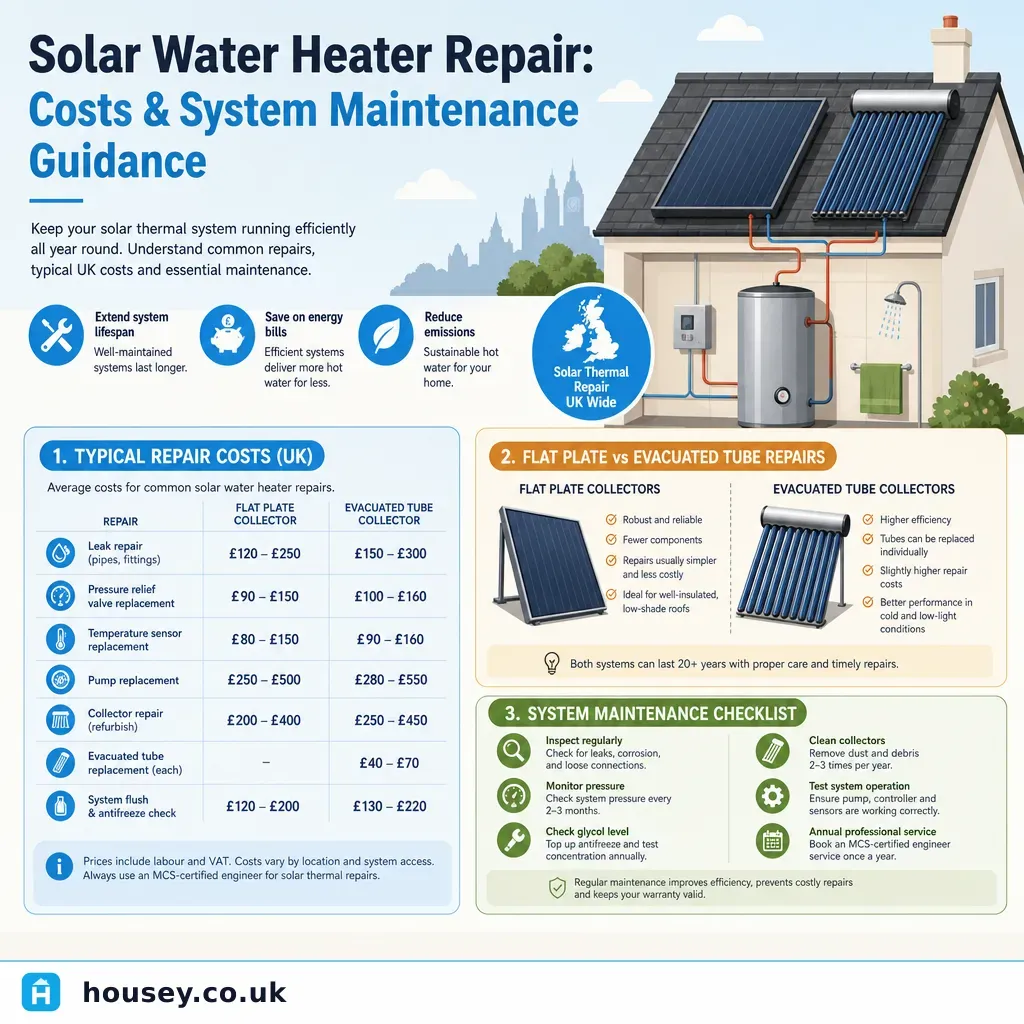
Solar thermal hot water systems — which use roof-mounted collectors to heat domestic water by circulating a heat-transfer fluid between panel and cylinder — are a relatively low-maintenance technology, but they are not maintenance-free. UK homeowners with systems installed under earlier incentive schemes may now be encountering first or second-generation maintenance requirements, while newer installations need periodic servicing to maintain efficiency and preserve any remaining manufacturer warranties.
Key points
- Solar thermal systems use either flat-plate or evacuated tube collectors; repair approaches and indicative costs differ between the two types.
- Professional servicing is recommended every 3–5 years as a minimum; the Energy Saving Trust supports this guidance for UK domestic solar thermal installations.
- The propylene glycol antifreeze heat-transfer fluid should be tested at every service and replaced when degraded — typically every 5 years — to prevent frost damage to collectors and pipework during UK winters.
- Circulation pump failure is the most common repair requirement; pump replacement typically costs £150–£400 including labour (indicative costs, last reviewed 2026-05-12).
- An MCS-accredited installer should carry out servicing and repairs to maintain any remaining manufacturer warranty and ensure correct re-commissioning of the pressurised circuit.
How solar thermal systems work and why they need maintenance
A solar thermal hot water system circulates a propylene glycol/water heat-transfer fluid between roof-mounted collectors and a hot water cylinder. The fluid absorbs heat from sunlight, transfers it to stored water via a coil heat exchanger inside the cylinder, and returns to the collectors to repeat the cycle. A differential temperature controller monitors the temperature gap between the collector and the cylinder base and activates the circulation pump accordingly.
Key components requiring periodic attention:
- Collectors (flat-plate or evacuated tubes): can accumulate moss, lichen, or debris, and may be physically damaged by hail or falling branches
- Circulation pump: drives the heat-transfer fluid around the circuit; typically has a 10–15 year service life
- Expansion vessel: absorbs pressure changes in the closed pressurised circuit; the internal rubber membrane can deteriorate over time
- Differential temperature controller: sensors and electronics can fail, causing the pump to run continuously or not at all
- Heat-transfer fluid: glycol degrades with age and heat cycling, reducing frost protection, increasing corrosion risk, and lowering heat-transfer efficiency
- Pipework and fittings: joints can deteriorate, particularly at roof entry points, pump station connections, and the cylinder coil inlet
Common faults and their indicative repair costs
Indicative UK costs, last reviewed 2026-05-12.
Fault | Indicative repair cost | Notes |
|---|---|---|
Annual or routine service | £80–£180 | Visual inspection, fluid check, pressure test |
Glycol fluid replacement (full drain and refill) | £150–£350 | Often combined with a service visit |
Circulation pump replacement | £150–£400 | New pump plus labour |
Expansion vessel replacement | £100–£300 | Includes recharging system to correct pressure |
Controller or sensor replacement | £100–£350 | Varies by brand and component type |
Evacuated tube replacement (single tube) | £50–£150 per tube | Individual tubes can usually be swapped without draining |
Flat-plate collector repair or replacement | £300–£1,200+ | Major job; flat-plate collectors usually replaced as a unit |
Frost damage repair | £300–£1,500+ | Severe damage may require full collector replacement |
All costs are indicative; quotes will vary by location, system type, brand, and access requirements. Scaffolding for collector-level access can add £400–£1,200 to any roof-based repair job.
Routine maintenance checklist
These checks should be carried out at every professional service, or at minimum every 3–5 years:
- Glycol concentration: test antifreeze protection level — should provide protection to at least -15°C for most UK locations; replace fluid if degraded
- Fluid pH: acidic fluid (pH below 7) indicates glycol degradation and increased corrosion risk; replace if outside manufacturer's specification
- System pressure: check against manufacturer's specified range on the pressure gauge; re-pressurise if low
- Pump operation: confirm the pump activates when temperature differential warrants it and is moving fluid at the correct flow rate
- Expansion vessel pre-charge pressure: check and recharge as needed; a failed membrane means the vessel cannot absorb pressure fluctuations
- Controller and sensors: verify the differential temperature controller is cycling the pump correctly in response to temperature readings
- Collector condition: visual inspection for physical damage, shading from moss or lichen growth, or discolouration indicating overheating episodes
- Pipework and fittings: inspect for signs of leakage, fluid staining, or corrosion at roof entry, pump station, and cylinder connections
- Hot water cylinder: confirm the solar coil is pre-heating the cylinder to an adequate temperature on a sunny day — typically 45–60°C at the top of the solar zone
When should you service or repair your solar thermal system?
Which action should you take?
- Schedule a routine service if the system has not been professionally checked in the past 3–5 years, or the glycol has never been tested since installation.
- Arrange an inspection promptly if the system appears to have stopped contributing to hot water (cylinder not pre-heated on sunny days), system pressure consistently drops between checks, or you notice fluid staining near the pump station.
- Replace the glycol if testing shows frost protection is inadequate (above -15°C) or fluid pH is outside the acceptable range.
- Contact an MCS-accredited installer for pump, expansion vessel, or controller replacement — correct re-commissioning and pressure testing of the closed circuit requires appropriate qualifications and equipment.
- Consider a full system assessment via solar surveys and system assessments if the collector is over 20 years old and showing significant performance degradation; at this stage a comparison of repair versus new installation may be worthwhile.
What not to assume
- Do not assume a sunny day means a working system. A failed circulation pump means collectors overheat without transferring heat to the cylinder — summer overheating and a pressure relief valve discharging are often the first visible symptoms of pump failure, not a solar performance problem.
- Do not assume low hot water temperature is a fault in the solar system. Before calling an engineer, confirm the immersion heater or boiler backup is correctly set; solar pre-heats but does not always fully heat the cylinder in winter or during prolonged overcast periods.
- Do not assume evacuated tube systems are maintenance-free. While individual tubes can be replaced without draining the main circuit, the manifold, pump, expansion vessel, and fluid system require exactly the same maintenance schedule as flat-plate installations.
- Do not ignore persistent pressure drops. A system that requires repeated re-pressurising has an underlying fault — either a leak in the circuit or a failed expansion vessel membrane — that will not resolve itself and will eventually cause more extensive damage.
When to get professional help
Contact a qualified solar thermal engineer or MCS-accredited installer if:
- The system has not been serviced in more than 5 years
- The circulation pump has stopped or runs continuously without establishing a temperature differential between collector and cylinder
- You notice fluid staining, discolouration, or a glycol smell near the pump station or at the roof entry point
- The expansion vessel requires repeated re-pressurising within a short period
- Any evacuated tube has shattered or a flat-plate collector shows physical damage, blistering, or discolouration
- You are not confident the system is operating correctly based on the hot water output you are experiencing
Working on pressurised heating circuits and roof-mounted equipment requires training and appropriate tools. Do not attempt to drain or refill the heat-transfer fluid circuit without the necessary competence — incorrect re-commissioning can leave the system vulnerable to frost damage or dangerous overheating.
How Housey can help
Housey can connect you with professionals who offer solar surveys and system assessments to evaluate your solar thermal installation's current condition and advise on whether routine servicing, targeted repair, or full replacement represents the most cost-effective path forward for your property.
Frequently asked questions
How often should a solar thermal system be serviced?
Most manufacturers and the Energy Saving Trust recommend a professional service every 3–5 years as a minimum. If the system has not been serviced since installation and is more than 5 years old, arrange a service promptly to assess fluid condition, system pressure, and component integrity before problems develop.
Can I replace an evacuated tube myself?
Individual evacuated tubes are designed to be removed and inserted without draining the main circuit, and some homeowners do this if they can access the collector safely from the ground. Any replacement requiring roof access should be carried out by a professional. Work on the pressurised circuit — pump station, manifold connections, pipework — must be done by a competent person.
Is frost damage common in UK solar thermal systems?
Frost damage can occur when glycol concentration is not maintained. UK winter temperatures fall well below 0°C in many regions, and degraded glycol offers reduced frost protection. Properties in northern England, Scotland, and upland areas should have glycol tested more frequently than those in milder southern locations.
Does the Boiler Upgrade Scheme cover solar thermal systems?
No. As of 2026, the Boiler Upgrade Scheme covers air source heat pumps, ground source heat pumps, and biomass boilers, but not solar thermal hot water systems. Check GOV.UK for current eligibility under any active renewable heat incentive schemes, as these can change.
Sources and further reading
- Energy Saving Trust: Solar water heating — system types, maintenance guidance, and UK performance context
- MCS: Microgeneration Certification Scheme — accreditation requirements for solar thermal installers
- GOV.UK: Boiler Upgrade Scheme — current grant eligibility for renewable heating technologies
- HSE: Working at height regulations — safety requirements for roof-level access and work
Useful next reads
 Energy & Retrofit
How Solar Water Heaters Work for Residential Properties
Solar water heaters use roof-mounted collectors to capture heat from sunlight and transfer it to a hot water cylinder via a fluid circuit.
 Energy & Retrofit
Solar Energy Integration in Below-Ground Structures: Design and Feasibility
Below-ground structures cannot host solar panels on their own roofs but can use surface-mounted panels connected via cable runs, solar light tubes for daylighting, and battery storage.
 Energy & Retrofit
Solar Hot Water Systems: Technology and Cost Comparison
Solar thermal systems use roof-mounted collectors to heat domestic hot water via a glycol circuit and twin-coil cylinder.
 Energy & Retrofit
Renewable Energy Technologies for Homes
UK homes can choose from solar photovoltaic panels, air source heat pumps, ground source heat pumps, and battery storage as the main residential renewable technologies.
 Energy & Retrofit
Making your home more sustainable
Making a UK home more sustainable usually starts with fabric-first improvements such as insulation, draught-proofing, and efficient glazing before adding renewable energy systems like solar panels or a heat pump.