Common Myths and Misconceptions About Heat Pump Technology
By Housey · Last reviewed 30th of May 2026
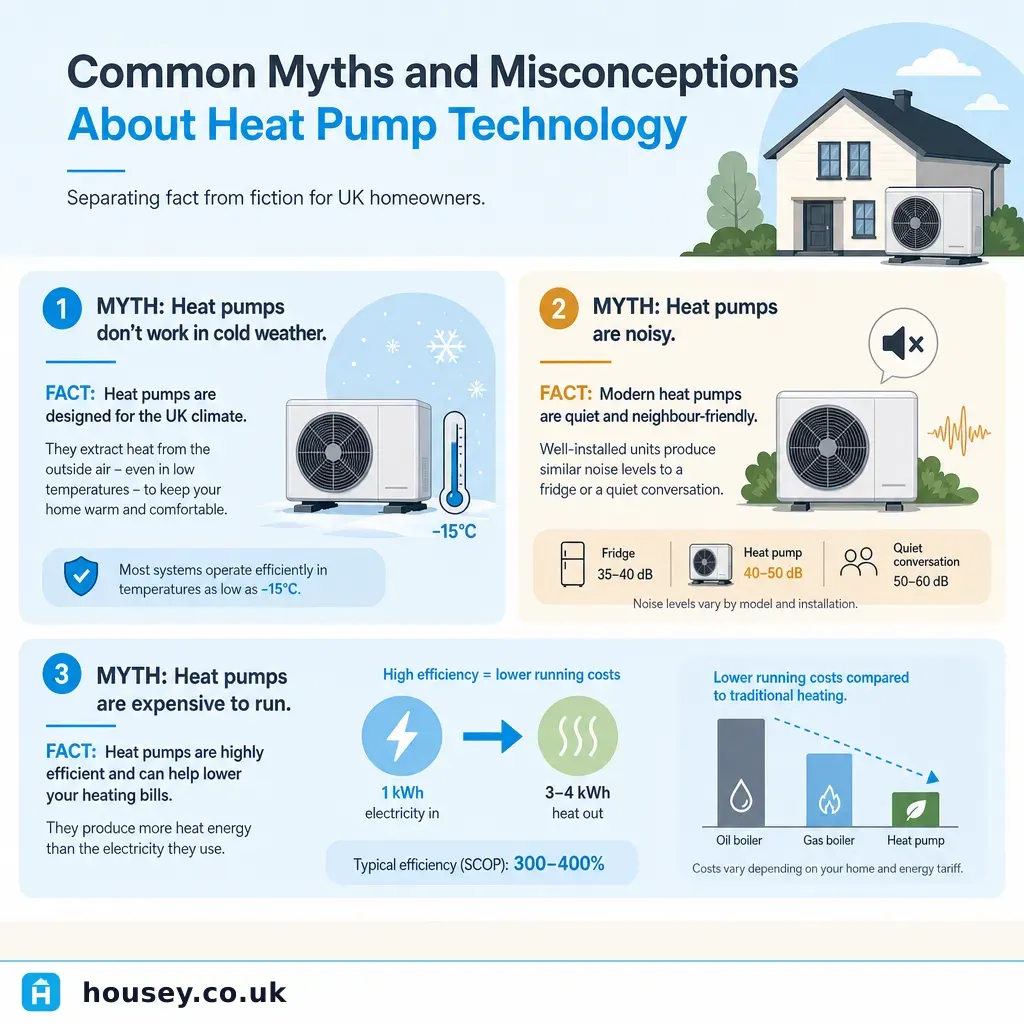
Common Myths and Misconceptions About Heat Pump Technology
Heat pumps feature prominently in discussions about UK home heating — partly because of the Government's Boiler Upgrade Scheme, partly in the context of rising energy costs, and partly as part of the broader shift toward lower-carbon heating. Alongside genuine interest, a persistent body of misinformation has taken hold: claims that heat pumps cannot cope with British winters, that they are prohibitively noisy, or that running costs will always be higher than gas. Some myths lead homeowners who would genuinely benefit to dismiss heat pumps outright; others encourage installations in properties that are not yet ready for them. Understanding what the evidence actually shows is the necessary first step before any decision is made.
Key points
- A well-specified air source heat pump (ASHP) typically achieves a Coefficient of Performance (COP) of 2.5–4.0 at outdoor temperatures common across the UK, delivering 2.5–4 units of heat per unit of electricity consumed.
- The Boiler Upgrade Scheme (BUS) currently offers a £7,500 grant toward ASHP installation in England and Wales; the installer must hold MCS (Microgeneration Certification Scheme) accreditation for the grant to be claimable by the homeowner.
- MCS-accredited installers are required by MIS 3005 (the MCS Heat Pump Standard) to carry out a room-by-room heat loss calculation to BS EN 12831 before specifying any system — a quote that skips this step is a significant warning sign.
- PAS 2035:2023 sets the retrofit standards framework for existing homes; for properties built before approximately 1980, a full retrofit assessment is strongly advisable before heat pump sizing is finalised.
- Running costs depend on the electricity-to-gas price ratio, achieved COP, flow temperature, emitter sizing, and electricity tariff — not on heat pump technology in isolation.
Myth vs reality
Myth | Reality | What the evidence shows |
|---|---|---|
Heat pumps do not work in cold UK winters | Modern ASHPs operate down to −15°C to −20°C; COP reduces at lower temperatures but heating continues | BEIS and Energy Saving Trust field trial data show average seasonal COP of 2.5–3.1 in UK homes |
Heat pumps are always very noisy | Typical ASHPs produce 40–60 dB at 1 m — similar to a quiet dishwasher; permitted development rules regulate siting near boundaries | Noise perception depends heavily on installation position relative to neighbours and windows |
Underfloor heating is required | Underfloor heating helps at very low flow temperatures, but correctly sized panel radiators work well at 45–55°C | Many successful UK retrofits use upgraded panel radiators rather than underfloor heating |
Heat pumps always cost more to run than gas | Running costs depend on the electricity-to-gas price ratio and the system COP; outcomes improve significantly with smart tariffs | Which? and BEIS data confirm results vary by property, tariff type, and system design |
Heat pumps are only viable in new-builds | Approximately 35% of UK heat pump installations are retrofits; suitability depends on insulation and emitter sizing, not build date | MCS certification data, 2024 |
Heat pumps need no maintenance | Annual servicing by a qualified engineer is recommended to maintain efficiency; most manufacturers require it to honour warranty terms | MCS guidance and manufacturer warranty documentation |
Do heat pumps work in the UK climate?
The UK's oceanic climate — with average winter temperatures in most of England rarely falling below −5°C for prolonged periods — is reasonably well suited to air source heat pumps. Ground source heat pumps draw from stable ground temperatures of around 10–12°C year-round across most of the UK, making them even less sensitive to air temperature fluctuations.
The more useful question is not whether the technology works in UK winters, but whether a specific property is adequately insulated and configured to distribute heat effectively at lower flow temperatures. Establishing this requires a heat loss calculation — a process that MCS-accredited installers and retrofit coordinators are required to carry out before any system is specified.
What not to assume
- Do not assume a heat pump will always be cheaper to run than a gas boiler. As of May 2026, electricity costs roughly 3–4× more per unit than gas on standard tariffs. A heat pump needs a seasonal COP of at least that ratio to break even on running costs. Time-of-use tariffs such as Agile or Economy 7 can materially improve the economics.
- Do not assume any installer can correctly size a system. An undersized heat pump will struggle at peak demand; an oversized one will short-cycle and lose efficiency. MCS-accredited installers must size to BS EN 12831 and should provide the heat loss calculation on request.
- Do not assume all properties need a hot water cylinder replacement. Many existing cylinders are compatible; however, a combi-boiler property will almost certainly require a new cylinder and associated pipework, which affects installation cost significantly.
- Do not assume permitted development always covers the installation. In conservation areas, Article 4 direction areas, listed buildings, or certain flats, planning permission may be required — confirm with your local planning authority before committing to any works.
- Do not assume the BUS grant is automatically available. Eligibility requires MCS-accredited installation, no outstanding improvement notice on the property, and other criteria. Check GOV.UK for the current rules before proceeding.
Red flags when getting a heat pump quote
Be cautious if an installer or quote:
- Has not offered to carry out — or cannot explain — a room-by-room heat loss calculation before specifying equipment.
- Does not discuss whether your existing radiators need to be upgraded or resized for the system's design flow temperature.
- Fails to state the design flow temperature the system will operate at.
- Is not MCS-accredited (verifiable on the MCS installer database at mcscertified.com).
- Makes no mention of insulation improvements before installation in an older or solid-wall property.
- Promises specific percentage bill savings without reference to your current energy use, tariff, or property heat demand.
- Does not mention building regulations notification — heat pump installations must be notified under Building Regulations Part L.
- Cannot or will not provide an MCS certificate number or installer accreditation reference.
Important limitations
This article provides general educational information about heat pump technology and common misconceptions. Whether a heat pump is suitable for your specific property depends on numerous factors including existing insulation levels, heating distribution type, hot water configuration, property size and construction, local planning constraints, and electricity supply capacity. Nothing in this article constitutes a recommendation to install or not install a heat pump in any particular property. A qualified retrofit assessor or MCS-accredited heat pump designer should evaluate your home before any decision is made or contract signed.
What to ask a qualified professional
Before accepting a heat pump design proposal or installation quote, ask:
- Can I verify your MCS accreditation on the MCS installer database, and what is your MCS certificate number?
- What is the calculated heat loss for my property, and can I receive the full calculation in writing?
- What flow temperature will the system be designed to operate at, and what does this mean for my existing or proposed emitters?
- Do my current insulation levels support efficient operation, or should improvements come before the heat pump?
- What size and specification of hot water cylinder is required?
- Have you modelled estimated running costs using my actual energy use data and current tariff options?
- Who will submit the building regulations notification, and will I receive a completion certificate?
- What warranty does the heat pump carry, and what annual servicing is required to keep it valid?
When to get professional help
Seek a qualified assessment before proceeding if:
- You are seriously considering installation — a heat loss survey and full property assessment are essential before any quote is accepted.
- You have received significantly varying quotes — this usually indicates installers are working from different assumptions about your property's heat demand.
- Your property was built before 1960, has solid walls, or has limited loft insulation — retrofit sequencing matters and insulation work may need to precede the heat pump.
- You live in a listed building, conservation area, or flat — planning and building regulations implications must be confirmed before any commitment.
- An installer declines to share or explain their heat loss calculation methodology.
How Housey can help
Housey connects homeowners with MCS-accredited surveyors and assessors who can carry out a heat pump survey to establish whether your property is a suitable candidate, what size and type of system is appropriate, and what preparatory works — if any — are needed before installation.
Frequently asked questions
Do heat pumps work in older UK houses?
They can, but suitability depends on insulation levels and heating distribution rather than age alone. A Victorian solid-wall terrace with no insulation is unlikely to be suitable without significant retrofit work first. A 1930s semi-detached with cavity-wall and loft insulation and adequately sized radiators may be a strong candidate. A heat loss survey will give you a reliable answer for your specific property.
What is COP and why does it matter for running costs?
COP (Coefficient of Performance) is the ratio of heat energy output to electrical energy input. A COP of 3.0 means the heat pump delivers 3 kWh of heat for every 1 kWh of electricity consumed. Real-world seasonal performance is measured as SCOP (Seasonal COP), which accounts for performance across the full range of outdoor temperatures over a heating year. A higher SCOP means lower running costs per unit of heat.
Does a heat pump fully replace a gas boiler?
In most installations, yes — the heat pump takes over as the primary and only heat source. Hybrid systems pair a heat pump with a retained gas or oil boiler for backup during extreme cold spells. Hybrids may suit properties not yet adequately insulated for a full heat pump installation where the existing boiler still has useful life remaining.
Can I get a grant toward a heat pump installation?
The Boiler Upgrade Scheme currently offers £7,500 toward an air source heat pump in England and Wales, subject to eligibility. The installer must be MCS-accredited and the property must not be subject to an outstanding energy improvement notice. Check the GOV.UK BUS guidance page for current eligibility rules and any updates to the scheme.
Sources and further reading
- Boiler Upgrade Scheme eligibility — GOV.UK — GOV.UK / DESNZ
- MCS installer database — Microgeneration Certification Scheme
- Heat pumps — Energy Saving Trust — Energy Saving Trust
- PAS 2035:2023 retrofitting dwellings for improved energy efficiency — British Standards Institution
- Heat pumps explained — Which?
Useful next reads
 Energy & Retrofit
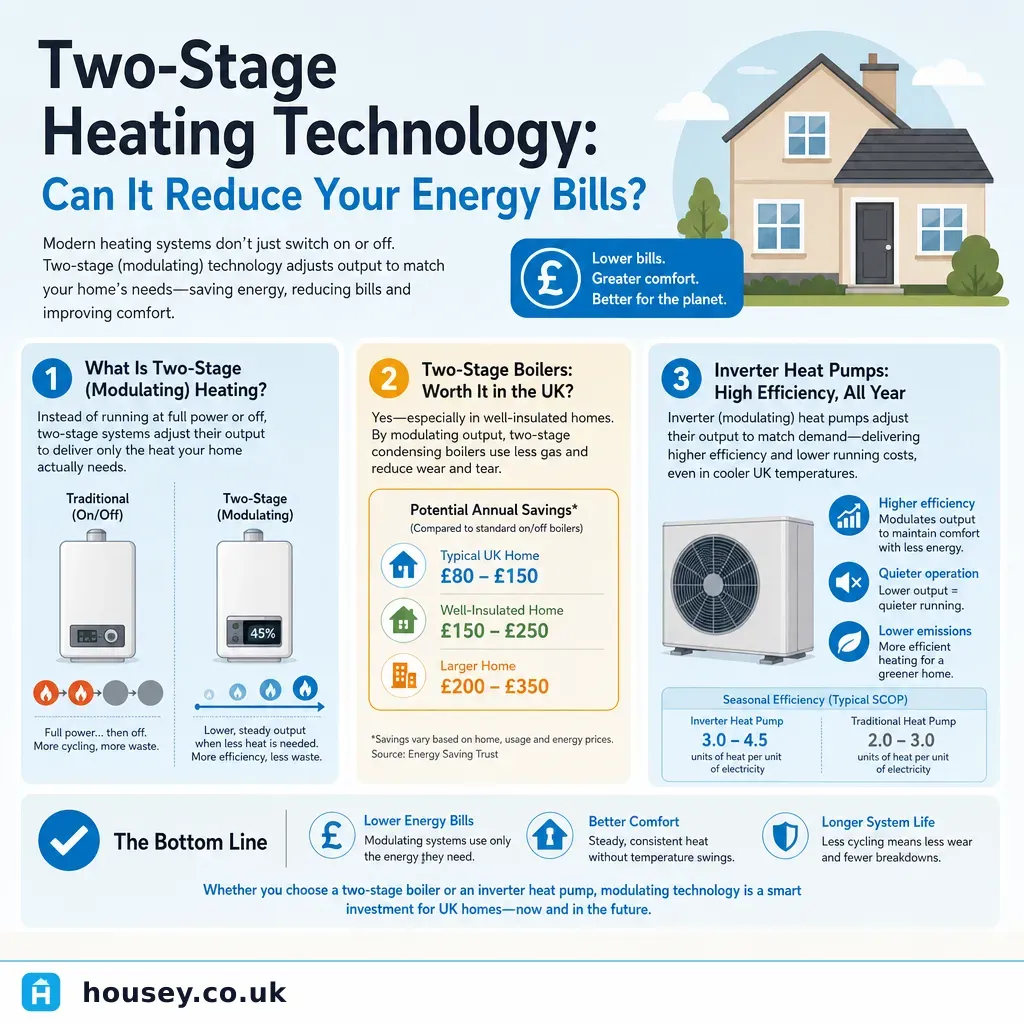
Two-Stage Heating Technology: Can It Reduce Your Energy Bills?
In UK homes, two-stage or modulating heating technology refers to modulating condensing gas boilers and inverter-driven heat pumps, not the forced-air furnaces common in North America.
 Energy & Retrofit
Residential Wind Turbines: Feasibility and Energy Generation
Whether a residential wind turbine is feasible depends largely on your site's average wind speed — most UK homes need at least 5–6 m/s to generate useful electricity.
 Energy & Retrofit
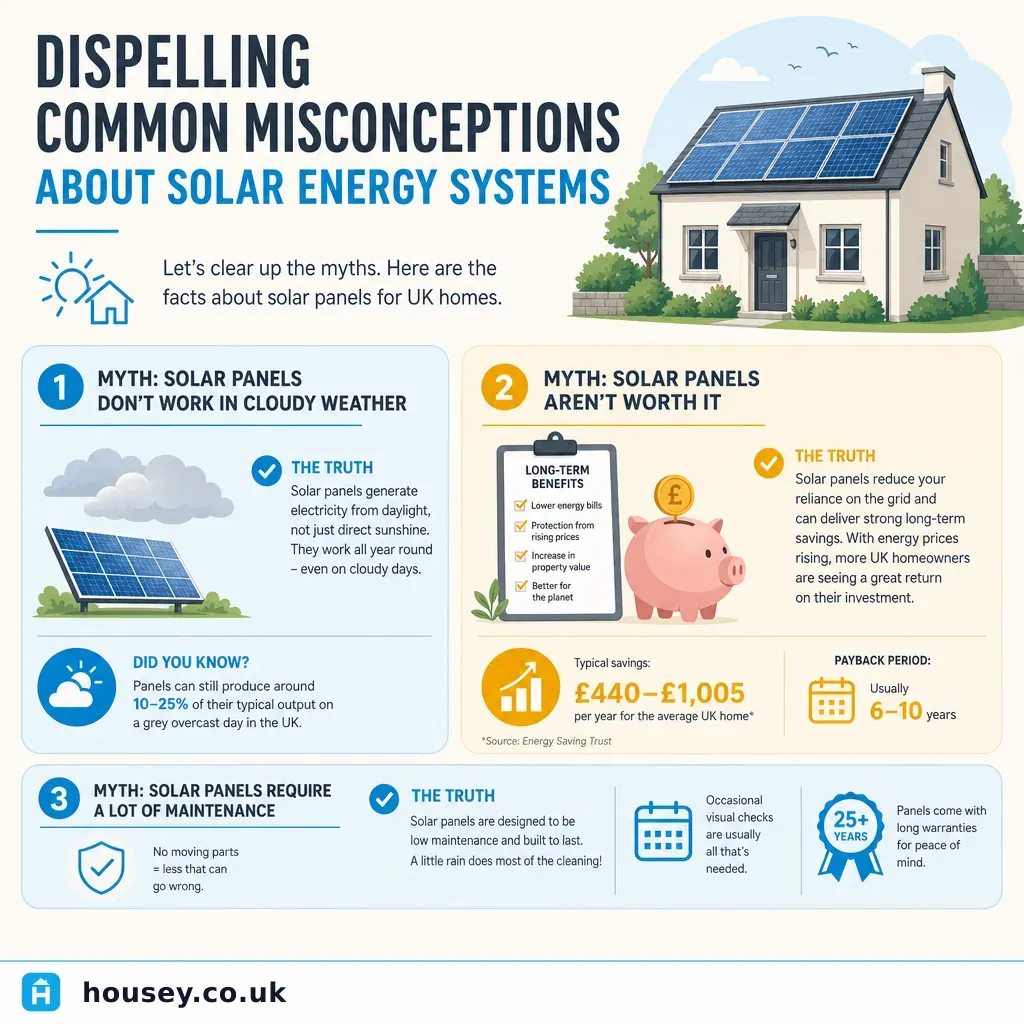
Dispelling Common Misconceptions About Solar Energy Systems
Most common solar panel myths — that panels don't work in cloudy UK weather, take decades to pay back, or cause net environmental harm — are not supported by evidence.
 Energy & Retrofit
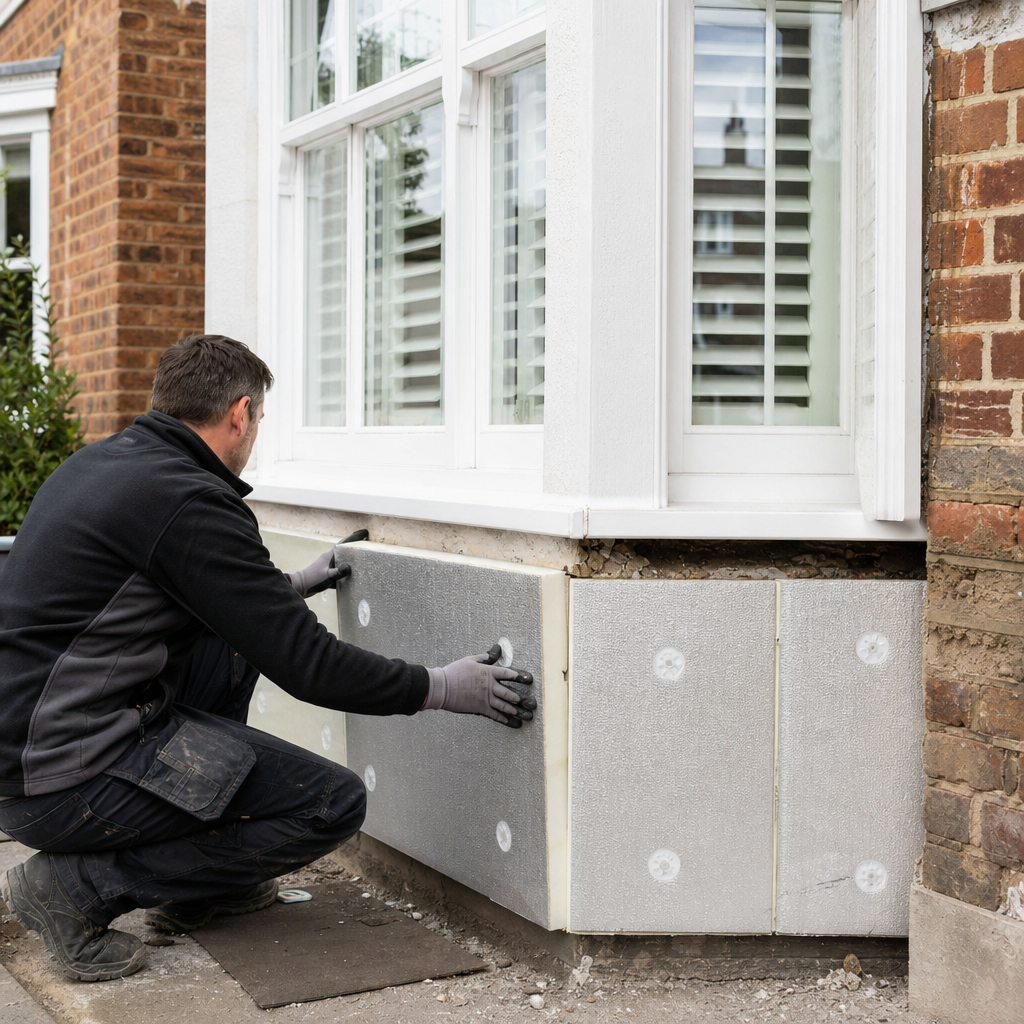
Insulating Solid Masonry Walls Under Bay Windows: Technical Guidance
Insulating solid masonry walls under bay windows requires specialist detailing at angled wall faces, window reveals, and the bay floor and ceiling junctions.
 Energy & Retrofit
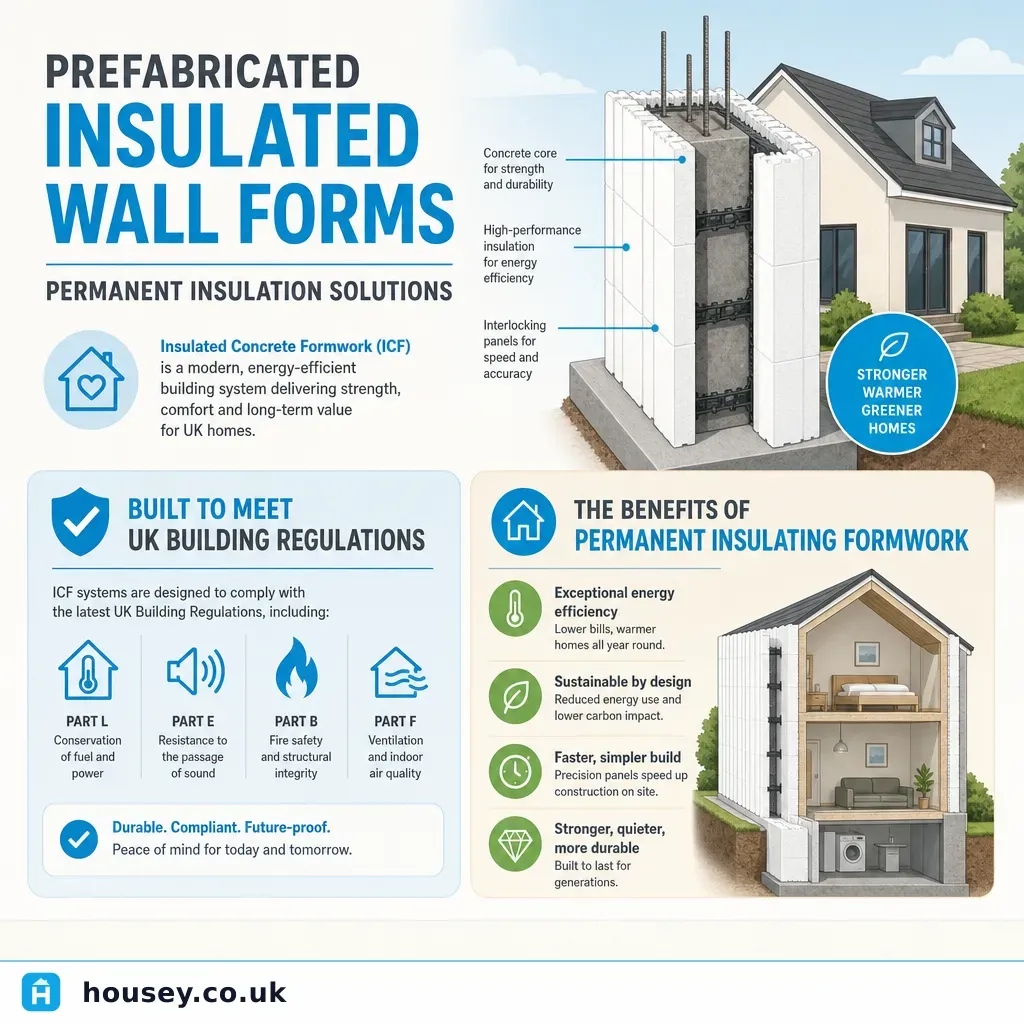
Prefabricated Insulated Wall Forms: Permanent Insulation Solutions
Prefabricated insulated wall forms — including ICF and SIPs systems — deliver high thermal performance by combining permanent insulation with structural concrete or timber in a single wall assembly.