Commonly Missed Fire Safety Risks in Residential Properties
By Housey · Last reviewed 30th of May 2026
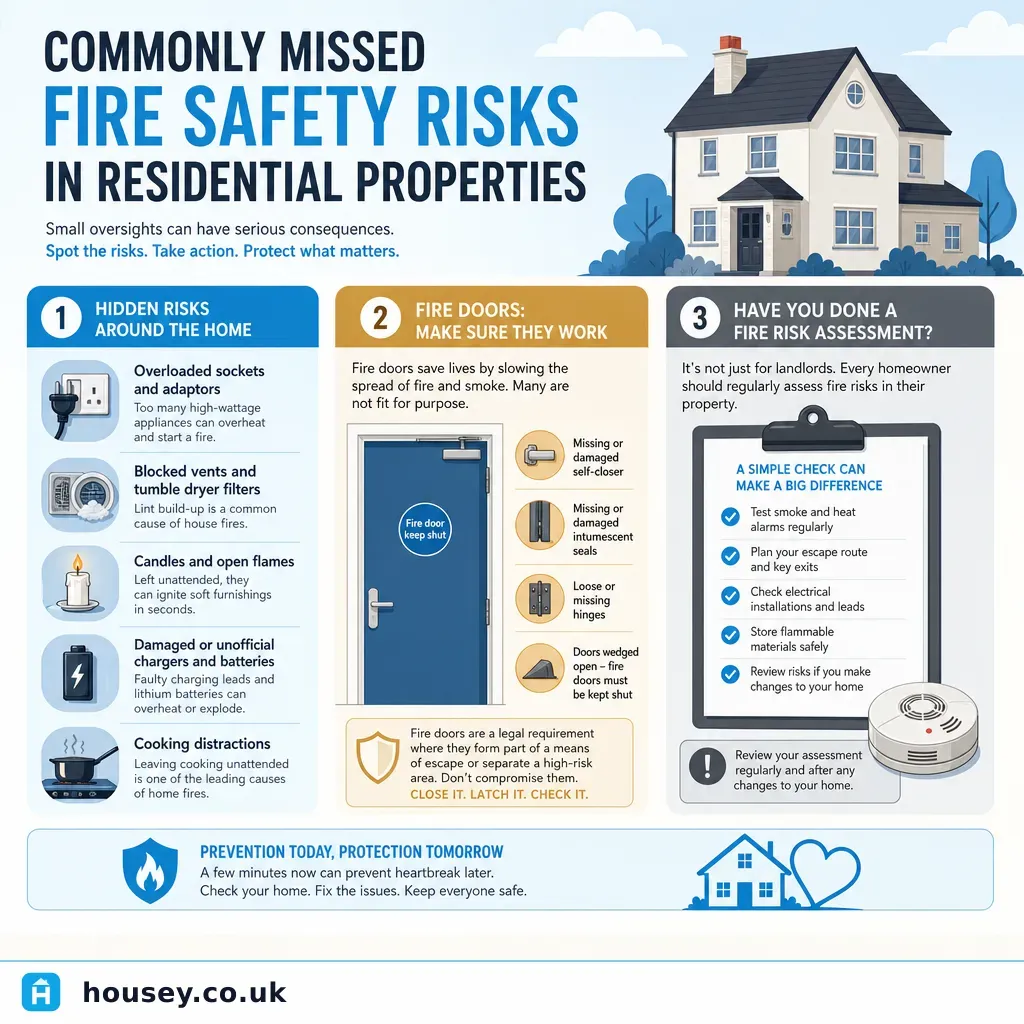
Commonly Missed Fire Safety Risks in Residential Properties
Fire safety in the home is often assumed to be adequately covered by a working smoke alarm, but the risk landscape in typical UK residential properties is considerably broader. Many hazards develop gradually — through ageing materials, informal alterations, or the accumulation of ordinary items — or exist as structural omissions from the original build that go unnoticed until a survey, inspection, or adverse event brings them to attention. Knowing what is commonly overlooked helps homeowners, landlords, and managing agents take meaningful preventive steps before a serious incident occurs.
Key points
- Under the Regulatory Reform (Fire Safety) Order 2005 (RRO), responsible persons in non-domestic and multi-occupied residential buildings must carry out and record a fire risk assessment; failure to comply is a criminal offence.
- BS 5839-6:2019 recommends a Grade D, LD2 smoke detection system for existing UK dwellings — interlinked alarms covering all hallways, landings, and principal habitable rooms where fire is most likely to start.
- The Smoke and Carbon Monoxide Alarm (Amendment) Regulations 2022 require private landlords in England to fit interlinked smoke alarms on every storey and a carbon monoxide alarm in every room containing a fixed combustion appliance.
- Cooking equipment is the leading cause of accidental dwelling fires in England, accounting for over 50% of incidents (Home Office fire statistics, 2023–24).
- Fire doors on escape routes must meet FD30 standard, carry intumescent strips and cold smoke seals, and be fitted with a functioning self-closing device — all three elements must be present and intact for the door to perform as rated.
Overlooked structural and passive fire protection risks
Missing or damaged fire doors
Fire doors are among the most commonly missed deficiencies in residential properties — particularly in converted Victorian terraces, 1930s semis divided into flats, and houses in multiple occupation (HMOs). Common failures include:
- Doors replaced with standard internal doors carrying no FD30 or FD60 certification label.
- Missing or degraded intumescent strips and cold smoke seals.
- Self-closing devices removed, propped open, or non-functional.
- Gaps at the head, sides, or foot of the door frame exceeding 3 mm (the maximum typically permitted under current guidance).
- Glazed panels without fire-rated glass.
A fire door that has been altered, damaged, or incorrectly fitted may fail well before its rated time — potentially within minutes of a fire starting on the other side.
Cavity fire stopping and compartmentation
In older UK properties — particularly Victorian and Edwardian terraces — roof spaces, wall cavities, and floor voids often run continuously between fire compartments or adjoining properties. Without fire-stopping materials at these junctions, fire and smoke can spread through concealed spaces rapidly and without visible surface signs.
Common compartmentation failures include:
- Missing cavity barriers at junctions between party walls and roof spaces.
- Services (pipes, cables, ducts) penetrating fire-rated walls or floors without intumescent collars or fire-stopping mortar.
- Loft hatches without fire-rated linings in converted properties.
- Voids beneath staircases used for combustible storage with no fire-rated closure.
Escape route obstructions
In HMOs and converted flats, the protected escape route — typically hallway and staircase — must remain clear. Common problems include combustible items stored in communal hallways such as bicycles, pushchairs, or furniture, and electrical panels or secondary boilers installed in the escape route without a fire-rated enclosure. Lighting in escape routes should also be on a reliable, dedicated circuit so that a fault on another floor does not leave the staircase unlit.
Commonly missed electrical and ignition risks
Electrical faults are the second most common cause of accidental dwelling fires in England. Specific risks that standard checks often miss:
- Extension lead daisy-chaining: plugging extension leads into each other overloads the circuit; a single fused multi-socket extension lead is significantly safer and reduces ignition risk.
- Older consumer units: pre-2016 consumer units without RCD (residual current device) or RCBO protection do not comply with BS 7671:2018+A2:2022 (IET Wiring Regulations, 18th Edition) and provide less protection against earth faults that can cause fires.
- Tumble dryer lint accumulation: lint filters and duct runs in condenser and vented dryers accumulate combustible material over time; regular cleaning is essential. Check the Office for Product Safety and Standards product recall database for models subject to ongoing safety recalls.
- Older recessed downlighters: downlighters installed in the 1990s or early 2000s often lack fire-rated covers above the ceiling void — a material risk where insulation has since been laid over them, trapping heat.
Red flags during a property inspection
The following observations warrant immediate professional attention:
- Missing or non-functional smoke alarms on any storey, or alarms that are painted over, have expired batteries, or have been disconnected from the mains supply.
- Scorch marks or heat browning around sockets or switches — evidence of localised electrical overheating that may indicate a more serious underlying fault.
- No evidence of an Electrical Installation Condition Report (EICR): for rented properties, an EICR is a legal requirement every five years under the Electrical Safety Standards in the Private Rented Sector (England) Regulations 2020.
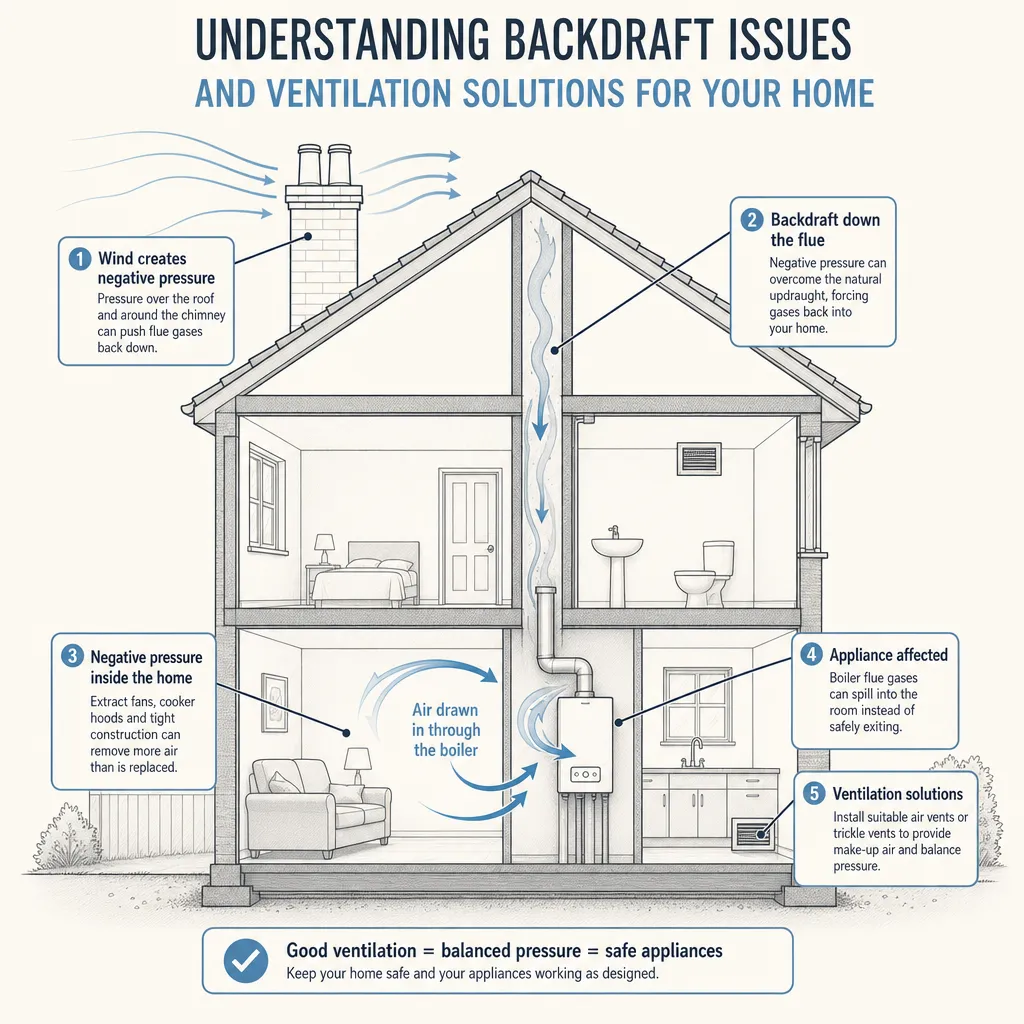
- Blocked or missing ventilation to solid-fuel or gas combustion appliances — inadequate air supply risks incomplete combustion, carbon monoxide production, and potential flashback.
- Undocumented alterations to partitions, door openings, or secondary staircases where no building control sign-off can be evidenced — these may have compromised fire compartmentation.
- Loft conversion without a Building Regulations completion certificate: loft conversions typically require fire-rated doors at each habitable room opening onto the staircase under Building Regulations Approved Document B.
Important limitations
This article provides general awareness information about commonly missed fire safety risks in UK residential properties. Fire safety rules, technical standards, and enforcement responsibilities vary by property type, tenure (owner-occupied, rented, leasehold), number of storeys, and date of construction or conversion. Nothing in this article constitutes a fire risk assessment or professional fire safety advice, and it should not be relied on in place of an assessment by a competent fire risk assessor or qualified building surveyor.
Rules and regulatory duties also differ between England, Scotland, Wales, and Northern Ireland. Always check the applicable legislation and guidance for your jurisdiction.
When this becomes urgent
Do not defer professional assessment if any of the following apply:
- A fire door on an escape route has been removed, permanently propped open, or replaced with a non-fire-rated door in a rented, converted, or multi-occupied property.
- You discover scorch marks, smell burning from an unknown source, or notice unexplained flickering lights.
- Smoke alarms in a rental property have been disconnected or are absent — this may constitute a breach of the Smoke and Carbon Monoxide Alarm (Amendment) Regulations 2022.
- You have a loft conversion with no evidence of Building Regulations approval and no fire doors on bedroom doors opening onto the staircase.
- A structural alteration has clearly breached a compartment wall or floor without fire-stopping being installed.
In these situations, prioritise professional inspection before carrying out any other property works.
What to ask a qualified professional
When commissioning a fire risk assessment or fire safety inspection, ask:
- What qualifications and register memberships do you hold — are you registered on the IFSM competency framework or BAFE SP205 certified?
- Will the assessment cover passive fire protection — compartmentation, fire doors, cavity barriers — as well as active measures such as alarms and emergency lighting?
- What standard will the smoke detection specification be written to — BS 5839-6:2019?
- If serious deficiencies are identified, what is the escalation process and what timescales for remediation are realistic?
- For landlords: will the assessment satisfy the requirements of the Regulatory Reform (Fire Safety) Order 2005 for this specific property type?
- Will the report identify any building control matters that may require retrospective approval?
When to get professional help
Fire safety concerns should not be deferred. Commission qualified professional assistance if:
- You are a landlord of an HMO, block of flats, or any multi-occupied residential building — the RRO places a legal duty on you to have a written fire risk assessment.
- You have purchased a converted property with no evidence of building control completion or a previous fire risk assessment.
- A surveyor or valuer has flagged fire safety concerns in their report.
- You are planning works that will alter, penetrate, or remove any element of fire-rated construction — walls, floors, doors, or compartment lines.
Contact a BAFE SP205-registered fire risk assessor or a RICS-qualified building surveyor with fire safety experience.
How Housey can help
If you are concerned about fire safety at a property you own, manage, or are considering purchasing, a professionally conducted fire risk assessment identifies specific deficiencies against current standards and produces a prioritised action plan. Housey connects you with verified assessors who carry out residential and mixed-use fire risk assessments across the UK.
Frequently asked questions
Do I need a fire risk assessment for my own home?
For owner-occupied single dwellings, a formal fire risk assessment is not a legal requirement under the Regulatory Reform (Fire Safety) Order 2005. However, the Order does apply to common parts of any multi-occupied building. For peace of mind, or where significant alterations have been made to the building fabric, a voluntary assessment by a competent person is worthwhile.
How often should smoke alarms be tested?
The National Fire Chiefs Council recommends testing smoke alarms monthly. Alarms with sealed long-life batteries should be replaced after ten years; alarms with replaceable batteries require annual changes, or sooner when the low-battery chirp begins. Interlinked mains-powered alarms should have all linked units tested together at each monthly check.
What is the difference between a smoke alarm and a fire alarm system?
A smoke alarm is a self-contained detector with an integral sounder — typically a Grade D device under BS 5839-6. A fire alarm system is an interconnected network of detectors, call points, and sounders with a central control panel. Most single dwellings use smoke alarms; HMOs with multiple floors or a significant number of occupants may require a full Grade A or B system.
Can I replace a fire door myself?
Fire door installation requires the correct door, frame, hardware, and fitting to maintain the fire-resistance rating. For properties where fire doors are a regulatory requirement — HMOs, flats, and conversions — professional installation and a written certificate from a BM TRADA Q-Mark or BWF-CERTIFIRE registered installer is strongly recommended to ensure the installation is fit for purpose.
Sources and further reading
- Regulatory Reform (Fire Safety) Order 2005 — legislation.gov.uk
- Smoke and Carbon Monoxide Alarm (Amendment) Regulations 2022 — legislation.gov.uk
- Fire and Rescue Incident Statistics, England, April 2023 to March 2024 — Home Office / GOV.UK
- BAFE SP205: Life Safety Fire Risk Assessments — BAFE
- National Fire Chiefs Council: home fire safety — National Fire Chiefs Council
- BS 5839-6:2019 Code of practice for fire detection and alarm systems in dwellings — BSI (British Standards Institution)
Useful next reads
 Surveys & Inspections
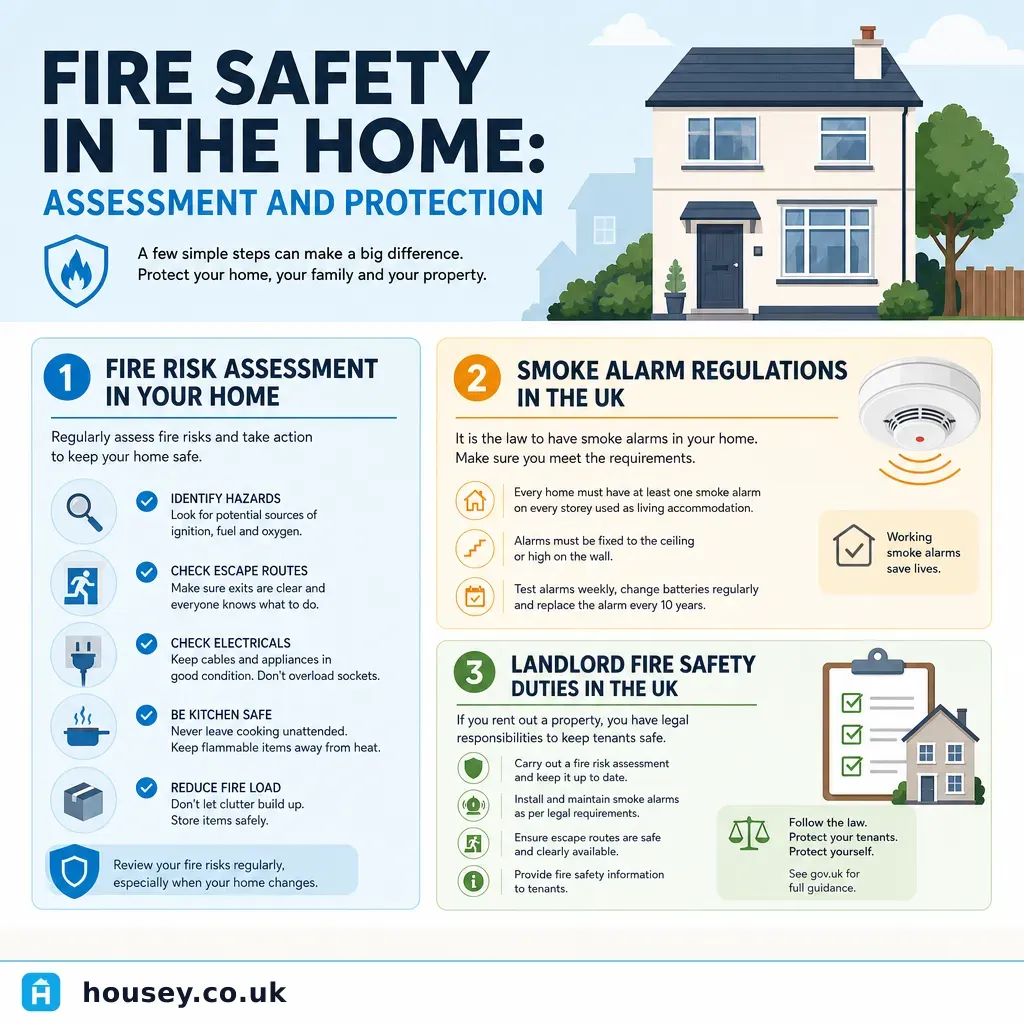
Fire Safety in the Home: Assessment and Protection
Most UK owner-occupied homes are the homeowner's responsibility to make fire-safe, while landlords have a legal duty to carry out fire risk assessments under the Regulatory Reform (Fire Safety) Order 2005.
 Surveys & Inspections
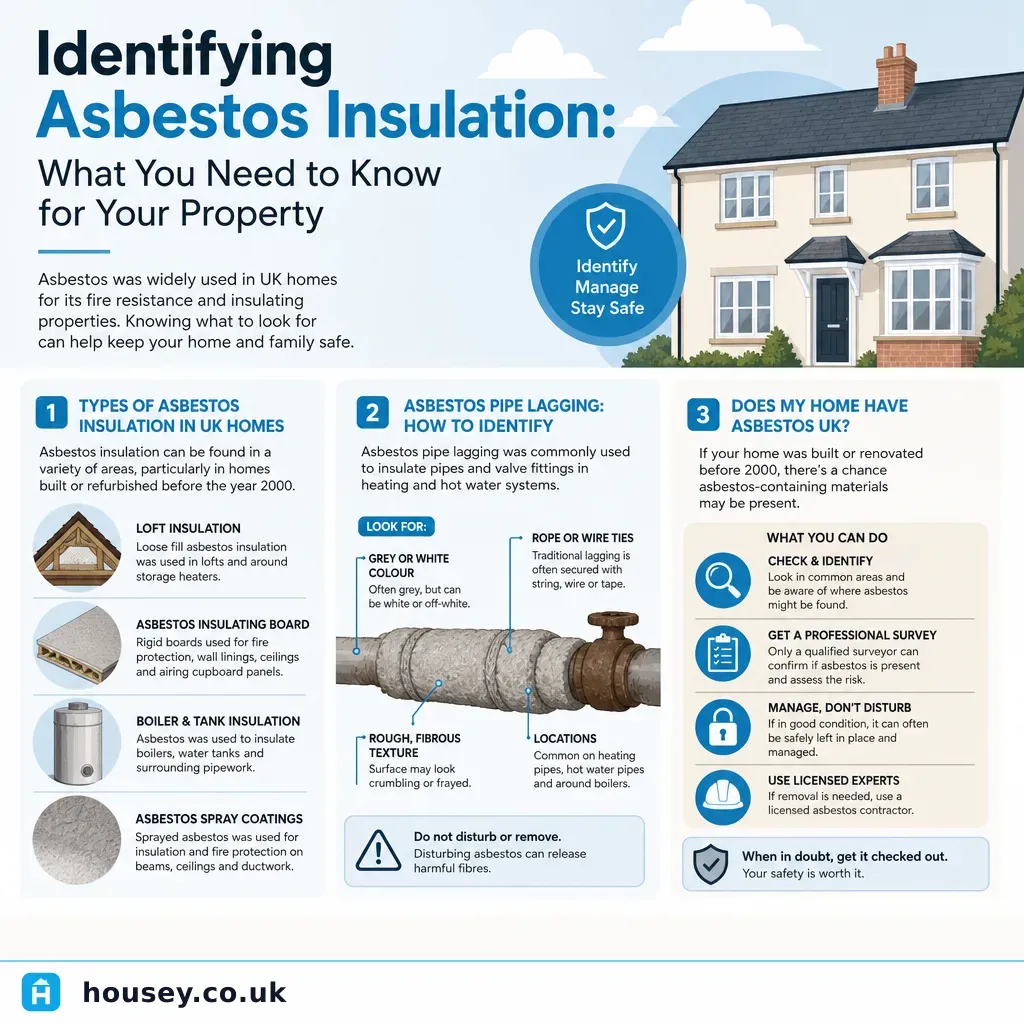
Identifying Asbestos Insulation: What You Need to Know for Your Property
Asbestos insulation was widely used in UK properties built before 2000, commonly found in pipe lagging, ceiling tiles, loose-fill loft insulation, and around boilers.
 Surveys & Inspections
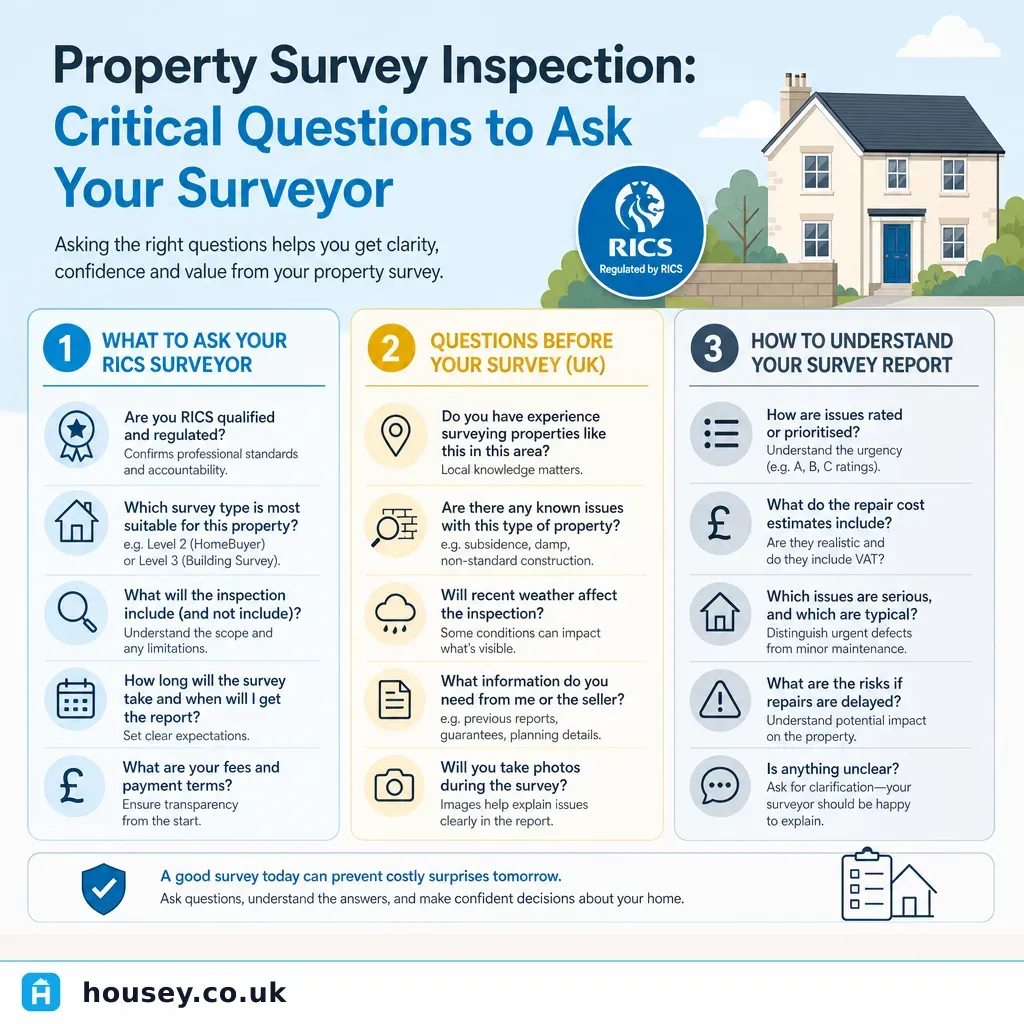
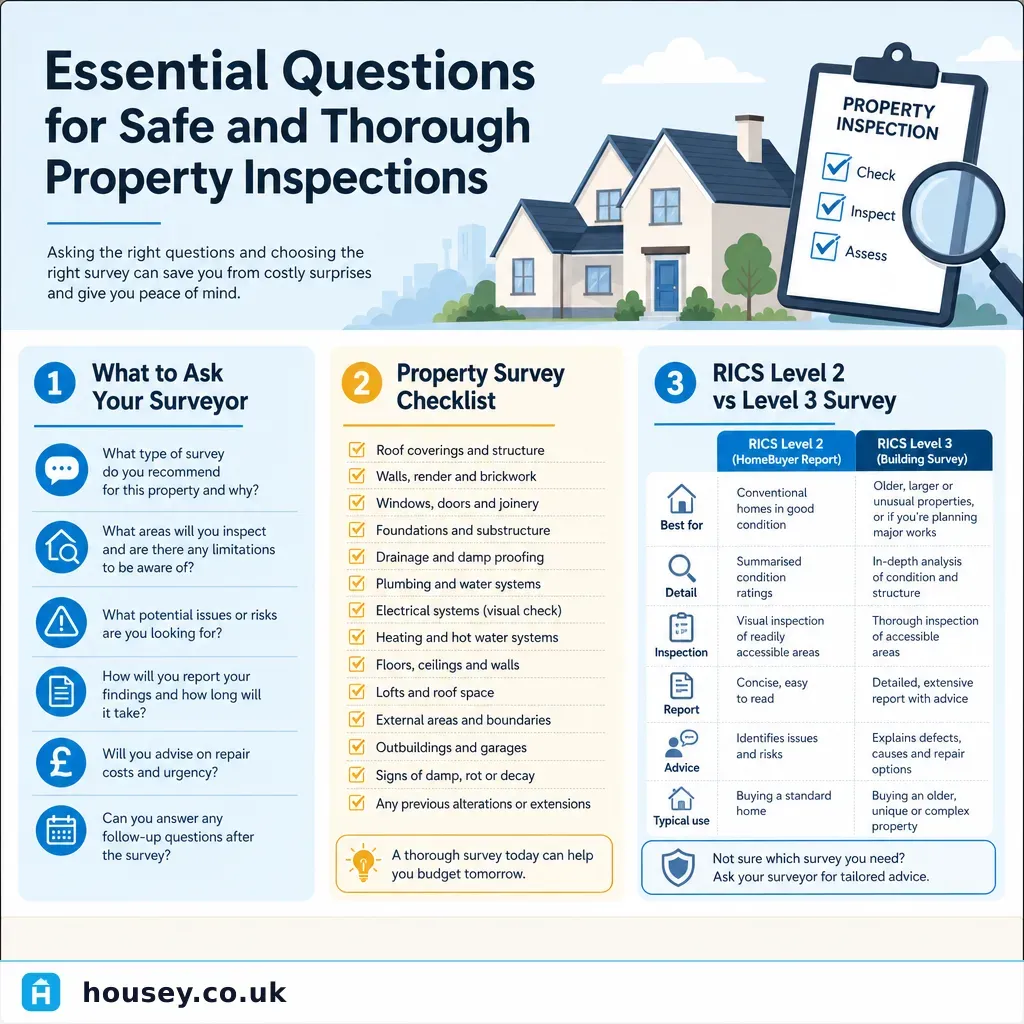
Property Survey Inspection: Critical Questions to Ask Your Surveyor
Before instructing a surveyor, ask which RICS level suits your property and what the report will and will not cover.
 Surveys & Inspections
Essential Questions for Safe and Thorough Property Inspections
Before commissioning a property survey, confirm what type of inspection suits your property's age and condition, ask the surveyor what defects they will and will not assess, and understand what the report will recommend.
 Surveys & Inspections
Understanding backdraft issues and ventilation solutions for your home
Backdraft occurs when negative pressure inside a building draws combustion gases back through a flue or chimney instead of expelling them outside.