Comparing Insulation Ratings: What You Need to Know
By Housey · Last reviewed 7th of May 2026
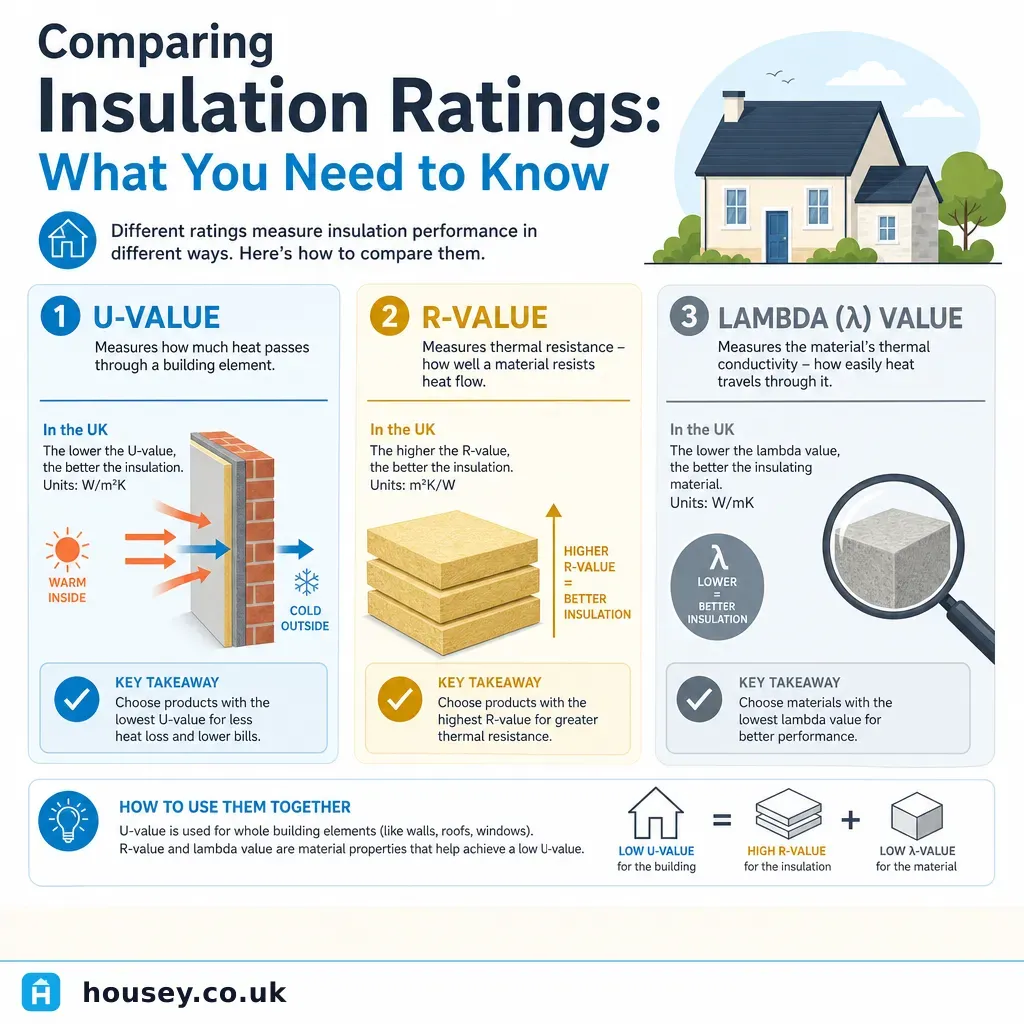
Comparing Insulation Ratings: What You Need to Know
When comparing insulation products or verifying whether a proposed installation meets Building Regulations, three measurements will appear repeatedly: lambda (λ), R-value, and U-value. Each describes performance from a different angle, and understanding how they relate helps you interrogate installer quotes, check compliance with Approved Document L, and avoid being misled by headline figures.
Key points
- Lambda (λ), or thermal conductivity (W/mK), describes a material's inherent insulating ability — lower is better, irrespective of installed thickness.
- R-value (thermal resistance, m²K/W) measures how well a specific thickness of material resists heat flow — higher is better; R = thickness in metres ÷ lambda (W/mK).
- U-value (thermal transmittance, W/m²K) measures heat loss through a complete building element including all layers — lower is better; U = 1 ÷ total R-value.
- Approved Document L (2021 edition, England) sets maximum U-values for renovations: 0.28 W/m²K for external walls, 0.18 W/m²K for roofs, and 0.22 W/m²K for ground floors.
- BBA (British Board of Agrément) certification independently verifies a product's declared lambda value; use BBA-certified products for Building Regulations compliance.
What is lambda (λ)?
Lambda, also called thermal conductivity, is a property of the material itself. It tells you how easily heat passes through 1 metre of the material under standardised conditions — regardless of how thick the installed layer is.
Typical values for common UK insulation materials:
Material | Typical lambda (W/mK) |
|---|---|
Mineral wool (glass/rock) | 0.033–0.044 |
EPS beads | 0.032–0.040 |
PIR boards | 0.022–0.028 |
Phenolic foam boards | 0.018–0.023 |
Wood fibre boards | 0.038–0.050 |
A lower λ means a better insulator per centimetre of depth. PIR board can match the thermal resistance of mineral wool at roughly half the thickness — important when installation space is limited, such as with internal wall insulation.
Always take lambda values from BBA-certified data sheets rather than manufacturer marketing materials.
What is R-value (thermal resistance)?
R-value tells you how well a specific layer of insulation at a given thickness resists heat flow:
R = thickness in metres ÷ lambda (W/mK)
Example: 100mm (0.1m) of mineral wool with λ = 0.040 W/mK:
R = 0.1 ÷ 0.040 = 2.5 m²K/W
At 200mm, R doubles to 5.0 m²K/W. R-values across all layers in a wall, roof, or floor are additive (plus small fixed surface resistances at each face), giving the total R used to calculate the U-value.
Higher R-value = better resistance to heat flow.
What is U-value (thermal transmittance)?
U-value is the standard used in UK Building Regulations. It describes the rate of heat loss through a complete building element at a temperature difference of 1°C:
U = 1 ÷ total R-value
Reference points:
- Uninsulated solid brick wall: approximately 2.0–2.1 W/m²K
- Well-insulated cavity wall: 0.18–0.28 W/m²K
- Part L renovation maximum for walls in England: 0.28 W/m²K
U-values must account for thermal bridges — interruptions in the insulation layer at wall ties, timber joists, and window reveals. A Standard Assessment Procedure (SAP) calculation or competent energy assessor should confirm thermal bridges are addressed before a U-value is submitted to Building Control.
Insulation ratings: comparison table
Measurement | What it measures | Unit | Better direction | Applies to |
|---|---|---|---|---|
Lambda (λ) | Material thermal conductivity | W/mK | Lower = better insulator | The material, at any thickness |
R-value | Thermal resistance at installed thickness | m²K/W | Higher = better resistance | A specific layer at a given thickness |
U-value | Heat transmittance through complete element | W/m²K | Lower = better performance | Whole wall, roof, floor, window, or door |
Part L U-value targets (Approved Document L, England, 2021)
Building element | Max U-value — renovation | Max U-value — new build |
|---|---|---|
External wall | 0.28 W/m²K | 0.26 W/m²K |
Pitched roof — insulation at ceiling | 0.18 W/m²K | 0.16 W/m²K |
Pitched roof — insulation at rafter | 0.18 W/m²K | 0.16 W/m²K |
Ground floor | 0.22 W/m²K | 0.18 W/m²K |
Windows and roof windows | 1.6 W/m²K | 1.4 W/m²K |
Scotland, Wales, and Northern Ireland have their own building standards with differing targets. Check national technical guidance for projects outside England.
How to compare products using these ratings
When an installer quotes two competing products, work through these four checks:
- Compare lambda values — which material insulates better per unit of thickness?
- Check R-value at the proposed installed thickness — does it deliver enough resistance to reach the target U-value for the whole element?
- Confirm BBA or equivalent certification — is the declared λ independently verified, or only a manufacturer's own figure?
- Ask how thermal bridges are addressed — wall ties, timber studwork, and window reveals all interrupt insulation and can significantly reduce effective performance.
A low lambda value is only useful if the product is installed correctly at the specified thickness and cold bridges are properly treated.
What to ask before accepting an insulation quote
- What is the declared lambda (λ) value, and is it BBA-certified or independently verified?
- What thickness are you proposing, and what R-value does that achieve for this layer?
- What U-value will the finished element achieve, and does it meet the Approved Document L target?
- How will thermal bridges at junctions and reveals be treated?
- Will you provide a U-value calculation for Building Control if this work is notifiable?
- Is VAT included? (Qualifying residential insulation currently attracts 0% VAT — check HMRC guidance for current criteria.)
When to get professional help
For straightforward top-up loft insulation, checking the declared lambda and proposed thickness is usually sufficient. For more complex projects, professional input is advisable:
- Extensions or conversions requiring Building Control sign-off — professionally calculated U-values are required as part of the application.
- Solid-wall retrofits, where achieving the Part L target at a practical installed thickness is challenging and thermal bridge risk is high.
- Whole-house retrofit under PAS 2035, where a retrofit assessor must specify required performance for each building element.
- Listed buildings and conservation areas, where Part L targets must be balanced against heritage and planning constraints.
An independent insulation assessment can confirm which products and thicknesses are appropriate for your property, reducing the risk of a Building Control rejection or costly remediation.
How Housey can help
Housey helps UK homeowners find qualified professionals at every stage of an insulation project. Request an insulation assessment for expert guidance on products and ratings, or find accredited insulation installers to carry out works to the correct specification and U-value targets.
Frequently asked questions
What is a good U-value for a wall in the UK?
For renovations and extensions in England, Approved Document L (2021) sets a maximum of 0.28 W/m²K for external walls. A well-insulated solid-wall retrofit can achieve 0.20–0.25 W/m²K; a new-build cavity wall is typically designed to 0.18–0.26 W/m²K. Lower is always better — aim to meet or exceed the target rather than simply comply.
Is R-value the same as U-value?
No — they are reciprocals. R-value (m²K/W) measures how well a layer resists heat flow; U-value (W/m²K) measures how much heat passes through a complete building element. U = 1 ÷ R. A high R-value corresponds to a low U-value and vice versa.
Do I need to understand lambda to choose insulation?
Not necessarily — your installer should propose the correct product and thickness to hit the target U-value. Lambda is most useful when comparing products: a lower λ achieves the same R-value at less thickness, which matters when installation depth is limited, such as in internal wall insulation.
Why do US and UK insulation ratings look different?
The US uses imperial R-values in h·ft²·°F/BTU, which differ numerically from SI m²K/W values used in the UK. To convert a US R-value to SI, divide by 5.678. Always confirm which system a product data sheet uses before comparing figures across markets.
What does BBA certification mean for insulation?
A British Board of Agrément (BBA) certificate confirms that a product's declared lambda value has been independently tested and verified. BBA certification gives assurance for Building Regulations compliance and is generally required by Building Control bodies when reviewing U-value calculations for notifiable works.
Sources and further reading
- Approved Document L: Conservation of Fuel and Power — GOV.UK / DLUHC
- BBA certification for building products — British Board of Agrément
- Standard Assessment Procedure (SAP) — BRE Group
- Insulation guidance for homeowners — Energy Saving Trust
- Thermal performance of buildings — CIBSE
Useful next reads
 Energy & Retrofit
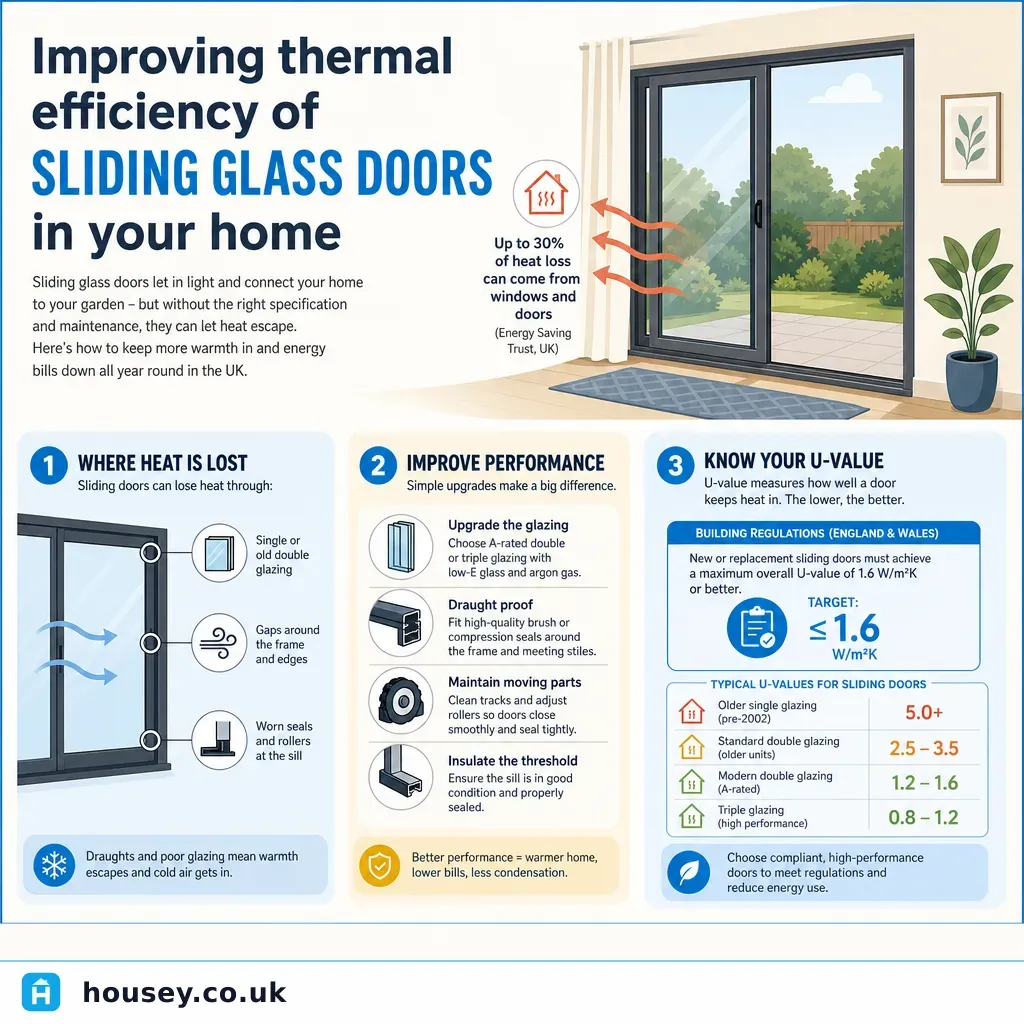
Improving thermal efficiency of sliding glass doors in your home
Sliding glass doors lose heat through the glazing unit, the frame, and air gaps in worn seals.
 Energy & Retrofit
The Growing Market for Home Performance: Energy Efficiency as Standard Practice
The UK home energy retrofit market is expanding, driven by tightening EPC regulations, rising energy bills, and grant schemes including ECO4, GBIS, and the Boiler Upgrade Scheme.
 Energy & Retrofit
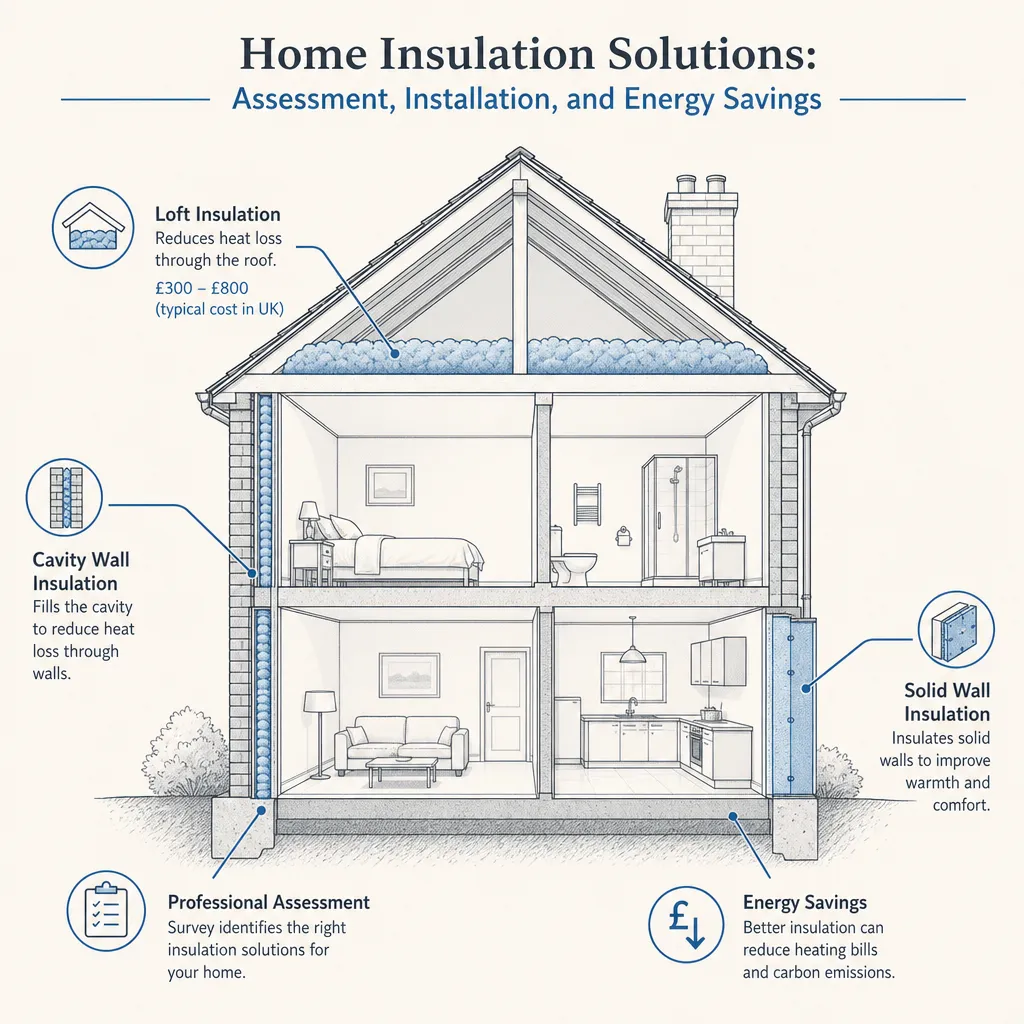
Home Insulation Solutions: Assessment, Installation, and Energy Savings
Home insulation in the UK covers loft, cavity wall, solid wall, and floor insulation.
 Energy & Retrofit
Professional Certifications and Accreditations in Insulation Services
In the UK, reputable insulation installers should hold TrustMark registration and be certified to PAS 2030:2019, the standard required for government-funded schemes such as ECO4.
 Energy & Retrofit
Insulating Solid Masonry Walls Under Bay Windows: Technical Guidance
Insulating solid masonry walls under bay windows requires specialist detailing at angled wall faces, window reveals, and the bay floor and ceiling junctions.