The Growing Market for Home Performance: Energy Efficiency as Standard Practice
By Housey · Last reviewed 31st of May 2026

The Growing Market for Home Performance: Energy Efficiency as Standard Practice
The UK retrofit and home-energy sector has expanded from a niche interest into a mainstream property consideration, driven by tightening EPC regulations, rising energy costs, and an accelerating policy agenda. Whether you own a Victorian terrace, a 1930s semi, or a post-war flat, energy performance now affects your property's rental legality, resale value, and running costs in ways that were not routine concerns a decade ago.
Key points
- Minimum EPC rating E is required for all privately rented homes in England and Wales under the Minimum Energy Efficiency Standards (MEES); government proposals would raise this to C by 2030 for new tenancies.
- The ECO4 scheme (Energy Company Obligation, Phase 4) funds insulation and heating upgrades for eligible low-income households through obligated energy suppliers.
- The Great British Insulation Scheme (GBIS) provides additional support for cavity-wall and loft insulation in homes rated EPC D–G.
- PAS 2035:2023 is the British Standard governing whole-house retrofit; it requires a Retrofit Coordinator to oversee medium-to-large projects to reduce the risk of moisture and ventilation failures.
- The UK Climate Change Committee estimates around 29 million homes need significant energy-efficiency improvements to meet net-zero targets by 2050.
How the UK retrofit market has grown
The market for domestic energy retrofit has grown significantly since 2021–22, when a gas price shock pushed average household energy bills well above historic norms. A combination of regulatory pressure on landlords, consumer awareness of running costs, and accessible grant funding has widened the customer base beyond early adopters.
Key drivers include:
- Mandatory EPC requirements for landlords: the Minimum Energy Efficiency Standards (MEES) already ban new tenancies in F- or G-rated properties. Proposed tightening to EPC C for new tenancies by 2030 is encouraging landlords to act early rather than wait for legislation.
- Consumer energy bills: average household dual-fuel bills remain well above pre-2021 levels. Homeowners increasingly treat insulation and efficient heating as capital investment rather than discretionary spend.
- Heat pump rollout: the Boiler Upgrade Scheme (BUS) provides a £7,500 grant toward air-source heat pumps, increasing demand for retrofit-ready homes with adequate insulation and heating system redesign.
- Future Homes Standard: new-build requirements expected from 2025/26 will require homes to produce 75–80% fewer carbon emissions than current standards, setting a higher baseline for what "efficient" means and raising expectations for existing stock.
What the market means for homeowners right now
Growing demand has a practical effect on costs and lead times. Specialist retrofit assessors, Retrofit Coordinators (required under PAS 2035 for medium-to-large projects), and accredited installers for external wall insulation and heat pumps are in high demand in many areas. Booking windows have lengthened, particularly for MCS-accredited heat pump installers and TrustMark-registered firms operating under ECO4.
Comparison of common retrofit pathways
Pathway | Typical driver | PAS 2035 required? | Grant funding available? | Typical professional |
|---|---|---|---|---|
Loft insulation top-up | Quick win, low disruption | No (single measure) | GBIS / ECO4 if eligible | Insulation installer |
Cavity wall insulation | Common in 1930s–1990s homes | No (single measure) | GBIS / ECO4 if eligible | Insulation installer |
External wall insulation | Solid-wall homes, Victorian terraces | Yes (medium retrofit) | ECO4 if eligible | Retrofit Coordinator + contractor |
Air-source heat pump | Replacing gas boiler | Yes (fabric-first check required) | Boiler Upgrade Scheme (£7,500) | MCS-accredited installer |
Whole-house retrofit plan | Comprehensive upgrade | Yes | Varies by scheme | Retrofit Coordinator |
A worked UK property scenario
A 1930s semi-detached home in the East Midlands, currently EPC-rated E, is let out and needs to reach C ahead of the proposed 2030 MEES changes. A PAS 2035 Retrofit Assessor identifies three priority measures: loft insulation top-up to 270 mm, cavity wall insulation, and replacement of an ageing gas boiler with an air-source heat pump. The landlord applies for the Boiler Upgrade Scheme grant (£7,500) and uses a TrustMark-registered contractor for the insulation via ECO4. Without a Retrofit Coordinator to sequence measures and check ventilation, sealing the envelope before improving airflow would risk interstitial condensation — a common and costly mistake.
Who carries out retrofit work?
The growth in the sector has produced a broader range of professionals. Homeowners should verify credentials before instructing anyone:
- Retrofit Assessors: carry out energy assessments under PAS 2035; must hold a recognised qualification (Elmhurst, Stroma, or equivalent).
- Retrofit Coordinators: oversee medium-to-large projects under PAS 2035; must be registered with TrustMark.
- MCS-accredited installers: required for heat pumps and solar PV under the Boiler Upgrade Scheme and Smart Export Guarantee.
- TrustMark-registered contractors: required for work funded under ECO4 and GBIS.
What not to assume
- Not all insulation installers are PAS 2035 compliant: single-measure loft or cavity work may not require a Retrofit Coordinator, but more complex projects do. Check whether your planned scope triggers the standard before instructing anyone.
- An EPC is not a retrofit plan: an EPC rating is a snapshot of potential performance; it does not substitute for a whole-house assessment under PAS 2035.
- Grant eligibility is not automatic: ECO4 and GBIS have income, property type, and EPC criteria. Confirm eligibility before committing to a scheme or a contractor.
- "Green" marketing does not equal accreditation: TrustMark registration and MCS accreditation are publicly verifiable; general sustainability claims are not.
When to get professional help
Most retrofit work beyond a straightforward loft top-up benefits from professional assessment. Seek qualified advice when:
- Your home has solid walls, unusual construction, or a listed-building designation.
- You are considering a heat pump and are unsure whether your insulation level and radiator sizing are adequate.
- You are a landlord approaching the proposed 2030 EPC-C deadline with a complex or poorly-documented property.
- You have noticed condensation, damp, or mould following a previous insulation installation — this may indicate a ventilation problem requiring professional diagnosis under PAS 2035.
How Housey can help
Housey connects homeowners with vetted energy-efficiency consultants who can assess your property against current and proposed EPC standards, and with insulation installers who hold the accreditations required for grant-funded and private retrofit work.
Frequently asked questions
What is PAS 2035 and does it apply to my retrofit project?
PAS 2035:2023 is the British Standard for domestic retrofit. It applies to medium and large retrofit projects — broadly, any improvement beyond a single isolated measure. It requires a Retrofit Coordinator to oversee the project and ensure measures are sequenced to avoid moisture and ventilation problems. Single-measure work such as loft insulation only generally falls outside its scope, though the standard is considered best practice for most projects.
Is the Boiler Upgrade Scheme still available in 2026?
The Boiler Upgrade Scheme (BUS) provides a £7,500 grant toward air-source and ground-source heat pumps in England and Wales. Eligibility requires using an MCS-accredited installer, and the property must have a valid EPC with no outstanding recommendations for loft or cavity wall insulation. Check GOV.UK for current availability, as the scheme is subject to annual budget allocation and rules may change.
What is the minimum EPC rating for rented homes in England?
Under the current Minimum Energy Efficiency Standards (MEES) in England and Wales, properties let to new tenants must have an EPC rating of at least E. An F or G rating means the property cannot legally be let in most circumstances. Government proposals would raise the threshold to EPC C for new tenancies by 2030, but legislation has not yet been enacted. Check the latest GOV.UK guidance for the current legal position.
Do I need planning permission for external wall insulation?
In most cases, external wall insulation added to a house in England falls under permitted development and does not require planning permission, provided the work does not materially alter the external appearance. However, listed buildings, properties in conservation areas, and some flats may require consent. Always check with your local planning authority before instructing a contractor.
Sources and further reading
- Minimum Energy Efficiency Standards (MEES) landlord guidance — GOV.UK
- Apply for the Boiler Upgrade Scheme — GOV.UK
- Apply for the Great British Insulation Scheme — GOV.UK
- PAS 2035:2023 retrofit standard — BSI Group
- TrustMark — government-endorsed quality scheme for retrofit — TrustMark
- Energy Saving Trust — retrofit and insulation guidance — Energy Saving Trust
Useful next reads
 Energy & Retrofit
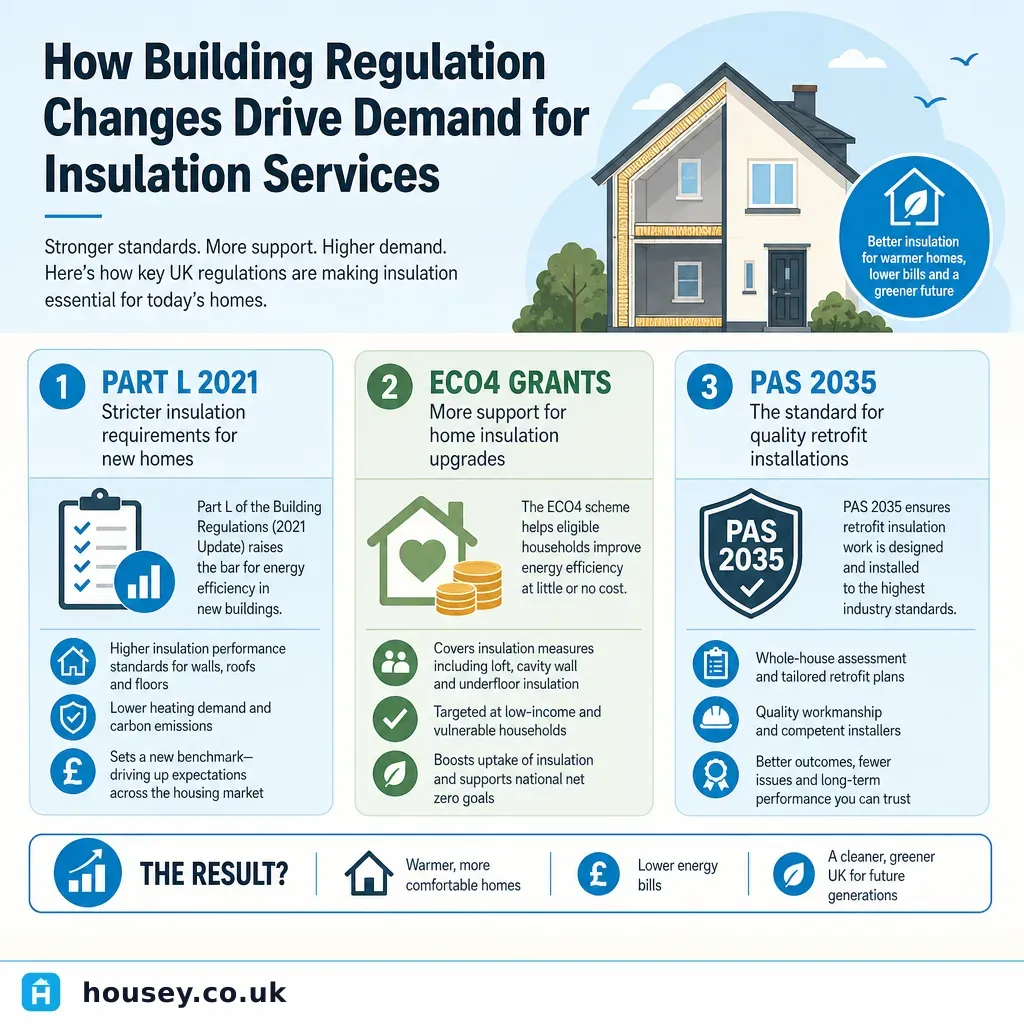
How Building Regulation Changes Drive Demand for Insulation Services
Building regulation changes — including 2021 updates to Approved Document L, ECO4 funding obligations, and proposed MEES tightening — are creating sustained demand for insulation services across the UK.
 Energy & Retrofit
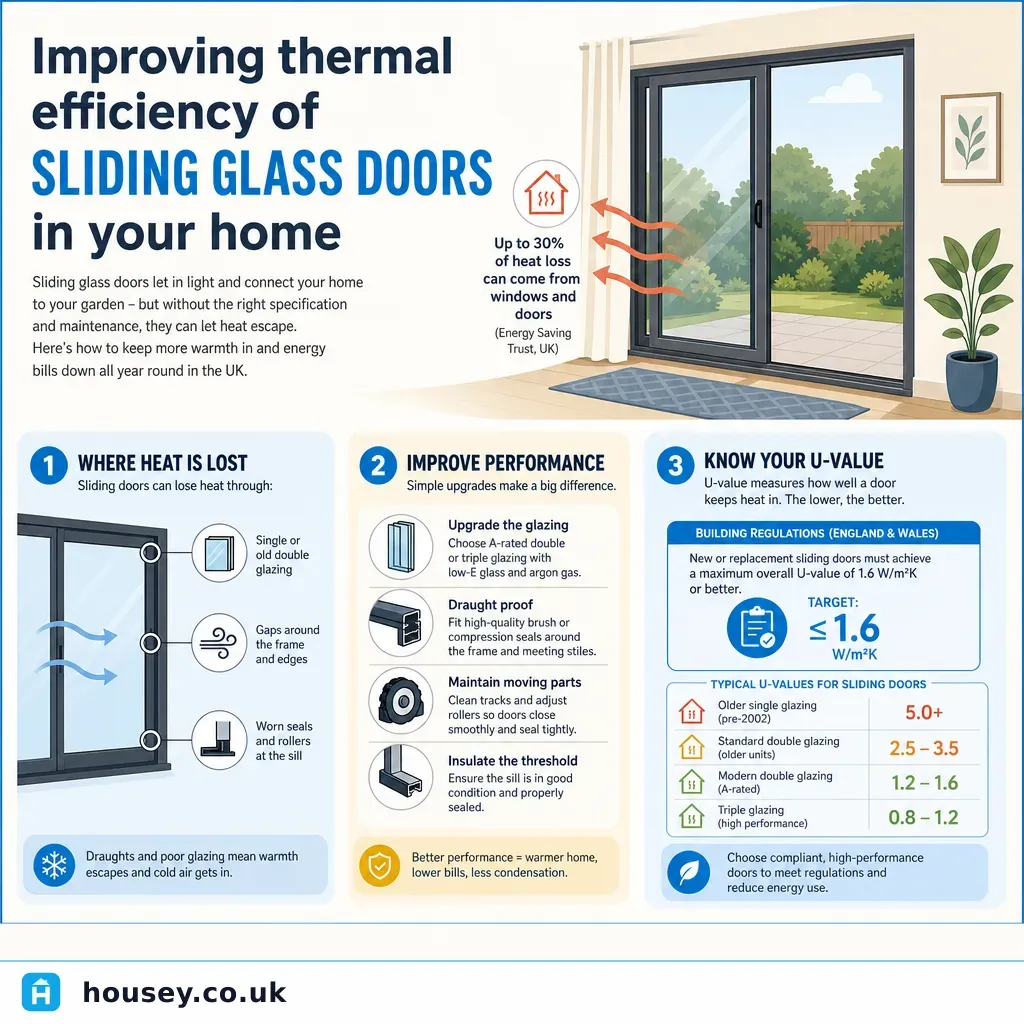
Improving thermal efficiency of sliding glass doors in your home
Sliding glass doors lose heat through the glazing unit, the frame, and air gaps in worn seals.
 Energy & Retrofit
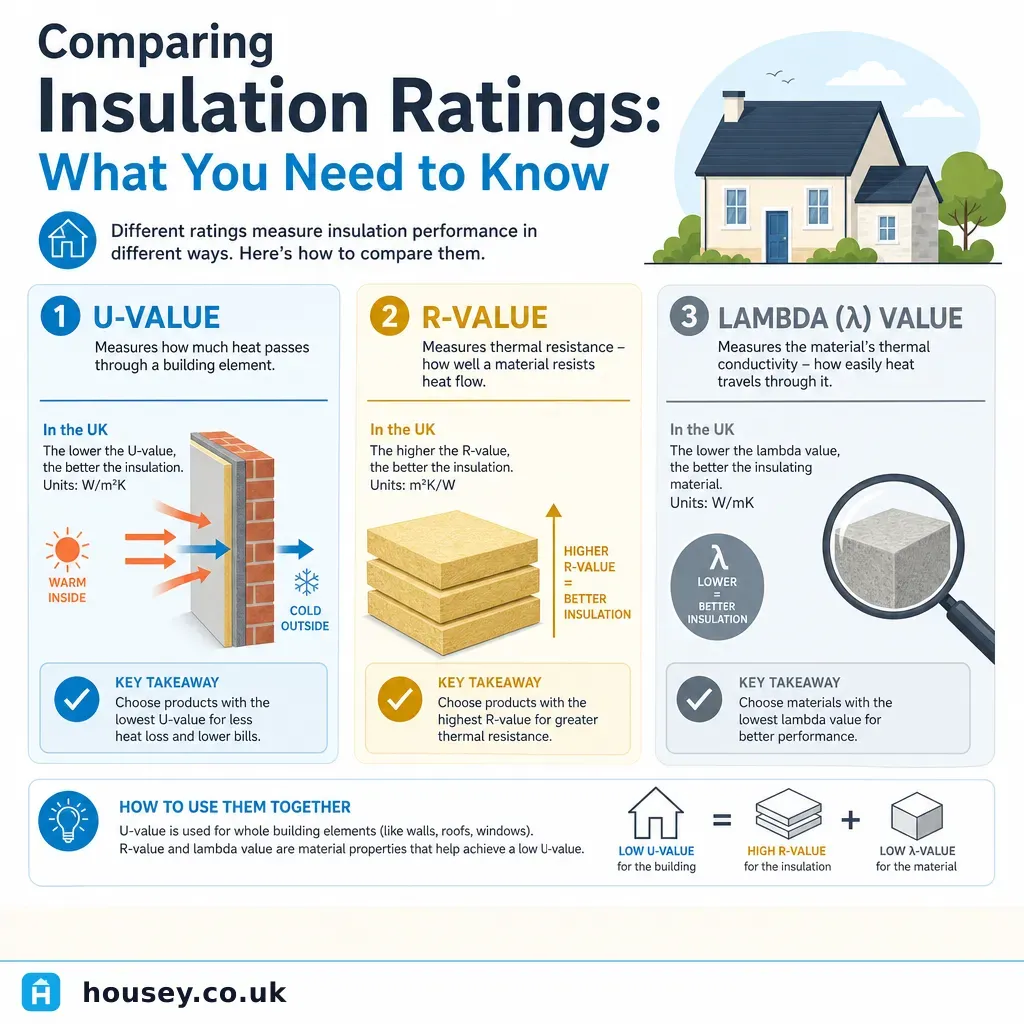
Comparing Insulation Ratings: What You Need to Know
UK insulation performance uses three linked measurements: lambda (λ) for material conductivity in W/mK (lower is better); R-value for thermal resistance at a given thickness in m²K/W (higher is better); and U-value for heat loss through a complete building element in W/m²K (lower is better).
 Energy & Retrofit
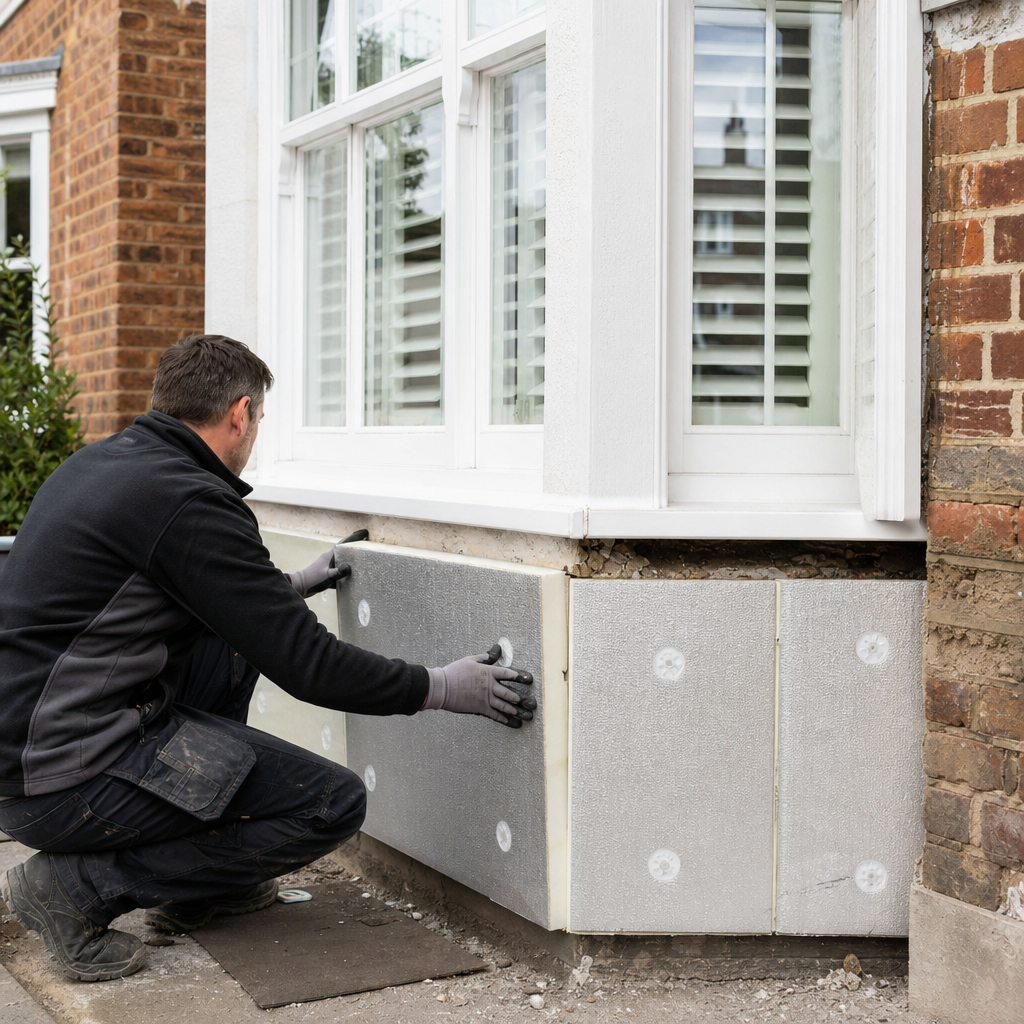
Insulating Solid Masonry Walls Under Bay Windows: Technical Guidance
Insulating solid masonry walls under bay windows requires specialist detailing at angled wall faces, window reveals, and the bay floor and ceiling junctions.
 Energy & Retrofit
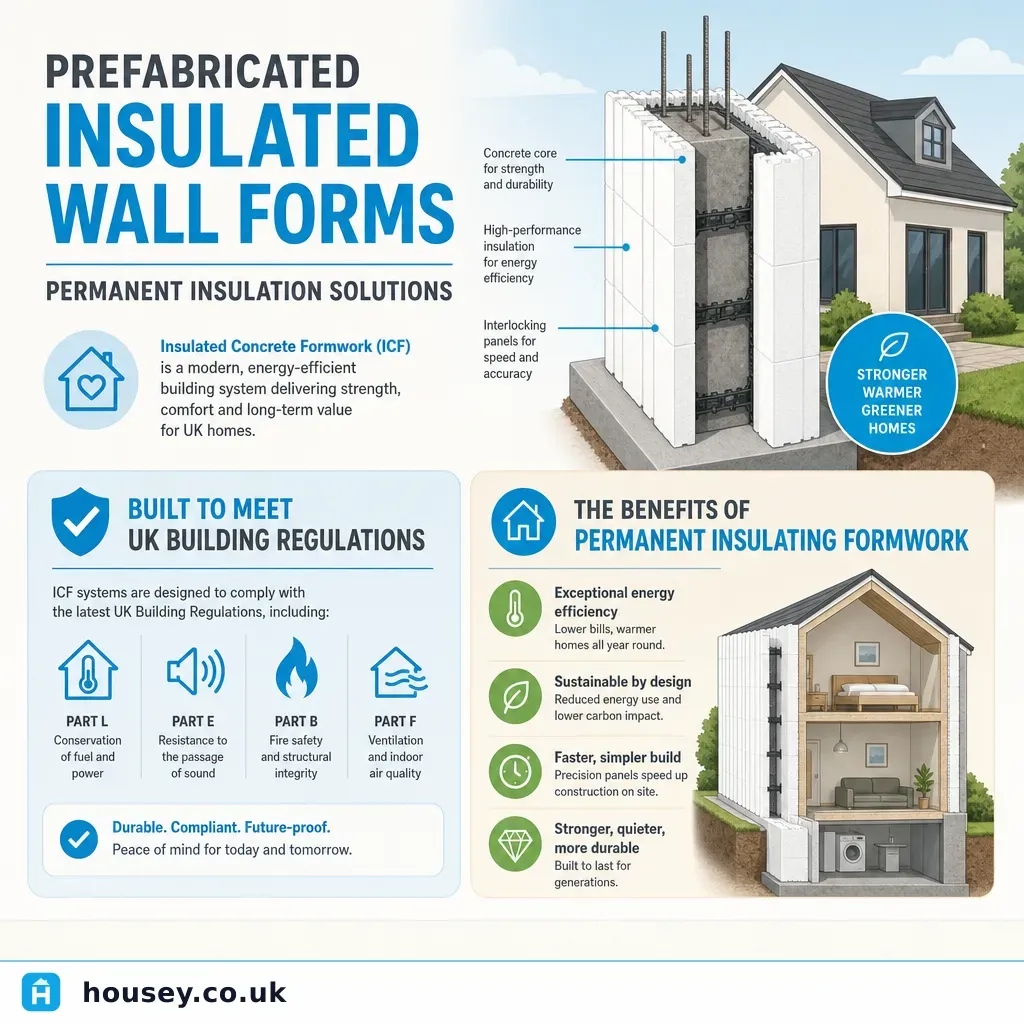
Prefabricated Insulated Wall Forms: Permanent Insulation Solutions
Prefabricated insulated wall forms — including ICF and SIPs systems — deliver high thermal performance by combining permanent insulation with structural concrete or timber in a single wall assembly.