Professional Certifications and Accreditations in Insulation Services
By Housey · Last reviewed 24th of May 2026
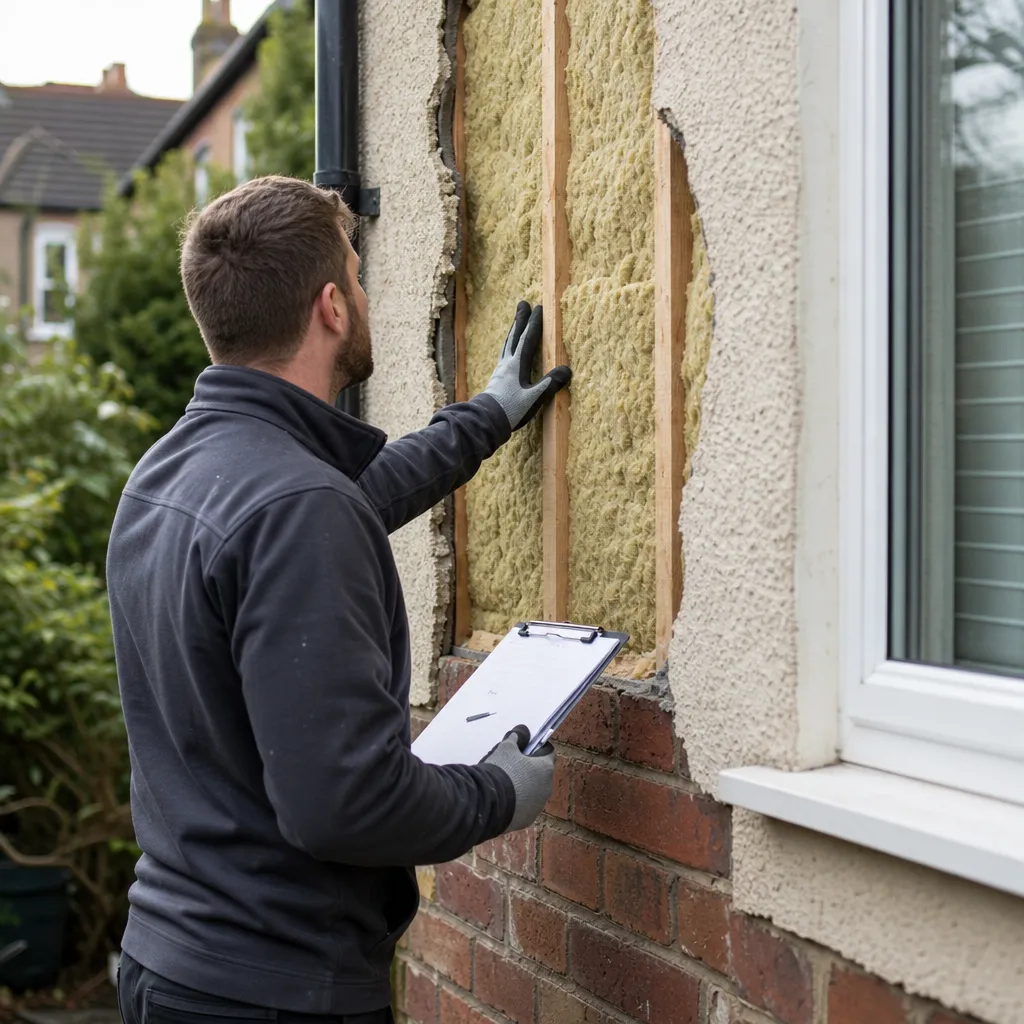
Professional Certifications and Accreditations in Insulation Services
Choosing an insulation contractor is one of the most consequential decisions in a home energy project. In the UK, insulation work — whether cavity wall, loft, underfloor, or solid-wall — is governed by a layered system of certifications, quality schemes, and product guarantees. Getting this right matters whether you are improving a 1930s semi-detached under your own budget or accessing government funding through ECO4 or the Great British Insulation Scheme (GBIS).
Key points
- PAS 2030:2019 is the British Standards Institution specification that installers must be certified to in order to carry out government-funded insulation work in Great Britain.
- TrustMark is the government-endorsed quality scheme required for all domestic retrofit work funded under ECO4, GBIS, and similar grant schemes — registration can be verified at trustmark.org.uk.
- The Cavity Insulation Guarantee Agency (CIGA) provides a 25-year transferable guarantee for cavity wall insulation installed by its member contractors.
- PAS 2035:2023 is the overarching framework for whole-house retrofit; where insulation is part of a coordinated package of measures, a qualified Retrofit Coordinator must oversee the project.
- Using an unaccredited installer can invalidate product guarantees, affect home insurance claims, and — in tightly sealed homes — introduce condensation and moisture risks if ventilation is not addressed.
Why accreditation matters in insulation work
Insulation may appear straightforward, but even loft insulation can cause problems if ventilation is inadequate or if existing materials are disturbed carelessly. Cavity wall and solid-wall insulation carry a higher risk of moisture ingress, cold bridging, or interstitial condensation if the wrong materials are specified or the installation is poor.
Accreditation schemes exist to ensure installers have been trained, assessed, and are subject to independent audit. They also create a structured route to redress. Without accreditation, your options if work fails may be limited to pursuing the contractor through the courts — a slow and uncertain process. An accredited installer is bound by a code of conduct and subject to ongoing oversight from their certification body.
The main certification and accreditation schemes
PAS 2030:2019 — the installation standard
PAS 2030:2019 sets out the technical requirements for installing energy efficiency measures in existing dwellings. It covers loft, cavity wall, underfloor, and solid-wall insulation (internal and external), and is assessed and certified by approved third-party bodies such as BESCA, NAPIT, and Stroma Certification.
Certification is ongoing: installers are subject to surveillance audits, and certification can be suspended or withdrawn if standards fall. Any work funded through ECO4, GBIS, the Home Upgrade Grant (HUG), or the Social Housing Decarbonisation Fund must be carried out by a PAS 2030-certified installer.
TrustMark — government-endorsed quality assurance
TrustMark is the government-endorsed framework for domestic retrofit and home improvement work. Registration requires firms to pass background checks, carry public liability insurance (typically at least £2 million for domestic work), commit to an approved code of conduct, and operate a consumer complaints procedure.
You can verify any installer's registration status at trustmark.org.uk. TrustMark registration is a prerequisite for all government-funded insulation schemes. If a contractor claims ECO4 eligibility but is not TrustMark registered, treat that as a significant warning.
CIGA — the cavity wall insulation guarantee
The Cavity Insulation Guarantee Agency (CIGA) provides a 25-year guarantee for cavity wall insulation installed by its member contractors. The guarantee covers material and installation failure, and it is tied to the property rather than the installer — transferring automatically to future owners on sale.
Not every cavity wall insulation installer is a CIGA member. If your chosen contractor is not, ask what alternative guarantee they offer, how long it lasts, and who underwrites it. An independent insurance-backed guarantee is the minimum acceptable alternative.
PAS 2035:2023 — whole-house retrofit coordination
PAS 2035:2023 is the broader standard governing how retrofit projects should be planned and managed. It applies when insulation forms part of a coordinated package of measures rather than a single standalone installation. Under PAS 2035, the project must be assessed by a qualified Retrofit Assessor and overseen by a Retrofit Coordinator. This requirement exists to prevent moisture and ventilation problems that can arise when a building's thermal envelope is significantly improved without corresponding airflow management.
Key certification schemes compared
Scheme | What it covers | Required for government funding? | Main homeowner benefit |
|---|---|---|---|
PAS 2030:2019 | Technical installation standard for energy efficiency measures | Yes (ECO4, GBIS, HUG) | Assurance of installer competence and quality audits |
TrustMark | Business standards, insurance, conduct, complaints | Yes (all government schemes) | Consumer protection and route to redress |
CIGA | Cavity wall insulation guarantee | No, but strongly advisable | 25-year transferable property guarantee |
PAS 2035:2023 | Whole-house retrofit planning and coordination | Yes (multi-measure projects) | Moisture and ventilation risk management |
What to ask before accepting a quote
When comparing insulation contractors, ask each one to confirm the following in writing:
- Their PAS 2030 certification number and which certification body assessed them (e.g. BESCA, NAPIT, Stroma Certification).
- Their TrustMark registration number — verify independently at trustmark.org.uk.
- Whether they hold CIGA membership (for cavity wall insulation specifically).
- The guarantee they offer: duration, what is and is not covered, and who underwrites it.
- Whether your project requires a Retrofit Assessor or Coordinator under PAS 2035:2023.
- Their public liability insurance level and whether it covers your property type.
- What process they follow if a problem is discovered after installation.
- Whether VAT is included in the quoted price.
Reputable, accredited contractors will provide all of this without hesitation. Reluctance to confirm certifications in writing is a warning sign.
What not to assume
- Accreditation is a baseline, not a quality guarantee in itself. Always check reviews, ask for references from recent customers, and compare at least two or three quotes.
- A low price does not necessarily mean an unaccredited installer — but always verify credentials regardless of price, especially for grant-funded work.
- Loft insulation is not always straightforward. If your loft contains loose-fill granular material installed before 2000, it may contain urea-formaldehyde or — in older properties — vermiculite with potential asbestos contamination. Do not disturb it without professional assessment.
- The right insulation material matters. Cavity wall insulation can use mineral wool, EPS bead, or polyurethane foam. The appropriate choice depends on wall type, exposure zone, and existing wall condition. Your installer should explain their material choice and its suitability for your property.
When to get professional help
Seek a qualified insulation assessor or Retrofit Assessor before any installation if:
- Your home has solid walls (typically pre-1920 construction or non-traditional build systems such as Airey, Cornish unit, or BISF).
- You have experienced damp, persistent condensation, or mould within the last five years.
- You are planning multiple energy-efficiency improvements at the same time.
- Your property is listed or in a conservation area, where breathable and vapour-permeable materials may be required.
- Your loft contains loose-fill granular material of uncertain origin.
- You are uncertain whether cavity wall insulation has already been installed in your property.
How Housey can help
Housey makes it straightforward to find and compare verified insulation installers who meet accreditation requirements, and to arrange insulation assessments for homeowners who need a professional view before committing to works. Request quotes, review credentials, and make an informed decision in one place.
Frequently asked questions
Does my insulation installer need to be TrustMark registered?
TrustMark registration is mandatory for installers carrying out work under government-funded schemes such as ECO4 and the Great British Insulation Scheme. For privately funded insulation work it is not a legal requirement, but it provides useful assurance that the firm meets conduct, insurance, and complaints-handling standards. Always verify registration at trustmark.org.uk before instructing a contractor.
What is PAS 2030 and why does it matter for insulation?
PAS 2030:2019 is the British Standards Institution specification setting out technical installation requirements for energy efficiency measures in existing dwellings, including loft, cavity wall, underfloor, and solid-wall insulation. Certification to PAS 2030 is required for any installer wishing to carry out work funded through government schemes in Great Britain, including ECO4 and GBIS.
Is a CIGA guarantee the same as a building warranty?
No. A CIGA guarantee covers cavity wall insulation specifically — primarily against material failure or installation defects — for 25 years. It transfers with the property on sale. It does not replace your building's structural warranty or home insurance policy. Some insurers require notification before cavity wall insulation is fitted, so check your policy before work begins.
When does PAS 2035 apply to insulation projects?
PAS 2035:2023 applies when insulation forms part of a coordinated whole-house retrofit — for example, combining wall insulation with a heat pump or mechanical ventilation system. In these cases, a qualified Retrofit Assessor must survey the property and a Retrofit Coordinator must oversee the project. This requirement exists to manage moisture and ventilation risks in tightly sealed homes.
Sources and further reading
- PAS 2030:2019 energy efficiency installation standard — BSI Group
- TrustMark government-endorsed quality scheme — TrustMark
- Cavity Insulation Guarantee Agency (CIGA) — CIGA
- Energy Company Obligation (ECO4) scheme — GOV.UK
- Great British Insulation Scheme — GOV.UK
- PAS 2035:2023 retrofitting dwellings for improved energy efficiency — BSI Group
Useful next reads
 Energy & Retrofit
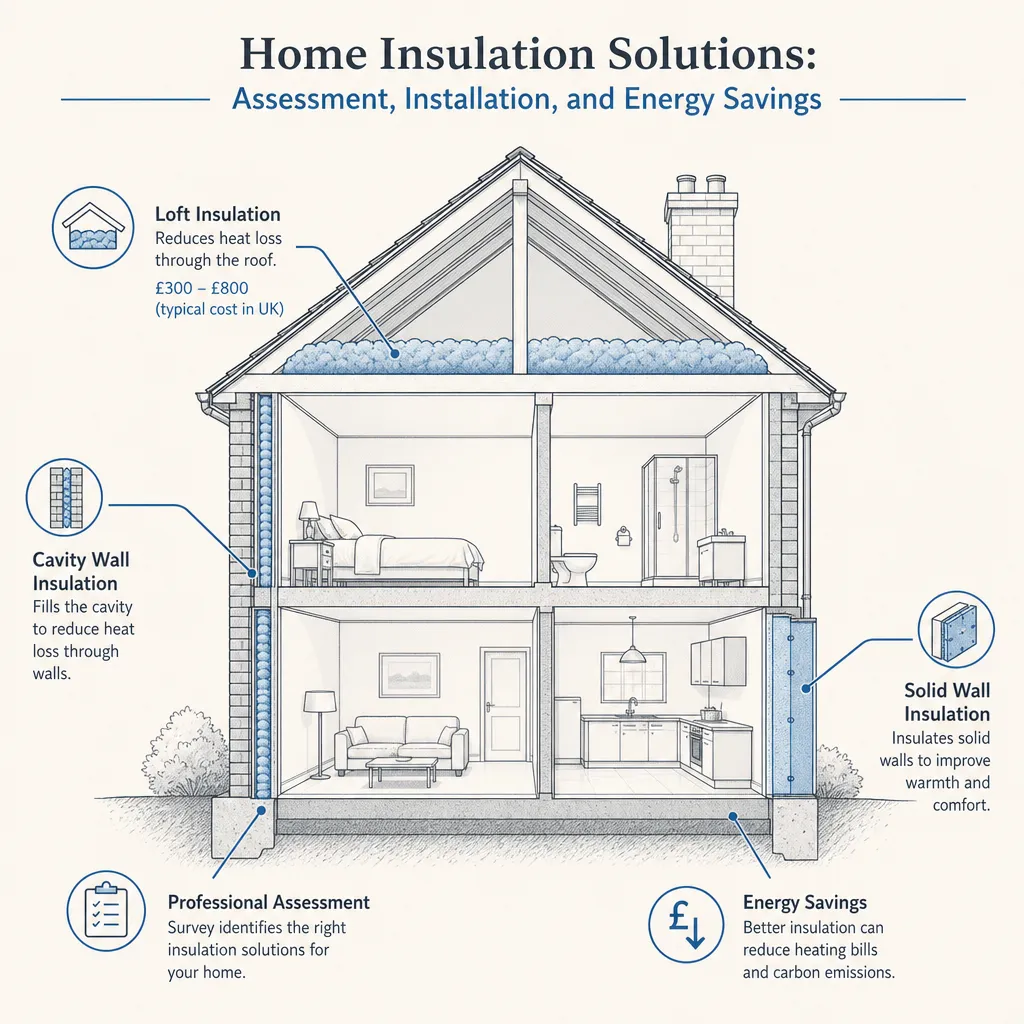
Home Insulation Solutions: Assessment, Installation, and Energy Savings
Home insulation in the UK covers loft, cavity wall, solid wall, and floor insulation.
 Energy & Retrofit
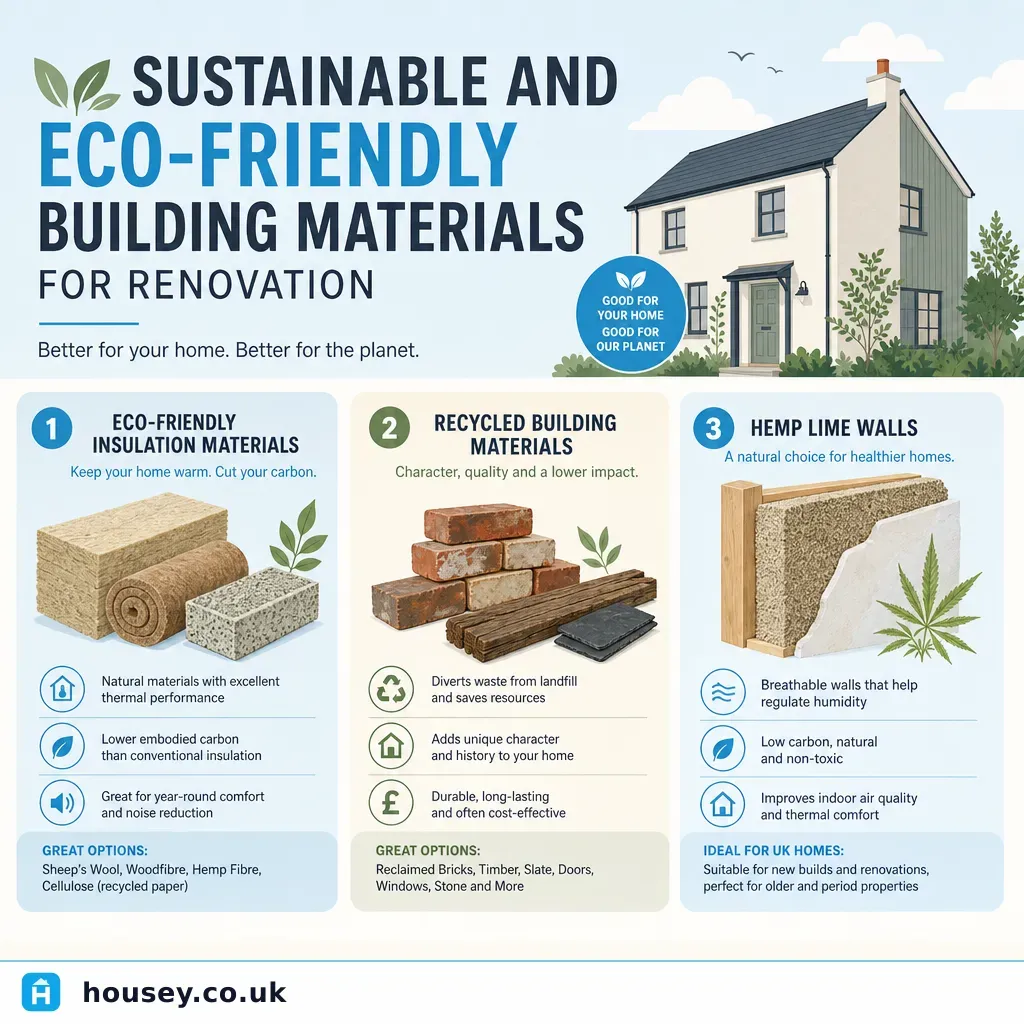
Sustainable and Eco-Friendly Building Materials for Renovation
Sustainable building materials for renovation include hemp lime, sheep's wool insulation, FSC-certified timber, and reclaimed brick.
 Energy & Retrofit
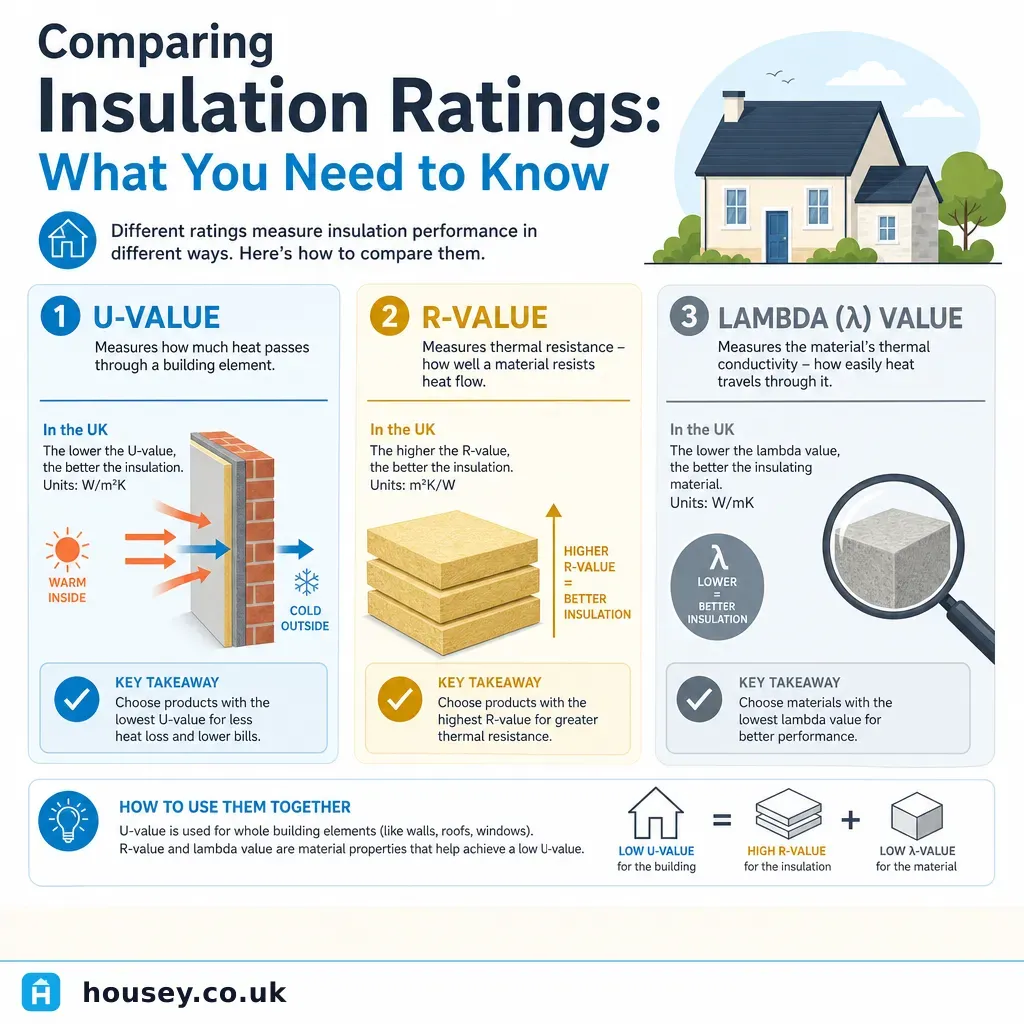
Comparing Insulation Ratings: What You Need to Know
UK insulation performance uses three linked measurements: lambda (λ) for material conductivity in W/mK (lower is better); R-value for thermal resistance at a given thickness in m²K/W (higher is better); and U-value for heat loss through a complete building element in W/m²K (lower is better).
 Energy & Retrofit
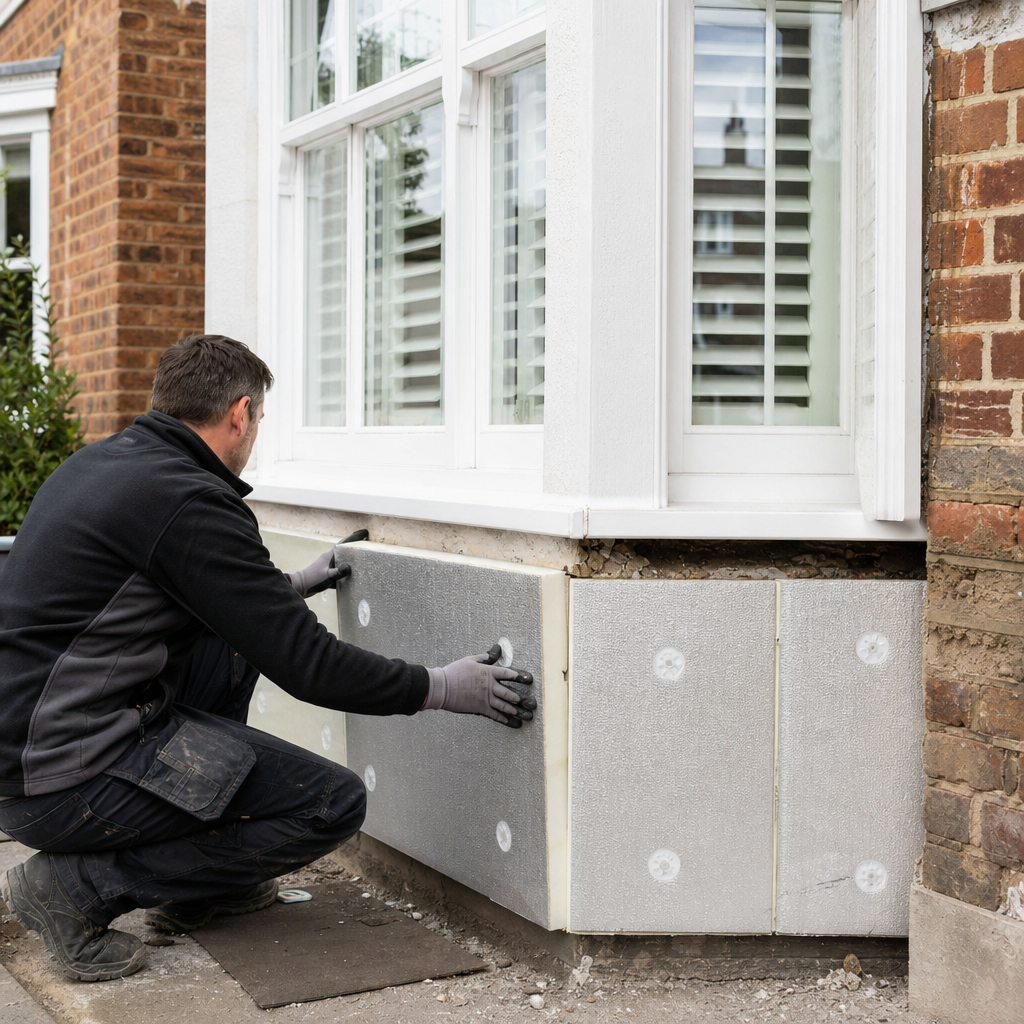
Insulating Solid Masonry Walls Under Bay Windows: Technical Guidance
Insulating solid masonry walls under bay windows requires specialist detailing at angled wall faces, window reveals, and the bay floor and ceiling junctions.
 Energy & Retrofit
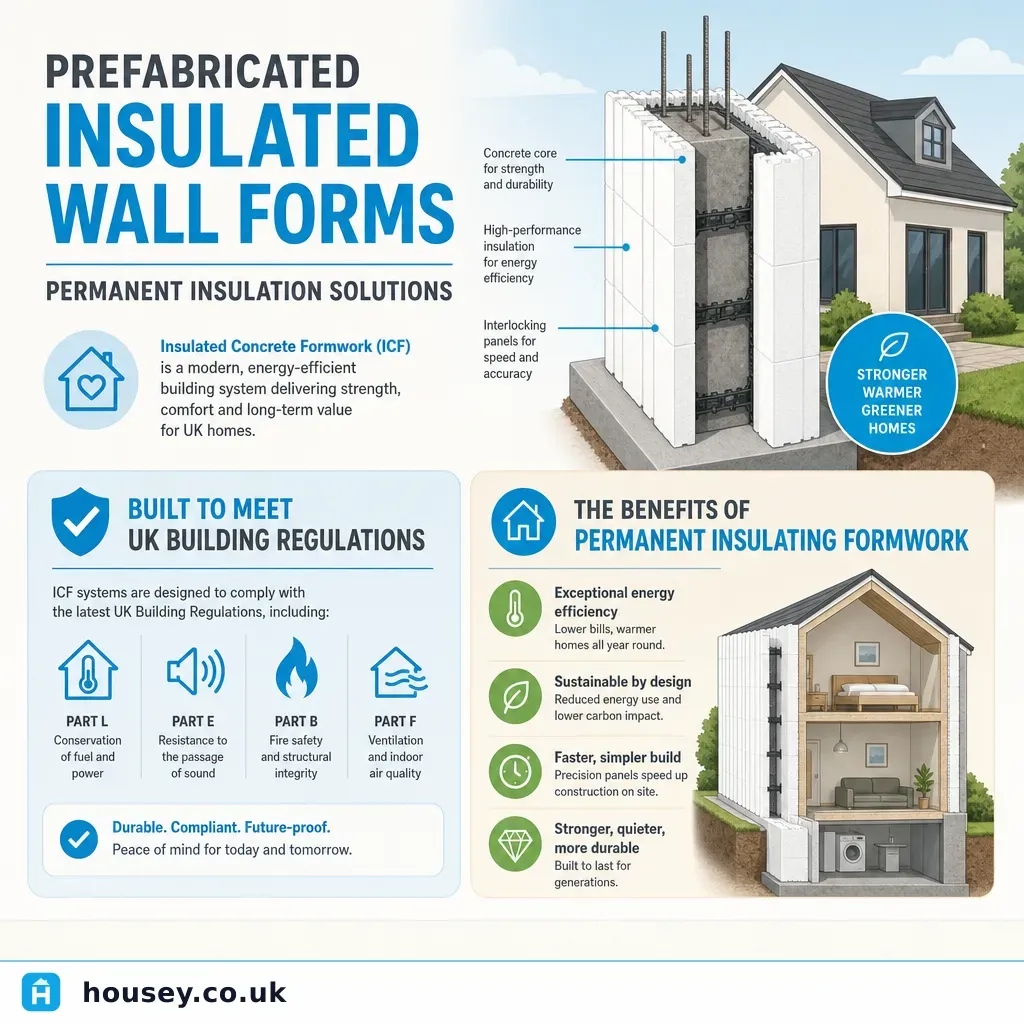
Prefabricated Insulated Wall Forms: Permanent Insulation Solutions
Prefabricated insulated wall forms — including ICF and SIPs systems — deliver high thermal performance by combining permanent insulation with structural concrete or timber in a single wall assembly.