Comparing Slate and Tile Roofing Materials
By Housey · Last reviewed 11th of May 2026
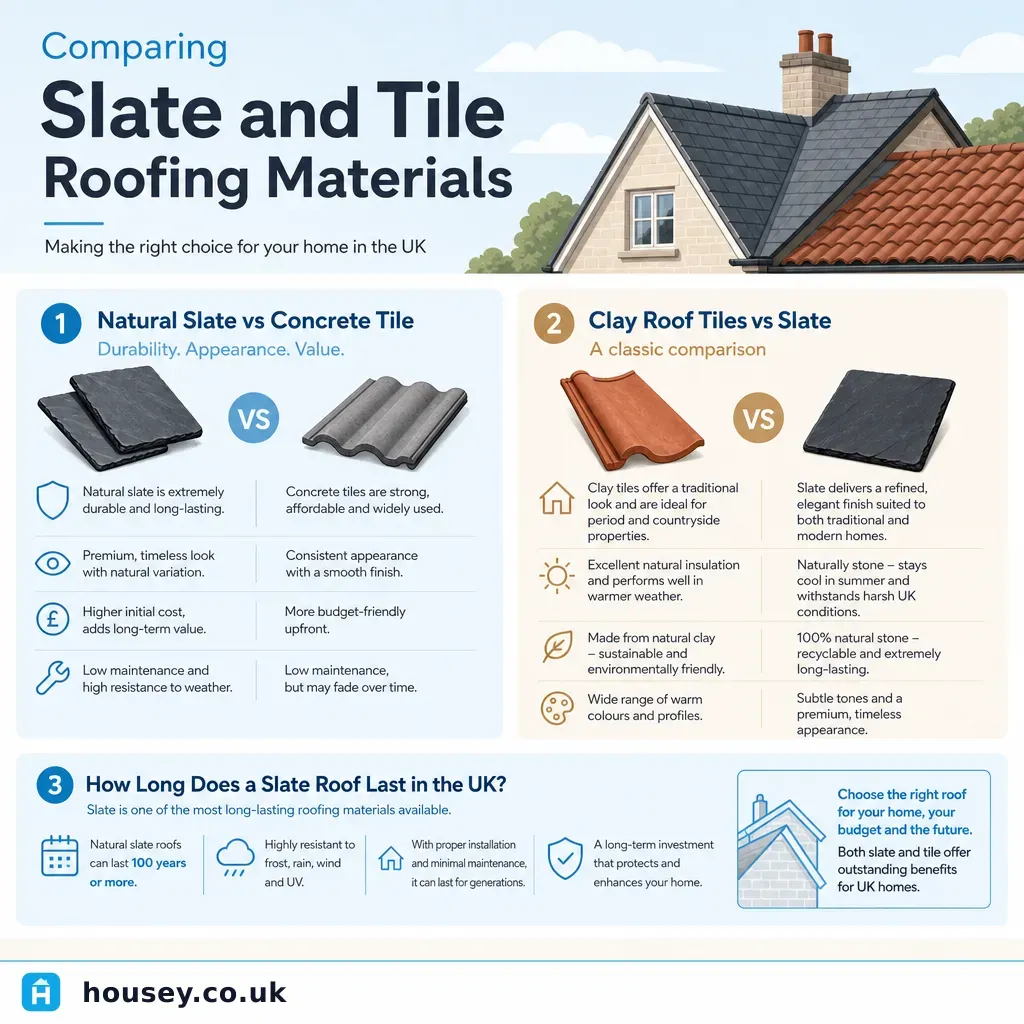
Comparing Slate and Tile Roofing Materials
Choosing a roofing material is one of the most consequential decisions in any reroofing project — the covering affects your home's appearance, structural loading, maintenance schedule, and costs for decades. For UK homeowners the decision is often complicated by local planning constraints: conservation areas, listed building consent, and permitted development rules can all restrict what you are permitted to use, making it essential to confirm material acceptability before obtaining quotes.
Key points
- Natural slate has a typical lifespan of 80–150 years; Welsh slate from Penrhyn and Ffestiniog quarries is widely regarded as the highest-quality domestic source and is frequently specified in conservation area guidance.
- Clay roof tiles can last 60–100 years and are the historically appropriate covering for much of England's pre-1940 housing stock, including Victorian terraces, Edwardian semis, and 1930s suburban homes.
- Concrete interlocking tiles (the dominant post-war choice) typically last 30–50 years, cost less to install, and accommodate lower roof pitches, but are usually not acceptable in conservation areas or on listed buildings.
- Building Regulations Approved Document A (Structure) requires any roof covering to be assessed against the structural capacity of existing timbers — heavier materials may require rafter strengthening before installation.
- In conservation areas and on listed buildings, the local planning authority (LPA) or Historic England may specify exact materials or sources; using an unapproved substitute can result in an enforcement notice.
Natural slate: characteristics and suitability
Natural slate is a metamorphic rock, hand-split into thin sheets and individually fixed to the roof. The most-prized UK sources are Welsh (particularly Penrhyn and Ffestiniog quarries), though imported Spanish, Brazilian, and Chinese slate is widely available at lower price points. Quality varies significantly between sources.
Advantages:
- Exceptional longevity — well-maintained Welsh slate on a Victorian terrace can outlast other major elements of the building's fabric.
- Very low water absorption (typically under 0.3% by weight for premium Welsh slate), which reduces freeze-thaw damage.
- Natural appearance well-suited to conservation areas, listed buildings, and period properties.
- High salvage potential — existing slates can often be cleaned, inspected, and re-laid, reducing cost and waste on a like-for-like reroof.
Disadvantages:
- Higher material and labour costs than tile alternatives.
- Heavier than most tile types — a structural check should confirm the roof can carry the load.
- Requires a steeper pitch, typically at least 25°, often 30° or more.
- Lower-grade imported slate may delaminate within 20–30 years; provenance and grade matter.
Clay tiles: characteristics and suitability
Clay tiles have been used on UK roofs for centuries and are strongly associated with traditional single-lap pantiles in eastern England and plain clay tiles across the Midlands and South. Handmade clay tiles are frequently specified for listed and conservation area buildings.
Advantages:
- Natural material with good longevity — 60–100 years for modern fired clay tiles; historic examples often outlast their structures.
- Wide range of profiles: plain tile, pantile, roman, and interlocking. Many LPAs specify clay tile for conservation areas.
- Good frost resistance in properly fired modern products.
- Complements brick, stone, and render well on traditional UK housing.
Disadvantages:
- Heavier per m² than concrete interlocking tiles; structural capacity of roof timbers should be verified.
- More expensive than concrete tile, though generally less costly than natural slate.
- Handmade or heritage clay tiles can have long lead times and carry a premium price.
Concrete tiles: characteristics and suitability
Concrete interlocking tiles became the dominant roofing material for UK new housing from the post-war period onwards and now cover a large proportion of suburban housing stock. They are available in a wide range of profiles and colours from manufacturers including Redland and Marley.
Advantages:
- Lower upfront material and installation cost than slate or clay.
- Can accommodate lower roof pitches than natural slate — some profiles down to 17.5°.
- Widely available with short lead times.
- Consistent quality from established manufacturers.
Disadvantages:
- Shorter lifespan (typically 30–50 years); colour fade and surface erosion are common after 25+ years.
- Generally heavier than clay interlocking profiles; structural implications should be considered.
- Not acceptable in most conservation areas or for listed buildings.
- Greater susceptibility to moss and lichen accumulation compared to slate.
Comparison table: slate vs clay tile vs concrete tile
Feature | Natural slate | Clay tile | Concrete interlocking tile |
|---|---|---|---|
Typical lifespan | 80–150 years | 60–100 years | 30–50 years |
Approximate weight | 25–35 kg/m² | 40–75 kg/m² | 40–55 kg/m² |
Minimum pitch | 25–30° | 35° (plain); 17.5°+ (interlocking) | 15–22.5° (profile-dependent) |
Conservation area use | Usually accepted | Usually accepted | Usually not accepted |
Listed building use | Often specified | Often specified | Usually not accepted |
Relative material cost | Higher | Moderate | Lower |
Maintenance frequency | Low | Low–moderate | Moderate |
Salvage potential | High | Moderate | Low |
Best for | Period homes, conservation areas, long-term ownership | Traditional housing stock, period appearance at lower cost | Post-war housing, lower budgets, complex profiles |
Indicative UK costs, last reviewed 2026-05-11. Actual costs vary by region, roof complexity, scaffold requirements, and contractor. Always obtain at least three written quotes.
Which roofing material suits your property?
- Choose natural slate if your property is listed, in a conservation area, or pre-1919 construction; if the existing roof is slate and you want like-for-like; or if you plan long-term ownership and want to minimise future reroofing costs.
- Choose clay tile if the original covering was clay; if you want a period aesthetic at lower cost than slate; or if the LPA specifies clay tile for your area.
- Choose concrete interlocking tile if the property is post-1945 construction with no planning constraints; if budget is the primary driver; or if the roof pitch is too shallow for natural slate.
- Ask a structural engineer or your roofing contractor if there is any uncertainty about whether existing rafters can support the chosen material's weight.
- Check with your local planning authority before proceeding if the property is in a conservation area, an Area of Outstanding Natural Beauty, or any other designated heritage setting.
A worked example: 1930s semi in a conservation area
A homeowner in a conservation area is planning a full reroof of a 1930s semi-detached house. The original covering is plain clay tile in declining condition. Three options are assessed:
- Like-for-like clay tile — the conservation officer confirms this is acceptable without a formal planning application. Handmade clay tiles with a period profile are specified. Lead time is approximately 10–12 weeks; cost is higher than concrete tile, but no separate consent is required.
- Natural Welsh slate — the conservation officer advises this would also be acceptable and may be considered an improvement, though slate was not the original material. A structural check confirms the rafters can take the load at a modest cost. Material and labour costs are higher than clay tile.
- Concrete interlocking tile — the conservation officer advises this is not acceptable as it would be harmful to the character and appearance of the conservation area.
Outcome: the homeowner proceeds with clay tile. Like-for-like reroofing is generally permitted development outside Article 4 direction areas; the conservation officer's written confirmation is retained for future sale enquiries.
Before-you-appoint checklist
Before accepting a reroofing quote, confirm:
When to get professional help
Always use a roofing contractor with relevant experience for your material and property type. For listed buildings and conservation area properties, seek a contractor familiar with Historic England guidance and local LPA requirements. A structural engineer should be consulted if you are changing material type and there is any uncertainty about loadbearing capacity.
Red flags when reviewing a roofer:
- A quote that does not specify material source, grade, or manufacturer.
- Pressure to commit quickly without a written specification.
- No mention of building regulations compliance — reroofing can require building control notification in some circumstances.
- The contractor cannot confirm relevant experience with your property's material or designation.
How Housey can help
Housey connects you with experienced, vetted roofers who can advise on material selection, provide detailed written specifications, and carry out reroofing work to the standard required for your property type — including for listed buildings and conservation area properties.
Frequently asked questions
Is natural slate always better than tile for a UK home?
Not necessarily. Natural slate has the longest lifespan and suits period properties well, but requires a steeper roof pitch, costs more to install, and is heavier than many tile alternatives. For a post-war home with no planning constraints and a lower-pitch roof, a quality concrete or clay tile may be more practical and cost-effective for the long term.
Do I need planning permission to reroof my house?
Reroofing using the same or similar materials is generally permitted development under Schedule 2, Part 1, Class A of the Town and Country Planning (General Permitted Development) (England) Order 2015, provided the property is not listed and is not subject to an Article 4 direction. Conservation areas, listed buildings, and some local restrictions may require consent — check with your local planning authority if in doubt.
How long does a natural slate roof last?
High-quality Welsh slate, correctly installed and maintained, can last 80–150 years. Imported slate varies considerably — lower-grade Brazilian or Chinese slate may delaminate or fail within 20–30 years. Ask your contractor about the slate's source, grade, and whether a water absorption certificate is available before accepting a quote.
Can I mix old and new roof tiles on a partial reroof?
Salvageable existing tiles or slates can often be re-used alongside new materials on a partial reroof, provided they pass a condition check. Mixing profiles or formats from different manufacturers can create inconsistency in appearance and may compromise weathertightness at junctions. Ask your contractor to assess and batch-test existing tiles before finalising the specification.
Sources and further reading
- Approved Document A — Structure — GOV.UK
- Town and Country Planning (General Permitted Development) (England) Order 2015 — legislation.gov.uk
- Historic England — Technical advice on buildings — Historic England
- Welsh Slate Landscape of Northwest Wales — UNESCO World Heritage — UNESCO
Useful next reads
 Improvement & Build
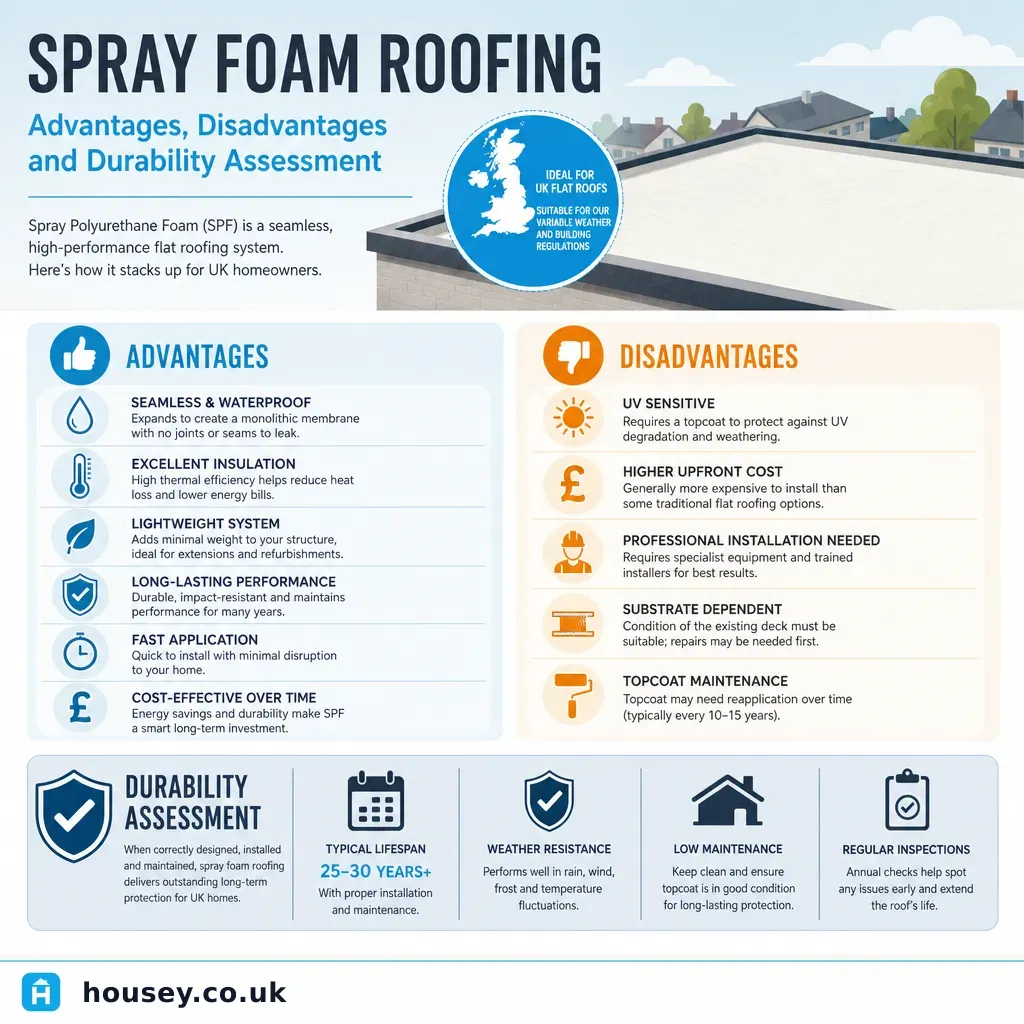
Spray foam roofing: advantages, disadvantages and durability assessment
Spray foam roofing creates a seamless, fully adhered waterproof membrane with built-in insulation that can extend the life of a flat roof by 20 to 30 years when correctly topcoated and maintained.
 Improvement & Build
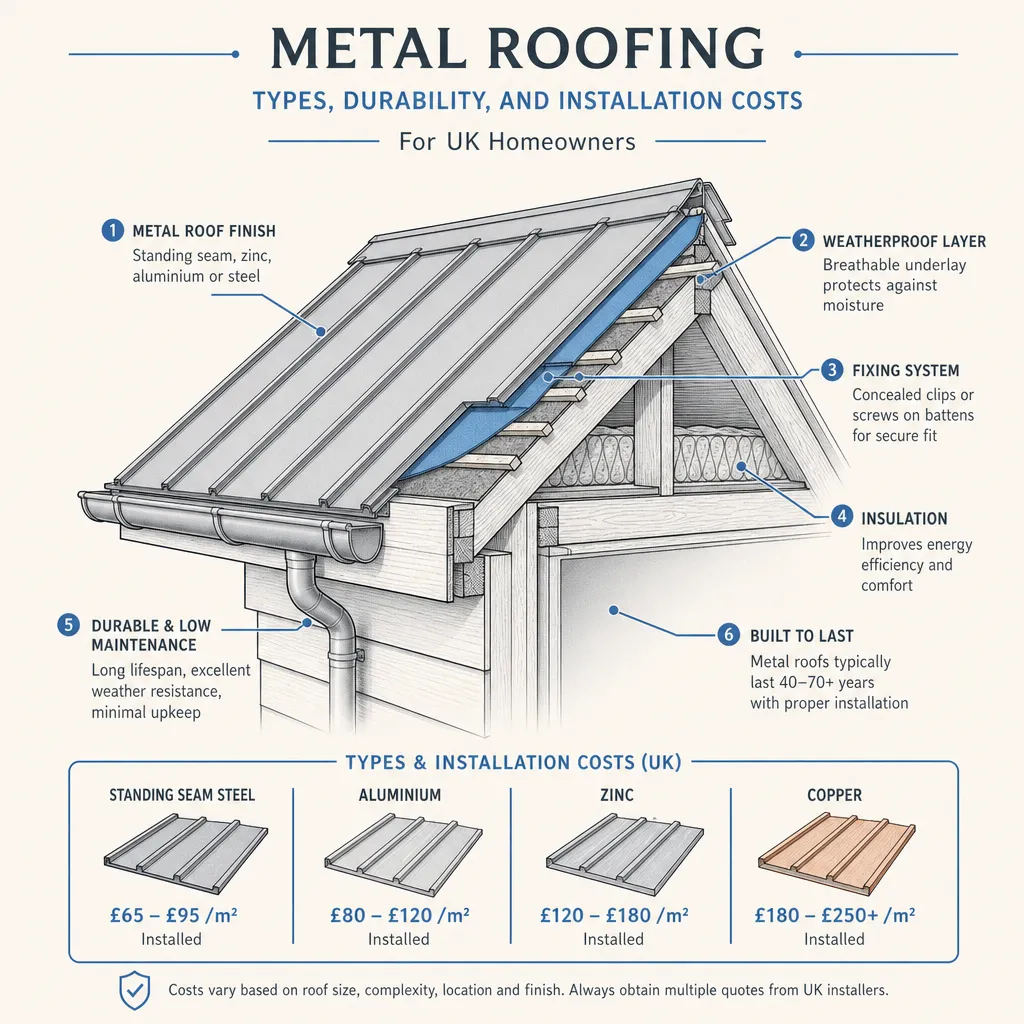
Metal Roofing: Types, Durability, and Installation Costs
Metal roofing in the UK includes standing seam, corrugated sheet, and metal tile systems in steel, aluminium, zinc, or copper.
 Improvement & Build
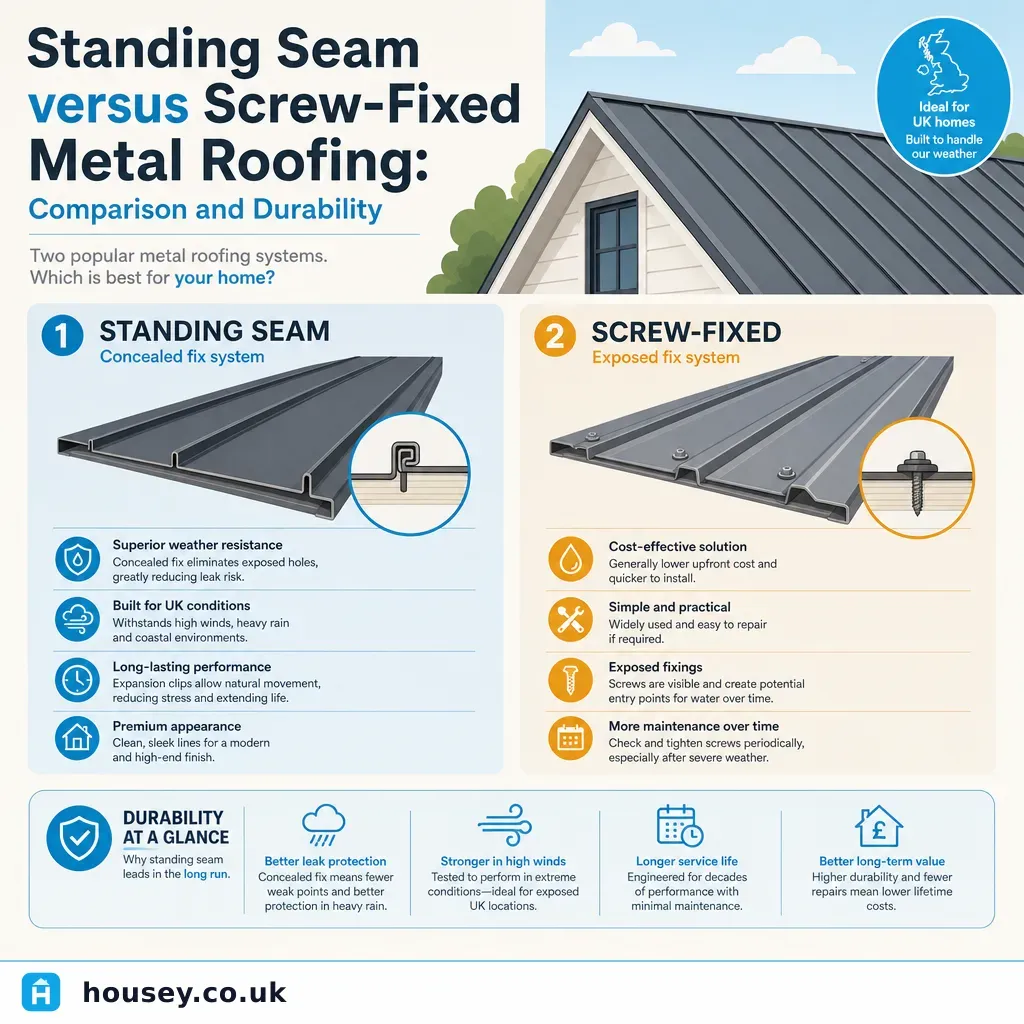
Standing Seam versus Screw-Fixed Metal Roofing: Comparison and Durability
Standing seam uses concealed clips to hold panels, keeping all fasteners out of the weatherline and giving a design life of 40–60 years or more.
 Improvement & Build
Synthetic Cedar Shake Roofing: Installation Costs and Material Performance
Synthetic cedar shake roofing uses polymer composite, rubber, or fibre-cement tiles to replicate the look of natural cedar wood shingles.
 Improvement & Build
Aluminium and uPVC Doors: Selecting the Right Material for Your Home
uPVC doors are lower-cost and low-maintenance, making them a practical choice for most UK homes.