Comparing Tile, Slate and Asphalt Roof Coverings for UK Homes
By Housey · Last reviewed 18th of May 2026
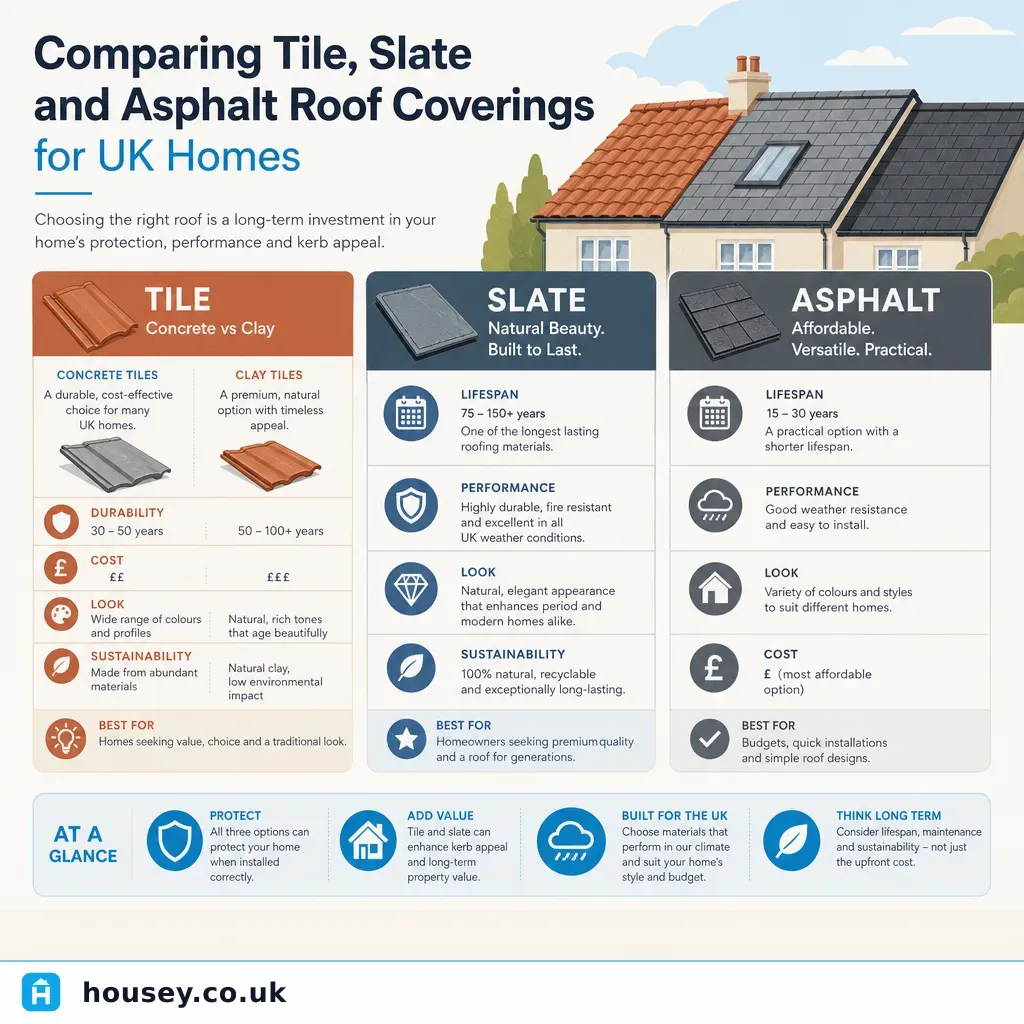
Comparing Tile, Slate and Asphalt Roof Coverings for UK Homes
Few decisions have a longer-lasting impact on a home than the choice of roof covering. When a roof reaches the end of its serviceable life — whether through cracked and slipping slates, spalling concrete tiles, or simply age — homeowners face a specification decision that will affect the property's appearance, maintenance burden, structural loading, and planning compliance for the next 30 to 100 years or more. In the UK, that choice is shaped by local planning policy, roof pitch, the existing structure's capacity, and a material landscape that differs from North American and continental European markets in important ways.
Key points
- BS 5534:2014+A2:2018 governs the design and fixing of slating and tiling in the UK, including minimum batten sizes, nail specifications, and wind-uplift calculations based on exposure zone.
- Most interlocking concrete tiles require a minimum roof pitch of approximately 17.5°; plain clay tiles typically need 35° or more; natural and fibre-cement slates can be fixed from approximately 15° with appropriate underlays.
- In conservation areas, Schedule 2, Part 1, Class C of the Town and Country Planning (General Permitted Development) (England) Order 2015 permits re-roofing under permitted development only where it does not materially alter the appearance of the building — local authorities often interpret this as requiring like-for-like replacement.
- Listed buildings require Listed Building Consent for any re-roofing that would alter the character of the structure, regardless of the planning permission position.
- Concrete tiles are typically heavier than natural slate (40–55 kg/m² versus 22–30 kg/m²) — older roof structures may require a structural assessment before switching from a lighter to a heavier material, or vice versa.
The main roof covering options available in the UK
Clay tiles
Clay roof tiles have been used on English buildings since at least the 13th century. They come in two principal forms: plain tiles (small, double-lapped, typically 265 × 165 mm) suited to steeper pitches, and single-lap interlocking tiles such as pantiles and Roman tiles that work on lower pitches and require fewer tiles per square metre.
Clay has excellent weather resistance, is colour-stable over decades, and is frequently specified — or required — in conservation areas where matching original materials is a planning condition. New clay tiles are also used to match existing clay coverings on extended period properties.
Concrete tiles
Concrete interlocking tiles became widely used on UK homes from the 1960s onwards and remain among the most common coverings on UK residential roofs. They are less expensive than clay or natural slate, widely available across a broad range of profiles and colours, and straightforward to fix. Colour durability has improved significantly in modern products, though some weathering occurs over the lifetime of the roof.
Concrete tiles are heavier than most alternatives. On pre-1960s roofs — or any roof originally covered with slate — a structural assessment is advisable before switching to concrete, as the additional load may require rafter or purlin strengthening.
Natural slate
Welsh slate (principally from Gwynedd) and imported slate from Spain (Galicia) and Brazil are the main sources for UK projects. Natural slate is valued for its longevity — well-fixed Welsh slate can last 100 years or more — its low water absorption, and its appearance, which many planning authorities require on traditional and rural properties.
Slate is generally lighter than concrete tiles (22–30 kg/m² for most natural slates), making it suitable for older, lighter roof structures. Skilled fixing is essential: incorrect or undersized nails are the most common cause of premature slate failure. Historic England's guidance on traditional roofing materials notes that slates should be fixed with two nails into adequate-depth battens, and that felt underlay specification affects the longevity of the system.
Fibre-cement slates
Fibre-cement slates — manufactured by companies such as Marley, Cembrit, and Eternit — offer a cost-effective alternative to natural slate. They have consistent thickness (unlike natural slate, which varies), no risk of fossil or pyrite inclusions that can accelerate weathering, and straightforward fixing using standard tools. Many local planning authorities accept fibre-cement on new extensions where exact matching of natural slate is not required, though some conservation areas do not.
Asphalt shingles
Asphalt shingles are common in North America but rarely specified on UK homes. Their typical lifespan of 15–25 years, limited UK installer experience, lower acceptability to planning authorities, and occasional insurer unfamiliarity make them a niche choice — occasionally used on garden rooms, very low-pitch extensions, or budget outbuildings.
How each material performs: lifespan, weight, and pitch requirements
Material | Typical lifespan | Approx. weight (kg/m²) | Minimum pitch | Planning acceptability in UK | Maintenance level |
|---|---|---|---|---|---|
Clay plain tile | 60–100+ years | 35–42 | 35° | High — often required | Low |
Clay interlocking tile | 50–80 years | 40–48 | 17.5° | High | Low |
Concrete interlocking tile | 30–50 years | 40–55 | 17.5° | Moderate | Low–moderate |
Natural Welsh slate | 80–150+ years | 22–30 | 15° | Very high — often required | Low (re-nailing after 60+ years) |
Imported natural slate (Spanish/Brazilian) | 50–80 years | 25–35 | 15° | High | Low–moderate |
Fibre-cement slate | 30–50 years | 20–30 | 15° | Moderate | Low |
Asphalt shingle | 15–25 years | 9–14 | 12.5° | Low | Moderate |
Indicative figures only; verify with manufacturer data and a structural assessment. Last reviewed 2026-05-18.
Planning and conservation area restrictions
In conservation areas in England, permitted development for roof coverings is governed by Schedule 2, Part 1, Class C of the Town and Country Planning (General Permitted Development) (England) Order 2015. Re-roofing falls within permitted development provided it does not materially alter the appearance of the building. In practice, many local planning authorities interpret this to require like-for-like material replacement — switching from natural slate to concrete tiles, for example, may require a householder planning application.
For listed buildings, any alteration affecting the character of the building — including re-roofing with a different material, or even re-roofing with the same material if it alters the appearance — requires Listed Building Consent from the local planning authority. This is separate from and additional to any planning permission. Historic England's guidance on traditional roofing materials is the primary reference for specifying repairs and replacements on listed structures.
If you are unsure whether your property or proposed material change falls within permitted development, always check with your local planning authority before starting work. Enforcement action can require reinstatement at the homeowner's cost.
Decision guide: which covering should you choose?
- Choose natural Welsh or Spanish slate if the property is pre-1920, in a conservation area where slate is original, or if planning policy requires it; the existing structure can carry the load; and budget is not the primary constraint.
- Choose clay tiles if the property already has clay tiles (matching or blending in is important); you want a long-lifespan traditional material; and the pitch and structure are appropriate.
- Choose concrete interlocking tiles if the property is post-1960 with no particular character or planning constraints; budget is a key consideration; and the structure can support the weight.
- Choose fibre-cement slate if you want a slate appearance at lower cost; planning allows it; and you want consistent thickness for straightforward fixing.
- Ask a roofer or commission a roof survey if you are unsure about the existing structure's load capacity, the roof has failed before its expected lifespan, or planning consent requirements are unclear.
- Consult your local planning authority if the property is listed or in a conservation area before ordering any materials.
When to get professional help
A qualified roofer should inspect the existing roof structure before specifying a replacement covering, particularly where the existing material is significantly heavier or lighter than the proposed replacement. Get professional advice when:
- There is evidence of sagging, ongoing movement, or water ingress not explained by covering failure alone — this may indicate a structural or ventilation issue that a new covering will not resolve.
- The property is listed or in a conservation area and you are unsure about consent requirements.
- The roof pitch falls close to a material's minimum specification — a roofer experienced with the product should confirm the underlay and batten arrangement.
- The existing covering was asbestos-containing (common on some 1960s–1980s roofs in the form of asbestos cement slates) — do not disturb the material without a professional asbestos assessment.
How Housey can help
Housey connects homeowners with vetted qualified roofers and roof survey specialists who can assess your existing structure, advise on material suitability for your pitch and planning context, and provide like-for-like quotes so you can compare the true cost of each covering option.
Frequently asked questions
Is natural slate better than concrete tiles for a UK roof?
Natural slate typically lasts significantly longer — often 80–150+ years for quality Welsh slate compared with 30–50 years for concrete tiles — and is more acceptable to planning authorities on traditional and listed properties. However, it costs considerably more to supply and fix, and requires skilled labour. Concrete tiles offer a cost-effective, low-maintenance solution for standard post-war homes.
Do I need planning permission to re-roof my house in England?
In most cases, re-roofing a house in England using a like-for-like material does not require planning permission under permitted development rights. However, if you are changing the roof material, the property is listed, or it is in a conservation area, you may need planning permission or listed building consent. Always check with your local planning authority before starting work.
What is the minimum roof pitch for concrete interlocking tiles?
Most concrete interlocking tiles specify a minimum pitch of around 17.5°, though this varies by product and manufacturer. Natural slates and fibre-cement slates can generally be fixed from approximately 15° with appropriate underlays. Plain clay tiles typically require a steeper pitch of 35° or more. Always confirm minimum pitch requirements with the tile or slate manufacturer and the fixing specification under BS 5534.
Sources and further reading
- BS 5534:2014+A2:2018 — Slating and tiling for pitched roofs and vertical cladding — BSI Group
- Town and Country Planning (General Permitted Development) (England) Order 2015 — legislation.gov.uk
- Traditional Roofing — Historic England guidance — Historic England
- National Federation of Roofing Contractors — guidance for homeowners — NFRC
- Approved Document C: Site preparation and resistance to contaminants and moisture — GOV.UK
Useful next reads
 Surveys & Inspections
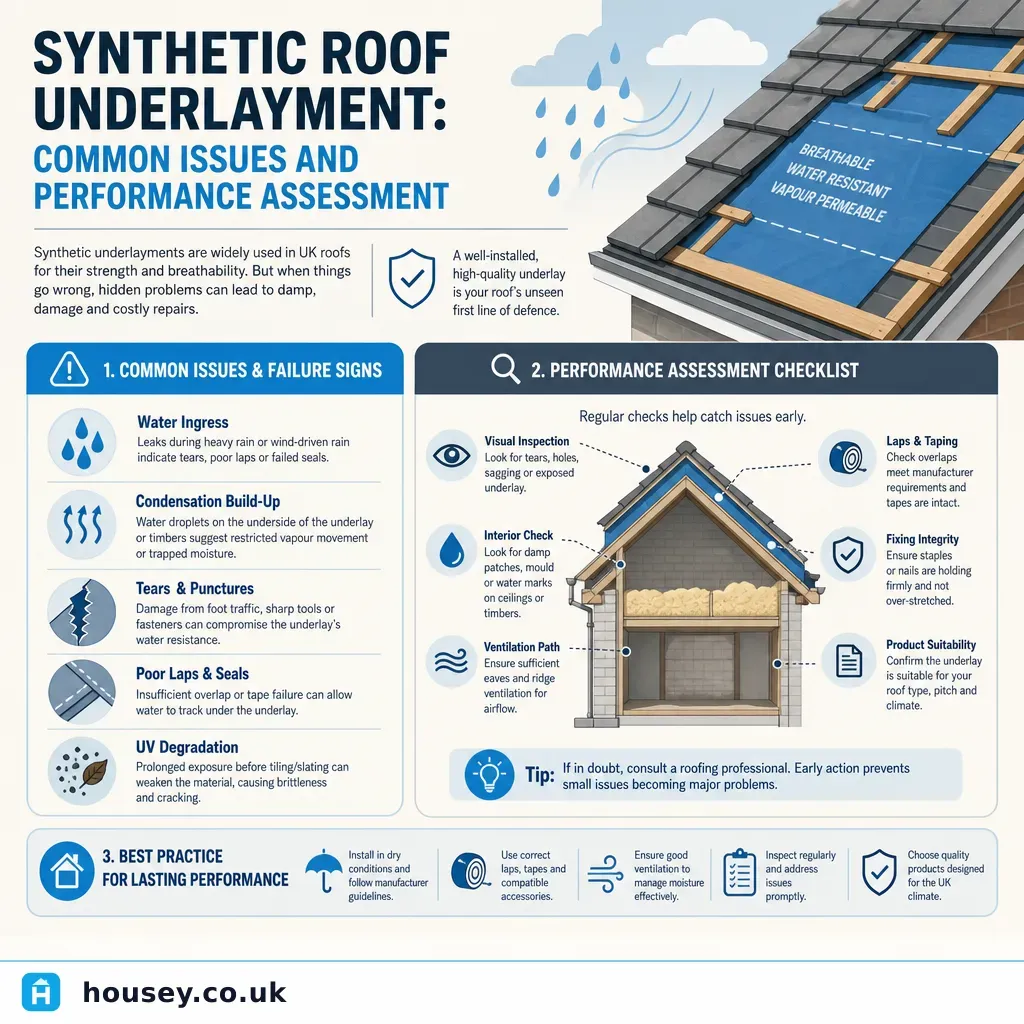
Synthetic Roof Underlayment: Common Issues and Performance Assessment
Synthetic vapour-permeable roof underlayment sits below your tiles and acts as the last barrier against moisture.
 Surveys & Inspections
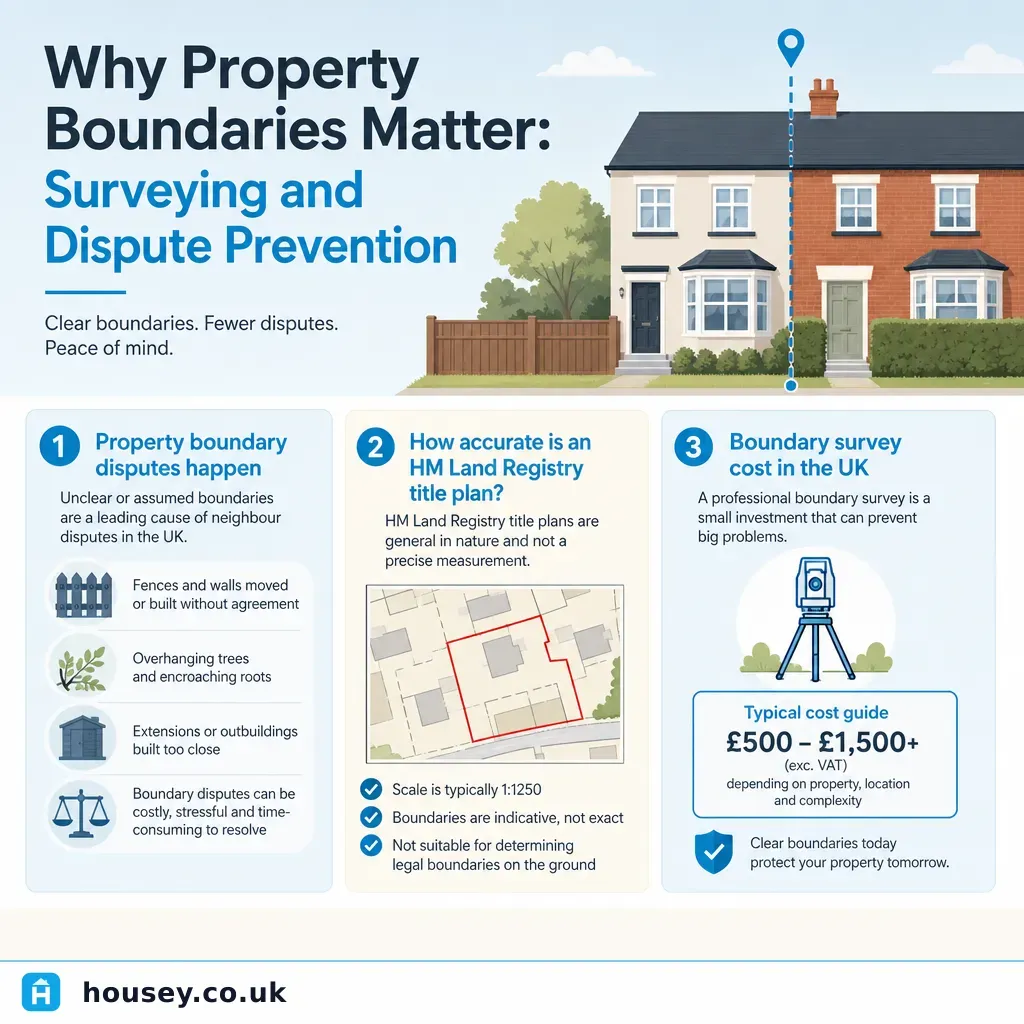
Why Property Boundaries Matter: Surveying and Dispute Prevention
Property boundaries in England and Wales are recorded as general boundaries by HM Land Registry — not precise measurements.
 Surveys & Inspections
Safe Property Viewing Practices: Protecting Yourself During Inspections
When viewing a property in the UK, always tell someone where you are going and share the full address before you leave.
 Surveys & Inspections
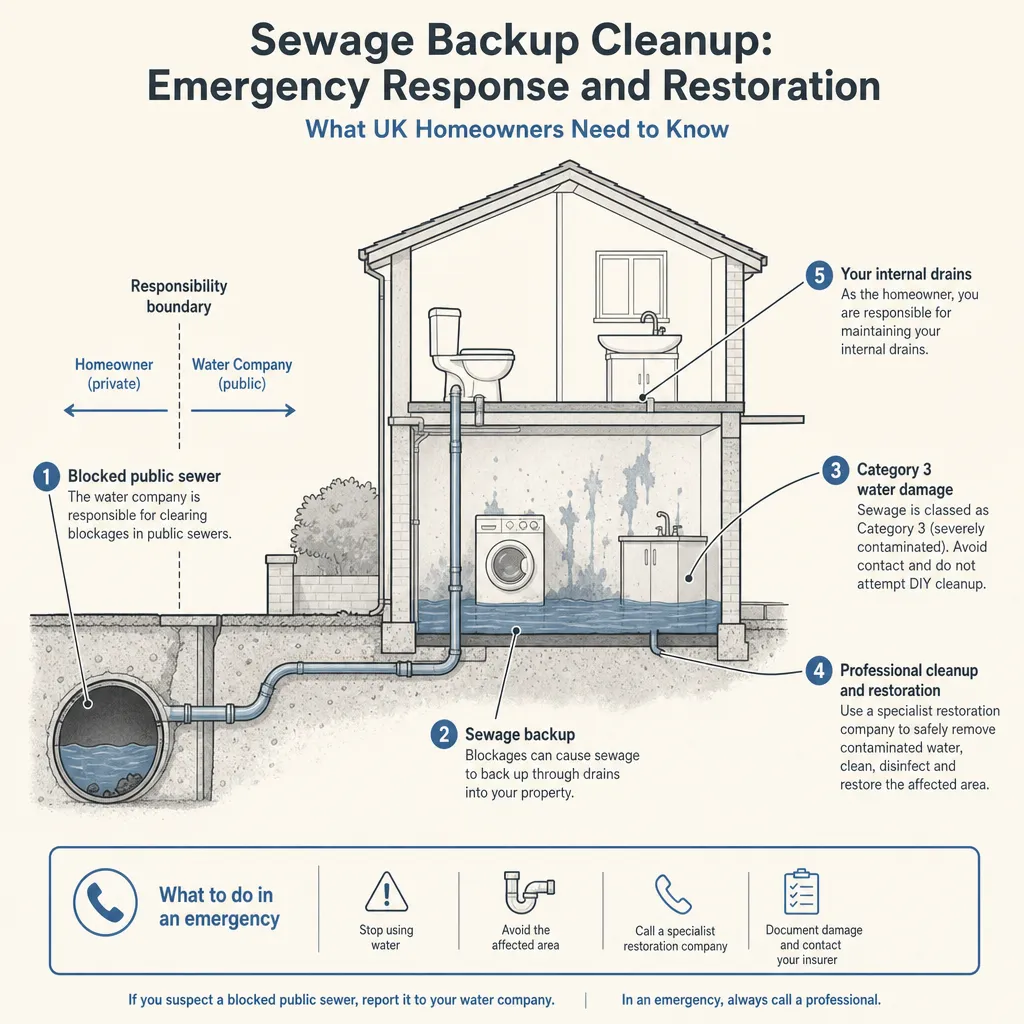
Sewage Backup Cleanup: Emergency Response and Restoration
A sewage backup should be treated as a Category 3 contamination event.
 Surveys & Inspections
Identifying Asbestos Insulation: What You Need to Know for Your Property
Asbestos insulation was widely used in UK properties built before 2000, commonly found in pipe lagging, ceiling tiles, loose-fill loft insulation, and around boilers.