Synthetic Roof Underlayment: Common Issues and Performance Assessment
By Housey · Last reviewed 25th of May 2026
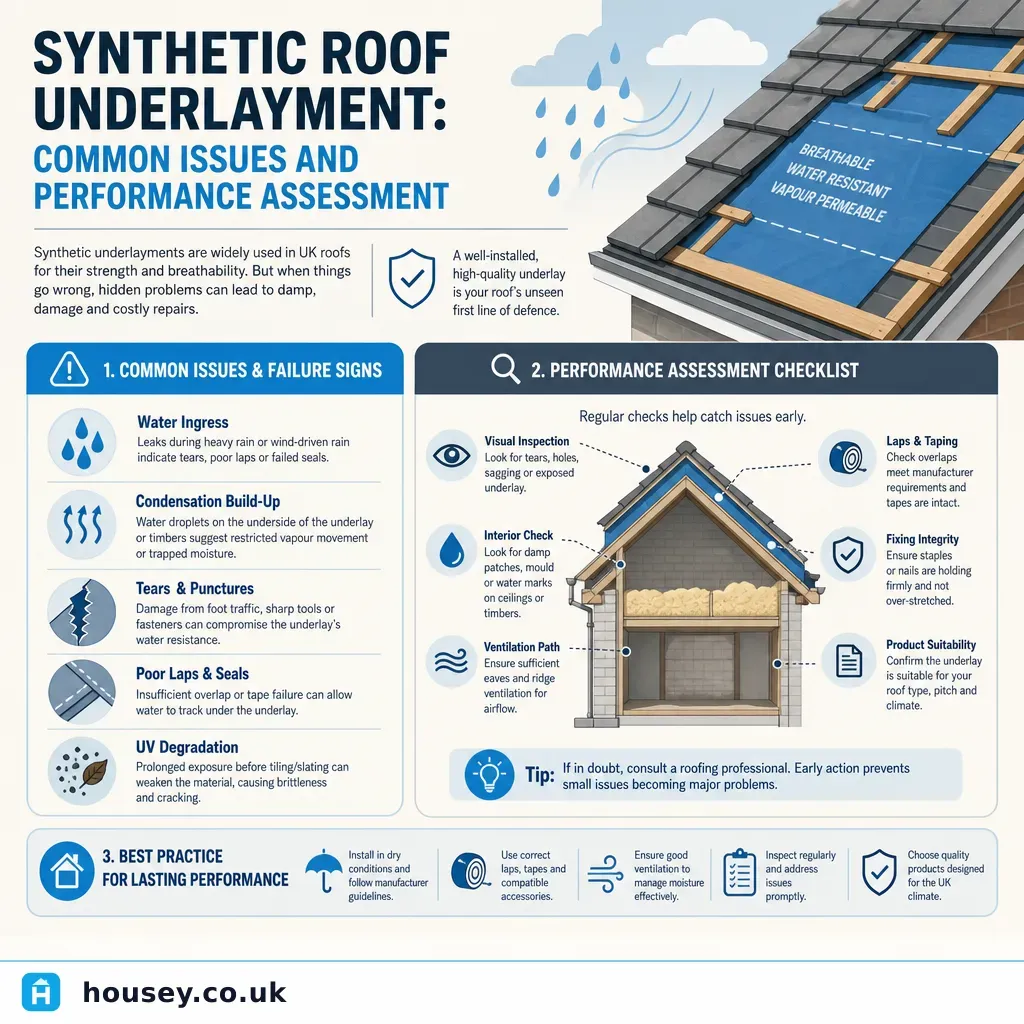
Synthetic Roof Underlayment: Common Issues and Performance Assessment
Roof underlayment sits below your tiles or slates and acts as the last line of defence against wind-driven rain, condensation, and air infiltration — yet it rarely features in a homeowner's thinking until something goes wrong. In the UK, synthetic vapour-permeable membranes have largely replaced traditional bituminous felt on new and replacement roofs since the late 1990s, making them the dominant underlayment type in homes built or re-roofed from approximately 2000 onwards. Problems with underlayment are commonly identified during RICS Level 2 or Level 3 home surveys or specialist roof inspections, and understanding what can go wrong — and what a professional assessment involves — helps homeowners respond effectively when issues are flagged.
Key points
- BS 5534:2014+A2:2018 (Code of Practice for Slating and Tiling) specifies installation requirements for roofing underlayments, including minimum lap dimensions and fixing methods for vapour-permeable membranes.
- Breathable roofing membranes are classified under BS EN 13859-1; manufacturers must declare the membrane's water vapour resistance (Sd value) and water tightness class.
- Common synthetic underlayment failures include lap joint separation, UV degradation at exposed eaves, puncture during or after installation, and condensation accumulation in poorly ventilated roof voids.
- Underlayment problems are typically invisible from outside — they are usually discovered during loft inspection, a specialist roof survey, or by evidence of moisture damage to roof timbers or insulation.
- Building Regulations Part C (site preparation and resistance to contaminants and moisture) sets the regulatory context; a failing underlayment can contribute to progressive timber decay and structural deterioration.
What is synthetic roof underlayment and why does it matter?
Traditional roofing felt (bituminous felt to BS EN 13707) was the standard UK underlayment until vapour-permeable underlays (VPUs) became established from the mid-1990s onwards. These modern synthetic membranes allow water vapour from inside the building to pass outward while resisting liquid water ingress from above.
The practical advantage is simplified ventilation management: in a cold roof construction (insulation at ceiling level, uninsulated void above), VPUs allow vapour to escape from the roof void without requiring the same degree of continuous eaves-to-ridge through-ventilation that bituminous felt demands. This simplifies construction but introduces different performance requirements and different failure modes.
The two main categories in UK residential use are:
- Low-resistance (highly vapour-permeable) membranes: typically polypropylene or polyethylene non-woven or laminated products; the most common type in UK domestic construction from the late 1990s onwards.
- High-resistance membranes: less common in domestic roofing; used where vapour control is required at roofline level rather than ceiling level — a different design strategy requiring a different approach to any remediation.
Knowing which type was used in your roof matters because the ventilation strategy of the whole roof build-up depends on it, and any remediation must be compatible with the design intent.
What are the most common synthetic underlayment problems?
Lap joint failure
Synthetic membranes are installed in horizontal runs with each upper course overlapping the one below by a minimum margin — commonly 150 mm for a standard pitch per BS 5534. If laps are insufficient, or if they were not fully retained by battens promptly after laying, wind-driven rain or condensate can penetrate the joint. Laps not mechanically fixed by battens can lift further over time, particularly in exposed locations.
UV degradation at the eaves
Synthetic membranes degrade when exposed to ultraviolet light. At the eaves, the membrane overhangs toward the gutter, and if it is not fully covered by the fascia board or by the first tile course, it may remain exposed. Most products have a limited declared UV resistance period — commonly 3–6 months from installation to covering. Degraded eaves edges become brittle and can crack, creating an ingress point that is difficult to identify without close inspection.
Puncture and tear
Synthetic membranes are thinner than traditional felt and more susceptible to puncture from tools, foot traffic during installation, or subsequent works such as solar panel installation, satellite dish fixing, or chimney repointing. Punctures may be small and difficult to locate without internal inspection from the loft.
Condensation management failure
Where a VPU has been installed but the roof's ventilation strategy is poorly designed — for example, where insulation fills the full rafter depth without adequate air paths — vapour can accumulate and condense on the membrane or timbers. This is primarily a design failure rather than a product defect, but it is a common finding in roofs that were insulated or upgraded after the original membrane was laid.
Deterioration of early products
First-generation synthetic underlayments installed in the late 1990s and early 2000s varied significantly in quality. Some have exhibited premature brittleness, delamination, or shrinkage. If your home was built or re-roofed between approximately 1995 and 2005 and has not had a roof inspection since, the underlayment may be approaching or beyond the end of its reliable service life even if the tile or slate covering above remains in reasonable condition.
Red flags: signs that your underlayment may be failing
The following observations — visible during loft inspection or noted during a professional survey — may indicate underlayment problems:
- Visible daylight between tiles when looking up from the loft space — indicates missing or displaced underlayment sections.
- Watermarks, staining, or active moisture on roof timbers or insulation — suggests water is passing through the tile or slate layer and the underlayment is not retaining it.
- Mould or fungal growth on roof timbers — can result from condensation accumulation in a poorly performing underlay system or from inadequate ventilation.
- Brittle, cracked, or powdery membrane visible from the loft — typical of UV-degraded or aged first-generation products.
- Excessive sagging between rafters — while some drape is intentional to guide water toward the eaves, pronounced pooling areas can trap debris and cause localised stress or failure.
- Flapping or whistling during windy conditions — may indicate loose membrane sections not fully retained by battens.
- Damp patches on upper-floor ceilings with no obvious plumbing explanation — often traceable to roof ingress once other sources have been ruled out.
What does a professional assessment involve?
A specialist roof survey or a RICS Level 2 or Level 3 home survey will assess underlayment condition where accessible. A professional typically:
- Inspects the loft space internally, examining the underside of the roof covering and the visible membrane condition at and between the rafters.
- Checks for moisture in timbers using a calibrated moisture meter, recording readings for the written report.
- Assesses ventilation paths and confirms the underlayment type where identifiable.
- Notes lap positions, evidence of taped joints, and any signs of degradation, lifting, or puncture.
- Recommends remediation ranging from localised spot repair — possible in limited circumstances — to full underlayment replacement, which typically requires removing all tiles since the membrane runs beneath them and the battens.
External drone surveys or ground-level visual inspections can identify displaced or damaged tiles but cannot assess underlayment condition directly. Internal loft inspection by a qualified professional is required for a meaningful assessment.
What to ask before commissioning a roof survey or repair
- What access to the loft will be required, and can the surveyor inspect the underside of the covering as well as the timber structure?
- Will a calibrated moisture meter be used on the timbers, and will the readings be recorded in the written report?
- Can the surveyor identify the type and approximate age of the underlayment from the loft?
- If underlayment replacement is recommended, will all tiles need to be removed and re-fixed — and will batten replacement also be needed?
- Are there signs that the ventilation strategy may be contributing to the problem, and should any remediation address that as well?
- What are the consequences of deferring repair, and is any temporary protection or monitoring possible in the interim?
When to get professional help
Underlayment issues are rarely DIY-accessible — meaningful assessment requires loft access and professional expertise, and remediation typically involves full or partial re-roofing. Seek professional advice promptly if:
- You notice staining, dampness, or mould in the upper-floor ceiling or in the loft space and cannot attribute it to plumbing or other sources.
- A RICS home survey report has flagged roof underlayment as a concern at condition rating 2 or 3.
- Your property was built or re-roofed in the late 1990s or early 2000s and has not had a specialist roof inspection since installation.
- You are planning solar panel installation, a rooflight, or other roof penetrations — this is an appropriate point to assess underlayment condition before new work disturbs the existing covering.
How Housey can help
Housey connects homeowners with qualified professionals who can assess roof condition and underlayment performance accurately. Whether you need a specialist roof survey following a home survey flag or a water ingress concern, getting an expert view before committing to costly remediation is always the right first step.
Frequently asked questions
Can synthetic roof underlayment be repaired without replacing the tiles?
In most cases, meaningful underlayment repair requires removing the tiles or slates above it to gain proper access. Small spot repairs using compatible repair tape are sometimes possible in accessible areas, but these are generally temporary measures that may not resolve the underlying problem. A qualified roofing contractor should assess whether partial or full replacement is the appropriate course of action.
How long should synthetic roof underlayment last?
Quality modern vapour-permeable underlayments are typically specified to last 25–50 years. However, early products from the late 1990s and early 2000s may have shorter effective service lives, and some have exhibited premature deterioration. Actual longevity also depends on installation quality and whether the membrane has been disturbed by subsequent roof works or penetrations.
Does my home survey cover the roof underlayment?
A RICS Level 2 or Level 3 survey will comment on visible roof covering condition and any underlayment accessible from the loft. However, a standard survey cannot open up concealed areas. If underlayment condition is a specific concern — particularly in older re-roofed properties — a specialist roof inspection may be advisable in addition to a general home survey.
Is a breathable membrane the same as a vapour barrier?
No. A vapour-permeable membrane (breathable membrane) allows water vapour to pass through while resisting liquid water. A vapour control layer or vapour barrier has very high resistance to vapour movement and is installed at ceiling level in a cold roof construction. Specifying or installing the wrong product for the design intent can lead to significant condensation problems within the roof build-up.
Sources and further reading
Useful next reads
 Surveys & Inspections
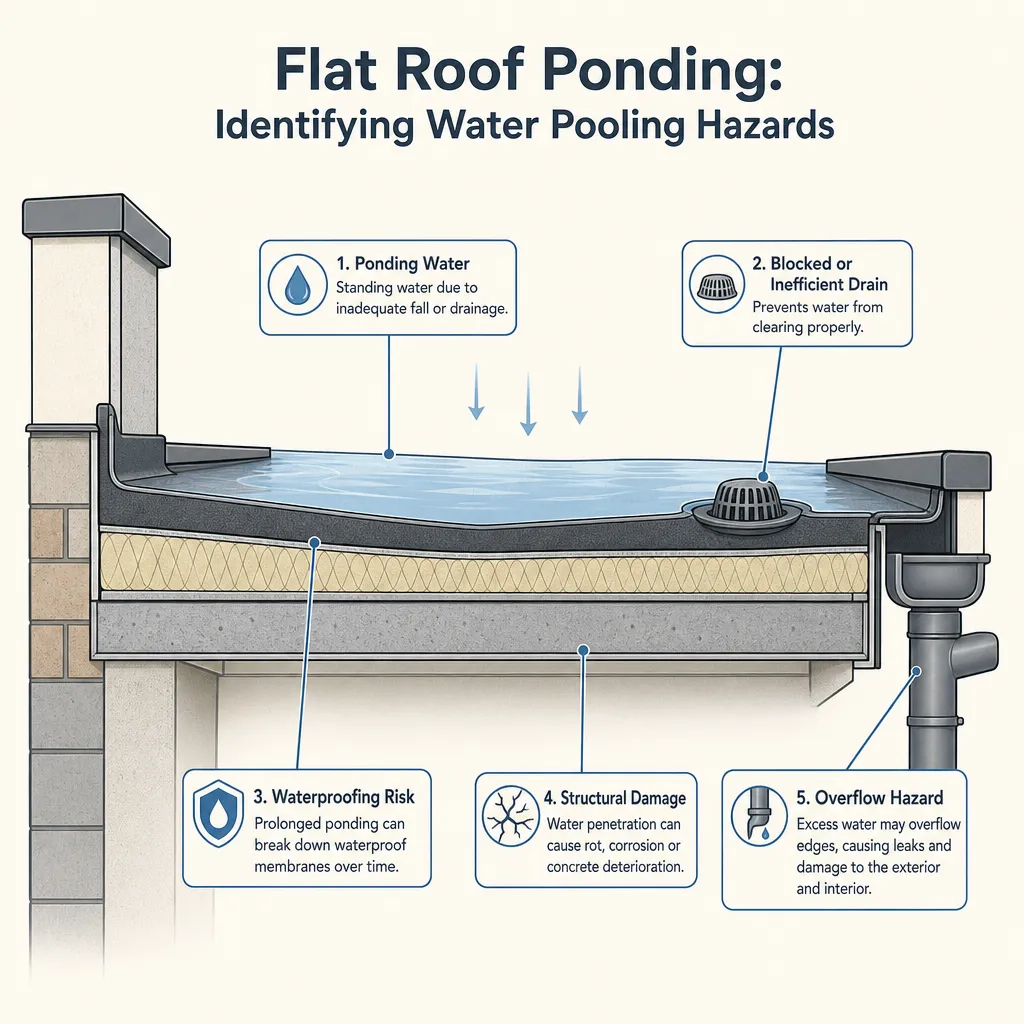
Flat Roof Ponding: Identifying Water Pooling Hazards
Flat roof ponding lasting more than 24–48 hours after rainfall warrants investigation.
 Surveys & Inspections
Annual Home Maintenance Checklist and Schedule
A structured annual maintenance schedule helps UK homeowners catch small problems before they become costly repairs.
 Surveys & Inspections
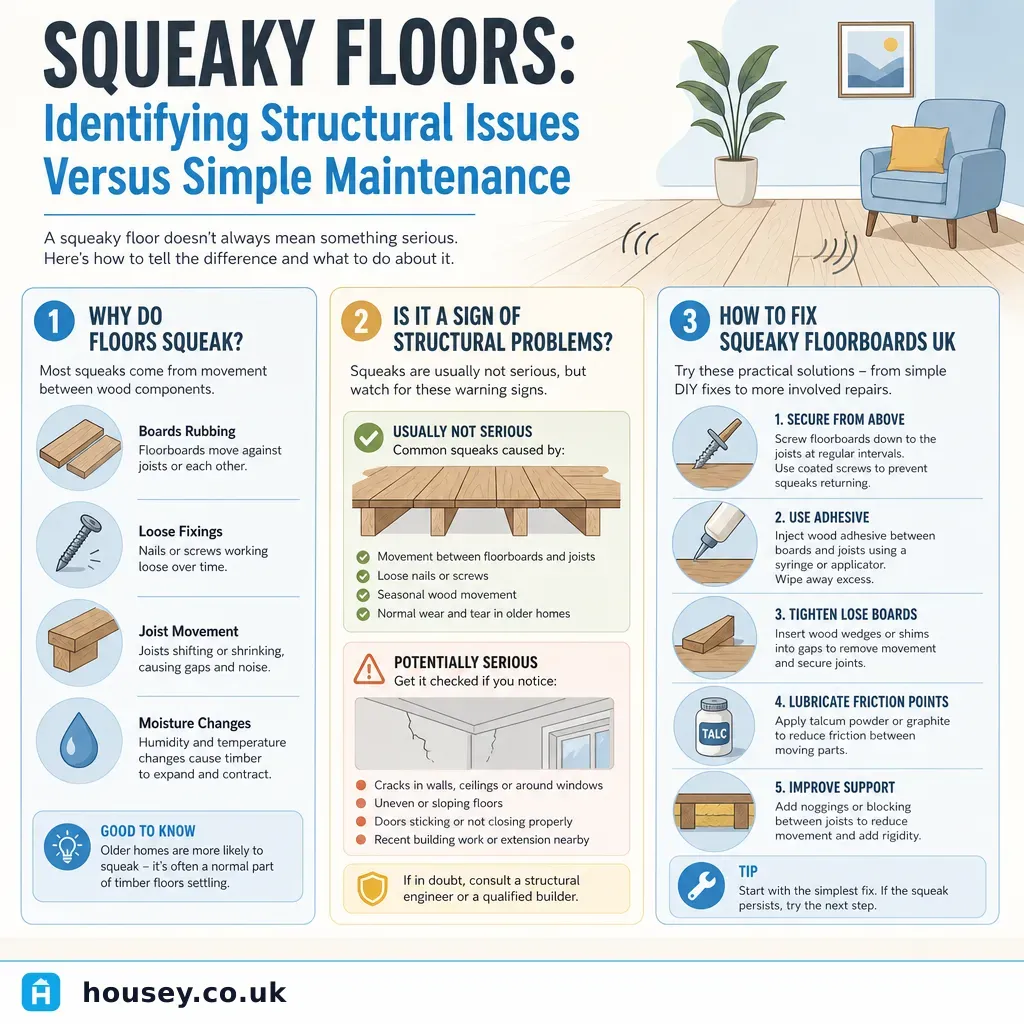
Squeaky Floors: Identifying Structural Issues Versus Simple Maintenance
Most squeaky floors in UK homes are caused by floorboards rubbing against each other or against fixings as they expand and contract — a maintenance issue rather than a structural one.
 Surveys & Inspections
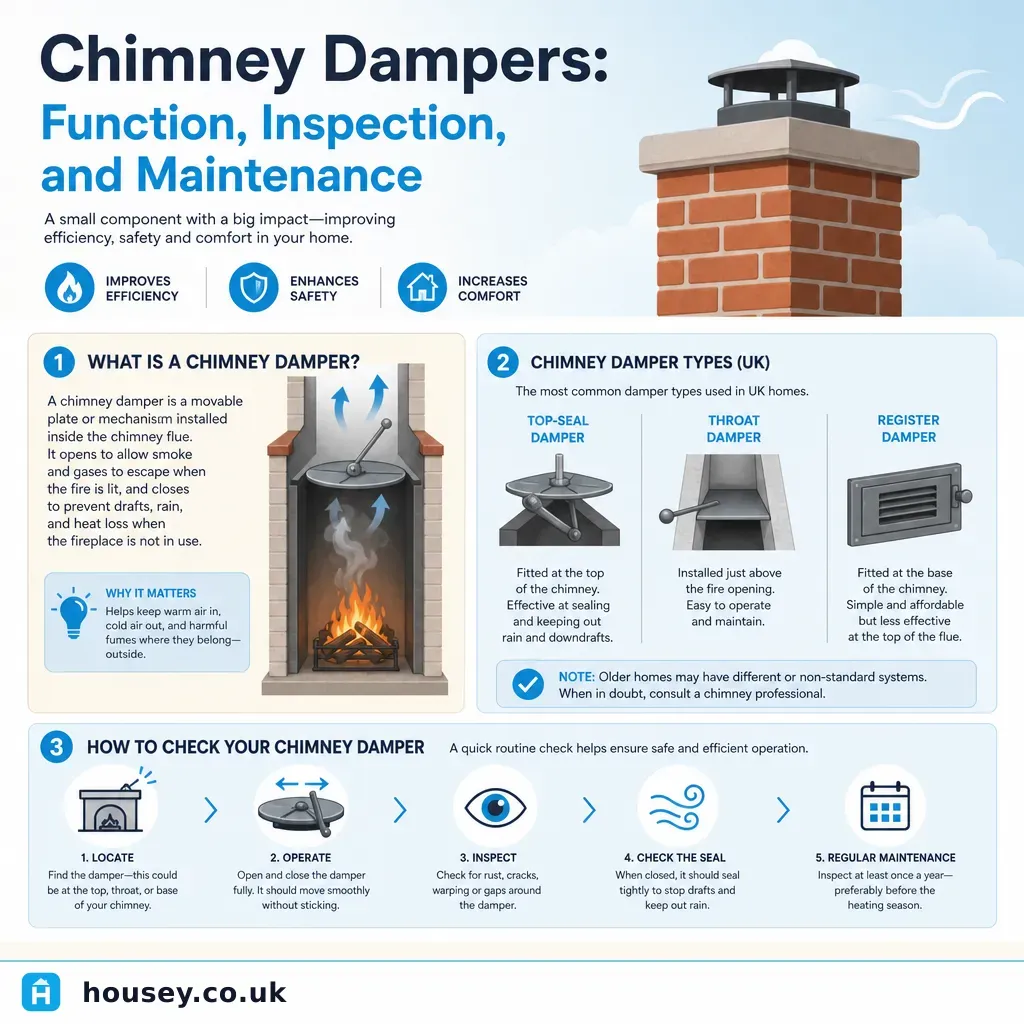
Chimney Dampers: Function, Inspection, and Maintenance
A chimney damper is a movable plate or valve in the flue that controls airflow when the fire is lit and seals the chimney when it is not.
 Surveys & Inspections
Understanding Crawl Spaces: Inspection, Maintenance, and Common Issues
Sub-floor voids beneath suspended timber ground floors in pre-1960 UK homes need cross-ventilation through airbricks to prevent dry rot and wet rot in floor timbers.