Complete Bathroom Renovation: Design and Installation
By Housey · Last reviewed 5th of May 2026
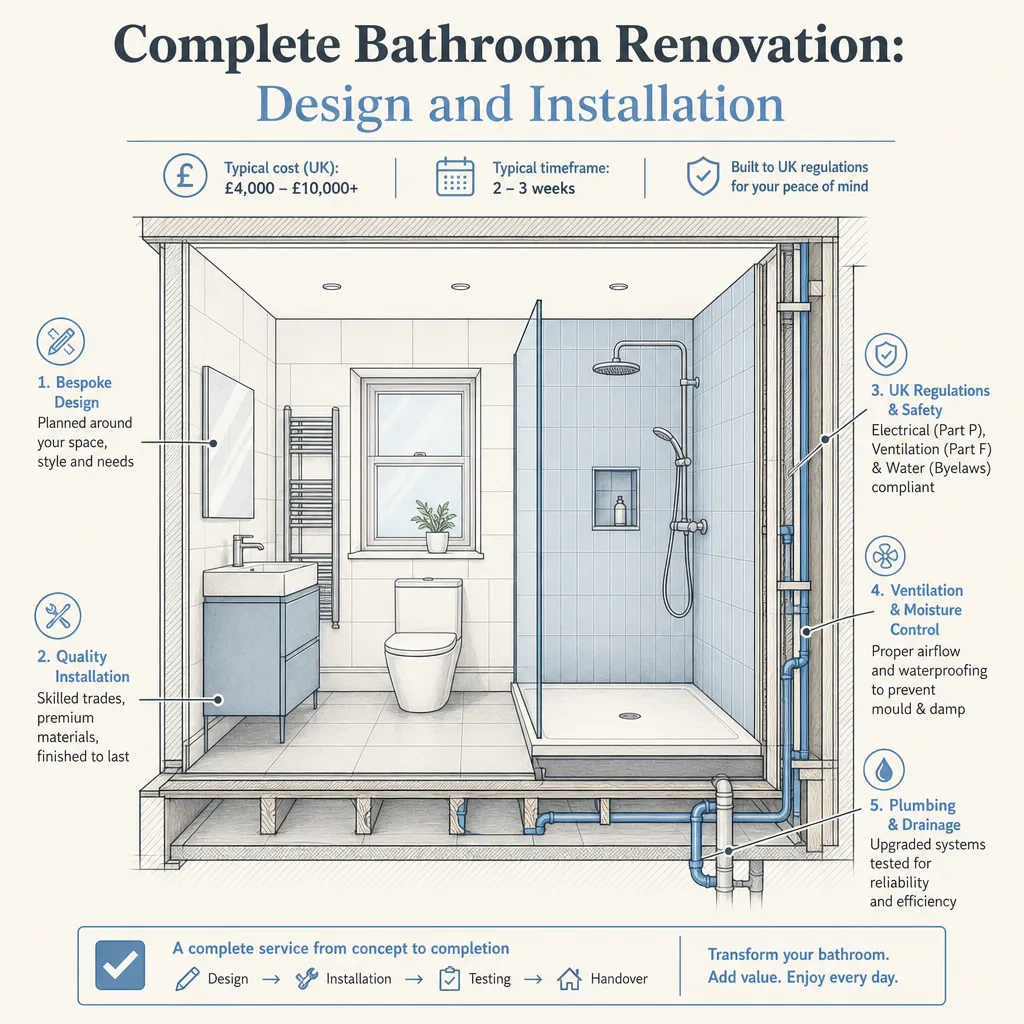
Complete Bathroom Renovation: Design and Installation
A bathroom renovation is one of the most disruptive yet most rewarding home improvement projects, touching plumbing, electrics, tiling, and joinery in a single space. In UK homes — from Victorian terraces with limited pipework access to modern new-builds with partition walls — the scope and cost of a full bathroom refurbishment varies considerably. Understanding the sequence of work, the regulations that apply, and the professionals involved helps you plan realistically and avoid costly mistakes.
Key points
- Bathroom electrical work is notifiable under Part P of the Building Regulations in England; it must be carried out by a registered competent person or inspected by building control.
- All plumbing must comply with the Water Supply (Water Fittings) Regulations 1999, which govern pipe materials, back-siphonage prevention, and connection to the mains.
- Wet rooms require a tanked (waterproofed) substrate; British Standard BS 5385 Part 4 covers ceramic tiling in wet areas and sets requirements for the underlying board.
- Moving a soil stack or waste outlet is subject to Building Regulations Part H (drainage); incorrect fall gradients cause persistent blockages.
- Competent-person schemes including NICEIC and NAPIT allow registered electricians to self-certify Part P notifiable work in bathrooms without a separate building control application.
What does a full bathroom renovation involve?
A complete bathroom renovation follows a fixed sequence of trades. Disrupting that order creates delays and rework. The standard stages are:
- Strip-out: Removal of existing sanitaryware, tiles, flooring, and boxing. This is when hidden problems — damp, rot, or poorly run pipework — are usually discovered.
- First-fix plumbing: Repositioning or extending supply and waste pipework before walls are closed.
- First-fix electrics: Routing new circuits, including a dedicated circuit for an electric shower if required.
- Waterproofing: Tanking of shower and wet areas; screeding of floors where needed.
- Boarding and tiling: Moisture-resistant boards (such as Hardiebacker or Wedi) must be used in wet zones before tiles are applied.
- Second-fix plumbing: Installing the bath, basin, WC, and shower tray or wet room former.
- Second-fix electrics: Fitting lights, extractor fan, shaver socket, and heated towel rail connections.
- Finishing: Grouting, siliconing, painting, flooring, accessories, and boxing in.
Getting trades in the correct order — plumber before tiler, and tiler before second-fix plumber — is one of the most common project-management challenges for homeowners coordinating their own renovation.
Planning your bathroom: layout and key decisions
Before specifying products, resolve the layout and structural questions. Changing the position of the WC, basin, or bath has the greatest impact on cost, because it means extending waste runs and, in some cases, breaking up floor screed.
Key layout decisions to make before ordering anything:
- Will the WC stay in its current position, or does the soil stack need extending?
- Is there adequate head height for a shower? A minimum of 2,000mm is generally recommended above the shower tray.
- Does the floor need levelling or strengthening — particularly relevant in older homes with suspended timber floors?
- Where will the extractor fan discharge? Building Regulations Part F requires adequate ventilation in bathrooms, typically a 15 l/s extract rate.
- Is natural light available, or does the lighting scheme need careful planning from the outset?
Wet room, shower enclosure, or bath: which suits your home?
Option | Best for | Not ideal for | Floor requirement | Maintenance note |
|---|---|---|---|---|
Wet room (fully tanked) | Accessibility; contemporary design; space efficiency | Suspended timber floors without reinforcement | Solid concrete or reinforced timber with tanking membrane | Drainage and grout require regular cleaning |
Shower enclosure with tray | Most UK homes; straightforward installation | Very small bathrooms where every centimetre counts | Any floor with adequate waste access | Seals and trays typically need replacing every 8–12 years |
Freestanding bath | Period properties; design-led projects | Small bathrooms under approximately 4 m² | Level, load-bearing floor (cast iron baths are very heavy) | Exposed pipework should be checked regularly for drips |
Built-in bath with shower over | Family bathrooms; flexible use | Where a separate shower-only space is preferred | Standard suspended or solid floor | Shower screen seals need annual silicone maintenance |
Regulations and permissions
Most bathroom renovations do not require planning permission — internal refurbishment is generally outside the scope of the planning system. However, several sets of Building Regulations apply:
- Part P (Electrics): Any new circuit, alteration to an existing circuit, or addition of a fixed electrical fitting in a bathroom zone must either be carried out by a Part P registered competent person (NICEIC, NAPIT, or similar) or be notified to building control and inspected.
- Part F (Ventilation): Extractor fans must meet minimum extract rates. A bathroom with no openable window must have a fan with a 15-minute overrun timer.
- Part H (Drainage): Changes to waste or soil connections must comply with correct pipe sizing, gradients, and trap depths to prevent blockages and odour ingress.
- Part L (Energy efficiency): If you replace a window in the course of the renovation, it must achieve the minimum U-value or Window Energy Rating set out in the Approved Document.
- Water Regulations 1999: All work connecting to the mains must prevent back-siphonage. Building Regulations Approved Document G recommends a maximum temperature of 48°C at shower outlets in homes used by children or elderly people.
Planning permission is not usually required for an internal bathroom renovation. If you are adding a bathroom in a room that requires a new window opening, or if the property is listed or in a conservation area, check with your local planning authority before starting.
Choosing fittings and materials
The specification of fittings directly affects installation cost and long-term durability.
- Wall-hung sanitaryware: Wall-hung WCs and basins require a concealed cistern frame fixed to the wall structure — not suitable for stud partition walls without additional noggins or a dedicated carrier frame.
- Tiles: Porcelain tiles rated R10 or above for wet area floors reduce slip risk. Large-format tiles (600×600mm and above) reduce grout lines but require a flatter substrate and a more skilled installation.
- Shower valves: Thermostatic valves are safer and more consistent than manual valves, and are particularly recommended where children or elderly people use the shower.
- Underfloor heating: Electric underfloor heating mats are easier to retrofit than wet systems and do not require a plumber, but they do require a qualified electrician and a dedicated thermostat circuit.
How long does a bathroom renovation take?
For a typical UK bathroom (4–8 m²), allow the following indicative durations:
Scope | Indicative duration |
|---|---|
Like-for-like replacement (no layout change) | 3–5 working days |
Full refurbishment with minor layout changes | 5–10 working days |
Full wet room conversion | 10–15 working days |
Ensuite creation from scratch (new room) | 2–4 weeks |
These assume a single main contractor coordinating trades. Self-managing separate trades typically adds 20–50% to the timeline because of scheduling gaps between the plumber, electrician, and tiler.
Homeowner checklist: before work begins
Red flags during installation
Watch for these warning signs during your renovation:
- A tiler who applies tiles directly to standard plasterboard in wet areas — moisture-resistant board or a tanking system is required in shower zones.
- An electrician who proposes adding a socket inside a bathroom Zone 1 or Zone 2 (this is prohibited under BS 7671).
- A plumber who does not fit an isolating valve on each supply pipe before installing a new fitting.
- Any tradesperson who suggests you do not need building control sign-off for notifiable electrical work.
- Grout applied at internal corners instead of silicone — movement joints at corners must be siliconed, not grouted, to prevent cracking as the building moves.
When to get professional help
Bathroom renovation always requires qualified professionals for safe and compliant results. In particular:
- Electrical work: All electrical work in bathrooms has specific zoning requirements under BS 7671. Use a Part P registered electrician for any new or altered circuit.
- Gas work: Relocating a boiler or any gas supply work requires a Gas Safe registered engineer. Never allow unregistered individuals to carry out gas work.
- Structural changes: Removing or altering a load-bearing wall or floor joist requires structural engineering calculations and building control approval before work begins.
- Suspected asbestos: If your home was built before 2000 and you encounter textured coatings, old floor tiles, or pipe lagging during strip-out, do not disturb the material. Arrange an asbestos survey before any further work.
How Housey can help
Housey connects UK homeowners with vetted local tradespeople for bathroom renovation projects. Whether you are looking for a full-service bathroom fitting company or need to compare separate plumbing, tiling, and electrical quotes, Housey's quote-request process makes it straightforward to compare local providers and verify their credentials before committing to any contract.
Frequently asked questions
Do I need building regulations approval for a bathroom renovation?
You do not usually need approval for like-for-like replacement of sanitaryware. However, any new or altered electrical circuits must comply with Part P of the Building Regulations — notifiable work must be carried out by a registered competent person or inspected by building control. Drainage changes must meet Part H. Your installer should clarify which notifications are required before starting work.
How much does a full bathroom renovation cost in the UK?
Costs vary widely by bathroom size, specification, and regional labour rates. Indicative UK costs, last reviewed 2026-05-05: a basic like-for-like refurbishment may start from around £3,000–£5,000; a full mid-range renovation with layout changes typically ranges from £6,000–£12,000; high-specification or wet room projects can exceed £15,000. Always obtain at least three itemised written quotes before committing.
Can I project-manage a bathroom renovation myself?
Some homeowners coordinate separate trades themselves, which can reduce costs but requires confident scheduling and knowledge of trade sequencing. DIY electrical work in bathrooms is not permitted without Part P competent-person registration. All plumbing connections to the mains must comply with the Water Supply (Water Fittings) Regulations 1999, carried out by or overseen by a competent person.
How do I find a reliable bathroom fitter in the UK?
Look for tradespeople registered with recognised professional bodies: WaterSafe or CIPHE for plumbers; NICEIC, NAPIT, or similar for electricians. Ask for references from recent bathroom projects, request itemised written quotes, and confirm the quote explicitly states who handles any building regulations notifications. Checking independently verified reviews before instructing anyone is also advisable.
What is the difference between a wet room and a walk-in shower?
A wet room is a fully waterproofed (tanked) room where the entire floor is graded to a drain, with no shower tray or enclosure. A walk-in shower uses a low-profile tray and a glass screen without a door. Wet rooms require more extensive waterproofing work, particularly on suspended timber floors, and are especially suited to accessibility needs and contemporary design.
Sources and further reading
- Building Regulations Approved Document Part P (Electrical Safety) — GOV.UK
- Water Supply (Water Fittings) Regulations 1999 — legislation.gov.uk
- Building Regulations Approved Document Part F (Ventilation) — GOV.UK
- Building Regulations Approved Document Part G (Sanitation, Hot Water Safety and Water Efficiency) — GOV.UK
- WaterSafe — find an approved plumber — WaterSafe
- NICEIC — find a registered electrician — NICEIC
Useful next reads
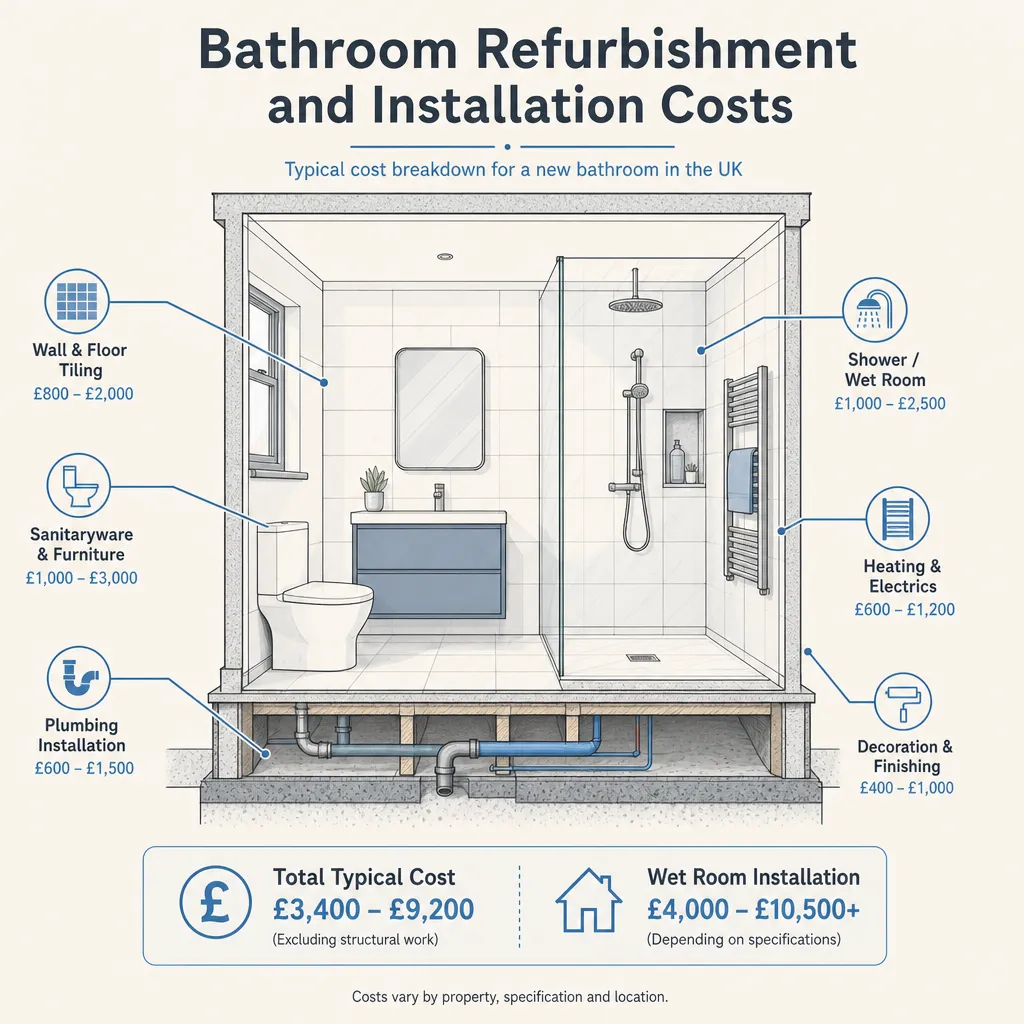 Improvement & Build
Bathroom Refurbishment and Installation Costs
A basic UK bathroom refurbishment typically costs £2,500–£5,000; a mid-range renovation with a revised layout runs £5,000–£10,000; a high-end or wet room installation can reach £12,000–£16,000 or more.
 Improvement & Build
Designing a Spa-Style Bathroom: Creating Relaxation at Home
A spa-style bathroom combines a rainfall shower or freestanding bath, natural materials such as stone or wood-effect tiles, dimmable lighting, underfloor heating, and effective ventilation.
 Improvement & Build
Bathroom Design Ideas: Fireplaces and Features
Gas fires in UK bathrooms are effectively prohibited under the Gas Safety (Installation and Use) Regulations 1998.
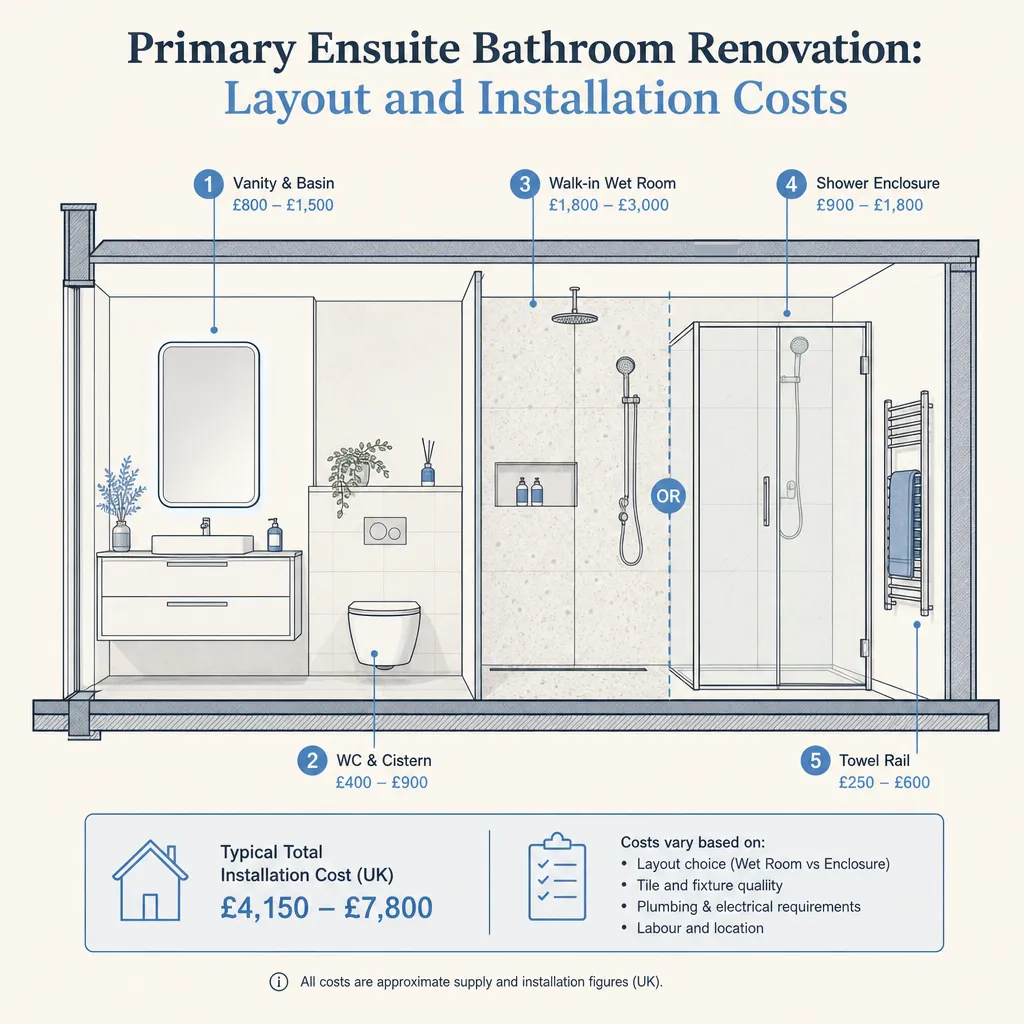 Improvement & Build
Primary Ensuite Bathroom Renovation: Layout and Installation Costs
A primary ensuite renovation in the UK typically costs between £3,000 and £12,000, depending on size, layout, and specification.
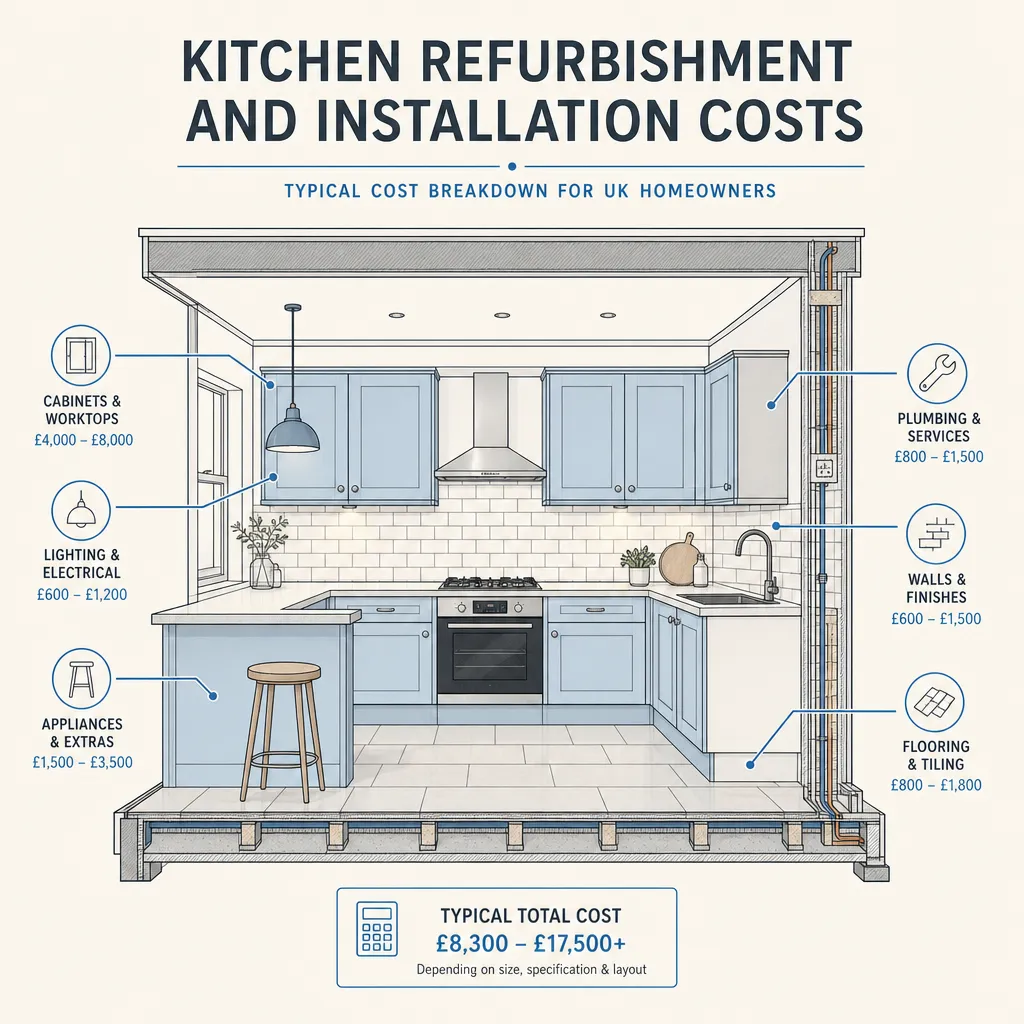 Improvement & Build
Kitchen Refurbishment and Installation Costs
A kitchen refurbishment in the UK typically costs between £3,000 and £40,000 or more, depending on whether you are replacing units only or carrying out a full design-and-build project.