Primary Ensuite Bathroom Renovation: Layout and Installation Costs
By Housey · Last reviewed 1st of June 2026
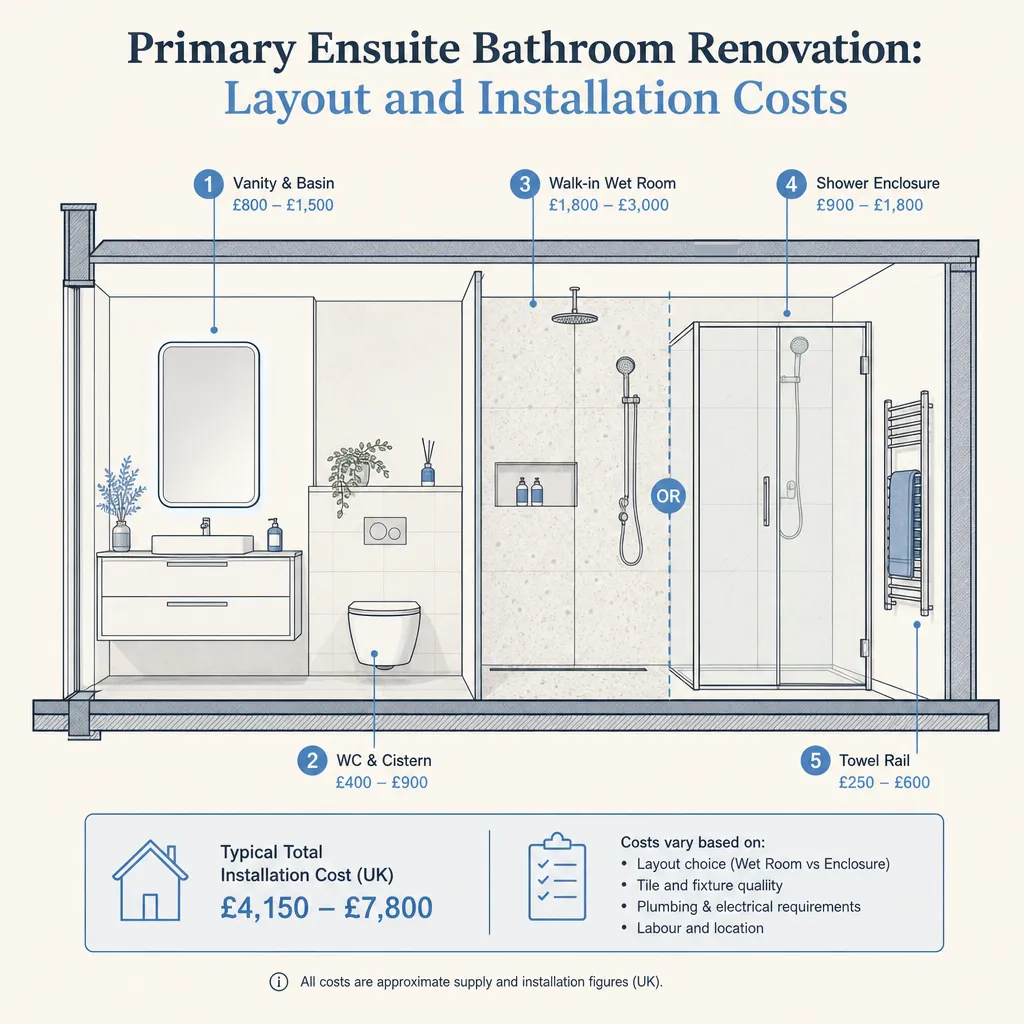
Primary Ensuite Bathroom Renovation: Layout and Installation Costs
Converting a bedroom corner or partitioning space from a landing to create an ensuite is one of the more involved home improvement projects UK homeowners undertake — it touches plumbing, electrics, ventilation, and often structural partitioning simultaneously. The decisions made at layout stage tend to lock in costs and constrain later options, so understanding the practical and regulatory constraints early prevents expensive rework.
Key points
- Approved Document F requires mechanical ventilation at a minimum of 15 l/s (litres per second) in bathrooms without an openable window — a common situation for ensuites built into internal bedroom spaces.
- All electrical circuits in an ensuite — lighting, extraction fans, underfloor heating mats, and shaver points — are notifiable under Part P of the Building Regulations and must use IP-rated fittings appropriate to Zones 0, 1, and 2 as defined in BS 7671.
- Adding or relocating a WC soil connection requires Building Regulations notification under Part H (Drainage and Waste Disposal).
- A wet room floor must be fully tanked using a proprietary waterproofing system applied to the wall and floor substrate — inadequate tanking is a leading cause of structural moisture damage in modern ensuites.
- Indicative costs for a standard primary ensuite from scratch range from approximately £4,500 to £12,000, depending on specification, drainage complexity, and region (last reviewed 2026-06-01; London and South East typically 20–40% higher).
Planning your ensuite layout: key constraints
Before specifying a suite, several practical factors will shape what is possible:
Soil stack proximity: A WC requires a gravity drain to the soil stack, typically falling at 1:40 to 1:80 for a 100mm pipe. A WC positioned more than around 6m from the stack may require a macerator unit (such as a Saniflo-type), which adds cost and ongoing maintenance considerations.
Partition walls: Most ensuites are formed behind a new stud partition, typically 100mm wide with a 70mm stud. Pipework runs can often be concealed within this wall thickness, reducing the need for surface-mounted boxing.
Ceiling height: In rooms beneath a roof pitch, the area with full standing height will constrain where a shower can be positioned. Approved Document K requires a minimum clear head height of 2m in areas intended for regular occupation.
Ventilation route: The extraction fan must discharge to outside air — through an external wall, via a soffit terminal, or through a roof vent. Discharging into an internal roof void without an external outlet does not comply with Approved Document F.
Wet room, shower enclosure, or bath and shower: comparing the options
Configuration | Best for | Minimum space | Indicative supply and fit cost | Key risk |
|---|---|---|---|---|
Walk-in shower enclosure | Most standard ensuites | From ~900mm × 900mm | £1,200–£3,500+ | Grout joints require regular sealing |
Fully tanked wet room | Luxury finish; accessible design | From ~1,200mm × 1,200mm recommended | £2,500–£6,000+ for floor and tanking | Poor tanking leads to structural moisture damage |
Shower bath combination | Larger ensuites; dual-purpose use | ~1,700mm × 700mm minimum | £1,500–£4,000+ | Requires more floor area |
Steam shower enclosure | Premium specification; wellness focus | From ~1,000mm × 1,000mm | £3,000–£8,000+ | Specialist installation; ongoing maintenance |
Indicative costs for the shower or bath element only, last reviewed 2026-06-01. Full ensuite renovation costs include additional trades and works.
Building Regulations that apply to ensuite renovations
Part P (Electrical safety): New or altered circuits in bathrooms are notifiable. Fittings in Zone 0 (inside the shower or bath), Zone 1 (above and immediately around), and Zone 2 (within 600mm horizontally) must carry appropriate IP ratings. Shaver sockets must be isolated-transformer type. Use a NICEIC- or NAPIT-registered electrician for all circuit work.
Part F (Ventilation): Ensuites require a minimum 15 l/s continuous extraction or 45 l/s intermittent extraction. Humidity-controlled fans that respond to steam are a widely used practical solution in ensuites without openable windows.
Part H (Drainage): New or relocated WC soil connections and material changes to the drainage arrangement require notification. A plumber familiar with Part H can advise on whether your specific drainage changes are notifiable and whether a full Building Regulations application is needed.
Part L (Conservation of fuel and power): Relevant if the ensuite forms part of a new extension or involves new openings in the building envelope. For internal ensuite conversions within the existing footprint, Part L is generally not triggered.
Like-for-like bathroom replacements in the same position with the same fitting types typically do not require a Building Regulations application, but any new circuits, new drainage connections, or new structural partitions will each trigger some form of notification.
What does an ensuite renovation cost in the UK?
The following are indicative UK costs, last reviewed 2026-06-01, for a primary ensuite renovation. These cover the ensuite room only, including labour and materials but excluding structural or extension work.
Scope | Indicative cost range |
|---|---|
Basic refurbishment (suite swap, retiling, minor plumbing) | £2,500–£4,500 |
Standard ensuite from scratch (stud partition, shower enclosure, WC, basin) | £4,500–£8,000 |
Mid-range with walk-in shower and wall-hung sanitaryware | £7,000–£12,000 |
Premium wet room with designer finishes and underfloor heating | £12,000–£20,000+ |
Costs vary significantly by region, specification, and access. Always obtain a minimum of three itemised quotes.
Main cost drivers:
- Distance from soil stack (determines drainage complexity and whether a macerator is needed)
- Whether structural partitioning or lintels are required
- Sanitaryware, tap, and shower enclosure specification
- Tile format and material (large-format porcelain costs more to lay than standard ceramic)
- Underfloor heating (add approximately £500–£1,500 for a small ensuite)
- Whether the consumer unit needs upgrading to accommodate new circuits
Worked example: 1930s semi-detached, new ensuite off the master bedroom
A homeowner in Bristol owns a 1930s semi-detached with four bedrooms and a single family bathroom. They want to create a shower-only ensuite off the master bedroom by partitioning part of an adjacent smaller bedroom, creating a space of approximately 5 sq m (2.5m × 2.0m).
Key decisions made at layout stage:
- Drainage: The soil stack on the exterior rear wall is approximately 2m from the proposed WC position — within acceptable distance for a gravity drain at 1:40. No macerator required.
- Partition: A 100mm stud partition wall with a door opening will be formed, reducing the adjacent bedroom slightly but leaving it habitable.
- Shower type: A walk-in enclosure (1,200mm × 800mm) with a fixed glass panel, rather than a full wet room, to manage tanking cost and risk.
- Ventilation: An extract fan through the ceiling, routed via rigid duct to a soffit terminal on the rear elevation — a clean, fully compliant solution.
Approximate total cost: £7,500–£9,500 for supply and full installation. Electrical work (new circuit, IP-rated downlights, extraction fan, shaver point, underfloor heating mat) accounts for approximately £1,200–£1,800, and wall and floor tiling approximately £1,500–£2,200.
Indicative figures, last reviewed 2026-06-01. Costs vary by contractor and location.
Ensuite renovation checklist
Before work starts, confirm the following:
When to get professional help
An ensuite renovation involves several regulated trades working in sequence. You will almost certainly need:
- A Part P-registered electrician for all new circuits and bathroom zone wiring.
- A qualified plumber for drainage connections, supply pipework, and any interface with the hot water system.
- A Building Regulations notification or application if you are forming structural openings, adding soil connections, or the work forms part of an extension.
Seek additional structural or specialist advice if:
- Removing or piercing a wall that may be load-bearing — always establish this before cutting.
- Installing a bath or wet room above a timber floor where load capacity or waterproofing integrity is uncertain.
- Existing condensation or damp is present in the proposed space — address moisture issues before enclosing them behind new tiles and walls.
How Housey can help
Housey helps UK homeowners plan and price ensuite renovation projects by connecting them with vetted bathroom installers, plumbers, and electricians. Whether you are at the initial layout stage or ready to compare quotes, Housey makes it straightforward to find local tradespeople who understand the Building Regulations requirements for bathroom work.
Frequently asked questions
Does an ensuite renovation need planning permission?
Most ensuite renovations within an existing dwelling fall under permitted development and do not need planning permission. However, if the ensuite involves a new external structure — such as a rear extension or dormer — planning permission will be required. Listed buildings need Listed Building Consent for internal alterations. Check with your local planning authority if you are uncertain about your specific situation.
What are bathroom electrical zones and why do they matter?
BS 7671 (IET Wiring Regulations) divides bathrooms into zones that determine which electrical fittings are safe in each area. Zone 0 is inside the bath or shower tray; Zone 1 extends to 2.25m above floor level around the bath or shower; Zone 2 reaches 600mm horizontally beyond Zone 1. Fittings must meet minimum IP ingress protection ratings for their zone — a registered electrician will specify the correct ratings for your layout.
How long does an ensuite renovation take?
A typical ensuite renovation from scratch takes two to four weeks for a team of bathroom fitter, plumber, and electrician working in sequence. Delays commonly arise from tile delivery lead times, sanitaryware availability, and waiting for plasterwork and waterproofing compounds to dry fully before tiling. Build in contingency time and agree a sequenced programme with your contractor before work begins.
Should I choose a wet room or a shower enclosure for my ensuite?
A wet room creates a fully waterproofed, barrier-free shower space suited to accessible design or a premium finish. It requires careful professional tanking — poor waterproofing is expensive to remedy. A shower enclosure with a tray is generally lower cost, faster to install, and more forgiving if any movement occurs over time. For most standard ensuites, a quality enclosure is the more practical and cost-effective choice.
Sources and further reading
- Approved Document F: Ventilation — GOV.UK
- Approved Document P: Electrical Safety in Dwellings — GOV.UK
- Approved Document H: Drainage and Waste Disposal — GOV.UK
- IET Wiring Regulations (BS 7671) — IET
- Planning Portal: Do You Need Permission? — Planning Portal
Useful next reads
 Improvement & Build
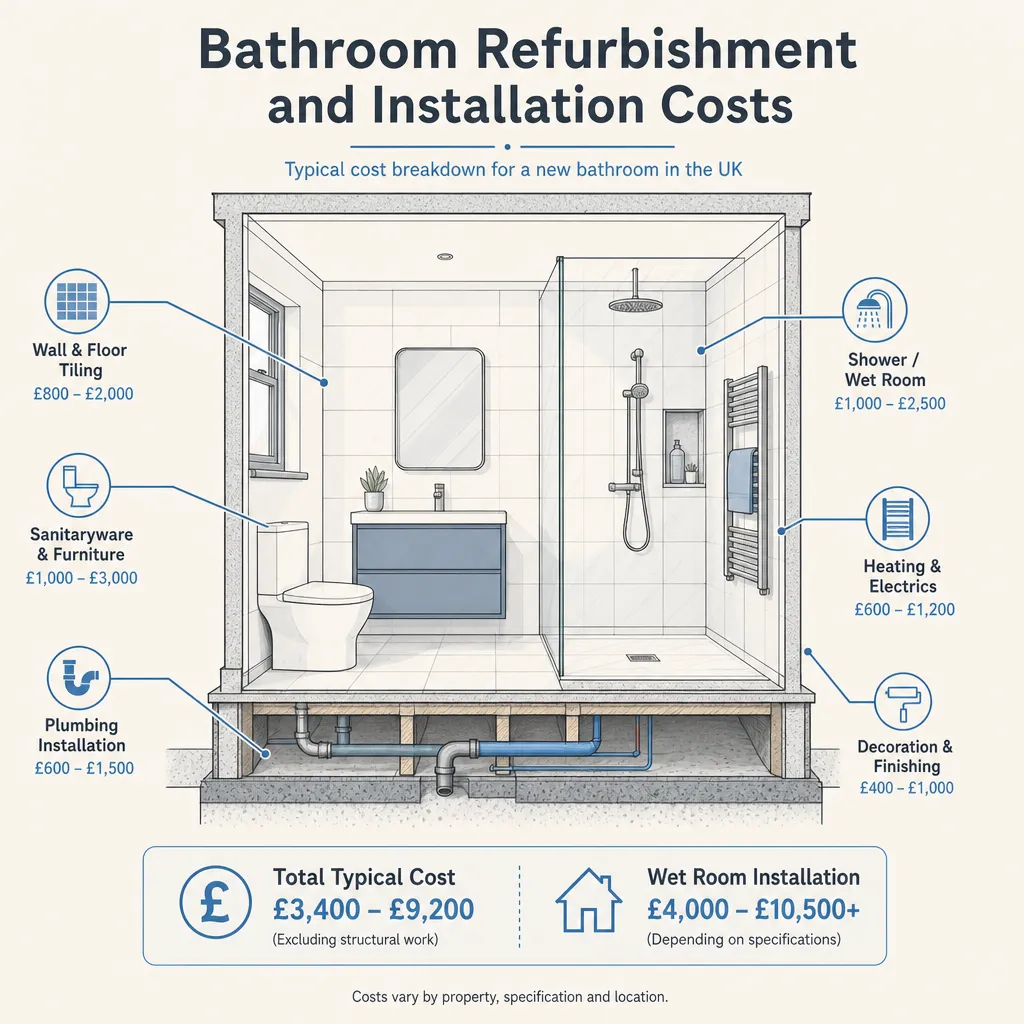
Bathroom Refurbishment and Installation Costs
A basic UK bathroom refurbishment typically costs £2,500–£5,000; a mid-range renovation with a revised layout runs £5,000–£10,000; a high-end or wet room installation can reach £12,000–£16,000 or more.
 Improvement & Build
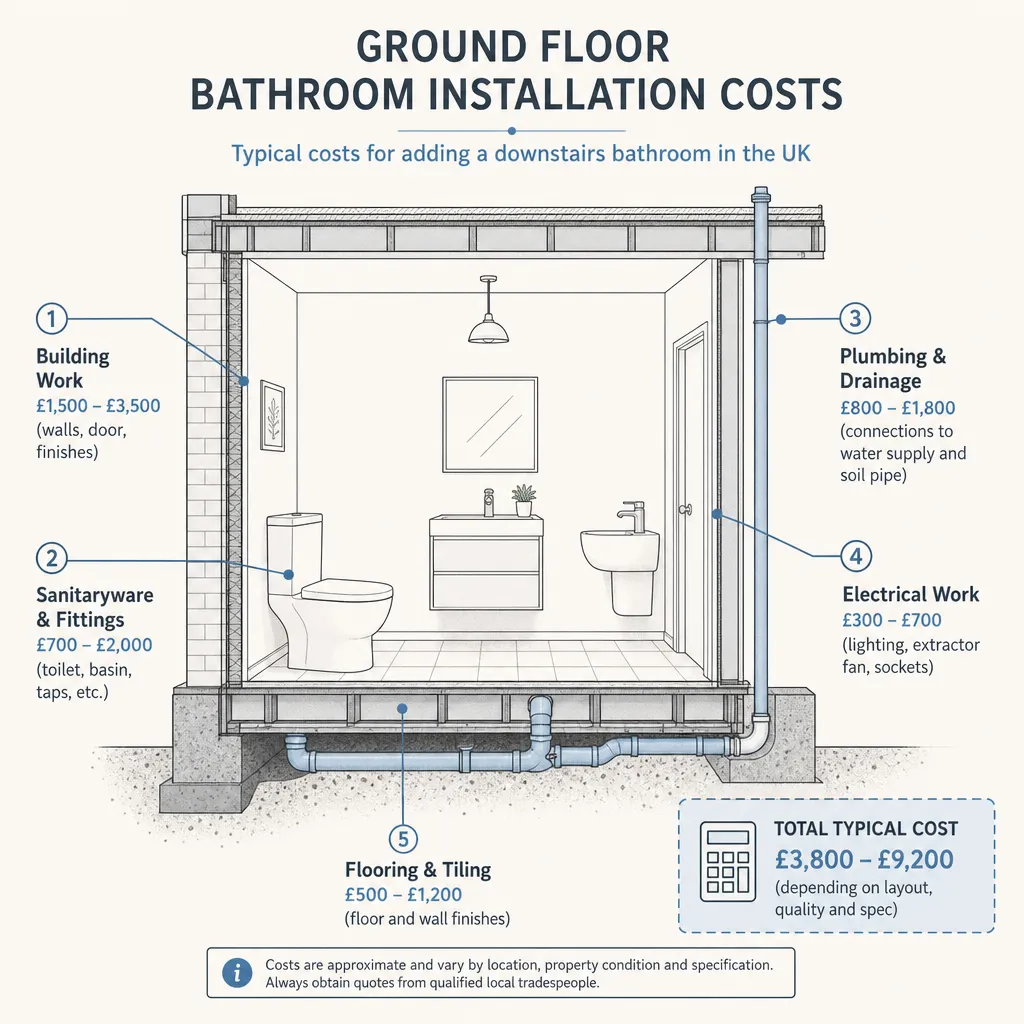
Ground Floor Bathroom Installation Costs
Installing a ground floor bathroom in the UK costs roughly £2,000–£5,000 for a basic cloakroom and £5,500–£15,000 for a shower room or wet room.
 Improvement & Build
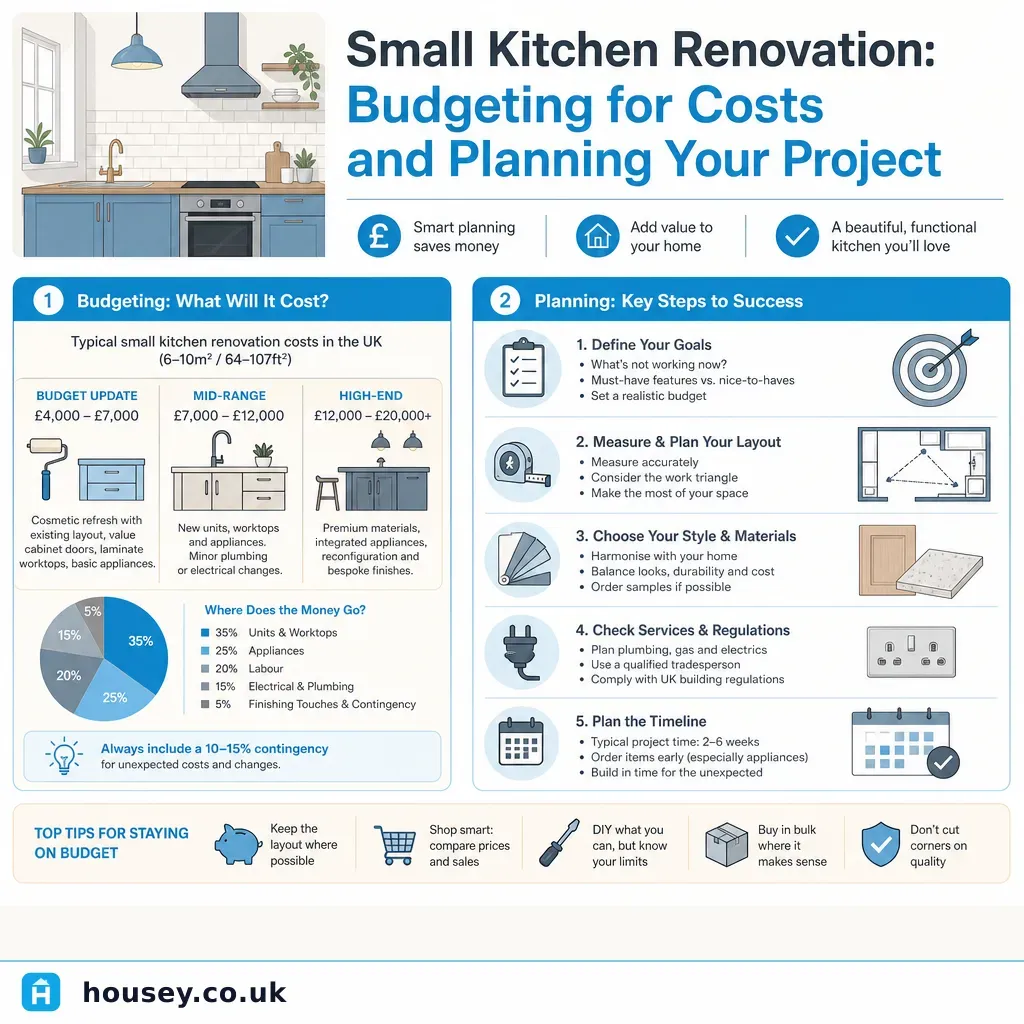
Small kitchen renovation: budgeting for costs and planning your project
A small kitchen renovation in the UK typically costs £5,000–£15,000 for a full refresh including new units, worktops, tiling, and appliances, though costs vary widely by specification, region, and whether structural changes or rewiring are involved.
 Improvement & Build
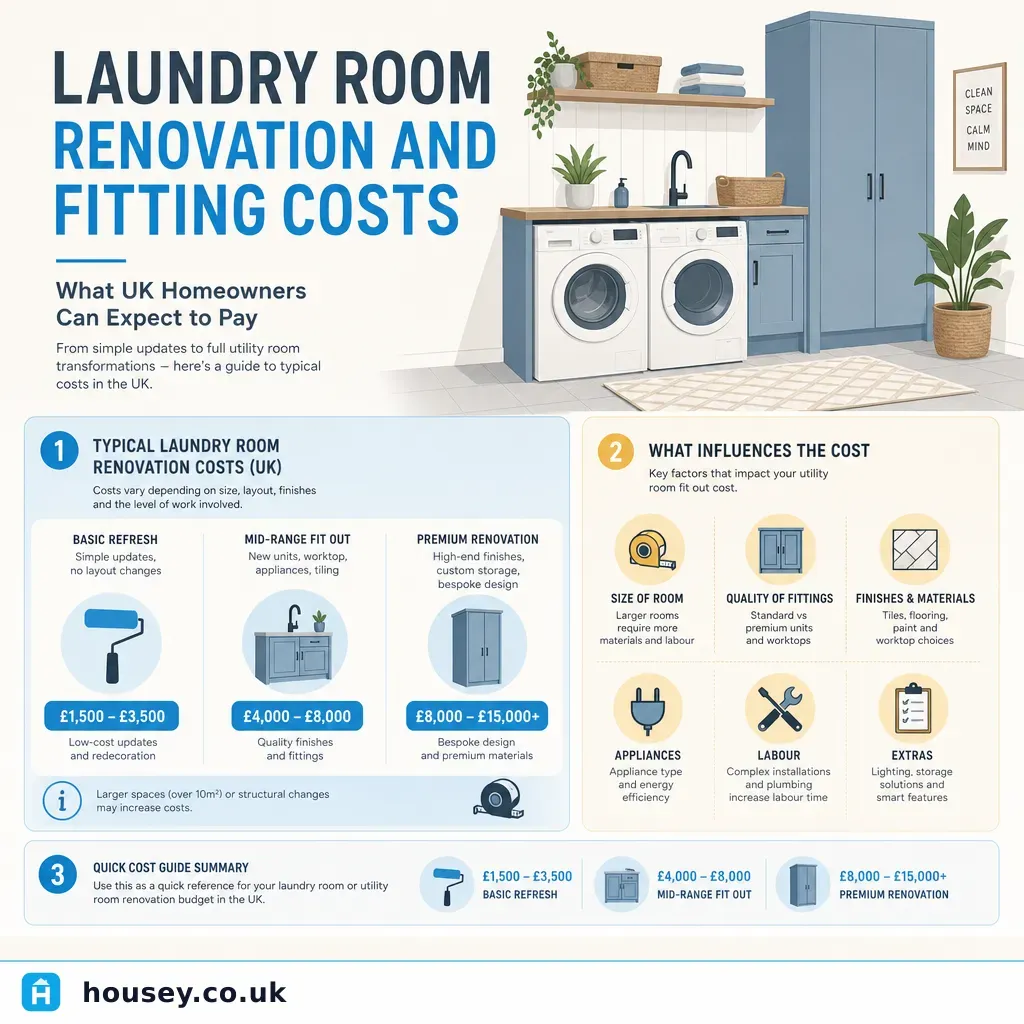
Laundry Room Renovation and Fitting Costs
A basic UK laundry room fit-out typically costs £2,000–£6,000 where plumbing and electrics are already in place, rising to £8,000–£15,000 or more when structural work, new drainage connections, or new electrical circuits are needed.
 Improvement & Build
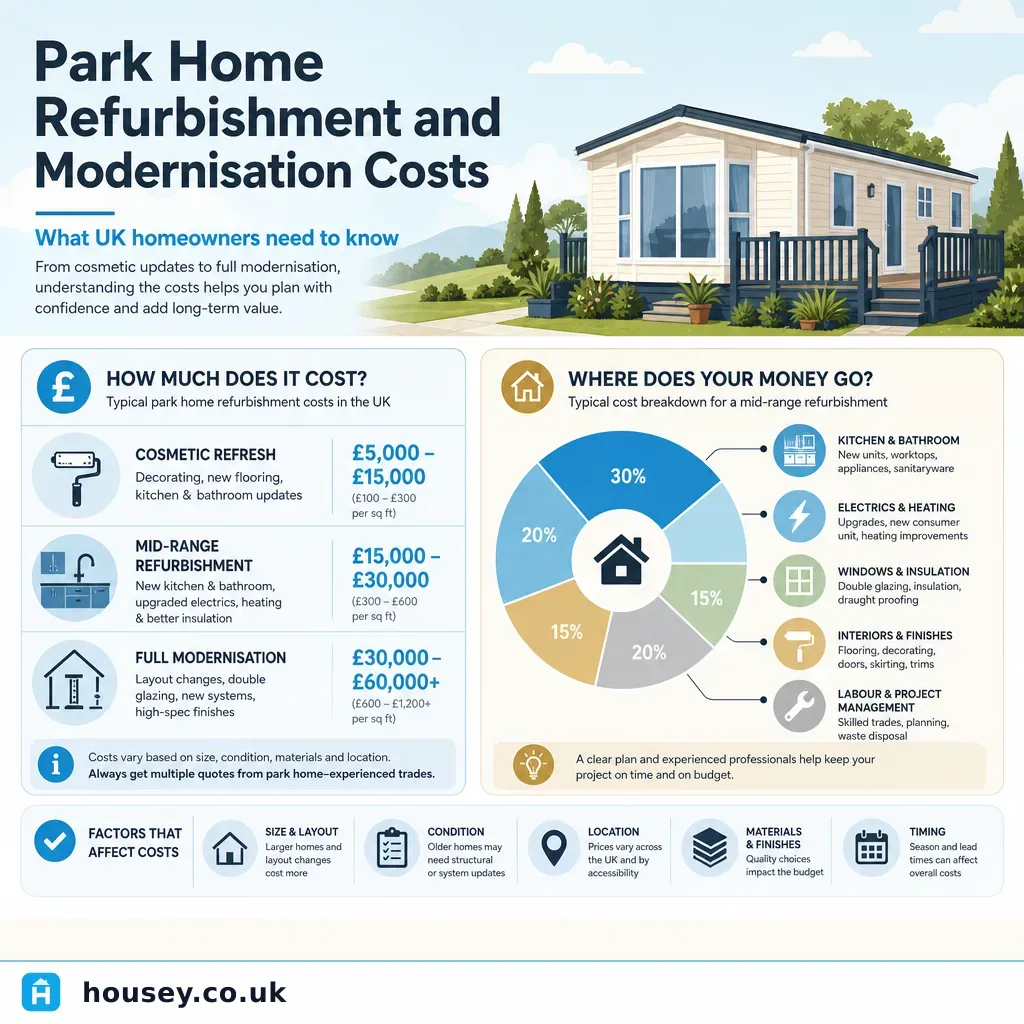
Park Home Refurbishment and Modernisation Costs
Park home refurbishment costs in the UK range from £2,000–£8,000 for cosmetic updates to £30,000–£60,000 or more for full structural modernisation.