A Complete Guide to House Conveyancing and Property Transactions in the UK
By Housey · Last reviewed 24th of May 2026
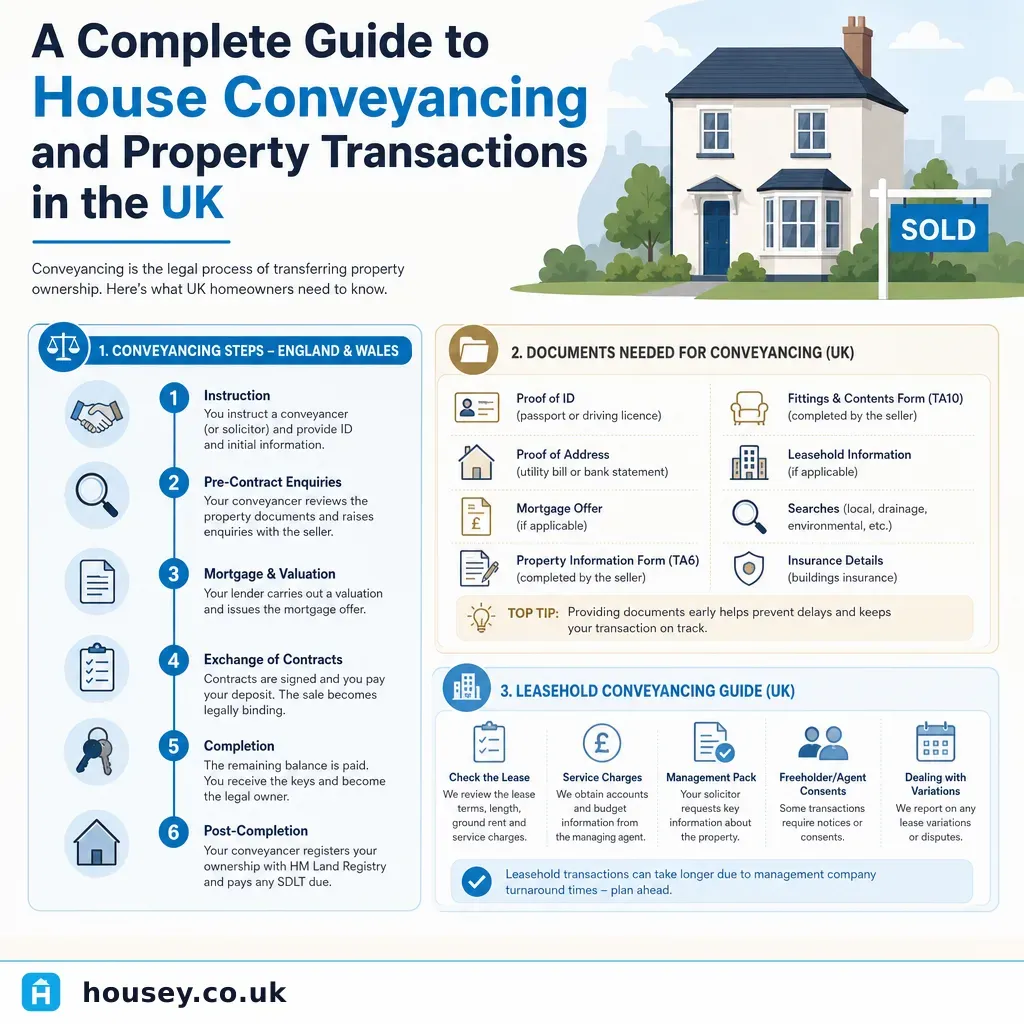
A Complete Guide to House Conveyancing and Property Transactions in the UK
When an offer is accepted on a property in England or Wales, the legal work has barely begun. The conveyancing process — from instruction through to the moment keys change hands — involves a sequence of legal, administrative, and financial steps that most homebuyers encounter for the first time at precisely the moment they can least afford to learn by trial and error. The decisions made in the first days after an offer is accepted — choice of conveyancer, speed of document submission, and understanding of what searches actually reveal — can determine whether a transaction completes in twelve weeks or stretches to six months.
Key points
- In England and Wales, accepting an offer is not legally binding — either party may withdraw without financial penalty until contracts are formally exchanged.
- The TA6 Property Information Form and TA10 Fittings and Contents Form are standard Law Society documents completed by the seller; both must be provided before a draft contract can be issued to the buyer's solicitor.
- Stamp Duty Land Tax (SDLT) must be paid within 14 days of completion; your conveyancer files the return, but the legal obligation rests with the buyer.
- Leasehold conveyancing requires a management pack from the managing agent — typically costing £200–£500 and taking 4–8 weeks to arrive — before exchange can proceed safely.
- If a sale falls through after exchange of contracts, the party in breach forfeits the 10% deposit and may face additional financial claims from the other party.
The four phases of conveyancing
Phase 1: Instruction (typically 1–2 weeks)
Once an offer is accepted, both buyer and seller instruct their own conveyancers separately. In this phase the conveyancer will:
- Issue a client care letter confirming fees, disbursements, and scope of work
- Request anti-money laundering (AML) identification and address verification documents
- For buyers: obtain mortgage offer details and lender panel confirmation
- For sellers: request title documents and issue the TA6 and TA10 standard forms
The AML verification process increasingly takes place online. Submitting identity documents within 24 hours of instruction avoids one of the most avoidable early delays.
Phase 2: Pre-exchange (typically 8–14 weeks)
This is the longest phase and where most delays occur. The buyer's conveyancer:
- Reviews the draft contract issued by the seller's solicitor
- Orders searches — local authority, drainage, environmental, and Land Registry
- Raises pre-contract enquiries: written questions about the property's planning history, boundaries, disputes, and any known defects or alterations
- Reviews the mortgage offer and reports its conditions to the lender
- Prepares a detailed report to the buyer summarising all findings before asking them to sign
The seller's conveyancer responds to enquiries and gathers additional documentation as requested. Search delays and slow responses to enquiries are the most common causes of this phase extending beyond expectations.
Phase 3: Exchange of contracts
Once both conveyancers are satisfied with the title, searches, enquiries, and mortgage position, each party signs their copy of the contract. The buyer pays a deposit — typically 10% of the purchase price — to the seller's solicitor. The two solicitors then exchange signed copies and the transaction becomes legally binding. A completion date is fixed at this point.
Phase 4: Completion
On the agreed completion date, the buyer's conveyancer transfers the remaining purchase funds to the seller's solicitor. On receipt, the seller's solicitor authorises release of keys — usually via the estate agent. The buyer's conveyancer then registers the new ownership with HM Land Registry and pays any Stamp Duty Land Tax due within the required 14-day window.
Document preparation list
Preparing documents promptly reduces delays at instruction and throughout the pre-exchange phase.
If you are buying:
If you are selling:
How to avoid common conveyancing delays
Cause of delay | Typically caused by | What you can do |
|---|---|---|
Slow local authority searches | Council processing times | Ask your conveyancer whether a personal search agent can be used for faster turnaround |
Slow replies to enquiries | Seller's solicitor or seller | Sellers should gather all documents before accepting an offer |
Missing building certificates | Seller | Obtain all certificates before listing; arrange indemnity insurance if originals are lost |
Mortgage offer conditions | Buyer's lender | Respond to any lender conditions the same working day; submit documents immediately |
Chain delays | Third parties | Request regular chain updates from your estate agent and conveyancer |
Incomplete AML verification | Buyer or seller | Submit all ID documents within 24 hours of instruction |
Leasehold management pack | Managing agent | Chase the agent directly; pack fees are normally met by the seller |
Leasehold properties: additional steps
Leasehold conveyancing involves enquiries and documents that freehold transactions do not require:
- Management pack from the managing agent: service charge accounts, buildings insurance, major works history, and any pending section 20 notices for significant expenditure
- Landlord's licence to assign (required by some leases before the property can be transferred to a new owner)
- Deed of covenant (the buyer formally covenants with the freeholder to comply with all lease obligations)
- Notice of transfer and charge sent to the freeholder after completion
Management packs typically cost £200–£500 and can take 4–8 weeks to arrive; this cost is normally met by the seller. If a lease has fewer than 80 years remaining at exchange, most mortgage lenders will refuse to lend. A lease extension must be negotiated or a statutory claim served before exchange — both routes require specialist legal and valuation advice separate from your standard conveyancing instruction.
What not to assume during conveyancing
A significant number of transaction difficulties arise from common homebuyer assumptions that turn out to be wrong:
- Do not assume the asking price includes all fixtures and fittings. The TA10 Fittings and Contents Form is definitive — anything not listed as included is excluded. Confirm all items in writing before exchange.
- Do not assume you move in on the exchange date. Exchange and completion are separate events; key release happens on the completion date agreed at exchange, usually one to four weeks later.
- Do not assume a clean search result means no problems. Searches check administrative records, not physical condition. A clear environmental search does not mean the property is structurally sound; commission an independent survey separately.
- Do not assume your conveyancer is co-ordinating the entire chain. Your conveyancer manages your part of the transaction; the estate agent typically co-ordinates the chain. Ask both for progress updates.
- Do not transfer completion funds based solely on an email instruction. Conveyancing fraud is an active and growing risk in the UK. Always verify bank account details by telephone using a number sourced independently before any transfer.
Important limitations
This guide describes the general conveyancing process for residential property in England and Wales. Scotland and Northern Ireland operate under entirely different legal systems. The specific steps, documents required, and timescales vary depending on property type (freehold, leasehold, shared ownership, new-build), lender requirements, local authority search processing times, and the complexity of the title. This article is for general information only and does not constitute legal advice. Always instruct a regulated solicitor or licensed conveyancer for your transaction.
What to ask a qualified professional
Before instructing and at key points during the transaction:
- What is your current average time from instruction to exchange for similar transactions in this area?
- How many files does each fee earner manage, and who is my dedicated point of contact?
- How do you communicate proactively about issues — do you flag problems before I need to ask?
- How will you keep me updated on chain progress?
- Can you advise on the Stamp Duty Land Tax position for my transaction, including any available reliefs?
- If a material problem emerges from searches or enquiries, what are my options?
- What fees will I owe if the transaction falls through before exchange?
When to get professional help
Conveyancing must always be handled by a regulated professional. Seek additional specialist advice if:
- Searches or enquiries reveal historic subsidence, mining activity, flooding, or contamination — instruct a chartered building surveyor or structural engineer to assess the property before exchange.
- The lease has fewer than 80 years remaining — consult a lease extension specialist before proceeding to exchange.
- You are using a government-backed scheme such as Help to Buy, shared ownership, or First Homes — confirm your conveyancer has specific experience of the scheme's requirements.
- You suspect the seller has misrepresented the property's planning history or condition — raise this with your conveyancer immediately, as misrepresentation claims are complex and time-sensitive.
- You receive unexpected bank account instructions by email — stop and verify before any transfer is made.
How Housey can help
Housey makes it straightforward to find and compare conveyancing solicitors and licensed conveyancers for your property purchase or sale across England and Wales. Our platform connects you with regulated professionals so you can receive quotes, review credentials, and get your transaction moving with confidence.
Frequently asked questions
How long does the conveyancing process take in England and Wales?
The average residential transaction takes 12–20 weeks from instruction to completion. Chain-free freehold purchases can complete in 8–10 weeks; leasehold transactions and long chains frequently take longer. The pre-exchange phase — searches, enquiries, and mortgage review — accounts for most of the timeline. A delay at any link in a chain affects all other participants, which is why early document preparation matters.
What is a TA6 form?
The TA6 Property Information Form is a standard Law Society document completed by sellers to disclose material information about the property. It covers boundaries, disputes with neighbours, planning history, building works, guarantees, and environmental matters. Buyers should read it carefully before exchange and raise any concerns with their conveyancer, as the form underpins the pre-contract enquiries process.
What happens if a sale falls through after exchange of contracts?
The party in breach faces significant financial consequences. A buyer who withdraws forfeits the deposit — typically 10% of the purchase price. A seller who pulls out must return the deposit and may face a further damages claim. Both parties remain liable for their own legal costs. Before exchange, either party can withdraw without financial penalty beyond legal fees already incurred.
Do I need a property survey as well as conveyancing?
Yes — they serve entirely different purposes. Conveyancing checks legal title and searches administrative records; it does not assess the physical condition of the building. A RICS Level 2 Home Survey suits most modern conventional properties; a RICS Level 3 Building Survey is recommended for older, larger, or visibly defective properties. A mortgage valuation is conducted for the lender's benefit, not yours.
What is Stamp Duty Land Tax and when must it be paid?
Stamp Duty Land Tax (SDLT) is a tax on residential property purchases in England, with rates varying by price, buyer status, and applicable reliefs. In Wales the equivalent is Land Transaction Tax; in Scotland it is Land and Buildings Transaction Tax. Your conveyancer calculates and files the SDLT return within 14 days of completion. Check GOV.UK for current rates and thresholds, which may change at Budget.
Sources and further reading
- HM Land Registry: registering a property — GOV.UK
- Law Society: buying and selling your home — Law Society
- Stamp Duty Land Tax — GOV.UK
- Council for Licensed Conveyancers — CLC
- Citizens Advice: buying a home — Citizens Advice
- Leasehold and freehold reform guidance — GOV.UK
Useful next reads
 Buying & Moving
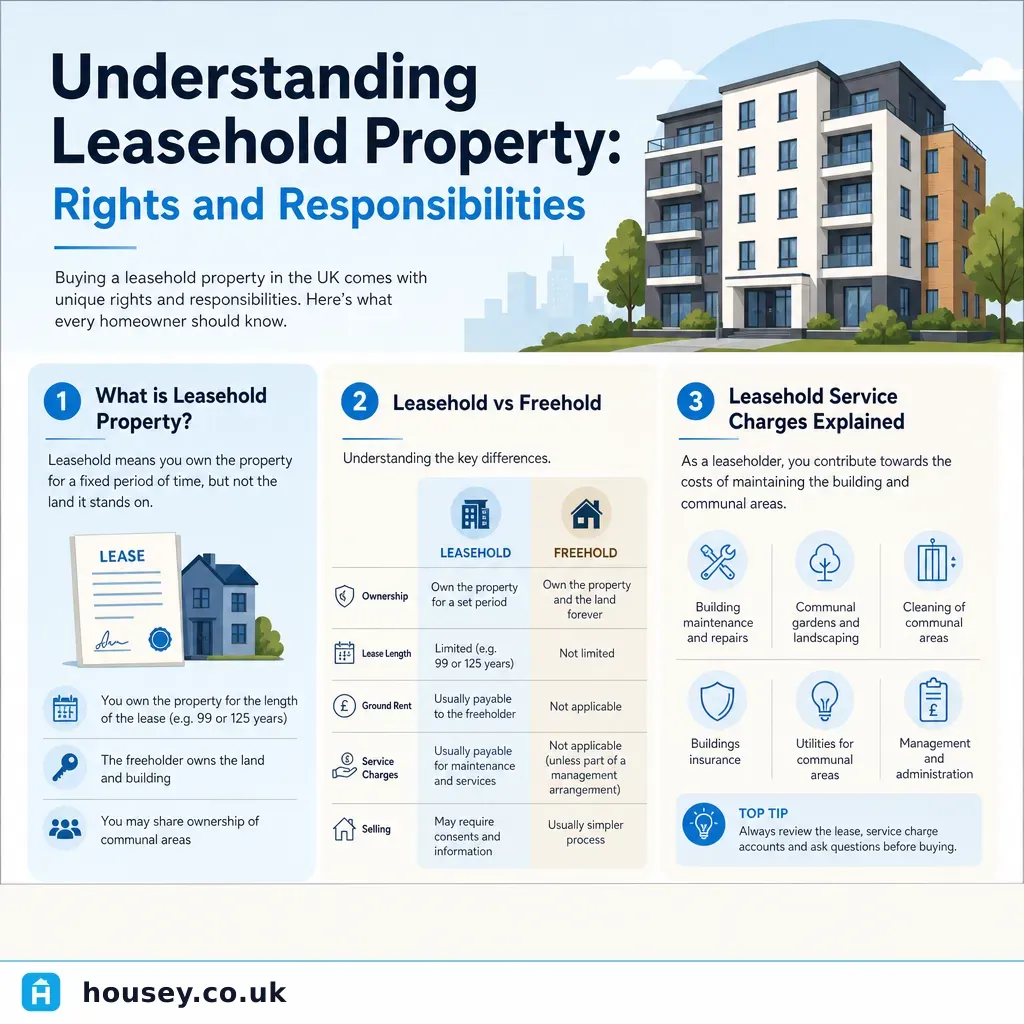
Understanding Leasehold Property: Rights and Responsibilities
Leasehold means you own a time-limited interest in a property while the freeholder owns the land and building.
 Buying & Moving
Navigating Simultaneous Purchase and Sale of Property
When buying and selling simultaneously in England and Wales, both sets of contracts are exchanged on the same day — this is called simultaneous exchange.
 Buying & Moving
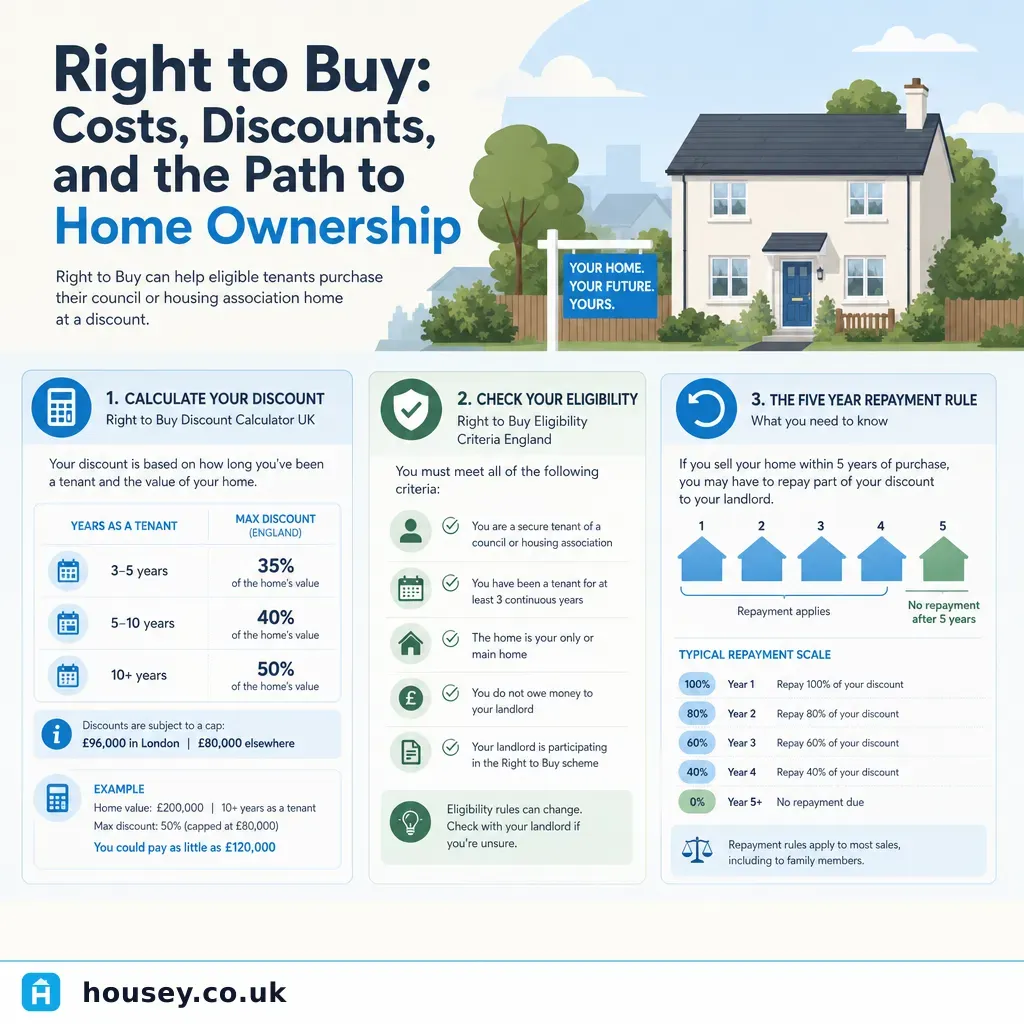
Right to Buy: Costs, Discounts, and the Path to Home Ownership
Right to Buy lets eligible council tenants in England buy their home at a government-funded discount — between 35% and 70% of its value, depending on tenancy length and property type.
 Buying & Moving
Essential Steps to Selling Your Home Successfully
Selling your home successfully in the UK involves obtaining a valid EPC, choosing an estate agent or alternative method, instructing a solicitor or conveyancer early, and completing the Seller's Property Information Form accurately.
 Buying & Moving
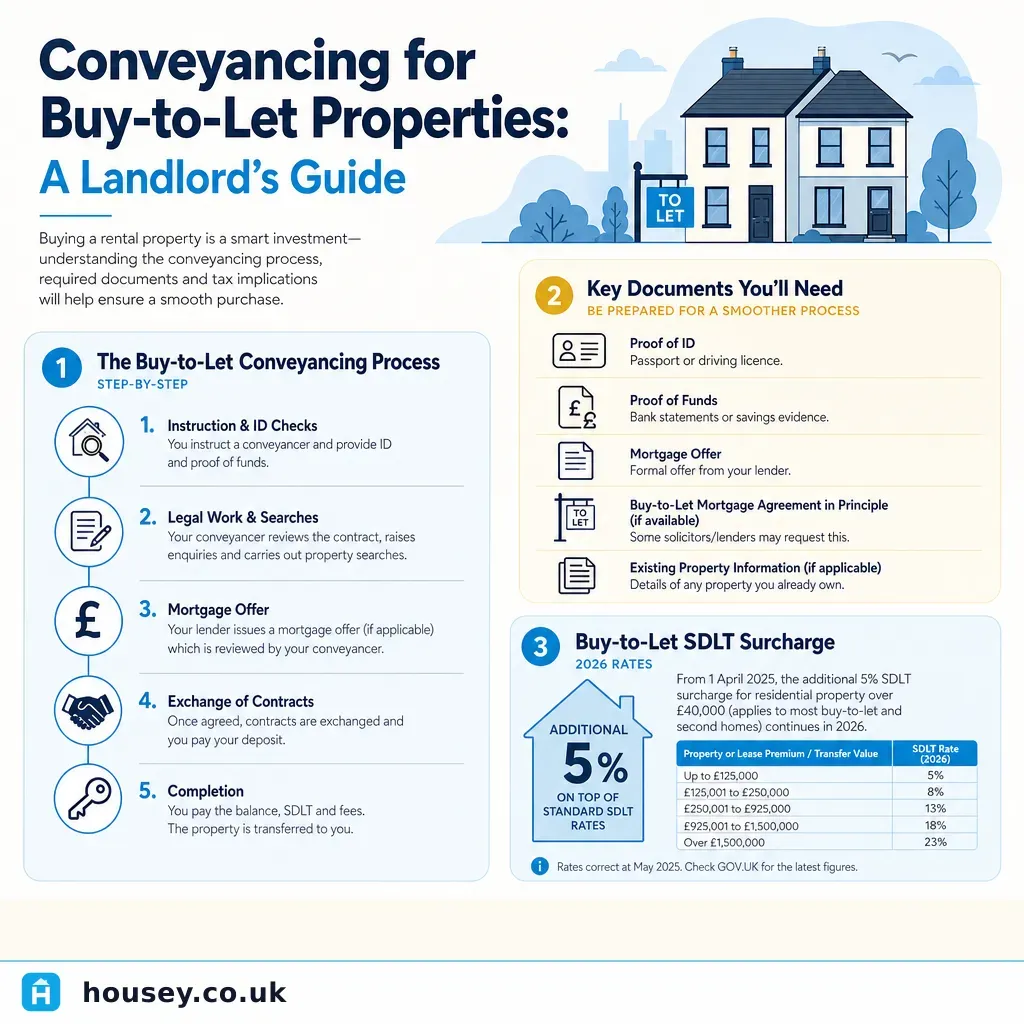
Conveyancing for Buy-to-Let Properties: A Landlord's Guide
Buy-to-let conveyancing follows the same legal process as any residential purchase but adds several layers: a 5% SDLT additional dwelling surcharge in England, review of any existing tenancy agreements, checking local authority licensing requirements, and ensuring buy-to-let mortgage conditions are correctly recorded.