First-Time House Purchase: Your Readiness Checklist
By Housey · Last reviewed 7th of May 2026
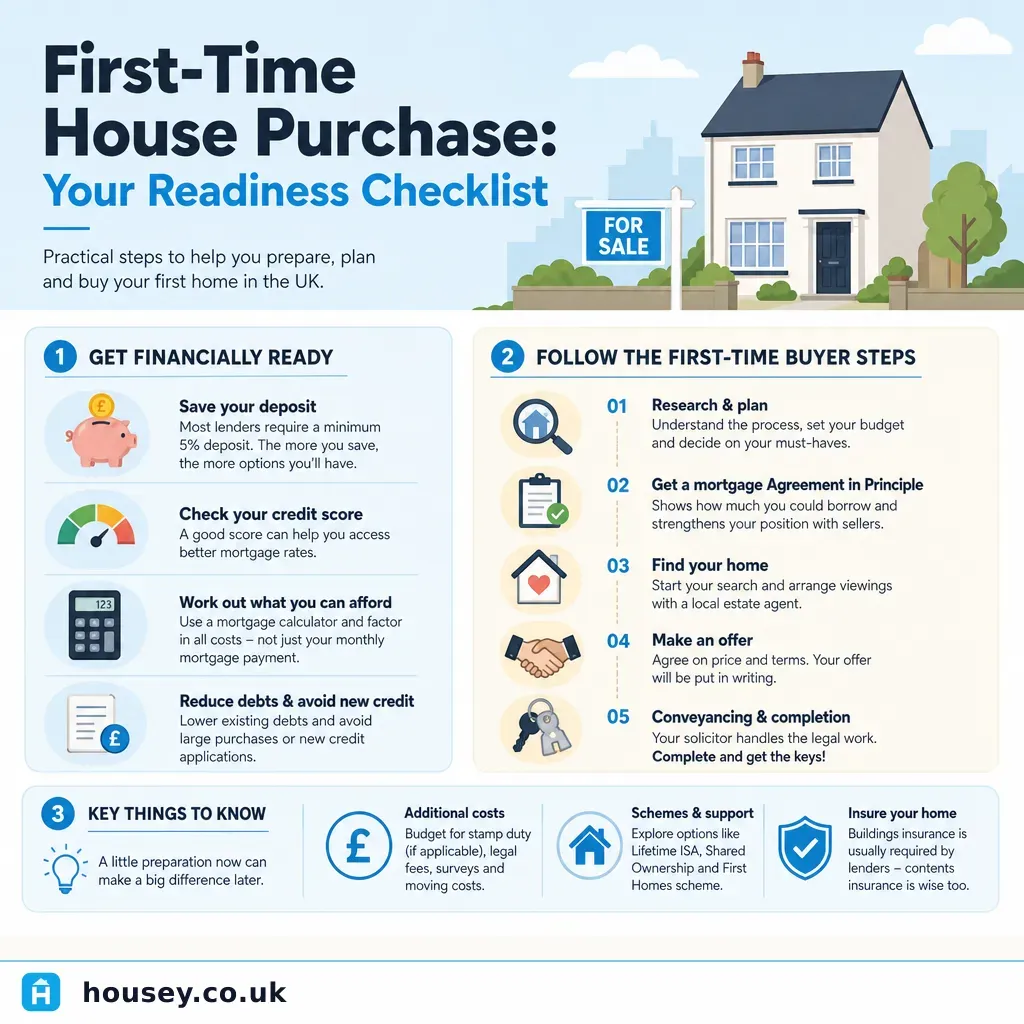
First-Time House Purchase: Your Readiness Checklist
The UK home-buying process has several distinct stages — each with its own professionals, documents, and costs — and decisions made at the start significantly affect how smoothly the later stages run. For most first-time buyers, the biggest risks are underestimating total buying costs, instructing professionals too late, and not knowing which survey their property actually warrants.
Key points
- First-time buyers in England pay no stamp duty land tax (SDLT) on properties up to £300,000 from 1 April 2025; the rate is 5% on the portion between £300,001 and £500,000, with no first-time buyer relief above £500,000.
- A Lifetime ISA (LISA) pays a 25% government bonus on contributions up to £4,000 per year toward a first home purchase — but the property must cost no more than £450,000 and the LISA must have been open for at least 12 months before use.
- Mortgage agreement in principle (AIP) is not a lending guarantee but signals serious buying intent to estate agents and vendors; most lenders issue AIPs valid for 60–90 days.
- RICS Level 2 Home Survey is broadly suited to post-1960 homes in reasonable condition; a RICS Level 3 Building Survey is more appropriate for older, larger, altered, or visibly defective properties.
- Conveyancing for a freehold purchase typically takes 8–16 weeks; leasehold purchases often take longer due to management company enquiries and lease review.
Are you financially ready? Deposit and total buying costs
Most lenders require a minimum 5% deposit for residential mortgages, with 10% often unlocking materially better rates. But the deposit is only part of your upfront requirement.
Total buying costs to budget for (freehold purchase, England):
Cost item | Typical range | Notes |
|---|---|---|
Deposit | 5–20% of purchase price | Higher deposit generally means better mortgage rates |
Stamp duty (SDLT) | £0–several thousand | Nil to £300,000 for first-time buyers from April 2025 |
Conveyancing solicitor | £1,200–£2,500 | Leasehold adds approximately £200–£500 |
RICS Level 2 Home Survey | £400–£800 | Suitable for most post-1960 conventional homes |
RICS Level 3 Building Survey | £600–£1,500 | Older, larger, or more complex properties |
Mortgage arrangement fee | £0–£2,000 | Can sometimes be added to the loan |
Mortgage valuation | £0–£500 | Often free with some lender products |
Land Registry fee | £20–£910 | Scales with purchase price |
Searches (local, drainage, environmental) | £250–£500 | Usually part of conveyancing disbursements |
Removal costs | £400–£2,000 | Depends on volume and distance |
Buildings insurance (first year) | £100–£400 | Required from exchange of contracts |
Indicative UK costs, last reviewed 2026-05-07. Figures vary by lender, solicitor, property, and location.
Which survey do you need as a first-time buyer?
Skipping an independent survey to reduce costs is usually a false economy. The mortgage lender's valuation is carried out for the lender's purposes and does not assess the property's condition in any detail.
Property type | Likely survey choice | Why |
|---|---|---|
New-build with NHBC or similar warranty (within 2 years) | Professional snagging inspection | New Build Warranty covers major structural defects; snagging covers incomplete or substandard finishing |
Post-2000 estate house, no visible defects | RICS Level 2 Home Survey | Conventional construction, moderate risk; produces clear condition ratings |
1930s–1990s semi-detached or terrace, no major flags | RICS Level 2 Home Survey | Usually adequate for standard construction of this era |
Victorian or Edwardian terrace, signs of damp or past extension | RICS Level 3 Building Survey | Older construction, possible hidden defects, greater detail needed |
Pre-1900 property, unusual construction, visible cracking or settlement | RICS Level 3 Building Survey | Essential; may also flag need for specialist structural or damp reports |
Any property with active cracks, suspected subsidence, or underpinning history | Structural engineer report | A survey identifies concern; an engineer diagnoses cause and required remediation |
Which survey decision tree
- Choose a RICS Level 2 survey if the property was built after 1960, uses conventional construction, and shows no visible signs of significant defects.
- Choose a RICS Level 3 survey if the property is pre-1960, has had significant alterations, shows signs of damp, cracking, or any unusual construction.
- Ask a structural engineer if there are active or widening cracks, suspected subsidence, sticking doors or windows, or a history of underpinning — a general survey can identify the concern but may not diagnose the cause.
- Never rely solely on the mortgage lender's valuation as a substitute for an independent condition report — it is not designed for that purpose.
The conveyancing process: what to expect
Conveyancing is the legal process of transferring property ownership. In England and Wales, you instruct a solicitor or licensed conveyancer. Scotland operates under different rules, with solicitors handling offers and title from the outset.
Key stages for a freehold purchase in England:
- Instruct your solicitor — ideally before or immediately after your offer is accepted; ask for a full quote including all disbursements.
- Memorandum of sale — the estate agent confirms the agreed price in writing to all parties.
- Draft contract and protocol forms — the seller's solicitor sends title documents, TA6 (property information form), and TA10 (fittings and contents form).
- Searches ordered — local authority, drainage, environmental, and sometimes chancel repair liability searches.
- Mortgage offer received — usually requires a satisfactory valuation; check the conditions carefully.
- Enquiries raised and resolved — your solicitor queries anything unclear in the documentation.
- Exchange of contracts — legally binding commitment; deposit paid; completion date agreed.
- Completion — remaining funds transferred; keys released.
For leasehold flats, add: lease review, ground rent and service charge enquiries, and a managing agent information pack (typically £200–£400, usually paid by the buyer).
Before offering on a leasehold property, check the lease length — below 80 years can affect mortgageability — and ask the agent for current annual service charge and ground rent figures.
First-time buyer checklist
Before you start viewing
Once you have an offer accepted
Before exchange
Before completion
What not to assume as a first-time buyer
"The mortgage valuation is a survey." It is not. A valuation confirms the lender's security in the property; it does not report on condition, flag defects, or advise you on maintenance. You need a separate, independent survey.
"New-build means no problems." New-build homes regularly have snagging issues — incomplete finishes, minor defects, and items not matching the specification. A professional snagging inspection before legal completion is worth commissioning.
"Exchange and completion happen simultaneously." Sometimes, but it is not the norm. Exchange fixes the price and completion date; completion is when you collect the keys — often one to four weeks later.
"I can pull out after exchange without cost." Withdrawing after exchange of contracts means forfeiting your deposit, which is typically 10% of the purchase price. Before exchange, you can withdraw without legal penalty, though you may lose survey and solicitor fees already incurred.
"Leasehold is the same as freehold." Leaseholders pay ground rent and service charges, and can face major works bills with little notice. Always check the lease length, annual charges, and any upcoming major works before making an offer.
When to get professional help
A first-time purchase requires several professionals working in parallel. The key appointments are:
- Whole-of-market mortgage broker: compares mortgage products across lenders and advises on affordability, protection, and total cost.
- Conveyancing solicitor or licensed conveyancer: handles all legal aspects of the title transfer, searches, and Land Registry registration.
- RICS-accredited surveyor: provides an independent condition report on the property.
- Structural engineer: if the survey flags movement, underpinning history, or structural concerns requiring specialist diagnosis.
Do not delay instructing your solicitor or surveyor after offer acceptance. Both can slow the purchase significantly if brought in late.
How Housey can help
Housey can help you arrange the key services you need as a first-time buyer. Compare quotes from RICS-accredited professionals for a RICS Level 2 survey on a modern home, or a more detailed RICS Level 3 survey for older or more complex properties. You can also request quotes from a conveyancing solicitor to handle the legal side of your purchase.
Frequently asked questions
How much deposit do I really need as a first-time buyer in the UK?
The minimum for most residential mortgages is 5% of the purchase price, but you also need to budget for stamp duty, solicitor fees, survey costs, searches, and removal costs on top. A practical rule of thumb is to have the deposit plus at least 2–3% of the purchase price available to cover all other buying costs before you start viewing seriously.
Do I need a solicitor or conveyancer to buy my first home?
Yes. You cannot complete a UK property purchase without a qualified conveyancing solicitor or licensed conveyancer to handle title transfer, searches, and registration at HM Land Registry. While you can legally act as your own conveyancer, most mortgage lenders will not permit it when a loan is involved, making professional instruction effectively mandatory.
How long does buying your first home take in England?
From offer accepted to completion, the average in England is around 12–16 weeks, though this varies considerably. Chains, leasehold complications, mortgage delays, and slow search returns can push the timeline to six months or more. Instructing your solicitor and surveyor promptly after offer acceptance is the most effective way to keep things on track.
Can I negotiate on price after the survey?
Yes. If the survey identifies significant defects or estimated remedial costs, you can renegotiate the agreed price, ask the seller to carry out repairs before completion, or — as a last resort — withdraw your offer. It is generally easier and more effective to negotiate a price reduction than to request specific works from a vendor.
What is the difference between exchange and completion?
Exchange of contracts is the legally binding commitment: both parties sign, you pay the deposit (usually 10% of the purchase price), and a completion date is fixed. Completion is when the remaining funds are transferred and you collect the keys. Withdrawing before exchange carries no legal penalty; withdrawing after exchange means forfeiting your deposit.
Sources and further reading
- Stamp Duty Land Tax: first-time buyers — GOV.UK: current SDLT thresholds and first-time buyer relief
- Lifetime ISA — GOV.UK: eligibility, contribution limits, and property price cap
- RICS Home Survey Standard — RICS: definitions of Level 2 and Level 3 surveys
- Registering land or property with HM Land Registry — GOV.UK / HM Land Registry: registration fees and process
- Buying a leasehold home — Citizens Advice: leasehold checks and risks for buyers
Useful next reads
 Buying & Moving
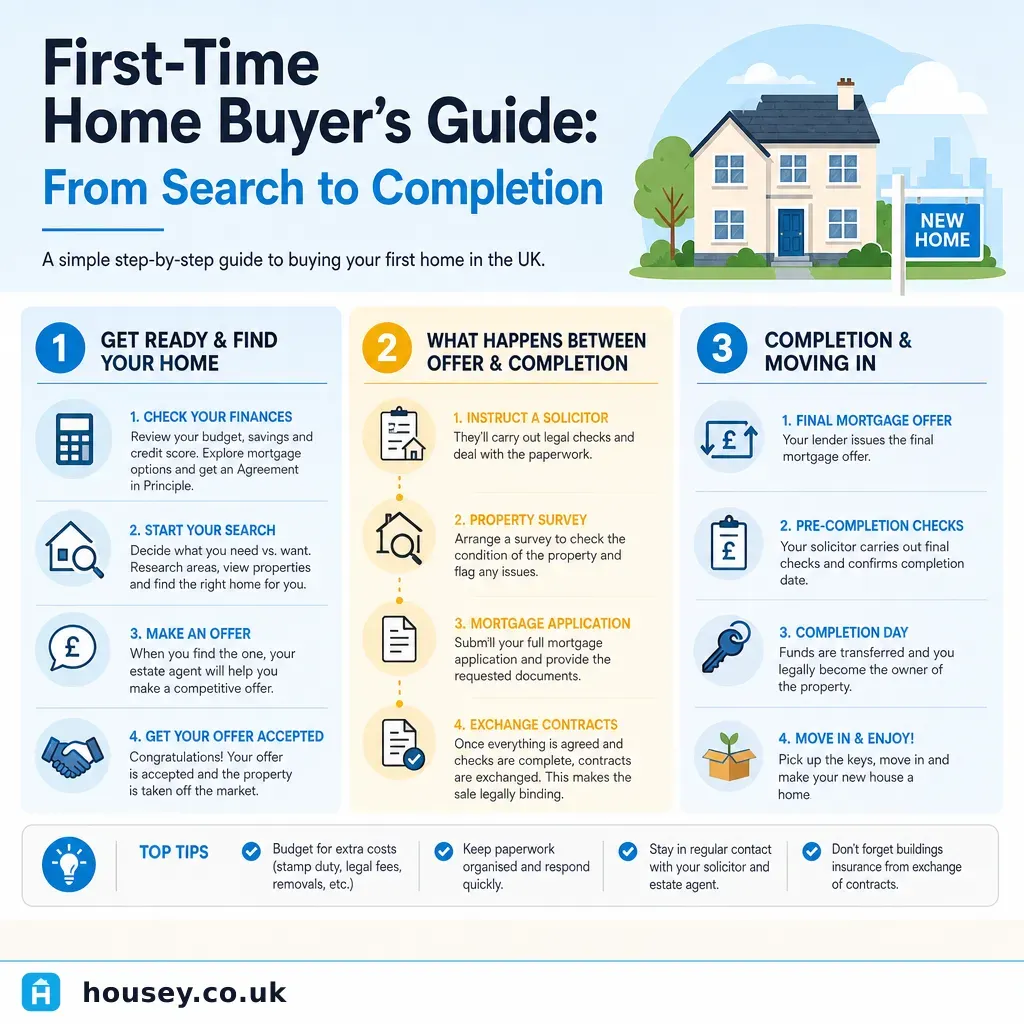
First-Time Home Buyer's Guide: From Search to Completion
Buying your first home in the UK typically takes 3–6 months from offer acceptance to completion.
 Buying & Moving
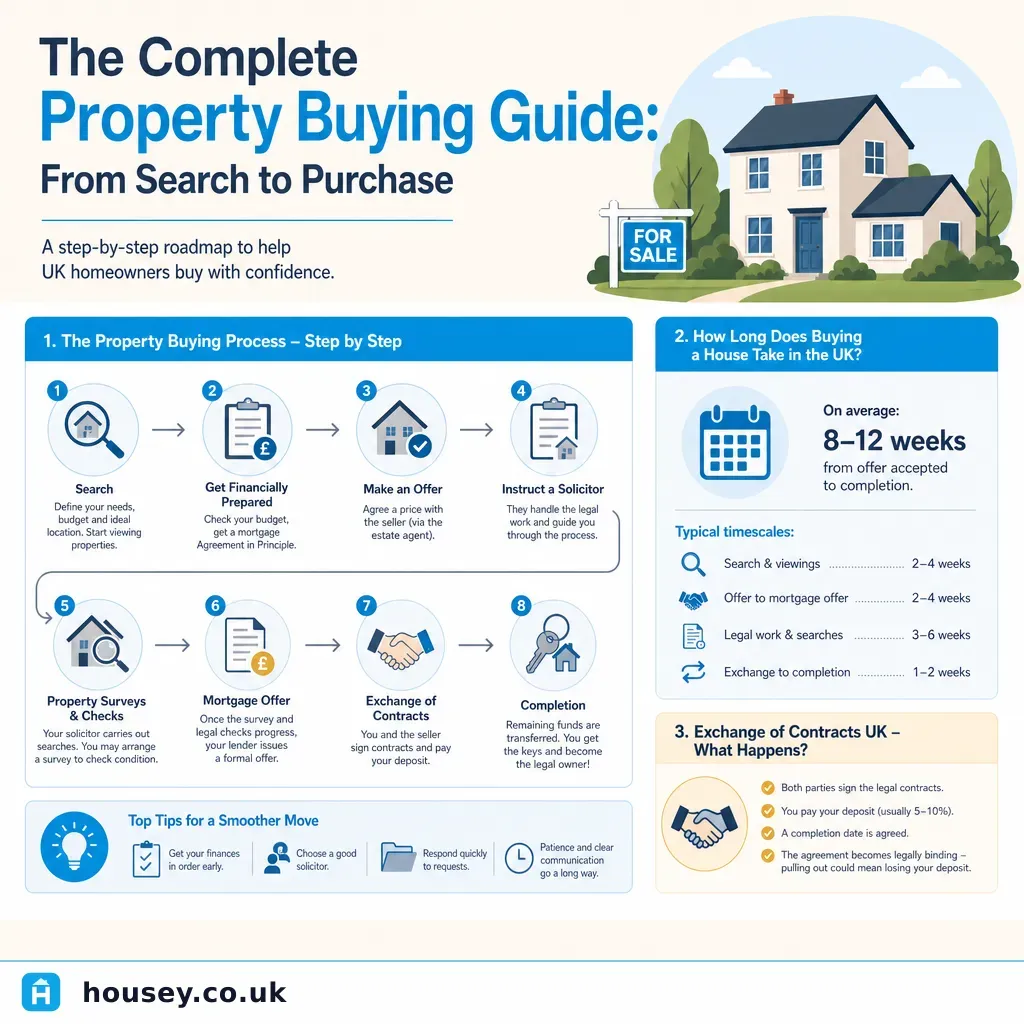
The Complete Property Buying Guide: From Search to Purchase
Buying a property in England and Wales typically takes 3–6 months from accepted offer to completion.
 Buying & Moving
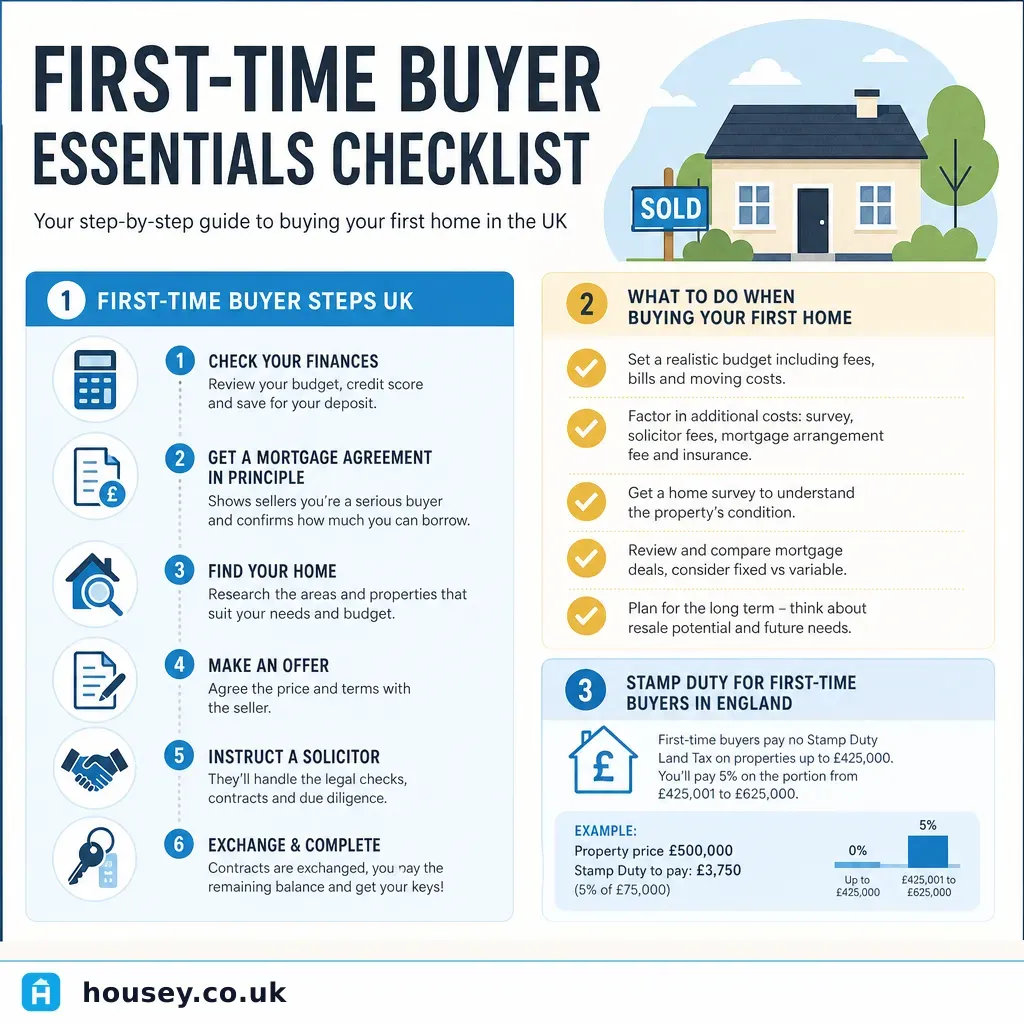
First-Time Buyer Essentials Checklist
Buying your first home involves obtaining a mortgage in principle, making an offer, instructing a solicitor, arranging a survey, and exchanging contracts before completion.
 Buying & Moving
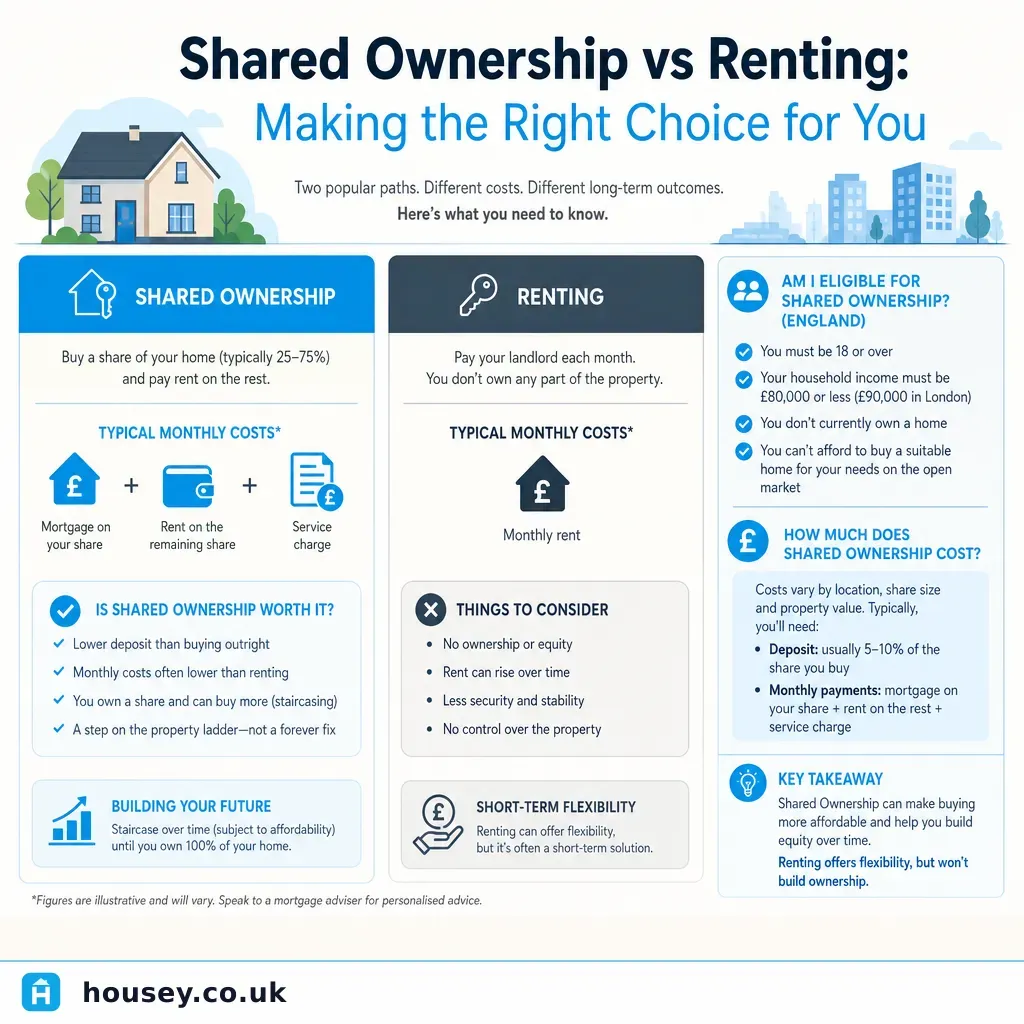
Shared Ownership vs Renting: Making the Right Choice for You
Shared ownership lets you buy a share of a property — typically 10% to 75% — and pay subsidised rent on the rest, building equity over time.
 Buying & Moving
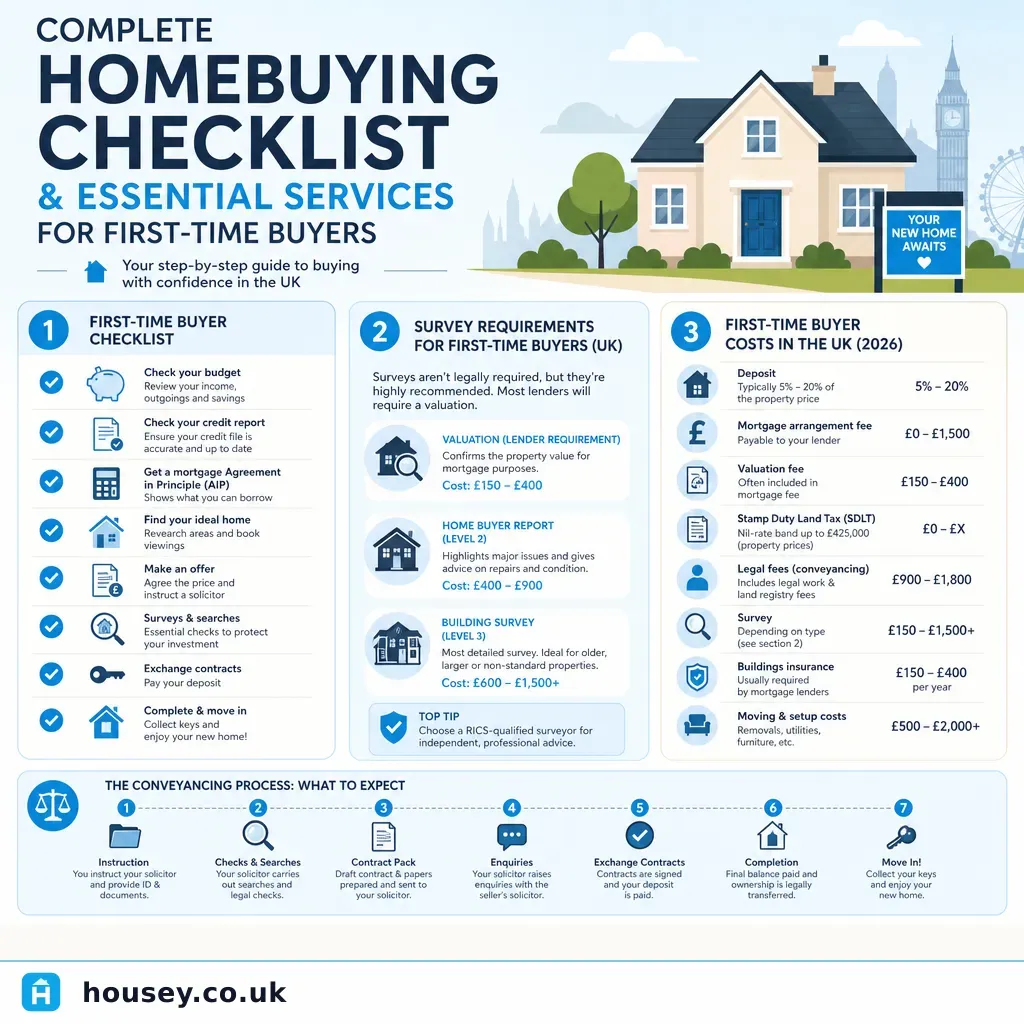
Complete Homebuying Checklist and Essential Services for First-Time Buyers
First-time buyers in the UK should commission an independent RICS Home Survey before exchange — a mortgage lender's valuation does not protect you.