Property Terminology and Listing Definitions: Buyer's Reference Guide
By Housey · Last reviewed 7th of May 2026

Property Terminology and Listing Definitions: Buyer's Reference Guide
Estate agent listings, conveyancing letters, and survey reports all use terms that can feel like a foreign language — whether you are buying your first home or returning to the market after years away. Misreading a listing phrase or misunderstanding a tenure arrangement can lead to wasted offers, unexpected ongoing costs, or legal difficulties after exchange. This reference guide explains the terms most commonly encountered during a UK residential property purchase.
Key points
- "Guide price" is an indication set by the agent and vendor, sometimes pitched deliberately below market value to generate competition — it is not a commitment to sell at that figure.
- Leasehold means you own the property but not the land it stands on; ground rent, service charges, and major works contributions may apply alongside a lease that can eventually expire.
- "Sold STC" (sold subject to contract) means an offer has been accepted but no legally binding contract has been exchanged — either party can still withdraw without legal penalty at this stage.
- In England and Wales, a sale only becomes legally binding at exchange of contracts, not on acceptance of an offer, commissioning of a survey, or payment of a booking fee.
- Leases below 80 years become significantly more expensive to extend under the Leasehold Reform, Housing and Urban Development Act 1993; below 70 years some mortgage lenders will refuse to lend.
Listing terms and what they mean
Estate agents use shorthand and phrases with specific industry meanings. Here are the most commonly encountered:
Guide price: The agent's indication of what the vendor hopes to achieve. In standard sales it is often set at or slightly below the expected sale price. In sealed-bid or informal tender sales it may be set deliberately low to encourage interest. It is not a legal commitment to sell at that figure.
Offers in excess of (OIEO): The vendor will only consider offers above the stated figure. Common in high-demand markets or where strong competition is anticipated.
Offers in the region of (OIRO): Similar to OIEO but with slightly more flexibility — offers somewhat below the stated figure may be considered in the right circumstances.
Asking price / list price: The vendor's stated sale price. Buyers may offer below, at, or above this depending on market conditions.
Sold STC (subject to contract): An offer has been accepted but contracts have not yet exchanged. The sale is not legally binding. Either party may withdraw without formal legal penalty, though doing so carries practical and reputational consequences. In Scotland, concluded missives bind both parties earlier in the process, reducing this risk.
Under offer: Similar to sold STC — an offer has been made and accepted. Some agents use "under offer" while due diligence is ongoing and switch to "sold STC" once the buyer is actively proceeding towards exchange.
Chain-free: The vendor or buyer has no linked property transaction. This can mean a faster, simpler process with fewer dependencies.
No onward chain: The vendor has already moved, is relocating to rented accommodation, or the sale is a probate sale. No upward chain dependency exists.
Vacant possession: The property will be empty on completion, with all occupants and belongings removed before the keys are handed over.
Leasehold with share of freehold: The property is leasehold but the leaseholders collectively own the freehold company. This arrangement can give greater control over service charges, building management decisions, and lease extensions.
New build / off-plan: A newly constructed property (new build) or one purchased before construction is complete (off-plan). NHBC Buildmark warranty or an equivalent developer-backed warranty typically applies, and different legal and mortgage rules may apply.
Tenure: leasehold, freehold, and commonhold
Tenure describes who owns what and on what terms. It is one of the most important aspects of any purchase.
Tenure | What you own | Land owned by | Key considerations |
|---|---|---|---|
Freehold | Property and land outright | You | No ground rent; no expiring term; most common for houses |
Leasehold | Property for the remaining lease term | Freeholder (landlord) | Ground rent, service charge, major works bills may apply; lease length is critical |
Commonhold | Your unit in perpetuity | Shared commonhold association | Rare in practice; no expiring lease; equal share in managing common parts |
Leasehold: what to check before making an offer
- Lease length: A lease below 80 years becomes significantly harder and more expensive to extend. Below 70 years, some lenders will refuse to lend. Check the title register at HM Land Registry before making an offer.
- Ground rent: The Leasehold Reform (Ground Rent) Act 2022 banned ground rent on new residential leases but did not apply retrospectively to existing ones. Escalating ground rent clauses — particularly "doubling" clauses — can render a property unmortgageable. Your solicitor should review these before exchange.
- Service charge: Annual charges for maintaining shared parts — roof, structure, communal areas, lifts. Ask for at least three years of service charge accounts and any upcoming budget forecasts.
- Major works (Section 20 notices): Leaseholders may face large one-off bills for building works. Under the Landlord and Tenant Act 1985, Section 20 notices give leaseholders the right to be consulted on qualifying works above £250 per leaseholder.
Conveyancing and legal terms
Exchange of contracts: The point at which both buyer and seller sign and exchange identical contracts, creating a legally binding obligation. A buyer who pulls out after exchange typically forfeits the 10% deposit; a seller who pulls out faces an equivalent financial claim.
Completion: The day the purchase money transfers and legal ownership passes to you. You receive the keys. Completion typically follows exchange by 1–4 weeks, though same-day exchange and completion is possible.
Conveyancer / solicitor: The legal professional managing the transfer of ownership. In England and Wales this may be a solicitor or a licensed conveyancer. In Scotland, a solicitor handles the equivalent process under Scots property law, where the transaction structure works differently.
Title deeds: The legal documents proving ownership. Most registered properties in England and Wales have their title held electronically at HM Land Registry.
Searches: Pre-exchange enquiries made by your conveyancer to local authorities, water companies, and other bodies. Common searches include: local authority (planning history, enforcement notices, road schemes), drainage and water, and environmental (flood, contamination, subsidence risk).
SDLT (Stamp Duty Land Tax): The property transaction tax in England, charged on purchases above the nil-rate threshold with tiered rates above that. Scotland uses Land and Buildings Transaction Tax (LBTT); Wales uses Land Transaction Tax (LTT). Check the latest rates and reliefs on GOV.UK before exchange — thresholds change.
Gazumping: When a vendor accepts a higher offer from another buyer after already accepting yours, before exchange. Legal in England and Wales but widely considered poor practice. Scotland's earlier binding point reduces this risk north of the border.
Gazundering: When a buyer reduces their offer immediately before exchange. Also legal but widely considered poor practice.
Mortgage in principle (MIP) / Agreement in principle (AIP): A conditional indication from a lender of how much they would be prepared to lend, subject to full application and a property valuation. It is not a guaranteed mortgage offer.
Property type and construction terms
Detached: A property with no shared walls with neighbouring buildings.
Semi-detached: Shares one party wall with an adjoining property.
Terraced / mid-terraced: Shares two party walls; an end-of-terrace property shares only one.
Conversion: A property adapted from another original use — flat conversions from Victorian houses are common; barn conversions exist in rural settings.
Purpose-built flat: A flat within a building constructed specifically for residential use, as opposed to a converted house or commercial building.
Listed building: A building of special architectural or historic interest, protected under the Planning (Listed Buildings and Conservation Areas) Act 1990. Works affecting character or fabric require listed building consent, often in addition to any planning permission.
Conservation area: A designated area of architectural or historic interest. Permitted development rights are typically more restricted within conservation areas.
Flying freehold: A section of one freehold property that overhangs or is physically supported by a neighbouring freehold property. Common in older town centre buildings with rooms above shared passages. Can complicate mortgage lending and insurance — check with your solicitor and lender before proceeding.
Permitted development: Works permitted without a formal planning application under the Town and Country Planning (General Permitted Development) (England) Order 2015. Rights vary by property type, location, prior works carried out, and whether the property is in a conservation area or subject to an Article 4 direction.
What not to assume when reading a listing
Common assumption | What is actually true |
|---|---|
"Sold STC" means I cannot buy this property | The sale is not legally binding; the vendor can still accept a higher offer, or the existing sale can fall through before exchange |
A high guide price means no room to negotiate | Guide prices are set by agents; some vendors are more flexible than the stated figure suggests, particularly if a property has been listed for some time |
Freehold is always better than leasehold | Leasehold can be a sound purchase with a long remaining lease (125+ years), reasonable charges, and no problematic ground rent clauses — leasehold with share of freehold is often preferable to an unmanaged freehold |
"Chain-free" means a fast completion | A chain-free vendor does not eliminate delays caused by your own mortgage application, searches, or conveyancing timeline |
A new-build EPC rating guarantees lower bills | EPC ratings are modelled on standardised assumptions; actual running costs depend on occupant behaviour, appliance use, and energy tariffs |
When to get professional help
Property terminology questions can usually be answered by your conveyancer as part of their service. However, seek professional advice when:
- You are unclear about a lease term — especially ground rent escalation clauses, a short remaining lease, or an unexplained service charge history — before making an offer. Ask your solicitor to review the lease prior to exchange.
- A listing mentions shared access, rights of way, restrictive covenants, or chancel repair liability. These require conveyancing advice, not just an agent's verbal reassurance.
- You are buying a listed building or a property in a conservation area. Planning and listed building consent rules will affect what works you can carry out after purchase.
- You encounter a flying freehold. Check with your solicitor and mortgage lender before proceeding, as not all lenders will accept this as security.
- The property has had extensions, conversions, or alterations without building regulations sign-off or planning consent. Your conveyancer should raise requisitions to establish whether regularisation is needed and whether indemnity insurance is appropriate.
How Housey can help
Housey helps UK buyers and homeowners find and compare qualified professionals for every stage of the property journey — from conveyancers and RICS surveyors to planning consultants and energy assessors. Visit Housey.co.uk to explore the full range of services and request quotes from verified professionals in your area.
Frequently asked questions
What is the difference between exchange and completion?
Exchange is when both parties sign and swap identical contracts, making the agreement legally binding — neither side can pull out without financial penalty. Completion is when the purchase money transfers and you receive the keys. Exchange and completion typically occur 1–4 weeks apart, though same-day exchange and completion is possible in some transactions.
Is a leasehold flat a bad buy?
Not necessarily. Leasehold flats are common in England and Wales and many are sound purchases. The key checks are: remaining lease length (ideally 125 years or more), whether ground rent is reasonable and non-escalating, service charge history, and any major works planned. Leasehold with share of freehold is generally considered a more secure form of leasehold ownership.
What does sold STC mean and can I still make an offer?
Sold STC (sold subject to contract) means an offer has been accepted but no legally binding contract has exchanged. You can technically still make an offer at this stage. However, doing so constitutes gazumping and is widely considered poor practice. It can be distressing and costly for the original buyer, and most agents will discourage speculative approaches on sold STC properties.
What searches does my conveyancer carry out?
Standard searches in England and Wales include: a local authority search (planning history, enforcement notices, road schemes), drainage and water search, and an environmental search (flooding, contamination, subsidence risk). Your conveyancer may recommend additional searches — such as a chancel repair liability search or a mining search — depending on the property's location and history.
What is stamp duty and how much will I pay?
Stamp Duty Land Tax (SDLT) in England applies to purchases above the nil-rate threshold, with tiered rates on the portions above. First-time buyer relief applies up to £500,000. Scotland uses Land and Buildings Transaction Tax (LBTT); Wales uses Land Transaction Tax (LTT). Always check the current rates and reliefs on GOV.UK before exchange, as thresholds can change.
Sources and further reading
- HM Land Registry — property ownership and title — GOV.UK
- Leasehold Reform (Ground Rent) Act 2022 — legislation.gov.uk
- Stamp Duty Land Tax rates and thresholds — GOV.UK
- Buying or selling your home — GOV.UK
- Listed buildings — what designation means — Historic England
- Leasehold Advisory Service (LEASE) — LEASE
Useful next reads
 Buying & Moving
Conveyancing Glossary: Key Terms and Definitions for Property Buyers
Conveyancing involves specific legal terms that appear throughout a UK property purchase.
 Buying & Moving
Property Terminology Explained: Your Essential Glossary For UK Property Buyers And Sellers
UK property transactions use a specific vocabulary that can be confusing for first-time buyers.
 Buying & Moving
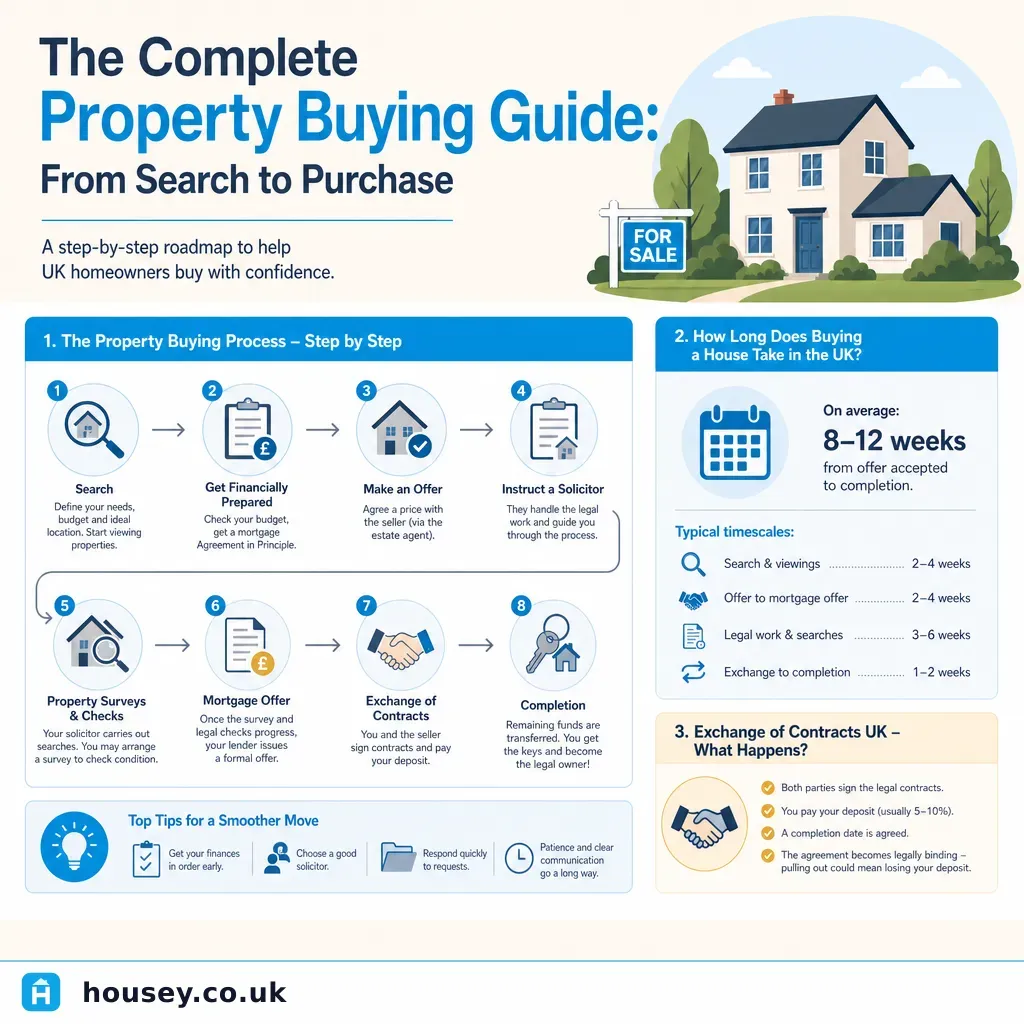
The Complete Property Buying Guide: From Search to Purchase
Buying a property in England and Wales typically takes 3–6 months from accepted offer to completion.
 Buying & Moving
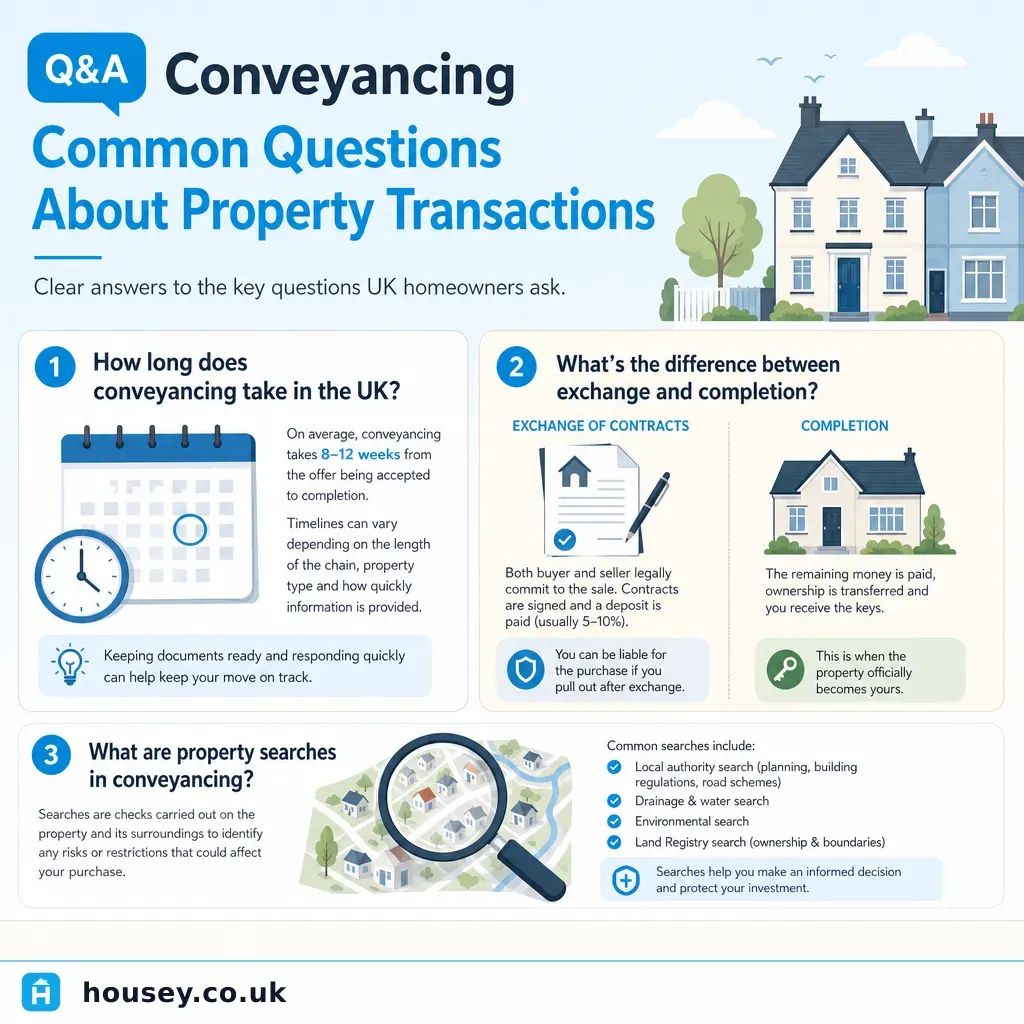
Conveyancing Q&A: Common Questions About Property Transactions
Conveyancing is the legal transfer of property ownership, typically taking 12 to 16 weeks in England and Wales.
 Buying & Moving
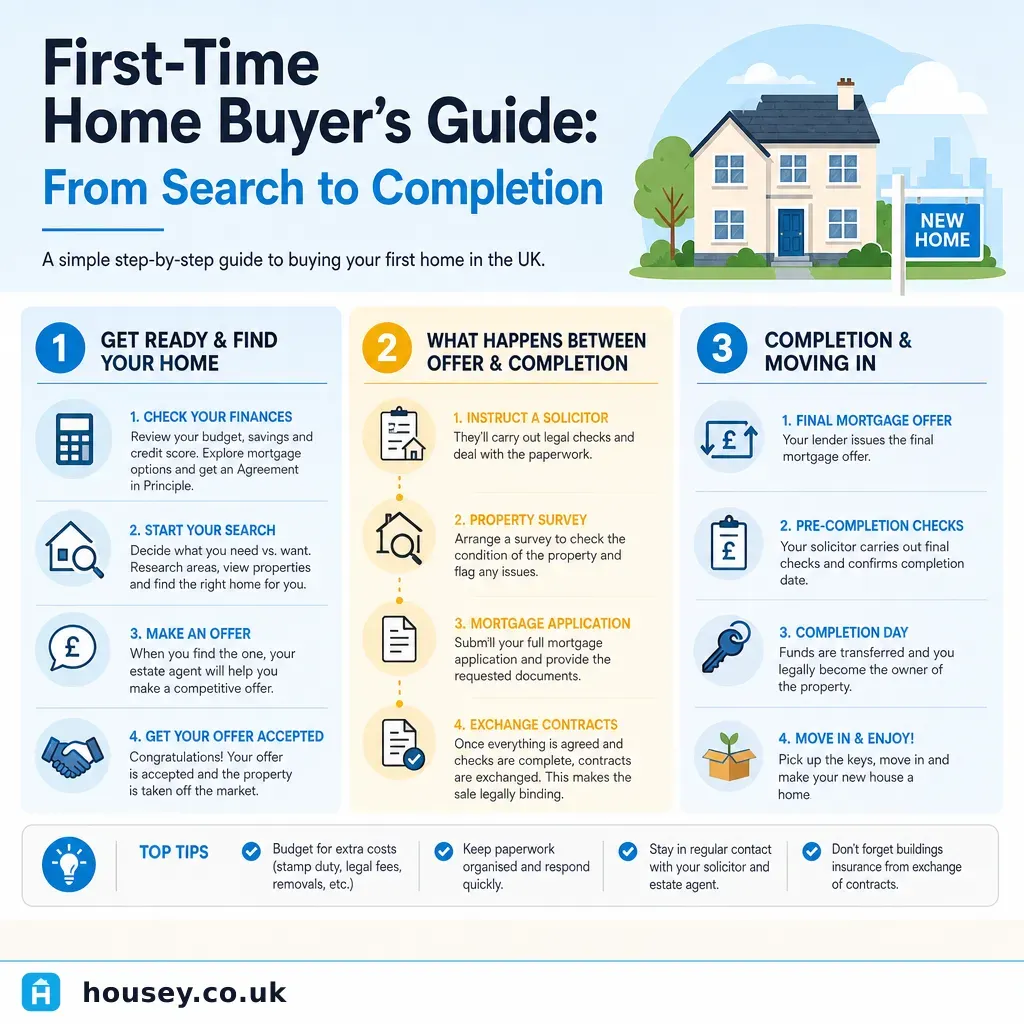
First-Time Home Buyer's Guide: From Search to Completion
Buying your first home in the UK typically takes 3–6 months from offer acceptance to completion.