First-Time Home Buyer's Guide: From Search to Completion
By Housey · Last reviewed 25th of May 2026
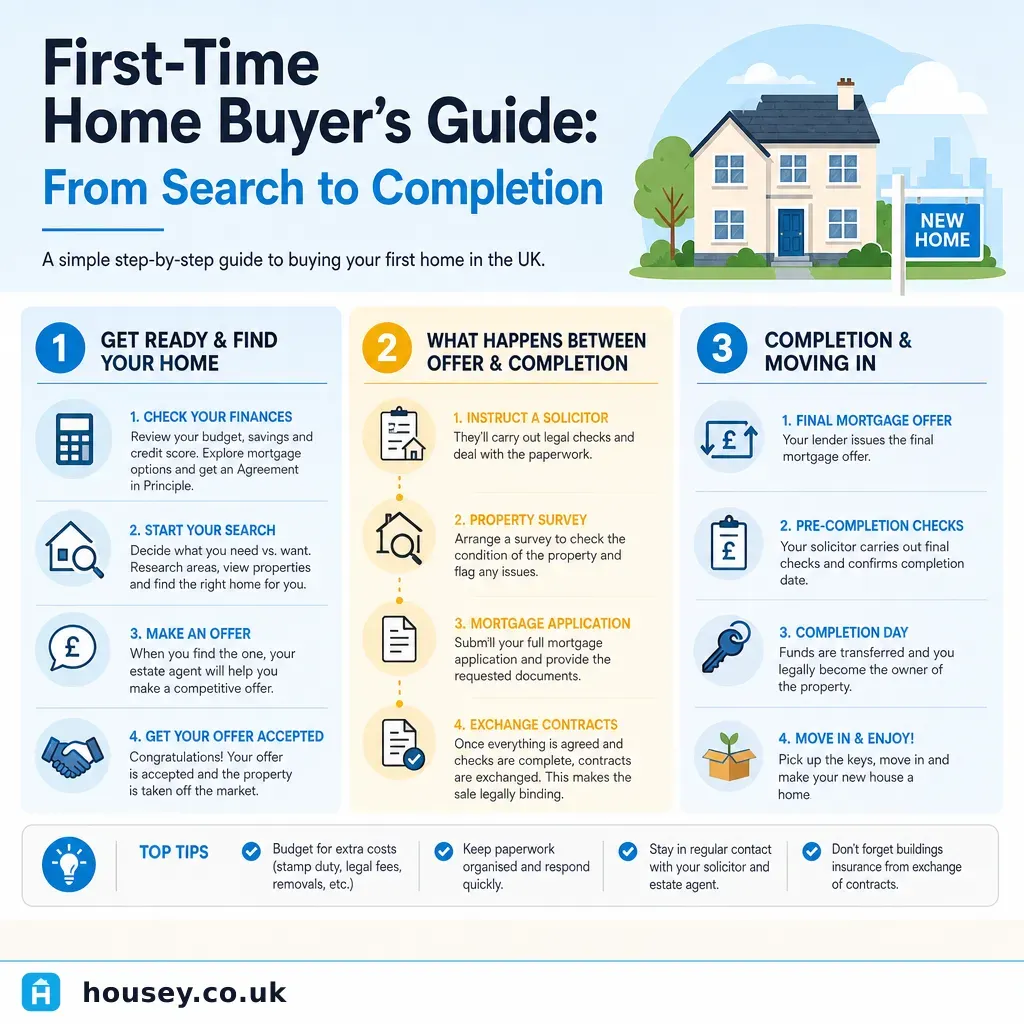
First-Time Home Buyer's Guide: From Search to Completion
Buying your first home is one of the largest financial commitments most people make, and the process involves legal, financial, and practical steps that can catch newcomers off guard. Whether you are registering with estate agents, comparing mortgage products, or navigating conveyancing for the first time, understanding each stage before you reach it reduces the risk of costly mistakes. The journey from your first viewing to receiving the keys typically takes three to six months after an offer is accepted.
Key points
- First-time buyers in England and Northern Ireland currently pay no Stamp Duty Land Tax on the first £425,000 of a property purchase (threshold correct as of 2025–26 — verify current rates on GOV.UK before budgeting, as thresholds change).
- A Lifetime ISA (LISA) allows eligible buyers under 40 to save up to £4,000 per year toward a first home purchase below £450,000 and receive a 25% government bonus.
- Exchange of contracts is the legally binding stage — once exchanged, withdrawing from the purchase will trigger significant financial penalties, typically forfeiture of the deposit.
- Mortgage lenders carry out their own property valuation, but this does not constitute a structural survey; a separate RICS survey should be commissioned independently.
- Conveyancing searches — including local authority, drainage, water, and environmental searches — are a standard requirement in most mortgage-financed purchases in England and Wales.
Saving your deposit and getting mortgage-ready
Most lenders require a minimum deposit of 5–10% of the purchase price, though a larger deposit (20% or more) typically unlocks better mortgage interest rates. Before making an offer, obtain a mortgage in principle — also called a decision in principle or agreement in principle — from a lender or mortgage broker. This is a conditional indication of how much you can borrow and signals to sellers that you are a serious, finance-ready buyer.
Documents typically required for a mortgage application include:
- Last three to six months' payslips, or two to three years' accounts if self-employed
- Last three months' bank statements
- Proof of identity and current address (passport, driving licence, utility bill)
- Details of existing debts or credit commitments
MoneyHelper provides free mortgage affordability guidance as a starting point; independent mortgage advice is recommended for anyone with complex employment or credit circumstances.
Making an offer and what happens next
Once you find a suitable property, you submit an offer through the estate agent — verbally or in writing. In England, Wales, and Northern Ireland, an accepted offer is not legally binding: either party can withdraw before exchange of contracts. Scotland operates differently under its own system of formal missives and qualified acceptance.
When forming your offer, review recent comparable sold prices on HM Land Registry's price paid data tool, and consider how long the property has been on the market and whether a survey is likely to reveal issues that could support a lower offer.
Which survey does a first-time buyer need?
A mortgage lender's valuation only checks that the property is worth the loan amount; it does not assess structural condition or identify defects. Commission an independent survey from a RICS-qualified surveyor.
Survey type | Best for | Scope | Typical output |
|---|---|---|---|
RICS Level 1 (Condition Report) | New-build or near-new conventional homes in good condition | Basic traffic-light condition ratings | Short report — no detailed advice |
RICS Level 2 (Home Survey) | Most conventional post-1900 homes in reasonable condition | Defects, condition, maintenance needs; optional market valuation | Detailed written report with condition ratings |
RICS Level 3 (Building Survey) | Older, unusual, extended, or visibly defective properties | Comprehensive structural and fabric assessment | Full report with repair guidance and indicative cost notes |
For a conventional 1990s estate house in reasonable condition, a RICS Level 2 survey is usually sufficient. For a pre-war property, a Victorian terrace, or a home showing signs of damp, cracking, or past alterations, a RICS Level 3 survey gives more complete structural information before you commit at exchange.
The conveyancing process step by step
Engaging a conveyancing solicitor — a solicitor regulated by the Solicitors Regulation Authority (SRA) or a licensed conveyancer regulated by the Council for Licensed Conveyancers (CLC) — is essential for the legal transfer of ownership. After your offer is accepted:
- Instruct a solicitor or licensed conveyancer — get at least two or three quotes before choosing.
- Receive the draft contract pack — this includes the title deeds, property information form (TA6), and fittings and contents form (TA10).
- Conveyancing searches are commissioned — local authority, drainage and water, environmental, and where applicable, mining searches.
- Enquiries are raised — your solicitor queries anything unclear in the documents or title.
- Mortgage offer received — once the lender's valuation is completed and underwriting approved.
- Exchange of contracts — you pay your deposit (usually 10% of the purchase price) and a completion date is fixed. You are now legally committed; withdrawing would forfeit your deposit.
- Completion — the remaining balance is transferred to the seller's solicitor and you receive the keys.
Which professional do I need?
Task | Professional to instruct | Regulated by |
|---|---|---|
Legal transfer of ownership | Solicitor or licensed conveyancer | SRA or CLC |
Property condition assessment | RICS-qualified surveyor | RICS |
Structural defect diagnosis | Structural engineer or chartered surveyor | IStructE or RICS |
Mortgage advice and application | FCA-authorised mortgage adviser or broker | FCA |
Formal property valuation | RICS-registered valuer | RICS |
First-time buyer checklist
Budgeting for all purchase costs
Beyond the deposit, budget for:
- Stamp Duty Land Tax (England) — first-time buyers pay 0% on the first £425,000 on properties up to £500,000 (check current SDLT rates on GOV.UK)
- Solicitor or conveyancer fees — typically £1,000–£2,500 depending on complexity (Indicative UK costs, last reviewed 2026-05-25)
- RICS survey fee — typically £300–£1,500 depending on survey level and property size (Indicative UK costs, last reviewed 2026-05-25)
- Mortgage arrangement and valuation fees — varies widely by lender; some charge nothing, others up to £2,000
- Removal costs — typically £300–£1,500 for a one- to three-bedroom property (Indicative UK costs, last reviewed 2026-05-25)
- Buildings and contents insurance — required from exchange of contracts
Important limitations
This article provides general information about the first-time buyer process in England and Wales. The legal system and property taxes differ in Scotland and Northern Ireland. Rules, costs, and timescales vary by property type, location, lender, and individual circumstances. Nothing in this article constitutes legal, financial, or professional advice. A qualified solicitor, licensed conveyancer, or FCA-authorised mortgage adviser should be consulted for advice specific to your situation.
What to ask a qualified professional
Ask your solicitor or conveyancer:
- What do the conveyancing searches reveal, and are there any issues I should know before exchange?
- Are there any problems with the title or property information forms that need resolving?
- What are the likely timescales, and what could cause delays?
Ask your RICS surveyor:
- Are there any defects that should be investigated further or costed before exchange?
- Do you recommend any specialist reports — damp, drainage, structural?
- Is the property's construction and condition consistent with what has been described to me?
Ask your mortgage adviser:
- Am I getting the most competitive rate available for my deposit size and credit history?
- What happens to my payments when the initial fixed rate expires?
When to get professional help
Seek specialist help immediately if:
- Your survey identifies significant structural movement, persistent damp, or serious roof defects
- Conveyancing searches flag planning restrictions, environmental contamination, or title disputes
- You receive a down valuation — the lender values the property below the agreed sale price
- The seller requests an unrealistically short window between exchange and completion
- You are purchasing a leasehold flat with fewer than 80 years remaining on the lease
How Housey can help
Housey connects first-time buyers with regulated professionals at every stage of the purchase. Whether you need a RICS Level 2 survey for a standard resale home, a RICS Level 3 survey for an older or unusual property, or a conveyancing solicitor to manage your legal transfer, you can request and compare quotes from verified local providers in one place.
Frequently asked questions
How long does it take to buy a house as a first-time buyer?
From offer acceptance to completion, the process typically takes 12 to 16 weeks in England and Wales, though this varies considerably. Delays often arise from slow conveyancing searches, mortgage underwriting backlogs, long property chains, or issues flagged during surveys. Instructing your solicitor and surveyor promptly after offer acceptance gives you the best chance of staying on track.
Do first-time buyers pay stamp duty in England?
In England, first-time buyers currently pay no Stamp Duty Land Tax on the first £425,000 of a property purchase on properties up to £500,000 in value. On properties between £425,001 and £500,000, a 5% rate applies to the portion above £425,000. Properties above £500,000 do not qualify for first-time buyer relief. These thresholds have changed in recent years — always check current rates on GOV.UK before budgeting.
What survey should a first-time buyer get?
Most first-time buyers purchasing a conventional post-war house or flat in reasonable condition will find a RICS Level 2 Home Survey sufficient. For properties built before 1919, Victorian terraces, or homes with visible damp, cracking, or past alterations, a RICS Level 3 Building Survey gives more detailed structural information. Your surveyor can advise based on the specific property.
What is a mortgage in principle?
A mortgage in principle — also called a decision in principle or agreement in principle — is a conditional statement from a lender indicating approximately how much they would lend, based on a preliminary review of your income and credit. It is not a guarantee, but it demonstrates to sellers and agents that you are a credible buyer with finance in place. Most lenders issue these quickly online or through a broker.
Sources and further reading
- Stamp Duty Land Tax: residential property rates — GOV.UK
- Lifetime ISA — GOV.UK
- Buying a home: step by step — GOV.UK
- RICS Home Surveys: find a surveyor — RICS
- MoneyHelper: buying a home — MoneyHelper (Money and Pensions Service)
- HM Land Registry price paid data — HM Land Registry
Useful next reads
 Buying & Moving
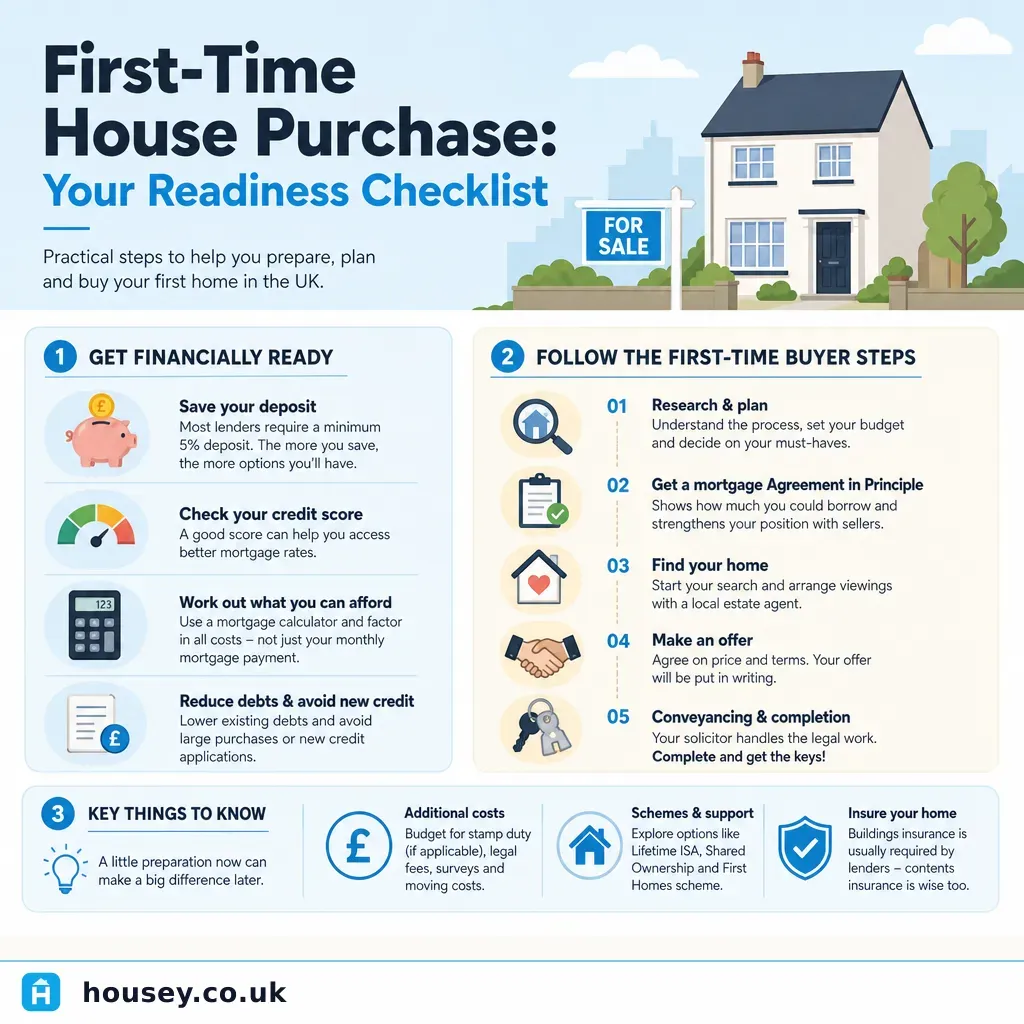
First-Time House Purchase: Your Readiness Checklist
Before making your first offer, have a mortgage agreement in principle, a deposit plus buying costs saved (allow 2–3% of the purchase price beyond the deposit itself), and a conveyancer ready to instruct.
 Buying & Moving
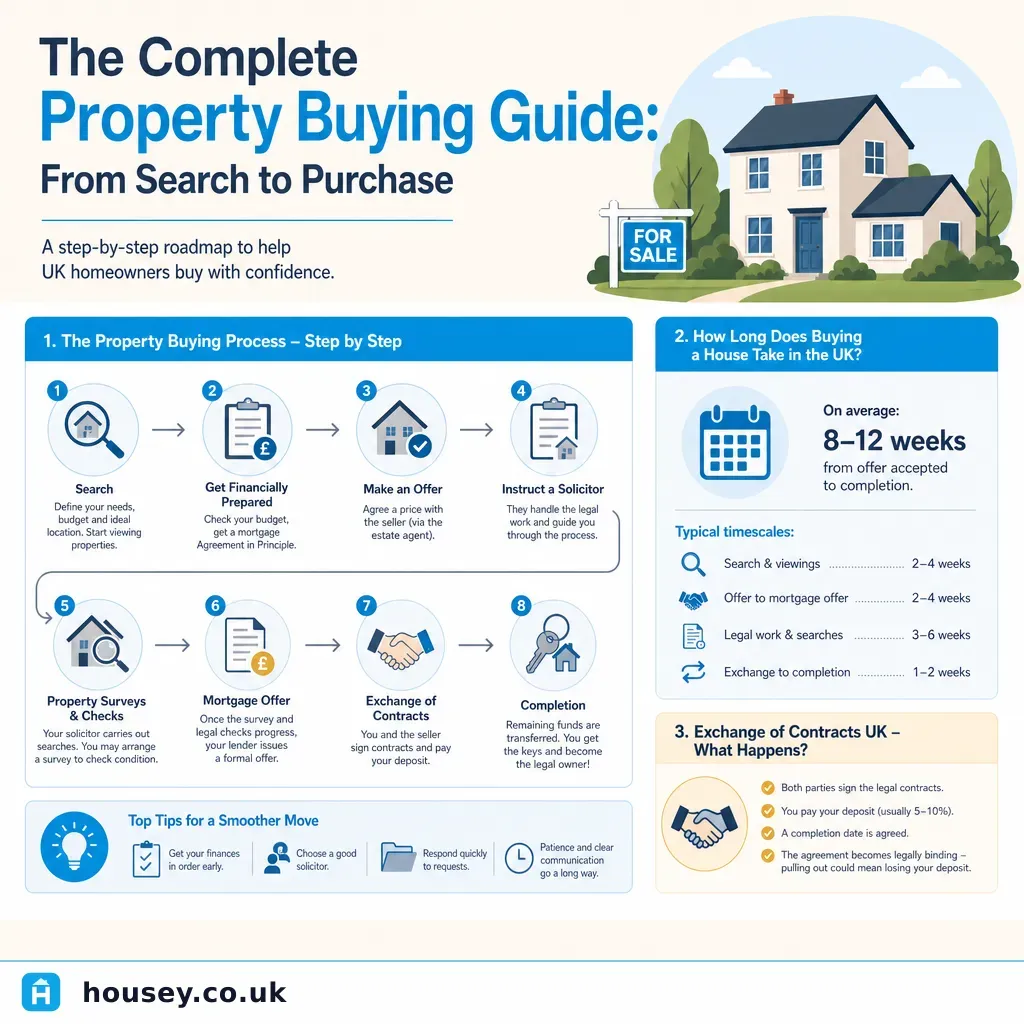
The Complete Property Buying Guide: From Search to Purchase
Buying a property in England and Wales typically takes 3–6 months from accepted offer to completion.
 Buying & Moving
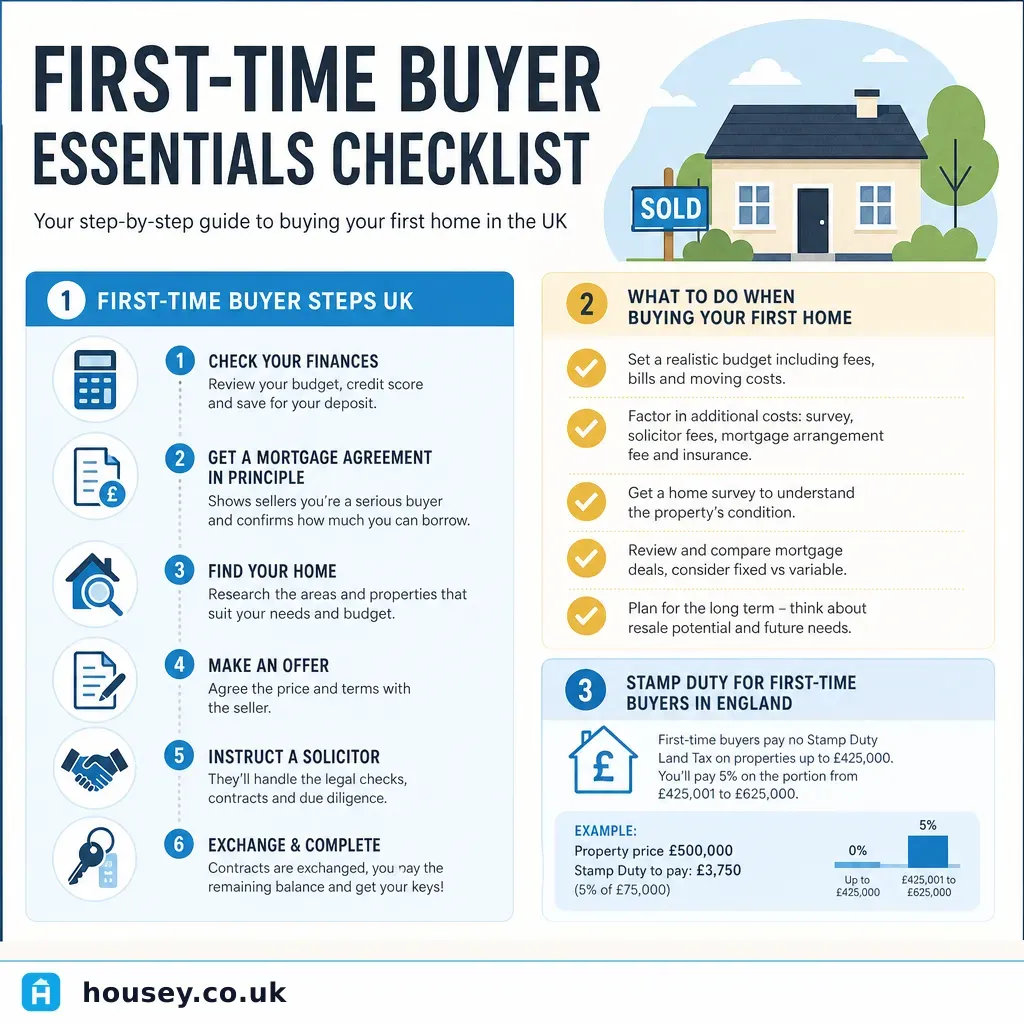
First-Time Buyer Essentials Checklist
Buying your first home involves obtaining a mortgage in principle, making an offer, instructing a solicitor, arranging a survey, and exchanging contracts before completion.
 Buying & Moving
Property Terminology and Listing Definitions: Buyer's Reference Guide
UK property listings and conveyancing documents use specific terms that affect buying decisions.
 Buying & Moving
Conveyancing Glossary: Key Terms and Definitions for Property Buyers
Conveyancing involves specific legal terms that appear throughout a UK property purchase.