Conveyancing Q&A: Common Questions About Property Transactions
By Housey · Last reviewed 25th of May 2026
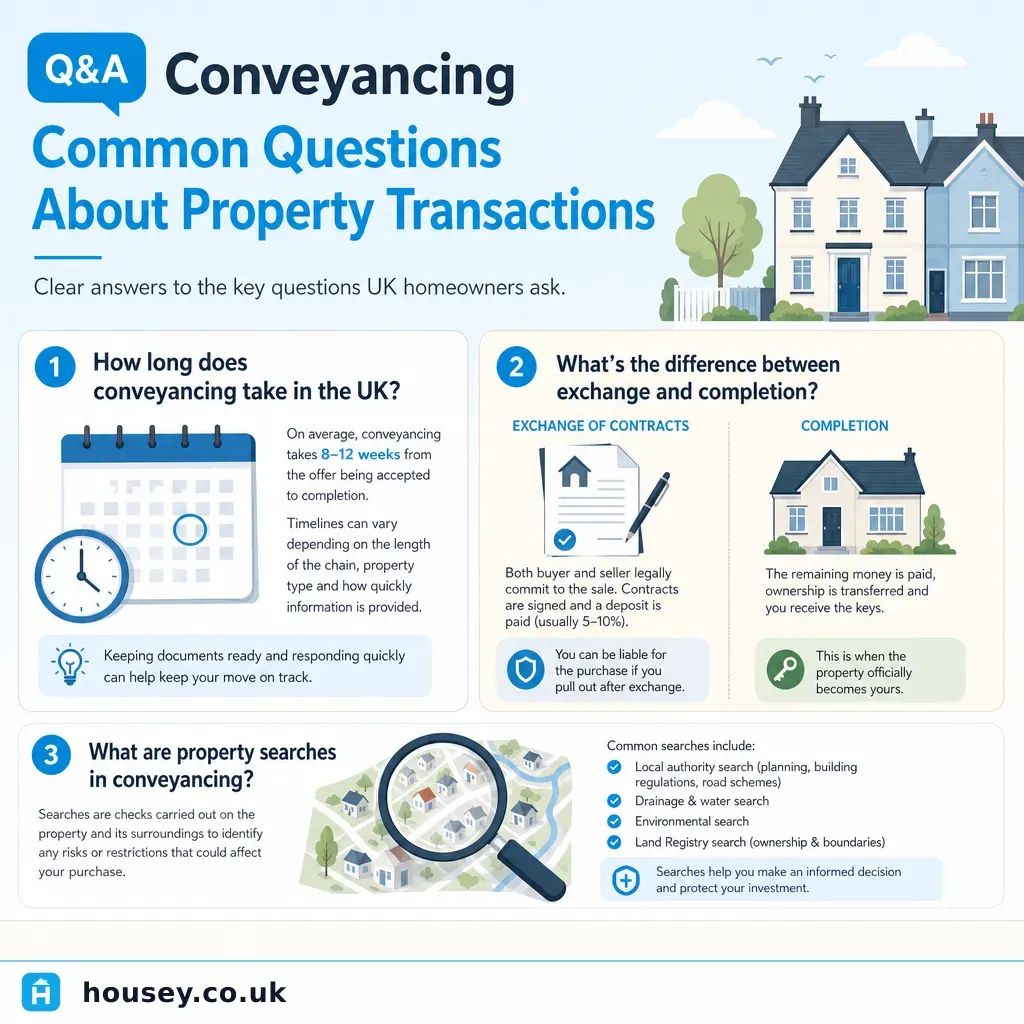
Conveyancing Q&A: Common Questions About Property Transactions
Property transactions generate a steady stream of questions at every stage — from the moment an offer is accepted right through to the day keys are handed over. Many of the most common concerns arise from uncertainty about what is normal, what the process requires, and when a concern warrants a call to a professional. Getting clear answers before problems arise saves time, reduces stress, and helps you make better decisions at the moments that matter.
Key points
- Exchange of contracts is the legally binding moment in a transaction — before exchange, either party can withdraw without penalty under the contract itself (though not without incurring costs for searches or surveys already paid).
- The average conveyancing timeline in England and Wales is 12–16 weeks from instruction to completion, though leasehold transactions or longer chains often take 20 weeks or more.
- A property can only be legally transferred by a signed, witnessed, and delivered deed — verbal agreements to sell are unenforceable in England and Wales.
- Searches (local authority, water and drainage, environmental) are typically ordered after the draft contract pack is received and reviewed, not at the point of instruction.
- Building Regulations completion certificates and FENSA certificates for replacement windows are among the most frequently missing documents that solicitors must chase before exchange is recommended.
How does the conveyancing process work?
Conveyancing is the legal process of transferring ownership of a property from one person to another. In a standard residential purchase, it involves five broad stages:
- Instruction — you appoint a solicitor or licensed conveyancer, who carries out identity checks and requests the draft contract pack from the seller's solicitor.
- Investigation — your solicitor reviews the draft contract and title documents, orders searches, and raises enquiries with the seller's solicitor.
- Mortgage offer — if buying with a mortgage, your lender carries out a valuation and issues a formal mortgage offer. Your solicitor reports on the offer and the title.
- Exchange of contracts — both sides sign identical contracts and exchange them, making the transaction legally binding. A deposit (usually 10%) is paid at exchange and a completion date is fixed.
- Completion — the balance of the purchase price is transferred, legal ownership passes to you, and your solicitor registers your ownership with HM Land Registry.
Common conveyancing questions
How long does conveyancing take?
The typical timeframe is 12–16 weeks from instruction to completion, though this varies significantly by transaction type. A chain-free cash purchase of a straightforward freehold property can complete in 6–8 weeks. A leasehold purchase in a longer chain, or one with title defects, missing documents, or a slow seller's solicitor, may take 20 weeks or more.
Key factors affecting the timeline include:
- Length of the chain
- Leasehold versus freehold tenure
- Mortgage lender turnaround for the formal offer
- Speed of the seller's solicitor in responding to enquiries
- Availability and completeness of title documents and certificates
What is the difference between exchange and completion?
Exchange is the point at which both parties sign and swap identical contracts. The transaction becomes legally binding. A completion date is agreed at or before exchange and a deposit — usually 10% of the purchase price — is paid by the buyer.
Completion is the day when legal ownership transfers, money is sent, and you receive the keys. The gap between exchange and completion is usually one to four weeks, though same-day exchange and completion does occur in straightforward transactions.
Neither party can withdraw after exchange without being in breach of contract and liable for financial penalties.
What searches are carried out and why?
Searches are checks carried out by your solicitor on your behalf to reveal matters that affect the property but are not visible during a physical inspection. Standard residential searches include:
Search | What it reveals | Who provides it |
|---|---|---|
Local authority (LLC1/CON29) | Planning decisions, enforcement notices, road adoption, tree preservation orders | Local council |
Water and drainage | Sewer connections, public sewer proximity to the boundary | Water company |
Environmental | Flood risk, contaminated land, radon levels, landfill proximity | Commercial search provider |
Chancel repair | Historic liability to contribute to church repair costs | Commercial search provider |
Bankruptcy (buyer) | Whether the buyer is subject to a bankruptcy petition | HM Land Registry / HMRC |
Can a sale fall through after exchange?
Yes, but it is rare and costly for the party in breach. If the buyer pulls out after exchange, they typically forfeit their deposit — usually 10% of the purchase price. If the seller pulls out, the buyer may be entitled to sue for specific performance (forcing the sale) or claim damages. Before exchange, either party can withdraw without contractual penalty, though any search fees, survey fees, or legal costs already incurred are unlikely to be recovered.
What happens if the survey reveals defects?
A RICS survey is separate from the conveyancing process, but its findings can directly affect it. If significant defects are identified:
- You can renegotiate the price with the seller — there is no obligation on either side to agree.
- You can withdraw your offer before exchange without contractual penalty.
- You can proceed at the original price, accepting the known risk.
- For structural or safety defects, you should seek a specialist opinion before exchange.
Your solicitor can assist with the renegotiation process, but cannot advise on the structural significance of defects — that requires a RICS Level 3 surveyor or structural engineer.
What documents should I expect to receive before exchange?
Before recommending exchange, your solicitor should have sent you:
- A copy of the draft contract and title documents, with a report explaining their content
- Search results and a summary of any issues arising from them
- A mortgage report explaining the terms of your offer (if applicable)
- A completion statement showing the funds you need to transfer before completion
- Property information forms (TA6 and TA10) completed by the seller, covering disputes, alterations, and fixtures
Decision tree: what to do at each stage
- Offer accepted but no solicitor instructed → Instruct a regulated solicitor immediately; delays at this stage slow the whole chain.
- Draft contract received but searches not back → Do not agree to exchange; your solicitor should not recommend exchange without completed searches unless specific indemnity insurance is confirmed in writing.
- Mortgage offer received but below the purchase price → Take advice before proceeding; you will need to fund the shortfall or renegotiate the price.
- Survey reveals significant defects → Seek a specialist opinion before exchange; do not assume defects are cosmetic or minor without professional confirmation.
- Seller pushing for exchange before you are ready → Resist pressure; your solicitor should advise whether exchange is safe given any outstanding enquiries or missing documents.
- Completion day delayed or keys not released → Contact your solicitor immediately; there are contractual remedies for late completion including daily compensation payments.
Red flags in a conveyancing transaction
Watch out for:
- Your solicitor recommending exchange before all searches have been returned — unless specific reasons and written confirmation of indemnity insurance are provided.
- Outstanding enquiries unresolved for more than four weeks without any explanation from the seller's solicitor.
- A management information pack for a leasehold property not requested within two to three weeks of instruction.
- SDLT or Land Registry fees absent from the completion statement.
- The seller's solicitor refusing to confirm vacant possession in the completion statement.
- Unexplained gaps in the title deeds or a property that is not yet registered at HM Land Registry with no clear explanation for the delay.
Important limitations
This article reflects general conveyancing practice in England and Wales. Scotland operates under a different legal system — offers are made and accepted through a process of missives rather than exchange of contracts, and the legal profession is regulated differently. Northern Ireland also differs in certain procedures. Individual transactions vary depending on tenure, property type, mortgage conditions, and local authority area. This is not legal advice — always instruct a qualified solicitor or licensed conveyancer for your specific transaction.
What to ask a qualified professional
Ask your solicitor at key stages:
- At what point in the process do you expect to be in a position to recommend exchange?
- Are there any outstanding enquiries or missing documents that could affect exchange readiness?
- Is there anything in the title documents or search results I need to understand before exchange?
- What is the financial penalty if either party pulls out after exchange?
- Are there any missing certificates — Building Regulations, FENSA, electrical installation — that could delay exchange?
When to get professional help
Always instruct a regulated solicitor or licensed conveyancer for a property purchase. If you have concerns about slow progress, unanswered questions, or missing documents, raise them in writing with your solicitor and ask for a clear timeline and next steps. If you cannot get a satisfactory response within a reasonable period, you can contact the SRA, CLC, or Legal Ombudsman as appropriate depending on the nature of your concern.
How Housey can help
Housey connects buyers and sellers with regulated conveyancing solicitors who can guide you through every stage of a property transaction — from instruction through to completion. Explore our conveyancing service to compare solicitors suited to your property type and timeline.
Frequently asked questions
Is gazumping legal in England and Wales?
Yes. Until exchange of contracts, the seller is under no legal obligation to proceed with an agreed sale and can accept a higher offer from another buyer. Some buyers use an exclusivity agreement to reduce this risk, though these have limited enforceability in residential transactions. The only certain protection against gazumping is reaching exchange of contracts as quickly as possible after your offer is accepted.
Can I do my own conveyancing without a solicitor?
It is legally possible for a cash buyer purchasing a registered property with no complications. However, mortgage lenders almost universally require a regulated solicitor or licensed conveyancer to act on their behalf, making self-representation impractical for most purchases. HM Land Registry also cautions unrepresented buyers about the risks of errors in title deeds and Land Registry applications that could affect legal ownership.
What is a title indemnity insurance policy in conveyancing?
Title indemnity insurance covers a specific, unresolvable defect in the title — such as a missing planning permission, a breach of a restrictive covenant, or an absent Building Regulations completion certificate. It insures you against financial loss if that defect is ever enforced against you. It does not correct the underlying issue, and your solicitor should advise in writing whether it is appropriate for any defect in your specific transaction.
What is the difference between exchange and completion?
Exchange of contracts is the legally binding moment: both parties sign identical contracts, swap them through their solicitors, and a deposit of usually 10% of the purchase price is paid. Neither party can withdraw without being in breach of contract and liable for financial penalties. Completion is when the balance is transferred, legal ownership passes to the buyer, and the keys are released. The gap between the two is typically one to four weeks.
Sources and further reading
- Buying a home — the process — GOV.UK
- Registering land or property with HM Land Registry — HM Land Registry
- Legal Ombudsman — complaints about solicitors — Legal Ombudsman
- Buying a home — Citizens Advice — Citizens Advice
- Find a regulated solicitor — Solicitors Regulation Authority
Useful next reads
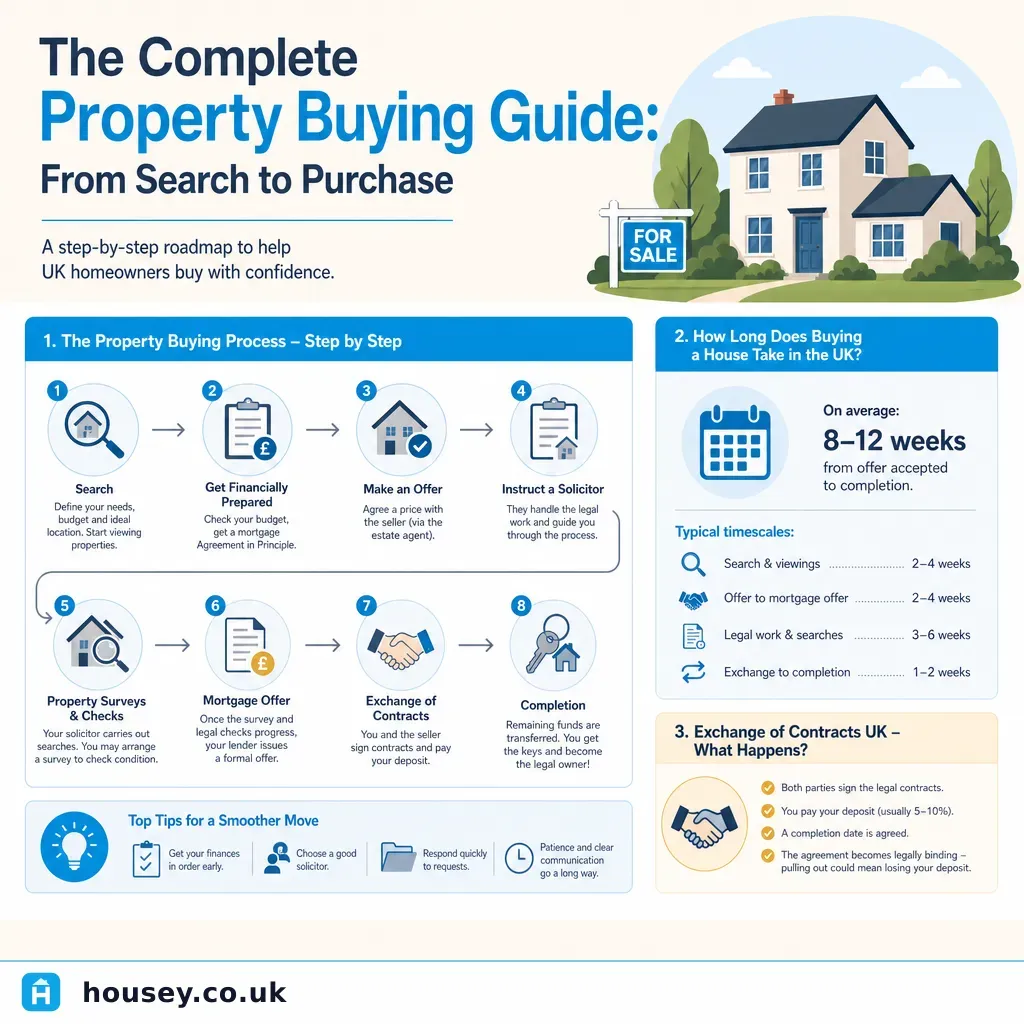 Buying & Moving
The Complete Property Buying Guide: From Search to Purchase
Buying a property in England and Wales typically takes 3–6 months from accepted offer to completion.
 Buying & Moving
Property Terminology and Listing Definitions: Buyer's Reference Guide
UK property listings and conveyancing documents use specific terms that affect buying decisions.
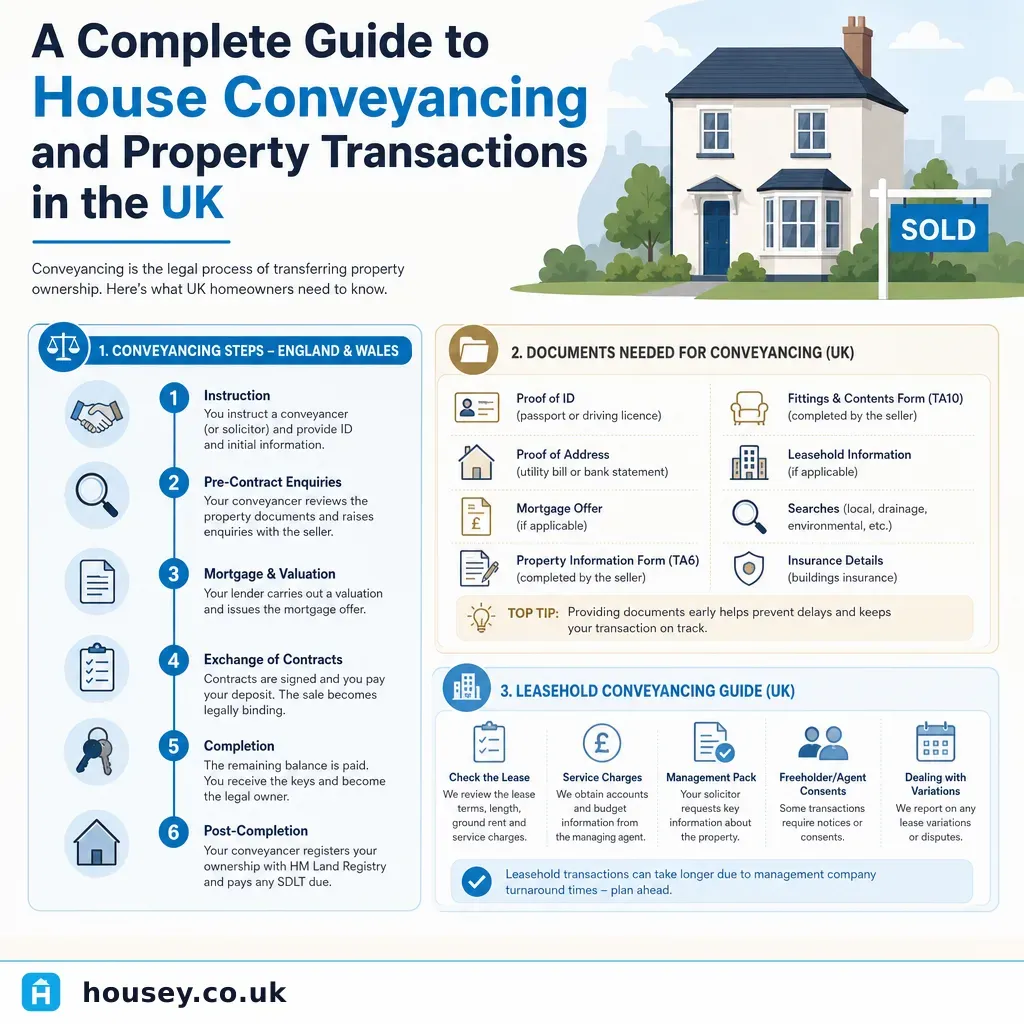 Buying & Moving
A Complete Guide to House Conveyancing and Property Transactions in the UK
House conveyancing in England and Wales follows four phases: instruction, pre-exchange work including searches and enquiries taking 8–14 weeks, exchange of contracts which makes the deal legally binding, and completion.
 Buying & Moving
Conveyancing Glossary: Key Terms and Definitions for Property Buyers
Conveyancing involves specific legal terms that appear throughout a UK property purchase.
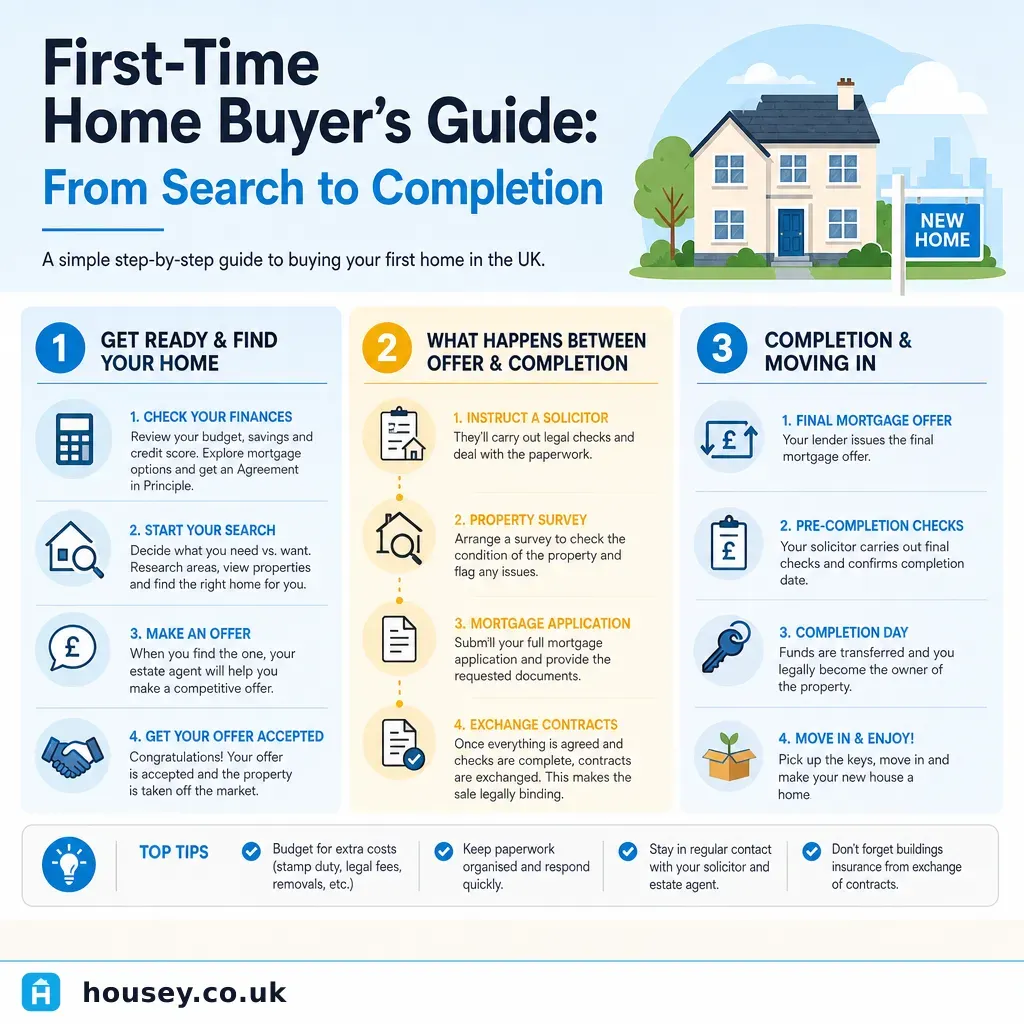 Buying & Moving
First-Time Home Buyer's Guide: From Search to Completion
Buying your first home in the UK typically takes 3–6 months from offer acceptance to completion.