Conveyancing Glossary: Key Terms and Definitions for Property Buyers
By Housey · Last reviewed 25th of May 2026

Conveyancing Glossary: Key Terms and Definitions for Property Buyers
Property buyers in England and Wales often encounter legal and procedural language for the first time during a conveyancing transaction — typically in correspondence from solicitors, in the Memorandum of Sale, or when reviewing draft contract papers. Knowing what these terms mean, and at which stage of the transaction they are relevant, helps buyers communicate more effectively with their legal team and avoid misreading important milestones or obligations.
Key points
- Exchange of contracts and completion are two legally distinct events: exchange makes the transaction binding on both parties; completion transfers ownership and possession.
- Disbursements are third-party costs paid by your solicitor on your behalf and are separate from the solicitor's own legal fee — SDLT and HM Land Registry fees are typically the largest disbursements for most buyers.
- The TA6 Property Information Form is completed by the seller and forms part of the contract; inaccurate answers can give the buyer grounds for a misrepresentation claim after completion.
- For registered land in England and Wales, the title register at HM Land Registry is the definitive record of ownership, charges, and restrictions — physical title deeds are largely superseded for most properties.
- Leasehold ownership is distinct from freehold: in a leasehold purchase, the lease length, ground rent, service charges, and any restrictions on use or alterations are all critical terms to understand before exchange.
Terms you will encounter before exchange
Memorandum of Sale: A document issued by the estate agent after an offer is accepted, confirming the agreed price and the details of both parties' nominated solicitors. It initiates the conveyancing process but is not legally binding.
Draft contract: An early version of the sale contract prepared by the seller's solicitor, sent to the buyer's solicitor for review, amendment, and eventual exchange.
TA6 Property Information Form: A standard Law Society form completed by the seller, covering disputes, planning history, notices, alterations, services, and other property-specific information. The answers form contractual representations.
TA10 Fittings and Contents Form: A Law Society form confirming which items are included in the sale and which are excluded — fitted kitchen appliances, light fittings, and curtain poles are commonly specified.
Searches: Formal enquiries made to third parties on the buyer's behalf. Core searches include a local authority search (covering planning history, enforcement notices, and nearby proposals), a drainage and water search, and an environmental search. Additional searches may be recommended depending on location and property type.
Enquiries: Questions raised by the buyer's solicitor — either as standard pre-contract questions or in response to search results — which the seller's solicitor must answer satisfactorily before exchange.
Title register: The definitive record of legal ownership held at HM Land Registry. It shows the registered proprietor (owner), any charges (mortgages), and restrictions or notices affecting the title. Obtained as official copy entries using form OC1.
Requisitions on title: Formal questions raised by the buyer's solicitor about the title, usually after the draft contract is approved but before exchange. They commonly cover vacant possession, existing charges to be redeemed, and practical completion arrangements.
Terms relating to exchange and completion
Exchange of contracts: The moment at which both parties' solicitors exchange signed copies of the contract, making the sale legally binding on both parties. The completion date is fixed at exchange. Neither party can withdraw after this point without incurring financial penalties.
Deposit: Typically 10% of the purchase price (negotiable), paid by the buyer at exchange and held by the seller's solicitor until completion. If the buyer withdraws without legal justification after exchange, the deposit is forfeited.
Completion: The final legal step, on which the balance of the purchase price transfers from buyer to seller, the Transfer deed is dated, keys are released, and legal ownership passes to the buyer. SDLT must be submitted to HMRC within 14 days of completion.
Transfer deed (TR1 or TP1): The document that transfers legal ownership from seller to buyer. TR1 applies to transfer of a whole registered title; TP1 to part of a title. Both parties must sign before completion.
Vacant possession: A contractual obligation that the seller will deliver the property free of occupants and possessions (other than included items) at completion.
Completion statement: A financial summary prepared by the buyer's solicitor showing the total funds required to complete, including the balance due, legal fees, disbursements, SDLT, and Land Registry fees, minus any deposit already paid.
Terms relating to costs, title, and tenure
Disbursements: Third-party costs paid by the solicitor on the client's behalf and charged on separately from the legal fee. Common disbursements include local authority search fees, HM Land Registry registration fees, Stamp Duty Land Tax, environmental search fees, and bank transfer charges.
Stamp Duty Land Tax (SDLT): A tax on property purchases in England. Wales has its own Land Transaction Tax (LTT); Scotland has Land and Buildings Transaction Tax (LBTT). Rates vary by purchase price, buyer type (first-time buyer, additional dwelling purchase, non-UK resident), and property use. Returns must be filed with HMRC within 14 days of completion.
Indemnity insurance: A policy that covers a specific, known defect in the title — for example, a missing building regulations completion certificate or a breach of a restrictive covenant. It is a common mechanism for progressing a sale when a defect cannot be rectified, but it does not remove the underlying defect.
Restrictive covenant: A legal obligation registered on the title (or binding in equity) that restricts what can be done with the property — for example, prohibiting extensions without consent or preventing commercial use. Restrictive covenants bind future owners, not just the current seller.
Charge: A mortgage or secured loan registered against the title at HM Land Registry. All charges must be redeemed (repaid) and removed before or at completion, unless the buyer is formally taking over the mortgage.
Freehold: Outright ownership of both the property and the land it stands on. Most houses in England and Wales are freehold.
Leasehold: Ownership of the right to occupy the property for the remaining term of a lease granted by the freeholder (landlord). Common for flats. Leases below 80 years can make a property significantly harder to mortgage and sell.
Terms commonly confused
Term | What it actually means | Commonly confused with |
|---|---|---|
Exchange | Contracts exchanged — sale legally binding on both parties | Completion (moving day) |
Completion | Funds transfer; keys released; legal ownership changes | Exchange |
Disbursements | Third-party costs paid by solicitor on your behalf | Solicitor's own legal fee |
SDLT | Tax on purchase, paid to HMRC | HM Land Registry registration fee |
Title register | HM Land Registry record of ownership, charges, and restrictions | Physical title deeds (largely superseded) |
Indemnity insurance | Policy covering a known defect — does not remove it | Buildings insurance |
Restrictive covenant | Obligation on use of the property binding on all future owners | Restriction (a condition on the title requiring consent before a disposition) |
What not to assume
"Sold subject to contract" means the deal is done. It does not. Until exchange of contracts, either party can withdraw without legal penalty. Gazumping (a seller accepting a higher offer after agreeing a price) and gazundering (a buyer reducing their offer close to exchange) are both legally possible before exchange in England and Wales.
A mortgage offer confirms the lender has approved the property. A mortgage offer confirms the lender will lend to you on that property, subject to satisfactory title. The valuation carried out for the lender is for the lender's purposes — it is not a survey of the property's condition, and it does not guarantee there are no structural or other defects.
Searches protect you from all future problems. Searches reveal what is currently registered or recorded at the time of the search. They cannot disclose undisclosed planning breaches, neighbour disputes not yet in formal litigation, or future development proposals not yet formally lodged with the relevant authority.
Completion always happens on the agreed day. Completions can be delayed by late funds transfers, banking errors, missing documents, or problems elsewhere in a chain. Building contingency time into removal and storage arrangements is advisable, particularly in a long chain.
When to get professional help
Conveyancing terminology becomes more than academic when your legal team uses it to describe the specific terms of your transaction. If you do not understand the implications of any restriction, covenant, notice, or condition in the contract, ask your solicitor to explain it before signing anything — and particularly before exchange, when withdrawing becomes costly.
How Housey can help
Understanding the language of conveyancing is a useful starting point; finding the right professional to guide your transaction is the next step. Housey can connect you with regulated conveyancing solicitors and licensed conveyancers who can explain each stage of your purchase clearly and act on your behalf through to completion.
Frequently asked questions
What is the difference between exchange and completion?
Exchange of contracts is when both parties' solicitors swap signed copies of the contract, making the transaction legally binding and fixing the completion date. Completion is the later event on which the balance of funds is transferred, keys are handed over, and legal ownership passes to the buyer. The two can happen on the same day but more often occur several weeks apart.
What are disbursements in conveyancing?
Disbursements are costs your solicitor pays to third parties on your behalf during the transaction. They are separate from your solicitor's own legal fee and are passed on at cost. Common disbursements include local authority search fees, HM Land Registry registration fees, Stamp Duty Land Tax, environmental search fees, and electronic bank transfer charges.
What is leasehold, and why does it matter when buying a flat?
Leasehold means you own the right to occupy the property for the remaining term of a lease granted by the freeholder. When buying a leasehold flat, critical factors include the remaining lease length — below 80 years makes mortgaging and reselling harder — plus annual service charges, ground rent terms, and the freeholder's management approach. An experienced conveyancer should review the lease carefully before exchange.
What does title mean in property law?
Title refers to legal ownership of a property and the evidence supporting it. In England and Wales, most land is now registered at HM Land Registry, which holds the definitive title register. Good title means the seller has the legal right to sell the property, free of undisclosed charges or encumbrances that would materially affect the buyer's position.
Sources and further reading
- HM Land Registry: title registers and official copies — GOV.UK
- Law Society: property transaction forms — Law Society
- Stamp Duty Land Tax: rates and reliefs — HMRC / GOV.UK
- Buying or selling your home — GOV.UK
- Buying a home — Citizens Advice
Useful next reads
 Buying & Moving
Property Terminology and Listing Definitions: Buyer's Reference Guide
UK property listings and conveyancing documents use specific terms that affect buying decisions.
 Buying & Moving
Property Terminology Explained: Your Essential Glossary For UK Property Buyers And Sellers
UK property transactions use a specific vocabulary that can be confusing for first-time buyers.
 Buying & Moving
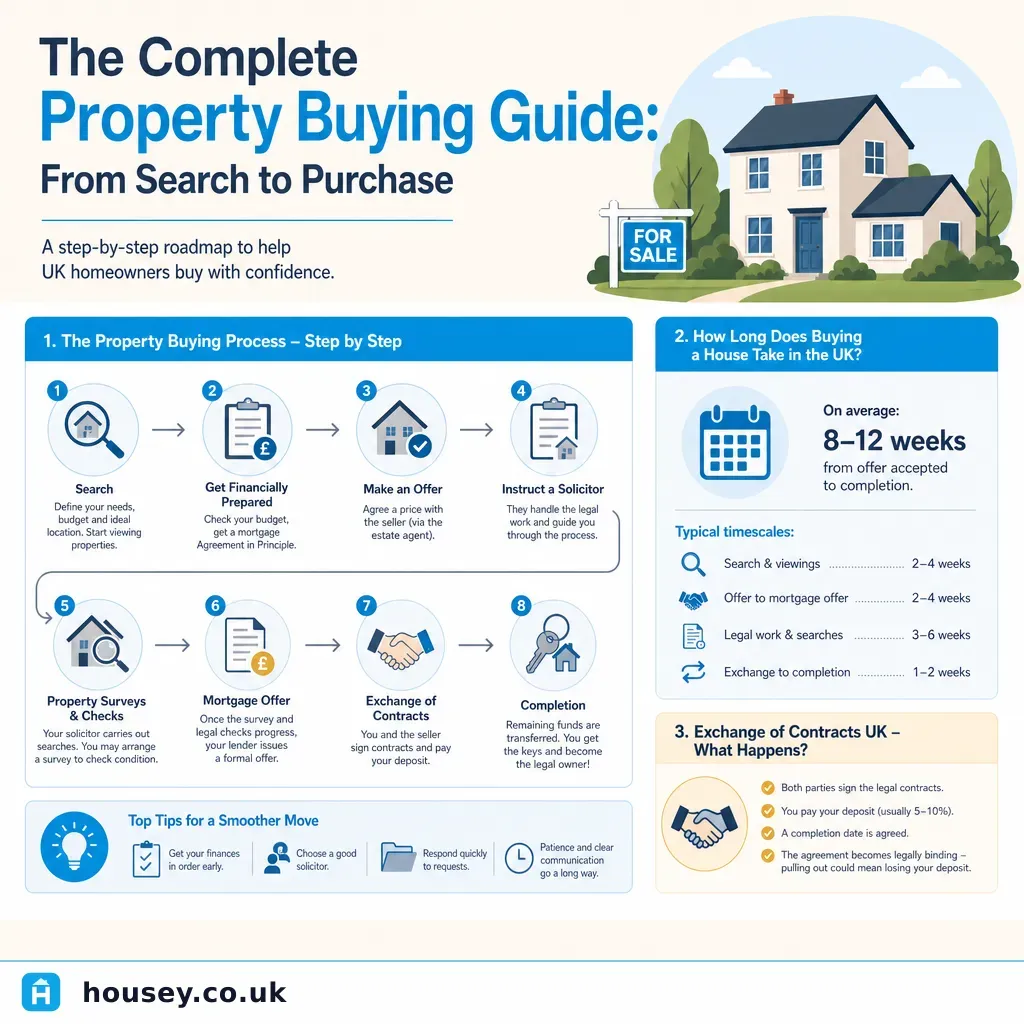
The Complete Property Buying Guide: From Search to Purchase
Buying a property in England and Wales typically takes 3–6 months from accepted offer to completion.
 Buying & Moving
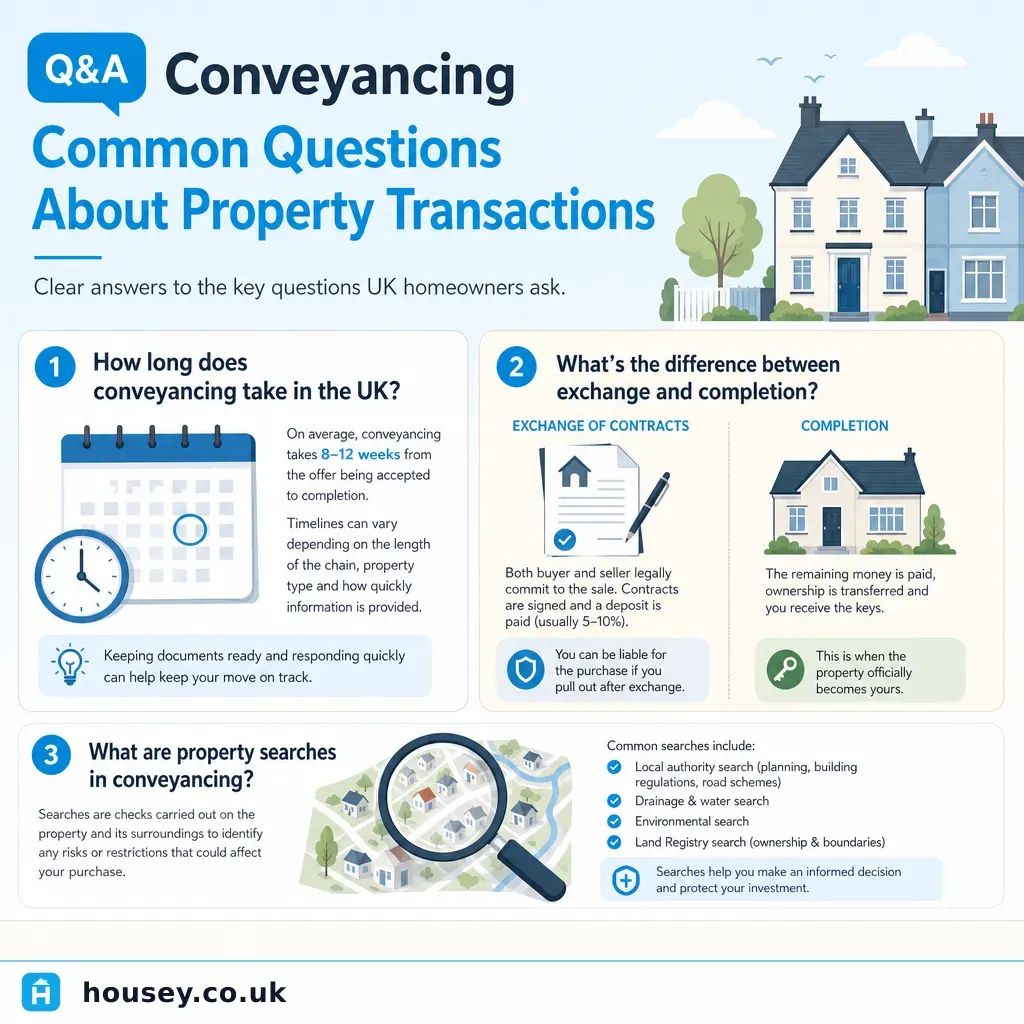
Conveyancing Q&A: Common Questions About Property Transactions
Conveyancing is the legal transfer of property ownership, typically taking 12 to 16 weeks in England and Wales.
 Buying & Moving
First-Time Home Buyer's Guide: From Search to Completion
Buying your first home in the UK typically takes 3–6 months from offer acceptance to completion.