Complete Property Conveyancing Guide: From Offer to Completion
By Housey · Last reviewed 25th of May 2026
Complete Property Conveyancing Guide: From Offer to Completion
The legal transfer of property ownership in England and Wales is one of the most document-intensive processes a homeowner encounters. Whether buying your first home, selling a family property, or remortgaging, understanding what conveyancing involves — and why each stage matters — helps you avoid costly delays and protects your legal position throughout the transaction.
Key points
- The Land Registration Act 2002 requires all freehold and leasehold titles in England and Wales to be registered at HM Land Registry; the title register is the definitive record of legal ownership.
- The Law Society Conveyancing Protocol sets the standard process most solicitors and licensed conveyancers follow, including use of the TA6 Property Information Form and TA10 Fittings and Contents Form.
- Stamp Duty Land Tax (SDLT) applies in England on residential purchases above £250,000 (or above £300,000 for eligible first-time buyers); check the GOV.UK SDLT calculator for current thresholds, as these change.
- Exchange of contracts is the moment both parties become legally bound; the defaulting party after exchange typically forfeits the 10% deposit and may face further damages.
- Leasehold properties require additional due diligence: reviewing the lease, three years of service charge accounts, and any Section 20 notices for planned major works.
What conveyancing involves
Conveyancing is the legal process of transferring ownership of property from one party to another. It covers verification of title, investigation of the property's legal history, carrying out searches, reviewing and negotiating the contract of sale, exchanging contracts, and completing the transaction by transferring funds and registering the new owner at HM Land Registry.
In England and Wales, buyer and seller each instruct separate legal representatives. Scotland and Northern Ireland operate under different legal frameworks — this guide focuses on England and Wales.
Choosing a conveyancer: solicitor or licensed conveyancer?
Type | Regulated by | Best for | Limitations |
|---|---|---|---|
Solicitor (with conveyancing specialism) | Solicitors Regulation Authority (SRA) | Complex transactions: leasehold, new-build, shared ownership, boundary disputes | Often higher fees |
Licensed conveyancer | Council for Licensed Conveyancers (CLC) | Straightforward freehold purchases | Narrower legal practice scope than a solicitor |
Both types handle standard residential conveyancing. For complex or disputed transactions, a solicitor is usually preferable. Search for regulated professionals via the Law Society Find a Solicitor tool or the CLC register.
The conveyancing process: stage by stage
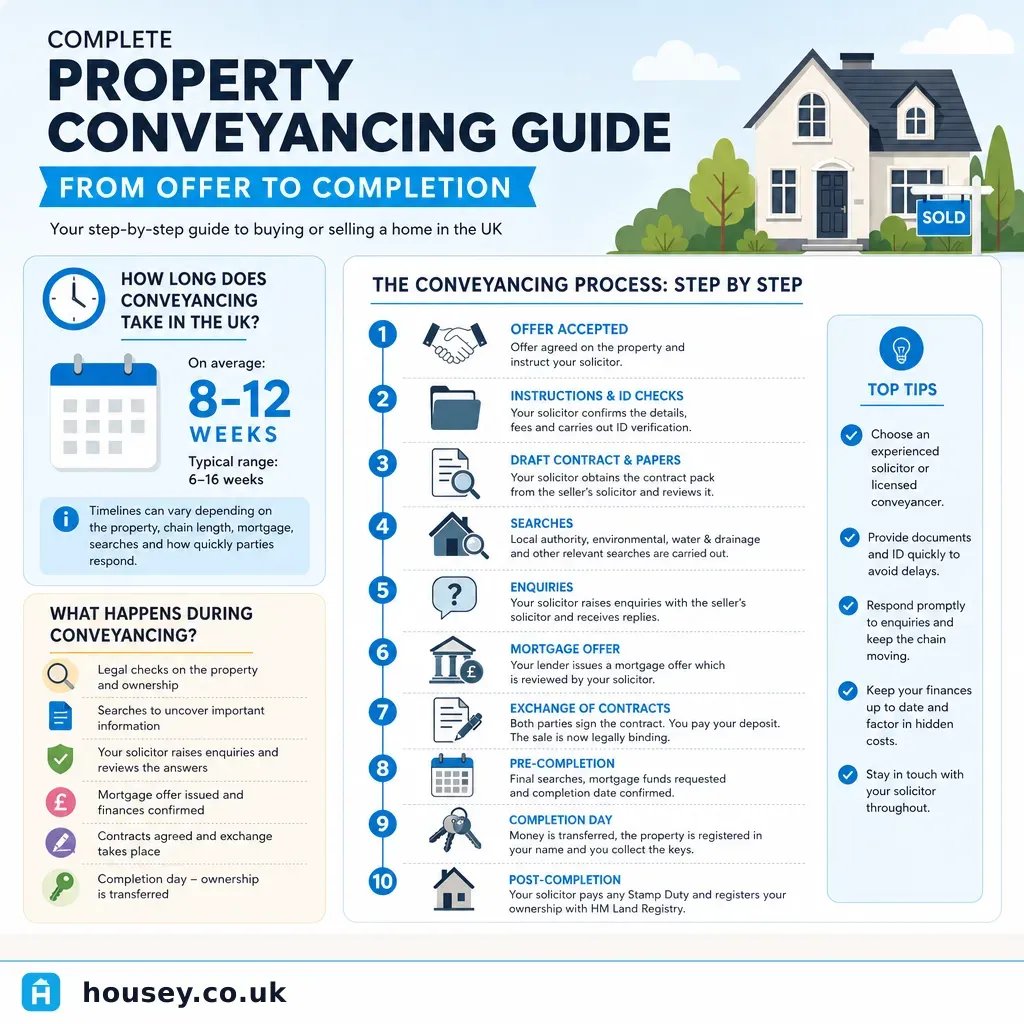
1. Instruction and initial checks (weeks 1–2)
Instruct your conveyancer as soon as an offer is accepted. They will confirm your identity under the Money Laundering Regulations 2017, request a source-of-funds declaration, and obtain the title register from HM Land Registry. The seller's conveyancer prepares the contract pack, including the draft contract, the TA6 Property Information Form, the TA10 Fittings and Contents Form, and (for leasehold) the TA7 Leasehold Information Form.
2. Searches (weeks 2–5)
Your conveyancer commissions searches on your behalf. Standard searches include:
- Local authority search: planning history, enforcement notices, road adoption, conservation area or listed building status, and tree preservation orders.
- Water and drainage search: confirms connection to mains water and public sewers.
- Environmental search: flood risk, ground contamination, landfill proximity, and radon levels.
- HM Land Registry official copy: confirms title and reveals any charges or restrictions.
- Chancel repair search: relevant in areas where properties may carry liability for church repair costs.
Additional searches may be needed for properties in coal mining areas, limestone zones, or near former industrial sites.
3. Enquiries and contract negotiation (weeks 3–8)
The buyer's conveyancer raises written enquiries seeking clarification on searches, title, and property information forms. Common areas include boundaries and rights of way, planning permissions for works carried out, building regulations completion certificates, and details of any disputes. If documents are missing — such as planning consents, FENSA certificates for replacement windows, or completion certificates — the seller must provide them or arrange indemnity insurance.
4. Mortgage offer (concurrent)
If buying with a mortgage, your lender will commission a valuation and may require additional surveys. Your mortgage offer must be formally issued before exchange. Read any conditions carefully — lenders sometimes impose retentions pending remedial works.
5. Exchange of contracts
At exchange, both parties sign identical contracts and the buyer pays the deposit (typically 10% of the purchase price). A completion date is agreed. After exchange, neither party can withdraw without breaching contract and facing financial penalties.
6. Pre-completion steps
Between exchange and completion, your conveyancer submits official Land Registry searches (OS1), receives mortgage funds from your lender, and provides a completion statement showing all sums due. The Stamp Duty Land Tax return is prepared in advance.
7. Completion
Funds are transferred on completion day. Legal ownership passes to the buyer when the seller's conveyancer confirms receipt of the full purchase price. Keys are released, usually via the estate agent.
8. Post-completion
The SDLT return must be submitted to HMRC and tax paid within 14 days of completion. Your conveyancer then registers the new ownership at HM Land Registry; processing times vary and can take several weeks to months depending on current workloads.
Freehold vs leasehold conveyancing
Aspect | Freehold | Leasehold |
|---|---|---|
Ownership | Property and land outright | A lease of fixed term; freeholder retains the land |
Additional documents | None beyond standard | TA7 form, full lease, service charge accounts, buildings insurance schedule, management pack |
Key checks | Boundaries, planning history, searches | Lease length (below 80 years limits mortgage options), ground rent, service charge history, Section 20 notices |
Typical additional cost | None | Management pack fee (typically £150–£350); possible lease extension costs |
Timescale | Usually shorter | Often longer due to managing agent involvement |
Leases with fewer than 80 years remaining are a specific concern: many mortgage lenders will decline to lend, and the cost of extending under the Leasehold Reform, Housing and Urban Development Act 1993 rises sharply below that threshold.
Document preparation checklist
Gather the following before instructing your conveyancer to avoid delays:
Indicative costs
Indicative UK costs, last reviewed 2026-05-25. Costs vary by firm, property value, and transaction complexity.
Cost item | Approximate range |
|---|---|
Solicitor/conveyancer legal fees (buyer) | £800–£2,000 + VAT |
Solicitor/conveyancer legal fees (seller) | £600–£1,500 + VAT |
Local authority search | £80–£200 |
Water and drainage search | £30–£60 |
Environmental search | £30–£80 |
HM Land Registry fee (buyer) | £20–£910 (scale fee, value-dependent) |
SDLT (England) | 0–12% depending on purchase price, buyer status, and property type — see GOV.UK SDLT calculator |
Management pack (leasehold seller) | £150–£350 |
Telegraphic transfer fee | £20–£50 per transfer |
Request a fully itemised quote before instructing — ensure disbursements are listed separately from legal fees.
Important limitations
This article provides general educational information about the conveyancing process in England and Wales. It is not legal advice. SDLT rates, Land Registry fees, lender requirements, and property law change regularly. Your specific transaction may involve unusual title, planning, leasehold, or structural characteristics not covered here. Always rely on the advice of your instructed solicitor or licensed conveyancer for decisions affecting your transaction.
When to get professional help
Instruct a conveyancer as soon as an offer is accepted — delays at the start add weeks to the overall timescale. Seek specialist legal advice if:
- The lease has fewer than 80 years remaining
- The title shows defects, adverse possession claims, or unresolved disputes
- You are purchasing a new-build, shared ownership, or Help to Buy property
- There is a boundary dispute or evidence of unauthorised building works
- The property has been subject to planning enforcement action
What to ask a qualified professional
Before instructing a conveyancer, ask:
- Are you regulated by the SRA or the Council for Licensed Conveyancers?
- What is your full fee, and which disbursements are not included in that figure?
- Do you have experience with this type of transaction — leasehold flat, new-build, or shared ownership?
- Who will handle my file day to day, and how will you communicate progress?
- What is your current average time from instruction to completion for this type of transaction?
- What fees remain payable if the transaction falls through?
- Do you hold professional indemnity insurance, and are you on my mortgage lender's conveyancer panel?
How Housey can help
Housey connects buyers and sellers with regulated conveyancing solicitors and licensed conveyancers across the UK. Compare quotes, check credentials, and instruct a conveyancer suited to your transaction type — whether a straightforward freehold purchase or a complex leasehold sale.
Frequently asked questions
What is the difference between a solicitor and a licensed conveyancer?
A solicitor is regulated by the Solicitors Regulation Authority and has a broad legal qualification, of which conveyancing is one practice area. A licensed conveyancer is regulated by the Council for Licensed Conveyancers and specialises in property law. Both handle standard residential conveyancing; solicitors are generally preferable for complex or disputed transactions involving boundary issues, defective title, or short leasehold.
How long does conveyancing take in the UK?
A straightforward freehold purchase typically takes 8 to 12 weeks from offer to completion. Leasehold transactions, chains, or new-builds often take 12 to 20 weeks or more. Missing documents, slow local authority search results, and delayed mortgage offers are the most common causes of extension.
Can I do my own conveyancing?
You can legally handle your own conveyancing for a cash purchase of a freehold property. However, most mortgage lenders require a regulated conveyancer to act on their behalf and will not permit the borrower to self-represent. DIY conveyancing for leasehold, new-build, or mortgaged transactions carries significant legal risk and is not generally advisable.
What happens if the seller pulls out after exchange?
Withdrawal after exchange constitutes a breach of contract. The non-defaulting party may retain the deposit and claim damages. A court can in some cases order specific performance to compel completion, though this remedy is expensive and slow. Both buyer and seller are legally committed from the moment contracts are exchanged.
What searches are required during conveyancing?
The standard set required by most mortgage lenders includes a local authority search, a water and drainage search, and an environmental search. Additional searches may be needed depending on location — coal mining searches in former coalfield areas, and sometimes a chancel repair search in older rural areas.
Sources and further reading
- HM Land Registry: how to transfer ownership of a property — GOV.UK
- Stamp Duty Land Tax rates and calculator — HMRC / GOV.UK
- Law Society Conveyancing Protocol — Law Society
- Find a solicitor — Law Society
- Council for Licensed Conveyancers: find a conveyancer — Council for Licensed Conveyancers
- Buying or selling your home — Citizens Advice
Useful next reads
 Buying & Moving
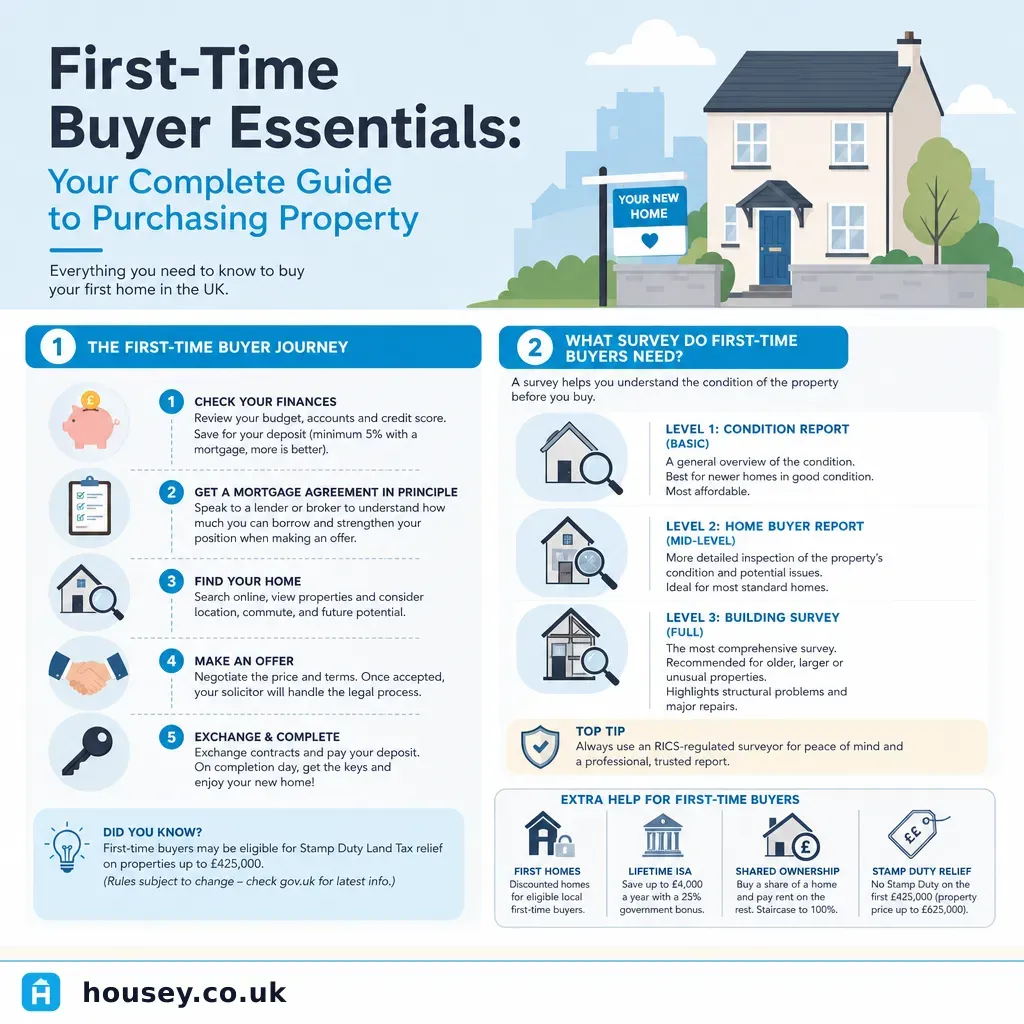
First-Time Buyer Essentials: Your Complete Guide to Purchasing Property
Buying your first UK home involves six key stages: securing a mortgage Agreement in Principle, making an offer, instructing a solicitor, commissioning an independent RICS survey, exchanging contracts (the legally binding point), and completing.
 Buying & Moving
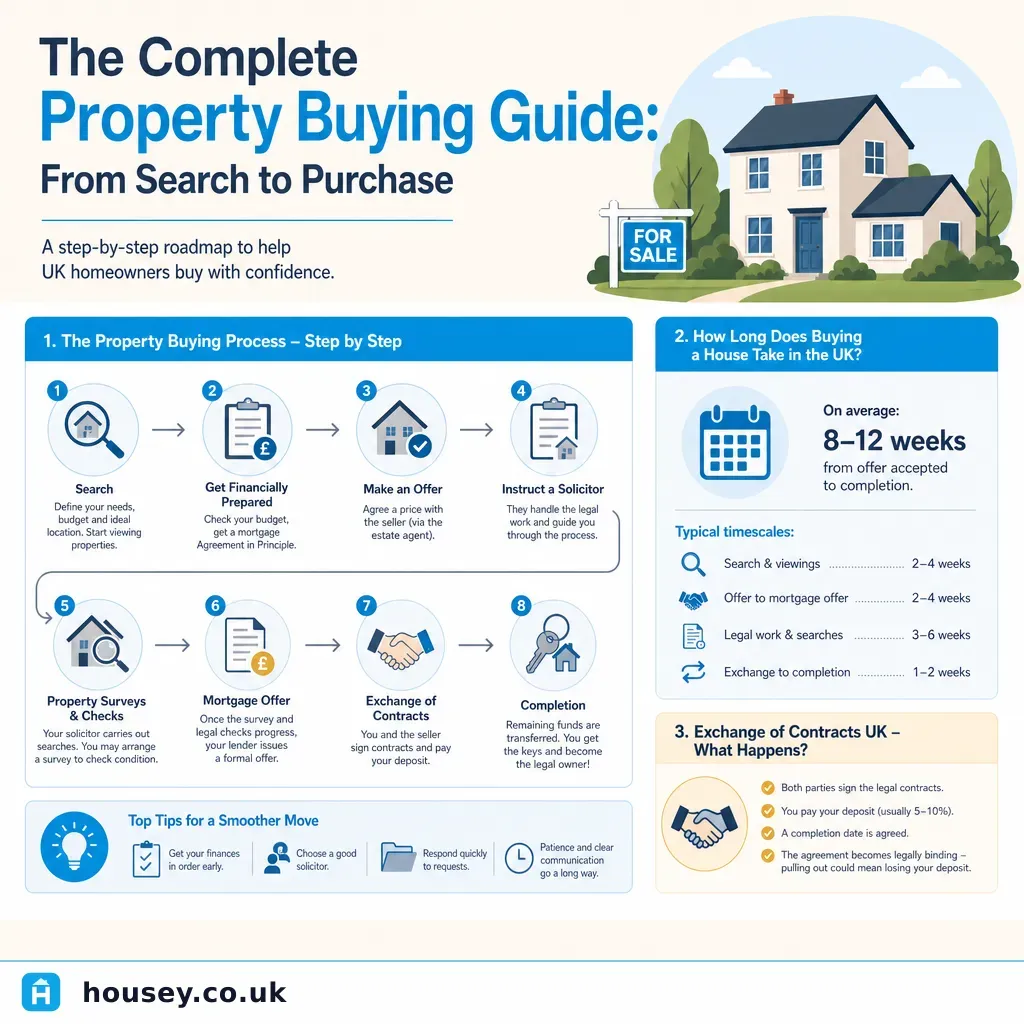
The Complete Property Buying Guide: From Search to Purchase
Buying a property in England and Wales typically takes 3–6 months from accepted offer to completion.
 Buying & Moving
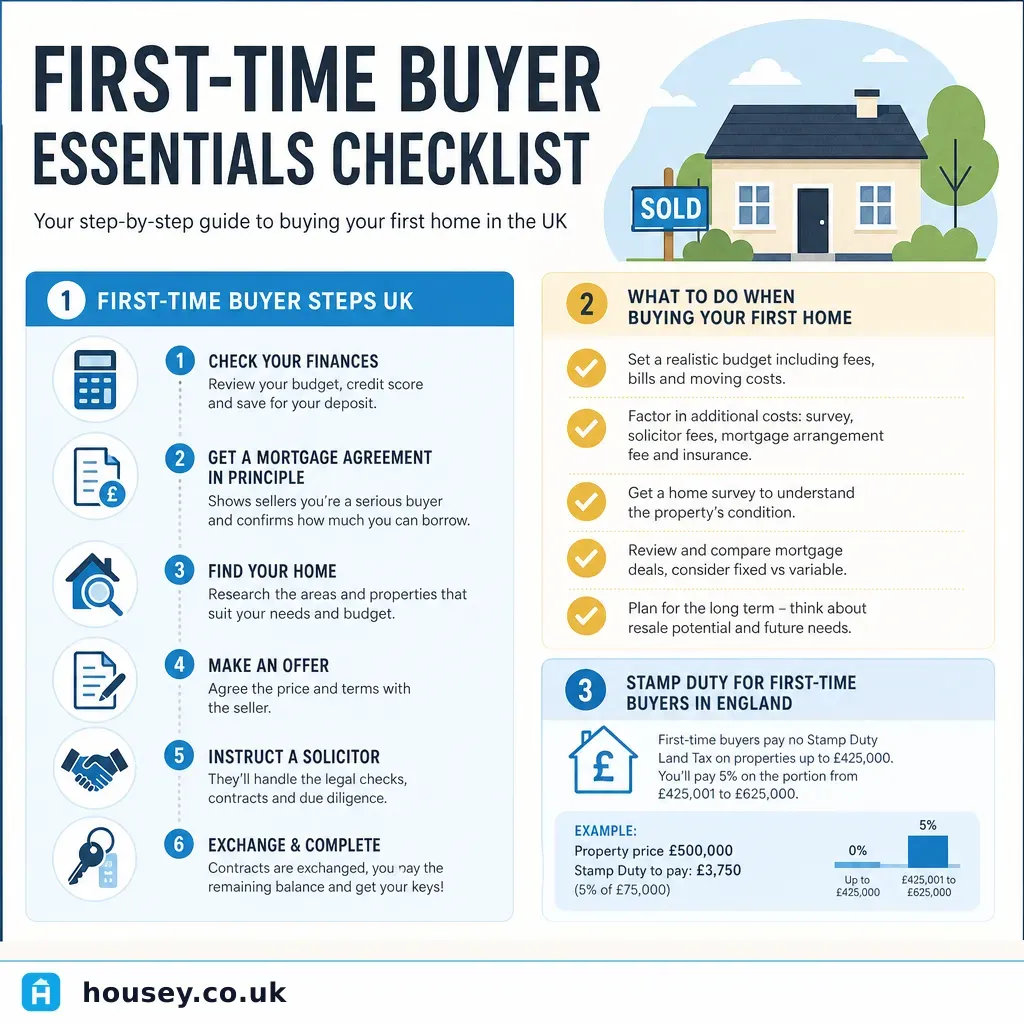
First-Time Buyer Essentials Checklist
Buying your first home involves obtaining a mortgage in principle, making an offer, instructing a solicitor, arranging a survey, and exchanging contracts before completion.
 Buying & Moving
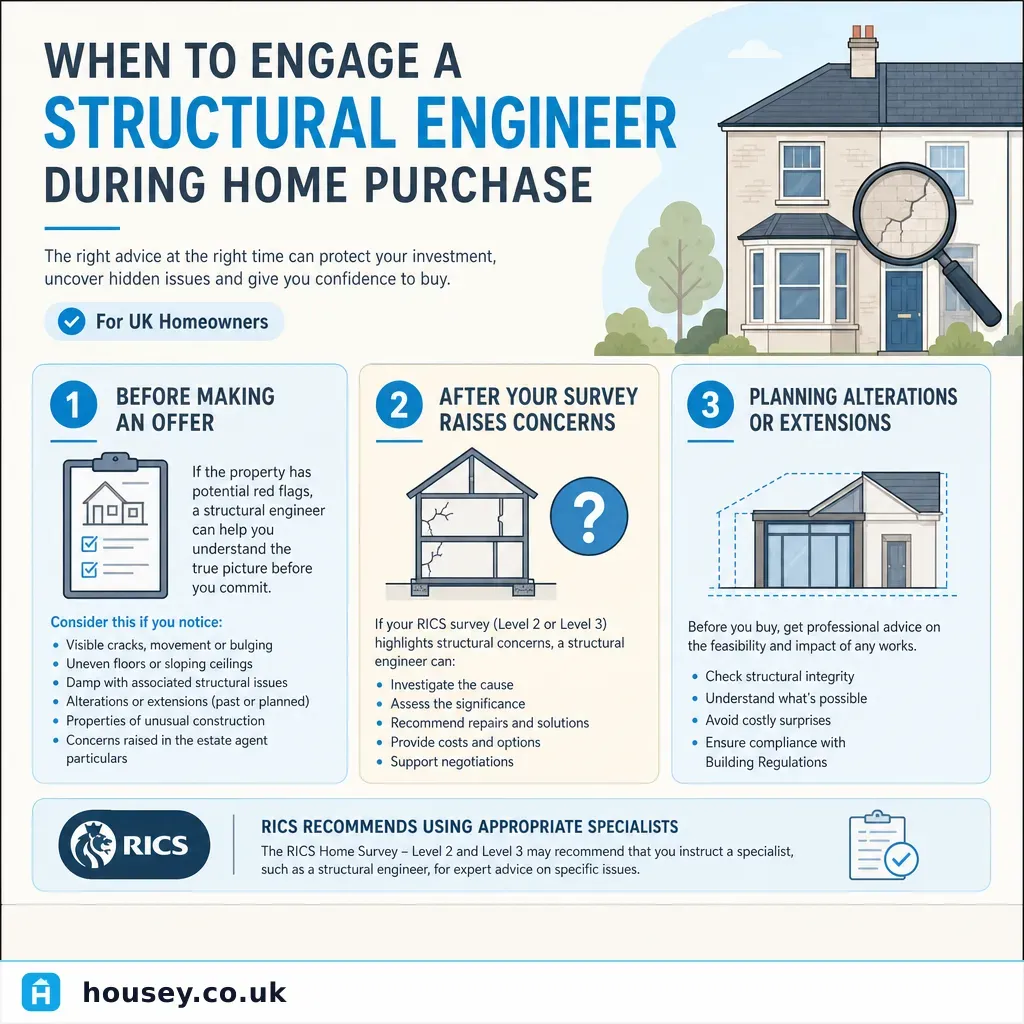
When to Engage a Structural Engineer During Home Purchase
Instruct a structural engineer before exchange if your RICS survey flags movement, cracking rated condition 3, or suspected subsidence.
 Buying & Moving
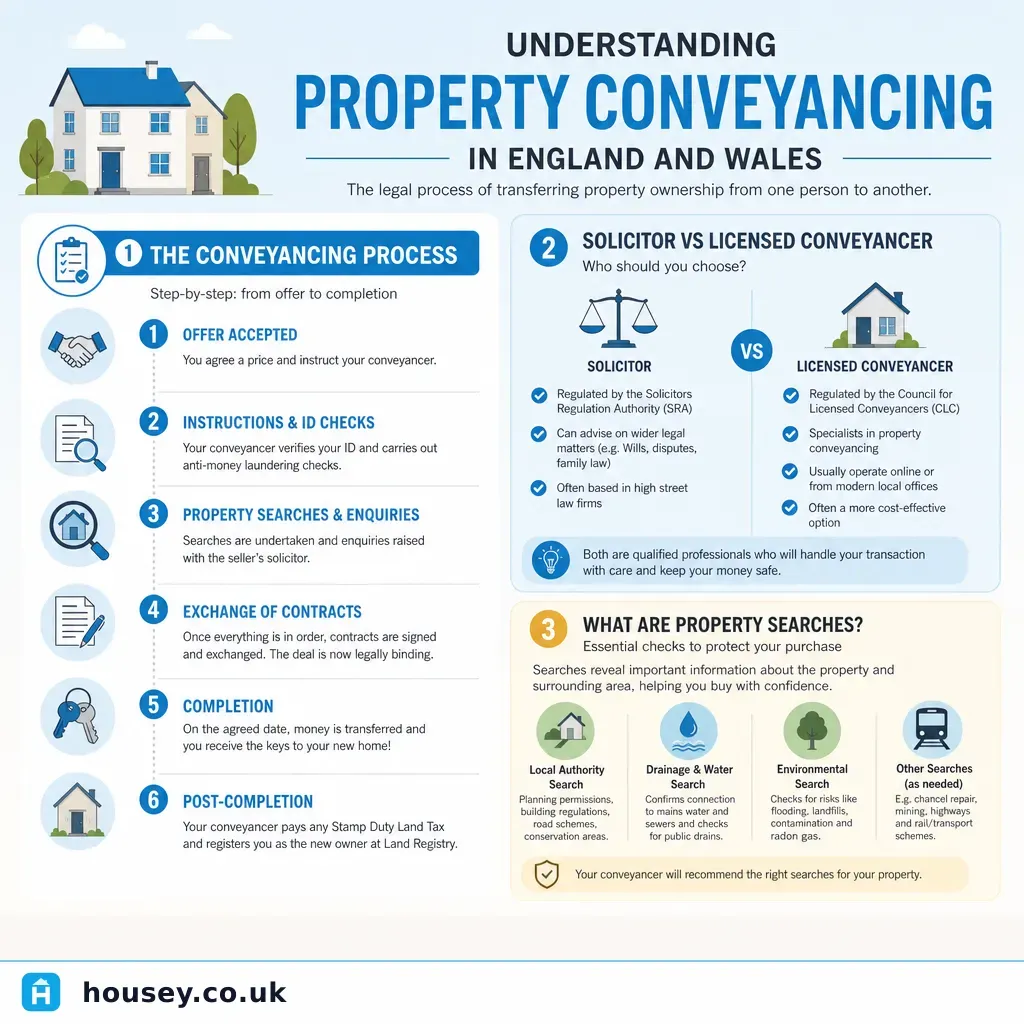
Understanding Property Conveyancing in England and Wales
Conveyancing is the legal process of transferring property ownership in England and Wales.