Complete Roof Replacement: Materials and Labour Costs
By Housey · Last reviewed 10th of May 2026
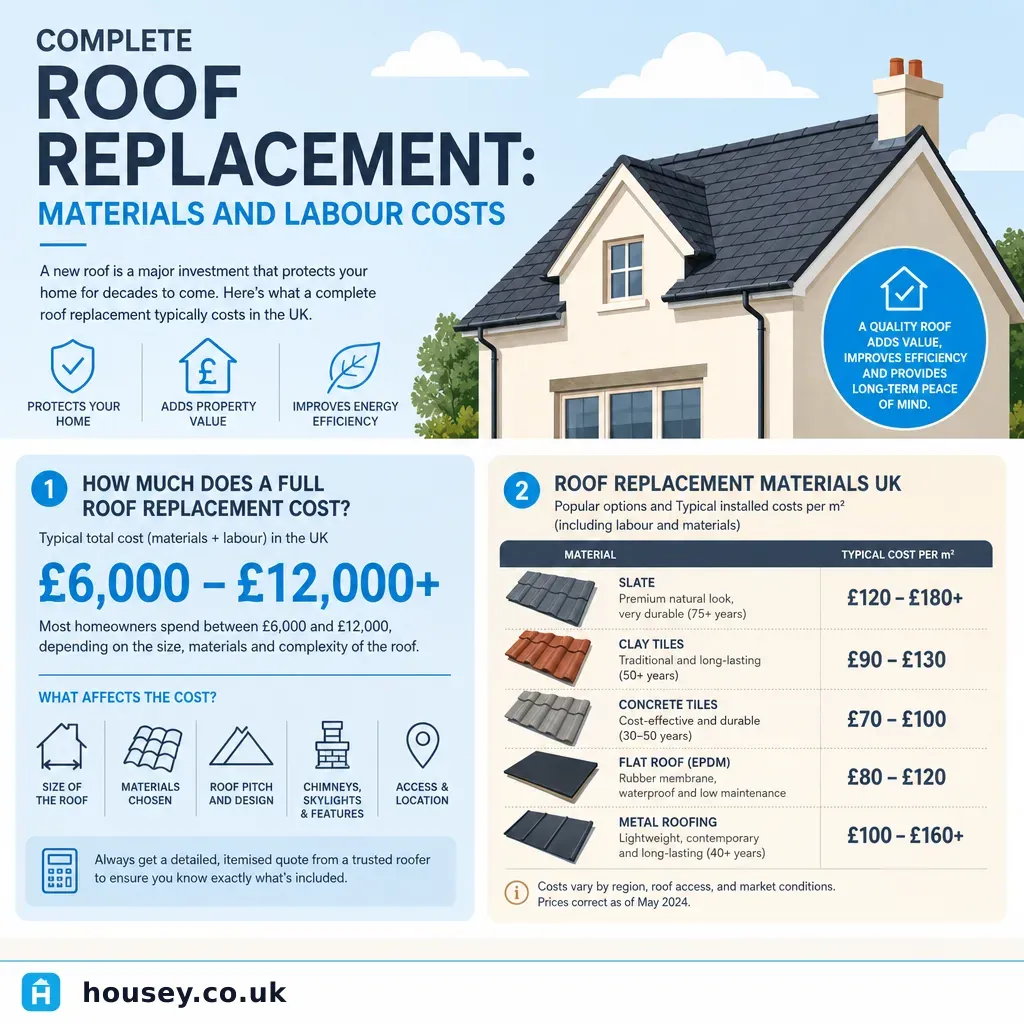
Complete Roof Replacement: Materials and Labour Costs
A full roof replacement is one of the largest single maintenance investments most homeowners face, typically arising when a roof has reached the end of its serviceable life, suffered widespread storm damage, or when a purchase survey has flagged the covering as a priority item. The choice of material, the condition of the underlying structure, and the competence of the contractor all significantly affect both the upfront cost and the longevity of the result.
Key points
- Replacing the roof covering on 25% or more of the roof area triggers a Building Regulations notification under Approved Document L (energy efficiency), requiring upgraded insulation to meet a U-value of ≤0.18 W/m²K for a pitched roof.
- Indicative costs for a full roof replacement on a typical three-bedroom semi-detached house range from £5,500 to £14,000 depending on material choice, roof complexity, and regional labour rates (Indicative UK costs, last reviewed 2026-05-10).
- Natural Welsh or Spanish slate typically lasts 80–150 years; concrete interlocking tiles have a lifespan of 40–60 years; clay plain tiles sit between the two at 60–100 years.
- A replacement roof on a listed building requires Listed Building Consent and materials matching the historic character — consult Historic England guidance and your local planning authority before instructing any work.
- Confirm the contractor is a member of the National Federation of Roofing Contractors (NFRC) or is TrustMark-registered, and carries public liability insurance of at least £2m.
Choosing the right roofing material
Material selection affects cost, lifespan, weight loading on the roof structure, visual appearance, and planning acceptability. The comparison table below covers the most common options for UK pitched roofs.
Material | Typical lifespan | Indicative supply cost (per m²) | Weight (kg/m²) | Best for | Planning notes |
|---|---|---|---|---|---|
Concrete interlocking tiles | 40–60 years | £15 – £30 | 40–55 | Most modern UK houses; cost-effective replacement | Usually acceptable like-for-like |
Clay plain tiles (handmade) | 60–100 years | £30 – £60 | 55–75 | Victorian/Edwardian terraces, conservation areas | Often required by LPA in conservation areas |
Natural Welsh slate | 80–150 years | £40 – £80 | 25–30 | Period properties and listed buildings | Often specified by LPA for heritage locations |
Fibre cement slate | 30–50 years | £15 – £25 | 25–35 | Budget alternative to natural slate | Check with LPA if in a conservation area |
Clay pantiles | 60–100 years | £25 – £45 | 45–60 | East Anglia and some northern regions | Regional planning sensitivities apply |
EPDM or TPO membrane | 25–50 years | £15 – £35 | Under 5 | Flat or low-pitch roofs | Generally no planning permission needed |
Supply costs exclude labour, scaffolding, disposal, underfelt, and battens. All figures are indicative.
Total cost breakdown for a full replacement
Indicative UK costs, last reviewed 2026-05-10. Figures shown are for a typical three-bedroom semi-detached house in England (approximately 50–60 m² of roof area). London and South-East labour rates are typically 20–40% higher than the national average.
Cost element | Indicative range |
|---|---|
Strip off existing tiles or slates and disposal | £600 – £1,200 |
New breathable vapour-permeable underfelt | £400 – £800 |
New tiling battens | £300 – £600 |
Roofing material (tiles or slate) | See materials table above |
Ridge, hip, and valley work | £500 – £1,500 |
Lead flashings (chimney and abutments) | £300 – £1,000 |
Scaffolding (erection, hire, and removal) | £900 – £1,800 |
Labour (total) | £2,000 – £5,000 |
Building regulations notification (Part L) | £300 – £600 |
Total indicative range (3-bed semi) | £5,500 – £14,000 |
Larger or more complex roofs — hipped roofs, multiple valleys, dormer windows, chimney stacks — will exceed these ranges. A written, itemised quote from at least three contractors is essential before committing to any work.
Building Regulations and Part L compliance
A full roof replacement triggers a Building Regulations notification regardless of whether planning permission is needed. The key requirements under the 2021 Approved Documents are:
Part L (Conservation of Fuel and Power): New roof insulation must achieve a U-value of ≤0.18 W/m²K where technically and economically feasible. If the existing loft insulation already meets this standard, an upgrade may not be required, but the contractor should confirm compliance in writing and this should be recorded in the building control application.
Part A (Structure): If heavier materials are being introduced — for example, replacing lightweight fibre cement slates with clay plain tiles — a structural engineering assessment of the roof timbers, purlins, and wall plates is advisable to confirm they can carry the additional load before the specification is finalised.
Ventilation: New breathable (vapour-permeable) underlay typically satisfies ventilation requirements without additional eaves ventilation tiles, but confirm this with your building control officer at the application stage.
Applications can be submitted to your local authority building control team or a Registered Building Control Approver. Retain the completion certificate — it is required when you sell the property or remortgage.
Homeowner checklist before instructing a roofer
Important limitations
This article provides general guidance on complete roof replacement in England. Building Regulations requirements differ in Scotland (Scottish Technical Handbooks), Wales (Welsh Building Regulations), and Northern Ireland, and can vary by property type, age, and specific roof construction. Cost figures are indicative ranges based on publicly available industry data and should not replace site-specific contractor quotes. Nothing in this article constitutes structural, planning, or building control advice. Always instruct a qualified professional to assess your specific property before work begins.
When this becomes urgent
Arrange temporary weatherproofing immediately if the roof covering has failed across a large area following storm damage — secondary damage to insulation, plasterwork, and structural timbers can escalate rapidly. If a survey has identified structural defects such as rotten rafters, failed wall plates, or visible movement in the roof plane, do not proceed with a replacement covering specification until a structural engineer has assessed and remediated the underlying structure.
What to ask a qualified professional
Before instructing a roofing contractor or building control consultants, ask:
- Does the full replacement trigger a Building Regulations Part L notification for this property, and who will submit the application and obtain the completion certificate?
- Is the existing roof structure — rafters, ridge, purlins, wall plates — in good enough condition to carry the proposed new covering, or is structural repair needed first?
- What material specification do you recommend, and is it acceptable to the local planning authority given the property's conservation status?
- What breathable underfelt system do you propose, and how does it satisfy ventilation requirements under current Building Regulations?
- What guarantees are provided for materials and workmanship separately, and over what period?
- Is all lead flashing and valley work included in the quoted price?
When to get professional help
A complete roof replacement should always be carried out by a qualified and insured roofing contractor. Seek independent advice in addition to contractor quotes if:
- The property is listed, in a conservation area, or subject to planning restrictions — LPA pre-application advice may prevent abortive cost.
- Survey reports or visual inspection suggest structural movement or timber decay — a structural engineer should advise before the new covering is specified.
- You are receiving widely varying quotes — an independent roof survey establishes a clear scope of works that all contractors price against the same specification.
- The contractor proposes significantly different materials from the existing covering — check planning and structural implications before accepting.
How Housey can help
Housey connects you with vetted qualified roofers who provide itemised quotes for full replacements, specialists who carry out an independent roof survey to confirm whether replacement is needed and define the scope, and building control consultants who can manage the Part L notification and completion certificate on your behalf. Submit one brief and compare quotes from up to four professionals.
Frequently asked questions
How long does a complete roof replacement take?
A full replacement on a typical three-bedroom semi-detached house usually takes three to seven working days, depending on roof size, complexity, material type, and weather. Scaffolding erection and dismantling typically adds two to three days at the start and end of the programme. Allow additional time if structural repairs to rafters, purlins, or wall plates are identified during the strip-off.
Do I need planning permission for a roof replacement?
Like-for-like replacement using the same material and profile is generally permitted development and does not require a planning application. Changing the material — for example, from concrete tiles to natural slate — may require planning permission in a conservation area or on a listed building. Always check with your local planning authority before agreeing a specification that differs from the existing covering.
How do I know whether to repair or replace my roof?
Repair is usually appropriate when the structure and underfelt are sound, the covering is relatively young, and failure is localised. Replacement becomes more cost-effective when 10–15% or more of tiles are failing, the underfelt has perished, the roof is at or near end of life, or a professional condition survey recommends it. An independent roof survey resolves the question objectively before money is committed.
Is VAT charged on roof replacement?
Standard-rate VAT at 20% applies to most roofing work. Reduced-rate VAT at 5% may apply in certain circumstances, such as when a property has been empty for two or more years. Check with your contractor and, if in doubt, consult HMRC guidance or a qualified accountant before agreeing a price inclusive or exclusive of VAT.
Sources and further reading
- Approved Document L: Conservation of fuel and power (2021 edition) — HM Government
- Roof alterations: do you need permission? — Planning Portal
- National Federation of Roofing Contractors — NFRC
- TrustMark: find a registered tradesperson — TrustMark
- Roofing materials: guidance for historic buildings — Historic England
Useful next reads
 Improvement & Build
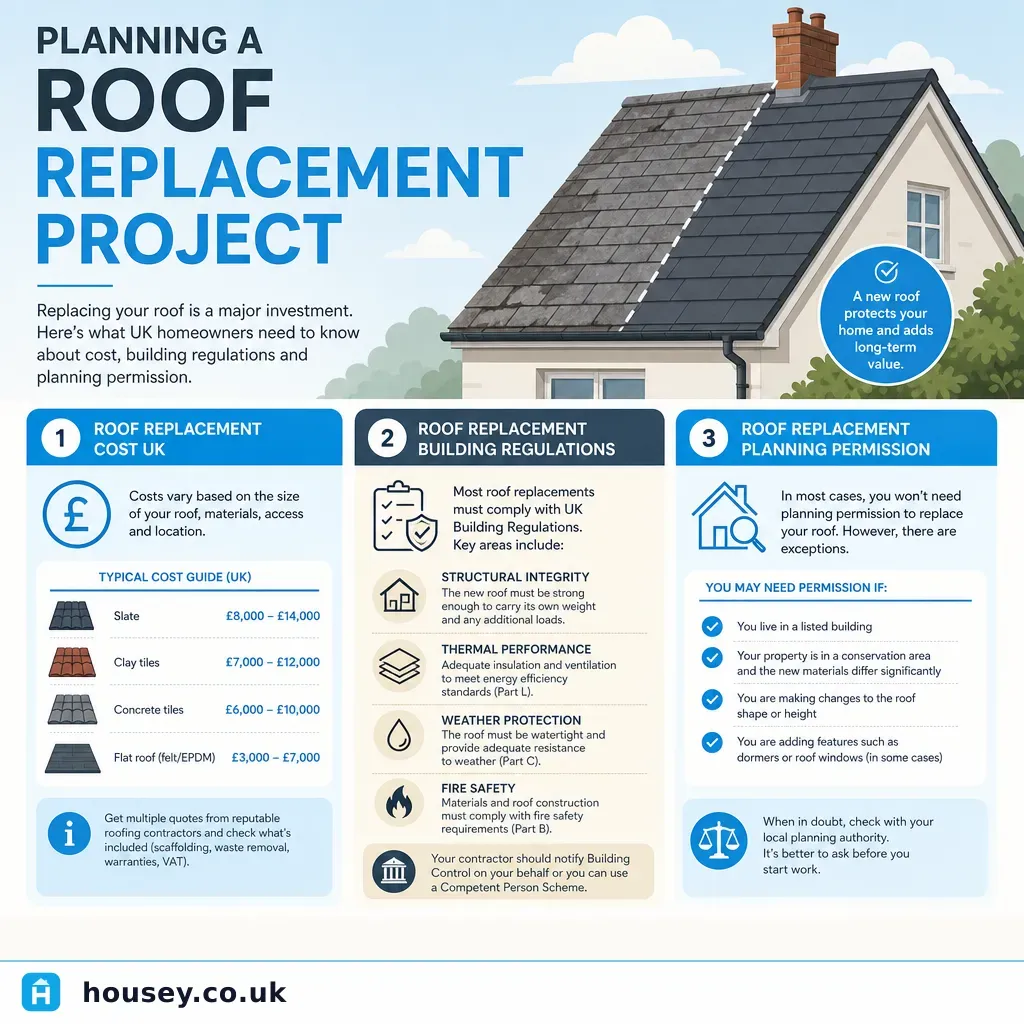
Planning a Roof Replacement Project
A roof replacement project involves stripping the existing covering, renewing the sarking felt and battens, and laying new tiles, slates, or a flat-roof membrane.
 Improvement & Build
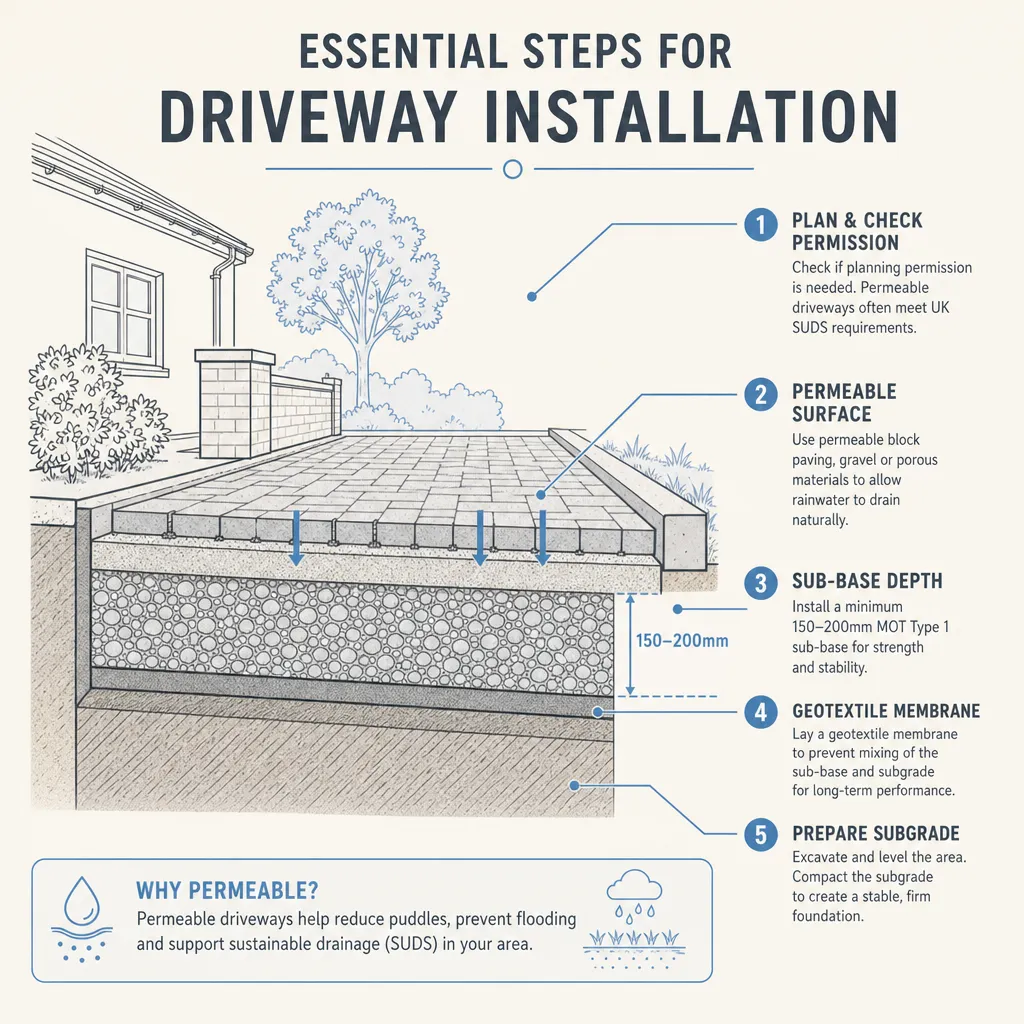
Essential Steps for Driveway Installation
Installing a driveway in England requires planning permission only when using an impermeable surface (standard tarmac, concrete, or block paving) on a front garden area over 5 m².
 Improvement & Build
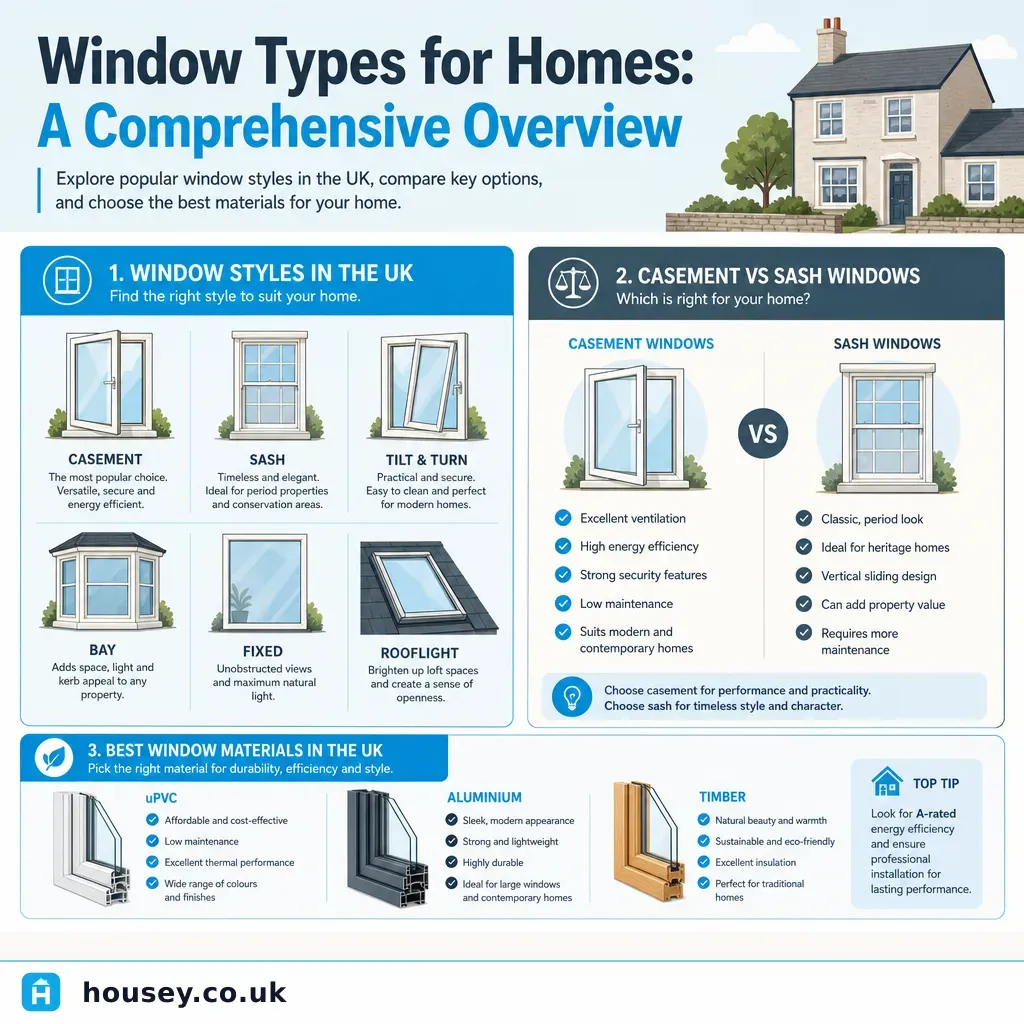
Window Types for Homes: A Comprehensive Overview
UK homes use several main window styles: casement (outward-swinging), sash (vertically sliding), tilt-and-turn, fixed light, and bay or bow.
 Improvement & Build
Installing a Garden Deck: Design, Materials and Installation Costs
Garden decking costs £80–250 per m² installed in the UK depending on material — softwood is cheapest, composite the most durable.
 Improvement & Build
Roof Replacement or Overlay: Which Option is Right for Your Home
Whether to replace or overlay a roof depends on the condition of the existing structure, battens, and sarking felt.