Complete Window Replacement: Phasing Strategy and Whole-Property Upgrade
By Housey · Last reviewed 1st of June 2026
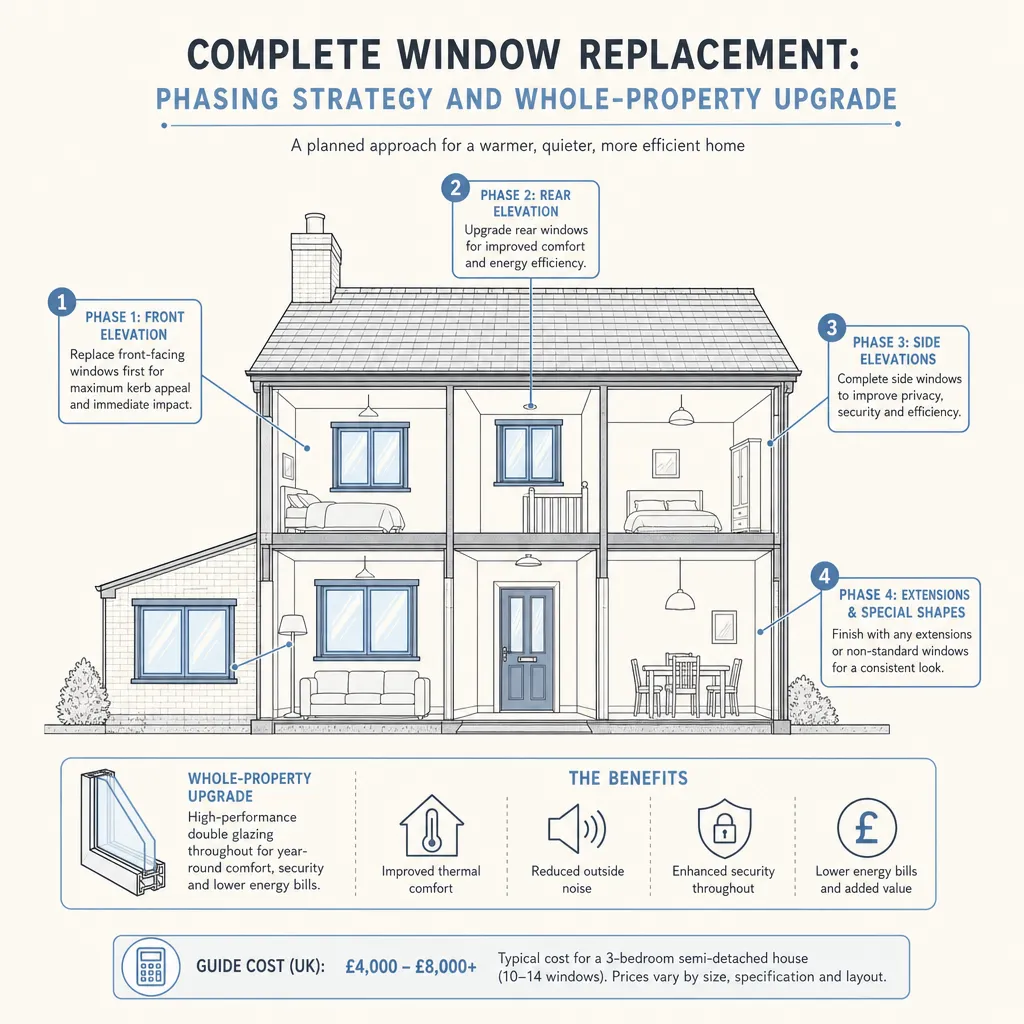
Complete Window Replacement: Phasing Strategy and Whole-Property Upgrade
Replacing all the windows in a home is one of the most visible and financially significant improvement projects a homeowner can undertake. It typically arises when draughts, condensation between panes, or rising energy bills make the status quo untenable — or when a wider renovation is under way and new windows form part of a coordinated fabric upgrade. Getting the sequence right, understanding the regulatory requirements, and choosing the correct specification can save significant money and prevent rework.
Key points
- Replacement windows in England and Wales must comply with Building Regulations Part L; installers must either notify building control directly or use a registered competent-person scheme such as FENSA or CERTASS.
- The minimum thermal performance requirement under Approved Document L for replacement windows is a centre-pane U-value of 1.4 W/m²K or a whole-window U-value of 1.6 W/m²K.
- Windows in listed buildings require listed building consent; those in conservation areas may also need planning permission — check with your local planning authority before ordering.
- A-rated windows under the British Fenestration Rating Council (BFRC) Window Energy Rating (WER) scheme typically exceed the Part L minimum and are the standard specification for a modern replacement.
- Whole-house replacement costs are indicative in the range of £5,000–£15,000 depending on property size, frame material, and glazing specification (Indicative UK costs, last reviewed 2026-06-01).
Which windows should you replace first?
Replacing all windows at once is the most cost-efficient approach — installers often price better for larger orders, scaffolding (if required) is erected once, and the property achieves a consistent specification. However, budget constraints, listed building consent timescales, or tenant occupation can make a phased approach necessary.
A practical starting point is to rank windows by condition and heat loss. The most deteriorated frames — rotting timber, blown sealed units showing condensation between panes, or single glazing — should come first regardless of orientation.
Phasing decision guide:
- Replace first if: frames are rotting, condensation is visible between panes, noticeable draughts track around the frame, or windows are single-glazed.
- Replace next if: windows are 20+ years old with failed seals, or aluminium frames are present without a thermal break.
- Can wait if: existing PVCu frames are under 15 years old, seals are intact, and windows carry a WER rating of C or above.
- Seek specialist advice before replacing if: windows are in a listed building or conservation area, or the property has unusual frame types such as retained steel Crittal windows.
Frame materials: which is right for your property?
Frame material affects cost, maintenance requirement, thermal performance, lifespan, and planning compliance. Use the table below to shortlist options before requesting quotes.
Frame material | Best for | Not ideal for | Typical lifespan | Maintenance demand |
|---|---|---|---|---|
PVCu (uPVC) | Post-1980s homes, tight budgets | Listed buildings, many conservation areas | 20–30 years | Very low |
Timber | Listed buildings, conservation areas, character properties | High-maintenance-averse owners | 30–60+ years with maintenance | High |
Aluminium (thermally broken) | Contemporary aesthetics, large or slender openings | Traditional character properties | 30–45 years | Low |
Composite (timber core, aluminium outer) | Conservation areas wanting low maintenance | Budget-sensitive projects | 30–40 years | Low to moderate |
Always confirm acceptable materials with your local planning authority before placing any order if your property is listed or in a conservation area.
Glazing specification: double or triple?
For most UK homes, A-rated double glazing with low-emissivity (low-e) coatings and an argon or krypton gas fill is the standard specification. Triple glazing offers better thermal performance — typical whole-window U-values of 0.8–1.0 W/m²K versus 1.2–1.6 W/m²K for double — but costs 20–40% more per unit and marginally reduces passive solar gain in winter.
Triple glazing is worth considering if:
- You are targeting EPC band A or a Passivhaus standard.
- The property is in a noisy urban or roadside location — triple glazing reduces sound transmission as well as heat loss.
- You are replacing all windows at once and the cost premium fits comfortably within budget.
For the majority of UK homes, A-rated double glazing remains the cost-effective benchmark.
FENSA, CERTASS, and building control certification
When a FENSA or CERTASS registered installer fits your windows, they self-certify compliance with Building Regulations and notify the local authority on your behalf. You receive a certificate that your conveyancer will require when you sell.
If your installer is not registered with a competent-person scheme, you must notify building control directly, pay an inspection fee, and obtain a separate completion certificate. Always ask at quote stage which compliance route the installer uses — uncertified work can create difficulties at the point of sale.
Homeowner checklist: before replacement begins
What every installer quote should specify
Quotes vary significantly because frame specifications, glass packages, hardware grades, and disposal arrangements all differ. Ask each installer to itemise:
- Frame material, colour, and profile system name.
- Glass specification: U-value, WER rating, gas fill type, and coating.
- Hardware standard — multipoint locks and hinges rated to BS EN 1670 for corrosion resistance.
- Lintel condition and making good — who is responsible if a defective lintel is discovered during removal?
- FENSA or CERTASS registration number.
- Guarantee length and exactly what it covers.
- VAT — window installation is standard-rated at 20% for most residential properties.
When to get professional help
Most window replacements by FENSA-registered installers are straightforward. However, seek additional professional input if:
- The property is listed or in a conservation area — consult a conservation architect or your local planning authority before ordering.
- Lintels above openings look cracked, sagging, or corroded — a structural engineer or experienced builder should inspect before frames are removed.
- Persistent damp or mould around existing frames is not explained by blown sealed units — a surveyor can determine whether the cause is condensation, penetrating damp, or a rainwater management failure.
- Bay windows are involved — bay window frames can carry structural load; confirm implications before removal.
How Housey can help
Housey connects you with vetted, FENSA-registered window and door installers who can survey your property, advise on the right specification for your property type, and provide itemised quotes so you can compare costs on a genuinely like-for-like basis.
Frequently asked questions
Do I need planning permission to replace windows in the UK?
In most cases replacing like-for-like windows in England is permitted development and needs no planning permission. Listed buildings always require listed building consent. Conservation areas may have restrictions — particularly on front elevations or where an Article 4 direction has removed permitted development rights. Always check with your local planning authority before placing an order.
How long does a whole-house window replacement take?
For a typical three-bedroom semi-detached home with eight to ten windows, an experienced installation team usually completes the work in one to two days. Larger properties, or those requiring scaffold erection, may take three to four days. The installer should confirm the expected programme as part of the written quote.
What is the difference between FENSA and CERTASS?
Both are government-authorised competent-person schemes for window and door installation in England and Wales. Installers registered with either can self-certify compliance with Building Regulations Part L and issue a certificate to the homeowner. Both certificates are accepted by conveyancers on sale; from a homeowner's perspective, either scheme is equally valid.
Will new windows improve my EPC rating?
Yes — replacing single glazing or aged double glazing with A-rated units typically improves your EPC score. The precise improvement depends on the number and size of windows, the current specification, and the property's overall fabric performance. An accredited energy assessor can model the expected EPC uplift before you commit to the expenditure.
Sources and further reading
- Approved Document L: Conservation of fuel and power — HM Government
- FENSA competent-person scheme — FENSA
- British Fenestration Rating Council (BFRC) — BFRC
- Planning Portal: windows and doors — Planning Portal
- Listed buildings and listed building consent — Historic England
Useful next reads
 Improvement & Build
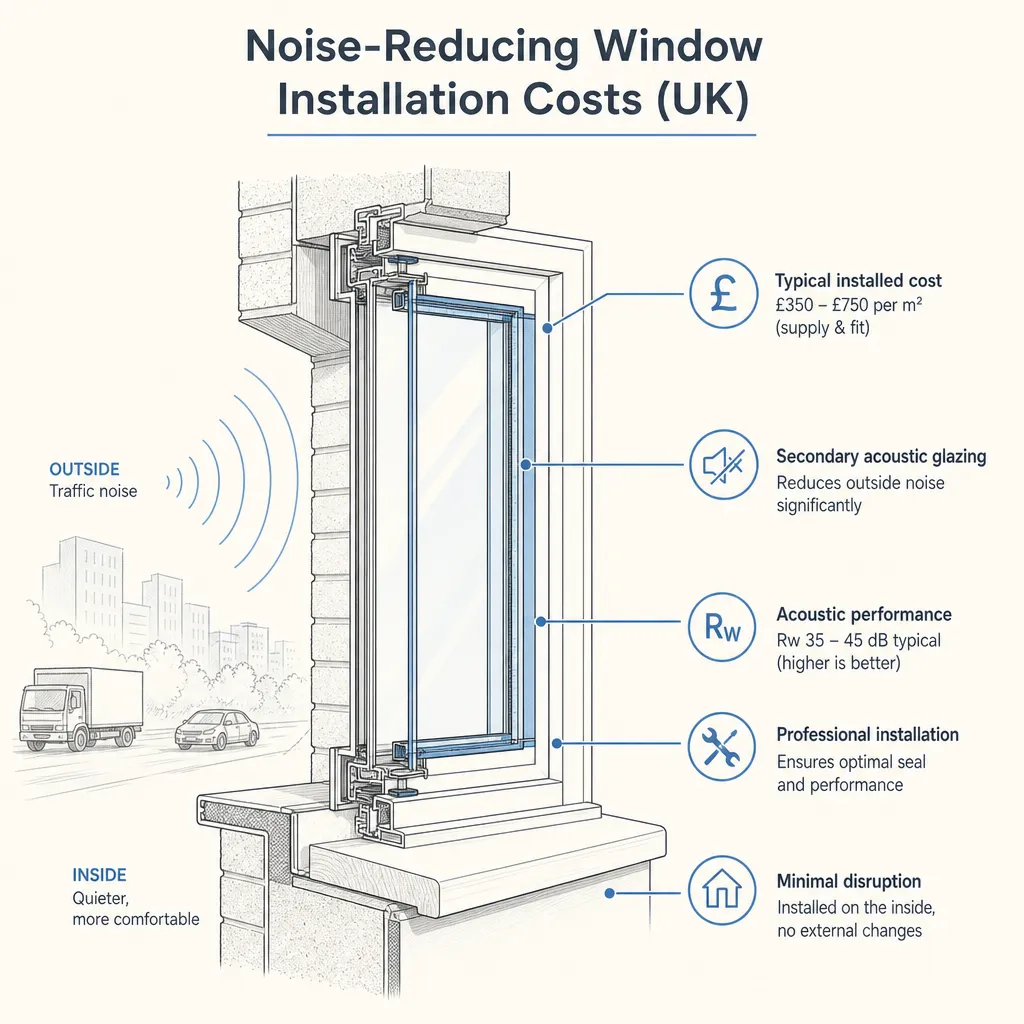
Noise-Reducing Window Installation Costs
Noise-reducing window installation in the UK typically costs £400–£1,500 per window depending on glazing specification, frame material, and property type.
 Improvement & Build
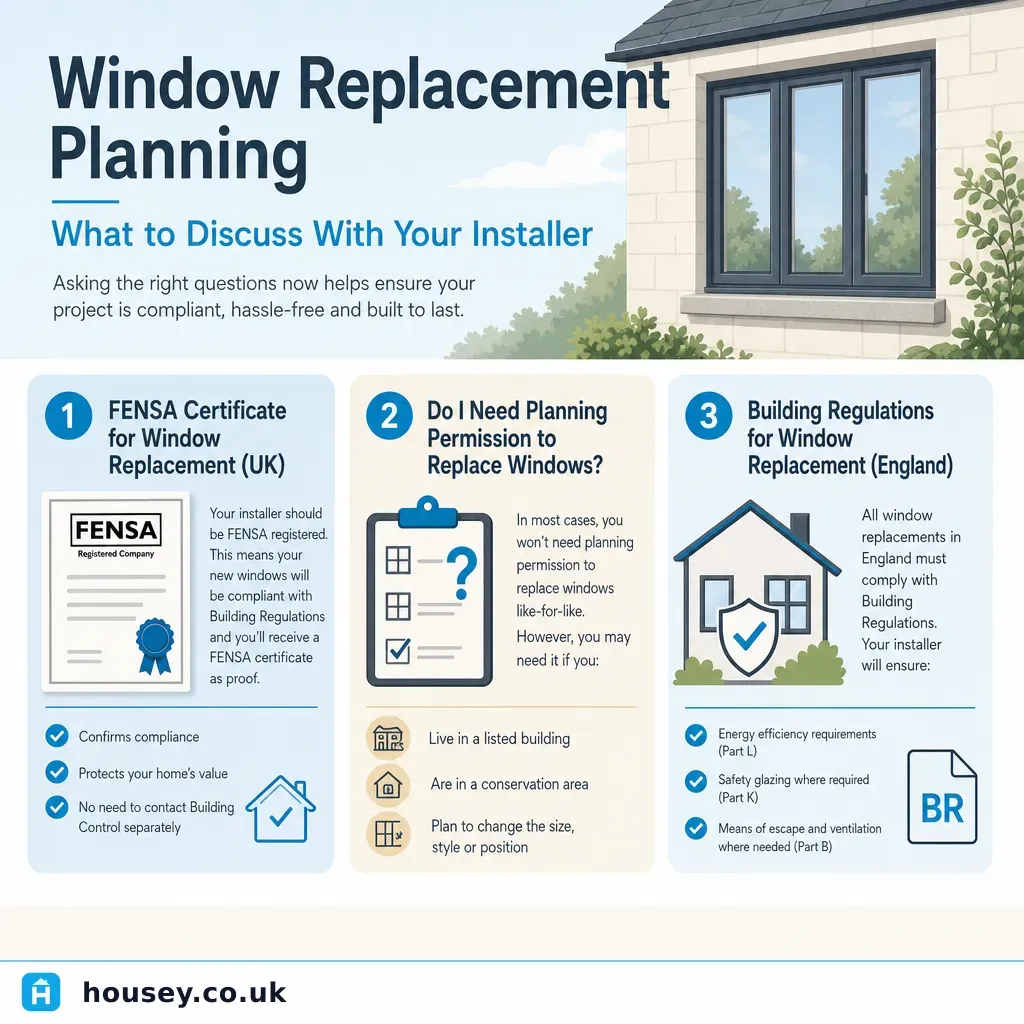
Window Replacement Planning: What to Discuss With Your Installer
Most window replacements in England fall under permitted development rights and do not require planning permission, but they must comply with Building Regulations Part L and Part K.
 Improvement & Build
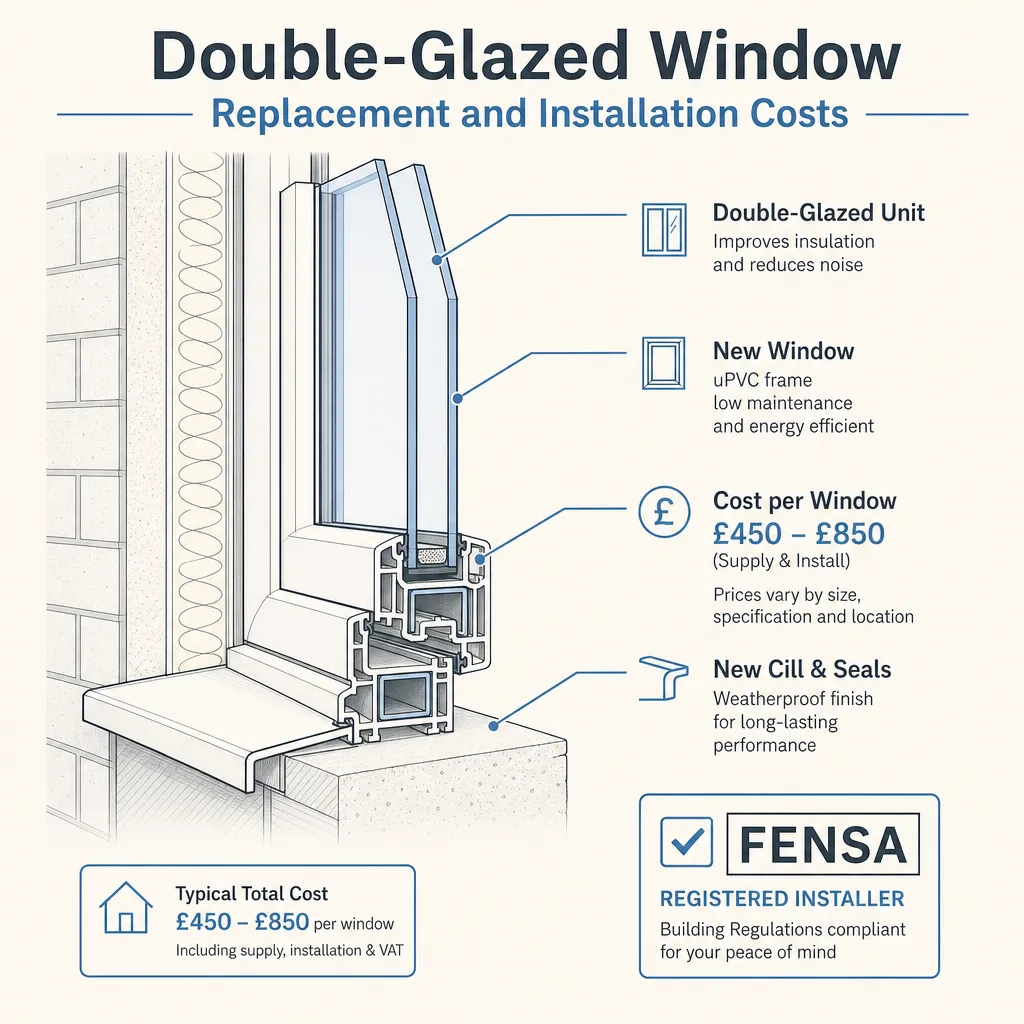
Double-Glazed Window Replacement and Installation Costs
Replacing double-glazed windows in a typical UK home costs roughly £300–£600 per uPVC casement window installed, rising to £500–£1,200 for timber and £400–£800 for aluminium.
 Improvement & Build
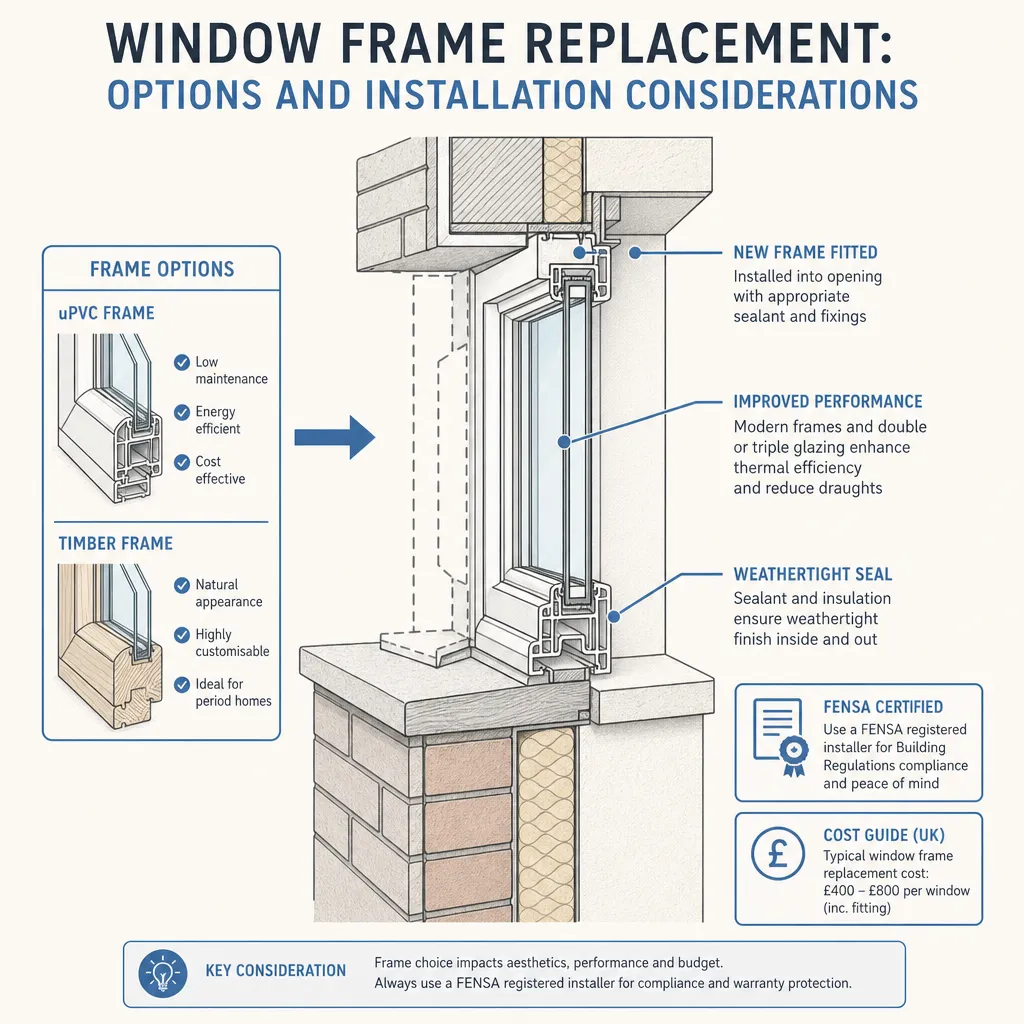
Window Frame Replacement: Options and Installation Considerations
Replacing window frames in the UK requires compliance with Part L of the Building Regulations and, in most cases, a FENSA or Certass certificate.
 Improvement & Build
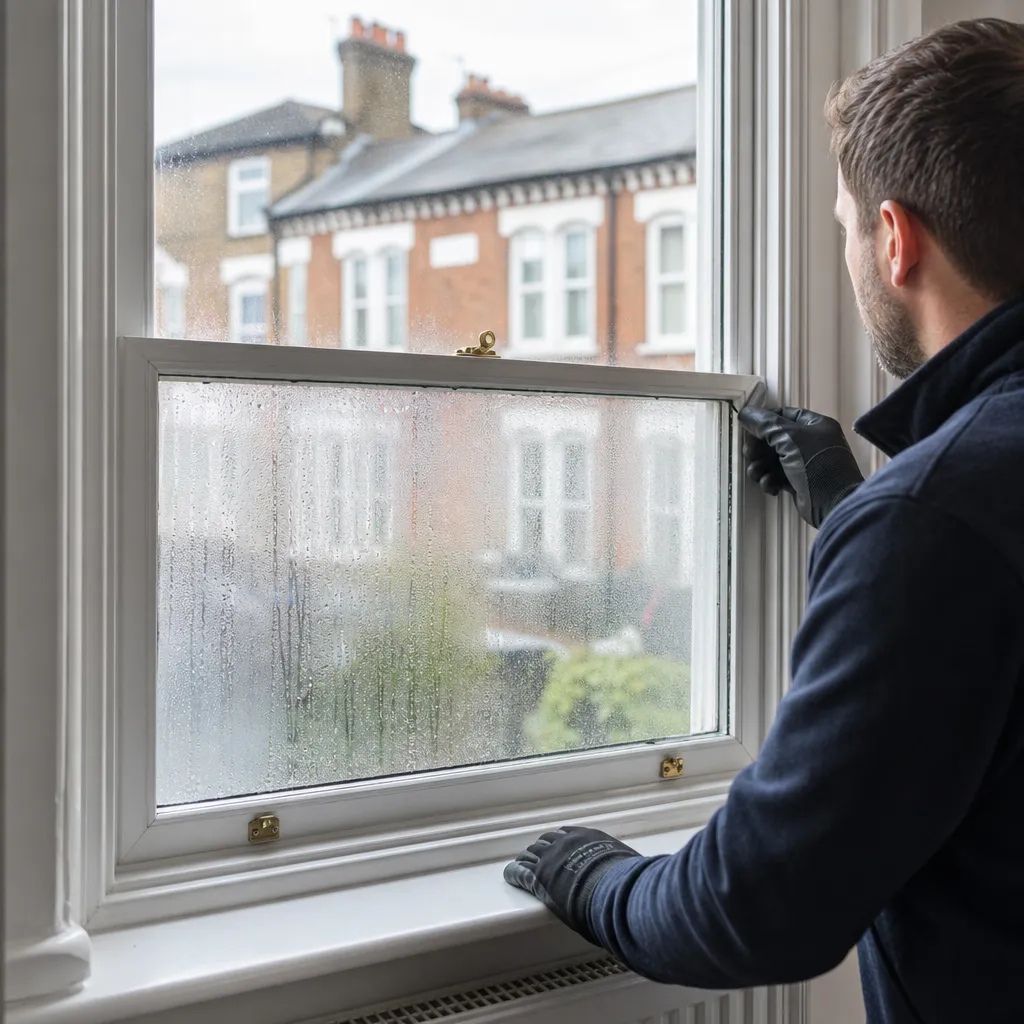
Repairing Failed Window Seals and Condensation Issues
Condensation between double-glazed panes means the hermetic seal on the insulated glass unit has failed.