Composite Decking Costs and Installation: Materials Comparison
By Housey · Last reviewed 31st of May 2026
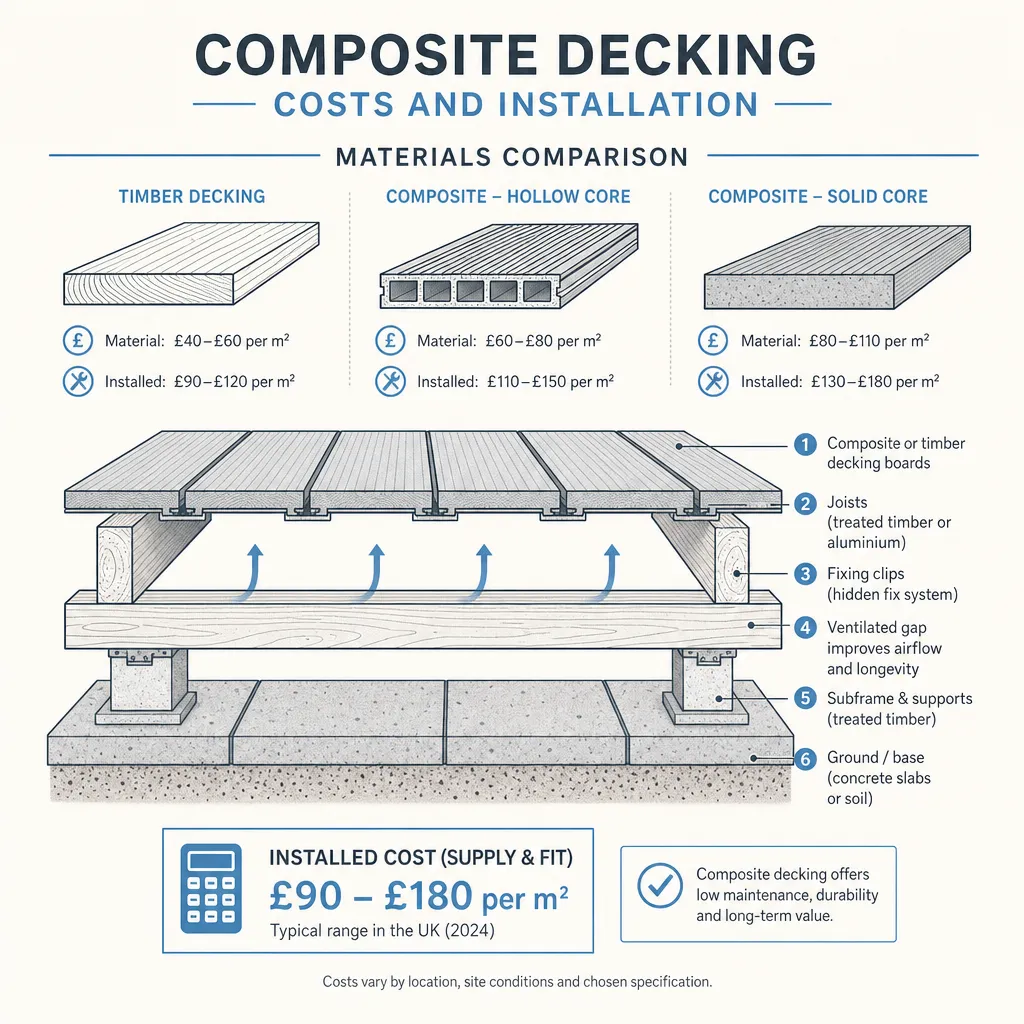
Composite Decking Costs and Installation: Materials Comparison
Deciding on the right decking material is one of the first — and most consequential — choices in a garden improvement project. Composite boards now dominate the UK market for new domestic installations, but the term covers a wide range of products with very different performance, durability, and cost profiles. Understanding what drives the price helps you choose the right specification and read supplier quotes with confidence before committing.
Key points
- Composite decking boards cost £30–£100 per square metre for materials alone; professional installation adds £40–£100 per square metre depending on site complexity (Indicative UK costs, last reviewed 2026-05-31).
- There are three main board types — hollow-core, capped hollow-core, and solid-core — each with different load tolerance, stain resistance, and warranty length.
- For most houses, decking under 30cm above ground covering less than 50% of the garden does not require planning permission, but conservation areas and listed buildings are exceptions.
- Sub-frame material (treated softwood, composite joists, or aluminium) can add 20–40% to material costs but significantly affects long-term stability in damp or poorly ventilated sites.
- Capped boards require manufacturer-specified hidden clip fixings rather than surface screws to avoid penetrating the protective cap layer; confirm the fixing system before signing a quote.
What does composite decking cost in the UK?
Most composite decking projects in the UK fall in the range of £80–£200 per square metre fully installed, but the figure depends heavily on which board you choose and how complex the site is.
Indicative UK costs, last reviewed 2026-05-31 (source: Checkatrade, APL member data):
Board type | Material cost (per m²) | Installed cost (per m²) | Typical warranty |
|---|---|---|---|
Hollow-core composite | £30–£50 | £70–£130 | 10–15 years |
Capped hollow-core composite | £50–£80 | £90–£160 | 15–25 years |
Solid-core composite | £70–£100 | £110–£200 | 25+ years |
Pressure-treated softwood (comparison) | £15–£30 | £50–£100 | 10–15 years (with annual treatment) |
Quotes vary significantly by region, access, site preparation, and whether old decking removal is included. Always ask whether the sub-frame, fixings, fascia boards, and post bases are included before comparing figures.
Composite vs timber: which is right for your garden?
The comparison between composite and natural timber usually comes down to lifetime cost versus upfront price.
Composite advantages: no annual staining or sealing; splinter-free surface; consistent colour retention; minimal maintenance beyond annual cleaning; manufacturer warranties typically 15–25 years.
Timber advantages: lower initial cost; individual boards easier to replace; more sustainable if FSC-certified; warmer natural appearance; simpler to cut on site.
Decision tree: choosing your decking material
- Choose hollow-core composite if budget is the primary concern and the deck receives light foot traffic from a small household.
- Choose capped hollow-core composite if you want low-maintenance performance for a family or pet-friendly garden with mid-range durability.
- Choose solid-core composite if the deck is a high-traffic area, will be cut into curves or intricate shapes, or you want the longest possible lifespan.
- Choose pressure-treated softwood if upfront cost is critical and you are comfortable with annual oiling or staining.
- Ask a landscaper or garden designer if the site has drainage issues, a significant slope, or requires a raised structure above 30cm — structural and drainage planning is essential in these cases.
Understanding composite board types in detail
Hollow-core composite
The most affordable entry point. These boards have a voided centre, making them lighter to handle. However, hollow-core boards are less resistant to heavy or point loads, may flex if joist spacing is too wide, and are usually not fully capped, making them more porous and prone to staining. Warranties tend to be shorter — typically 10–15 years.
Capped hollow-core composite
A significant step up in performance. The cap — an outer shell of PVC or polymer encasing the board surface — makes capped boards more stain-resistant, fade-resistant, and moisture-resistant. These are the most commonly specified boards for domestic gardens in the UK. Brands such as Trex, Millboard, and Cladco offer capped products across a range of price points.
Solid-core composite
The heaviest and most durable option. Because the board material is consistent throughout, it can be cut at any angle without exposing a void — making it suitable for curved decking, complex patterns, hot tub surrounds, and roof terraces. Solid-core boards command a price premium, but manufacturer warranties often extend to 25 years or beyond.
What affects installation cost?
Beyond board specification, the following factors drive the installed price:
- Sub-frame specification: Treated softwood joists are most affordable but require adequate clearance and ventilation. Composite or aluminium joists perform better in damp or poorly ventilated sites.
- Site preparation: Clearing existing paving, levelling ground, or installing concrete pads adds to labour time.
- Access: Restricted rear garden access — narrow passages, steps, or gated entries — may mean materials are carried through the house, adding time and cost.
- Shape and detail: Straight boards on a rectangular deck are the cheapest to lay. Steps, curves, picture-frame borders, and integrated lighting all increase the labour element.
- Waste removal: Confirm whether old decking removal and disposal is included or charged separately.
Pre-installation homeowner checklist
Before accepting a quote, work through these checks to avoid surprises on installation day:
When to get professional help
Composite decking is generally low-risk, but seek professional advice rather than attempting DIY in these situations:
- The deck will be elevated more than 30cm above the ground, where building regulations may apply to the structure.
- The proposed deck will cover more than 50% of the rear garden, which has planning implications.
- There are drainage gullies, manholes, or underground services beneath the proposed area — these must remain accessible.
- The site has a significant slope requiring a designed structural sub-frame.
- The property is in a conservation area or is listed — check with your local planning authority before any work commences.
How Housey can help
Housey connects homeowners with vetted landscapers and garden designers who can assess your garden, recommend the right composite board specification, and provide itemised quotes. Use the Housey platform to compare credentials and pricing before committing.
Frequently asked questions
Does composite decking need planning permission?
In most cases, no. Composite decking under 30cm in height covering less than 50% of the rear garden usually falls within permitted development rights for houses. Conservation areas, listed buildings, and flats are subject to different rules. Always check with your local planning authority before starting work if you are in any doubt.
How long does composite decking last?
Hollow-core composite typically lasts 10–15 years. Capped hollow-core is usually warranted for 20–25 years, and solid-core composite can last 25–30 years or more. Actual lifespan depends on installation quality, drainage beneath the deck, and how regularly the surface is cleaned to prevent organic build-up.
Can composite decking be laid over an existing timber deck?
Sometimes, but it is not usually recommended without a structural assessment first. The existing sub-frame must be sound, level, and correctly spaced to match the new board's joist-span requirements. An installer should inspect the existing frame before quoting to avoid premature failure or a voided manufacturer warranty.
Does composite decking get hot in summer?
Composite boards can become warmer underfoot than timber in direct sunlight, particularly in darker colourways. Lighter-coloured boards and grooved surface profiles retain less heat. Ask your supplier for thermal performance data if this is a concern, particularly for south-facing decks that receive full sun throughout the day.
Sources and further reading
- Planning Portal: decking and planning permission — Planning Portal / GOV.UK
- Association of Professional Landscapers — trade body for landscaping professionals; member search for qualified contractors
- Composite decking cost guide — Checkatrade indicative cost data for UK homeowners
Useful next reads
 Improvement & Build
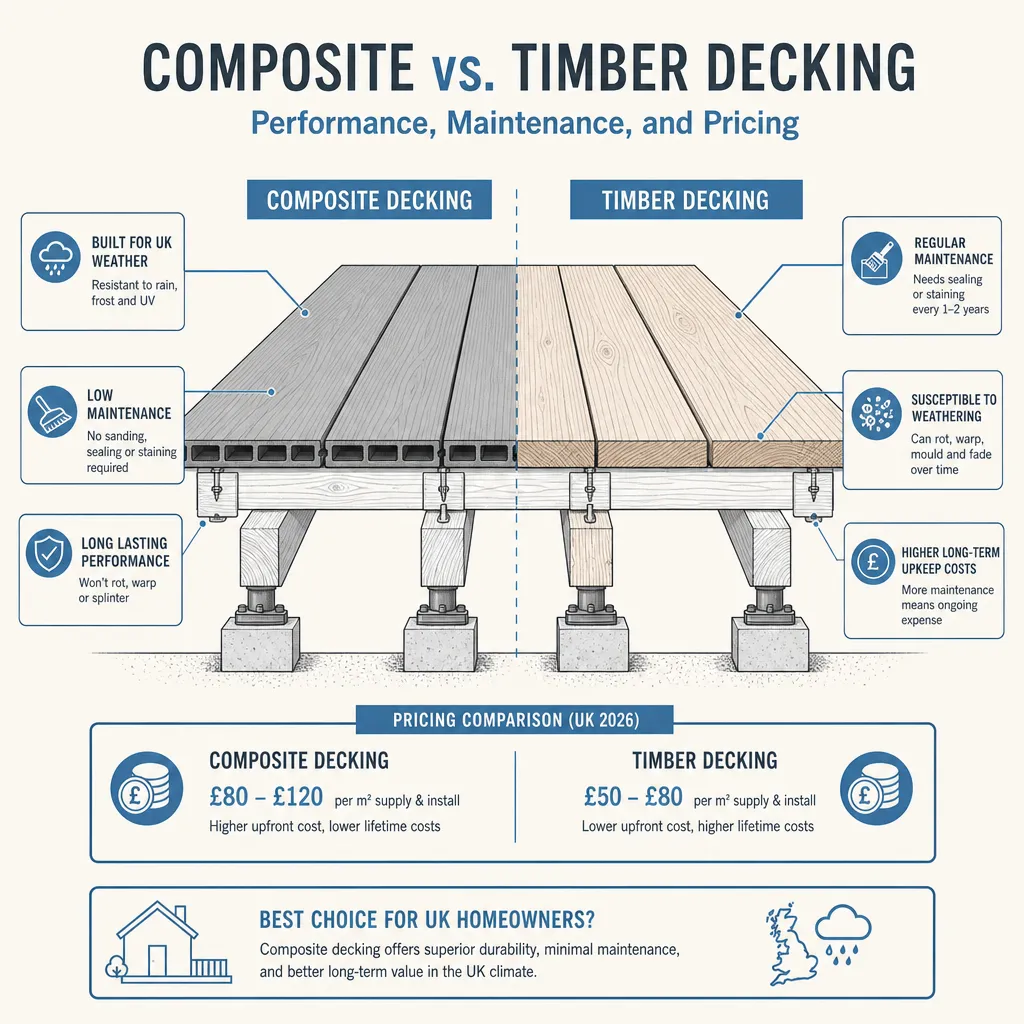
Composite vs. Timber Decking: Performance, Maintenance, and Pricing
Composite decking costs more upfront — typically £120–£220 per m² installed versus £80–£150 for treated softwood — but requires far less maintenance and carries a 25-year warranty.
 Improvement & Build
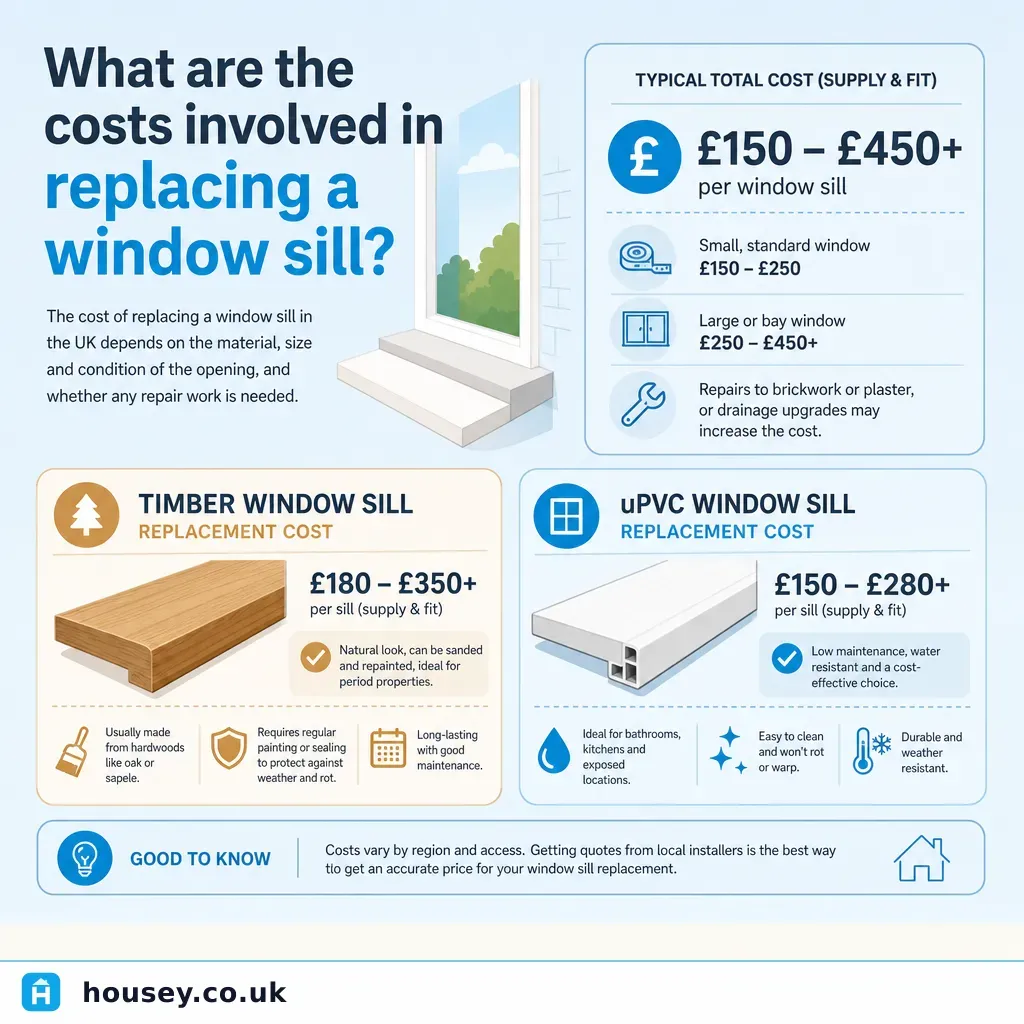
What are the costs involved in replacing a window sill?
Window sill replacement in the UK typically costs £100–£350 per window, depending on material, sill length, and access.
 Improvement & Build
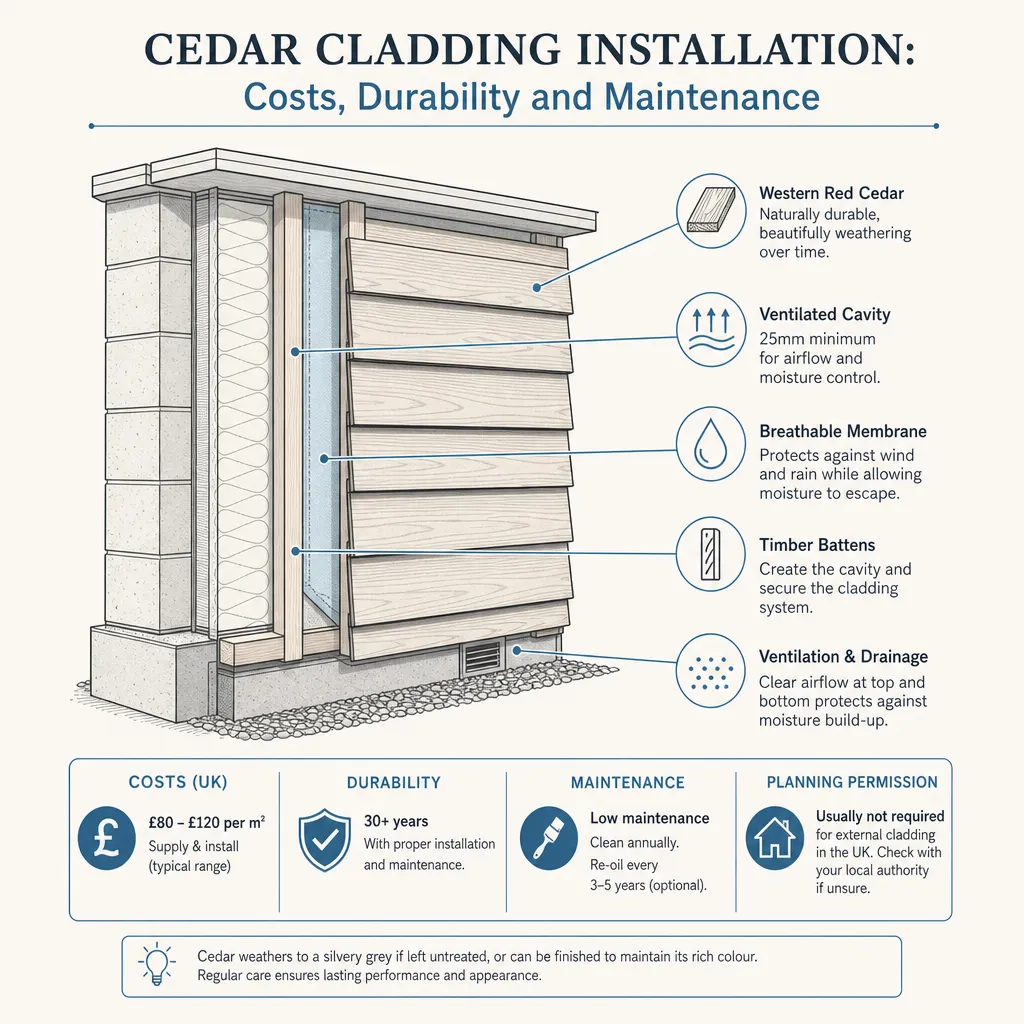
Cedar Cladding Installation: Costs, Durability and Maintenance
Cedar cladding is a natural timber exterior finish popular for UK homes and extensions.
 Improvement & Build
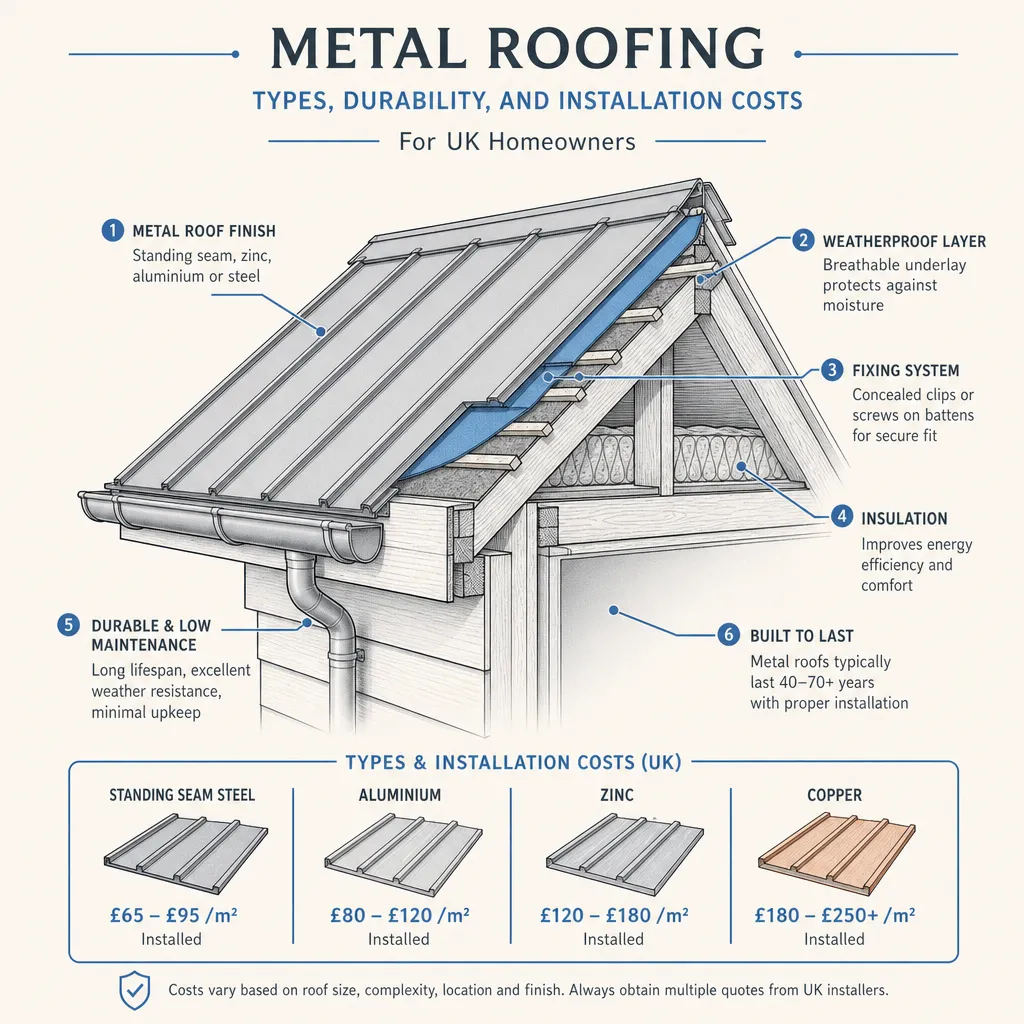
Metal Roofing: Types, Durability, and Installation Costs
Metal roofing in the UK includes standing seam, corrugated sheet, and metal tile systems in steel, aluminium, zinc, or copper.
 Improvement & Build
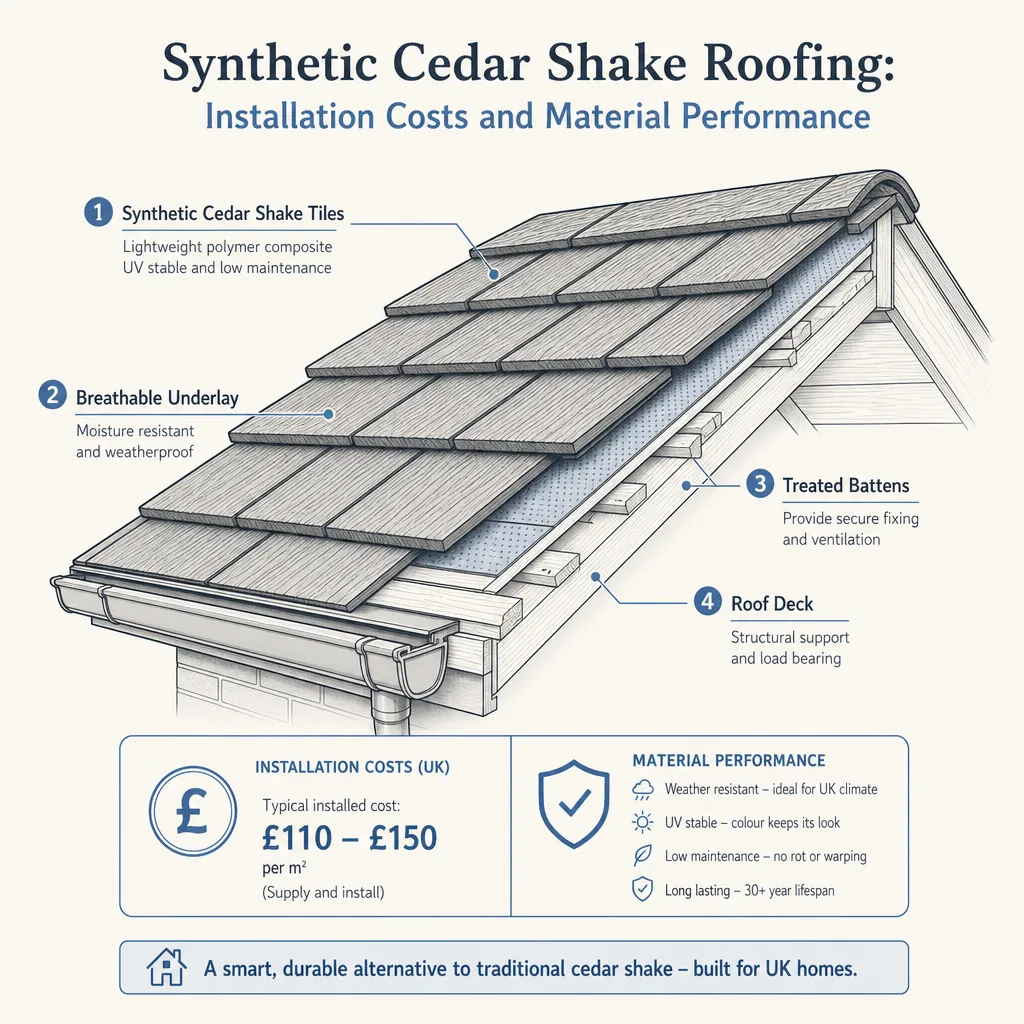
Synthetic Cedar Shake Roofing: Installation Costs and Material Performance
Synthetic cedar shake roofing uses polymer composite, rubber, or fibre-cement tiles to replicate the look of natural cedar wood shingles.