Composite vs. Timber Decking: Performance, Maintenance, and Pricing
By Housey · Last reviewed 6th of May 2026
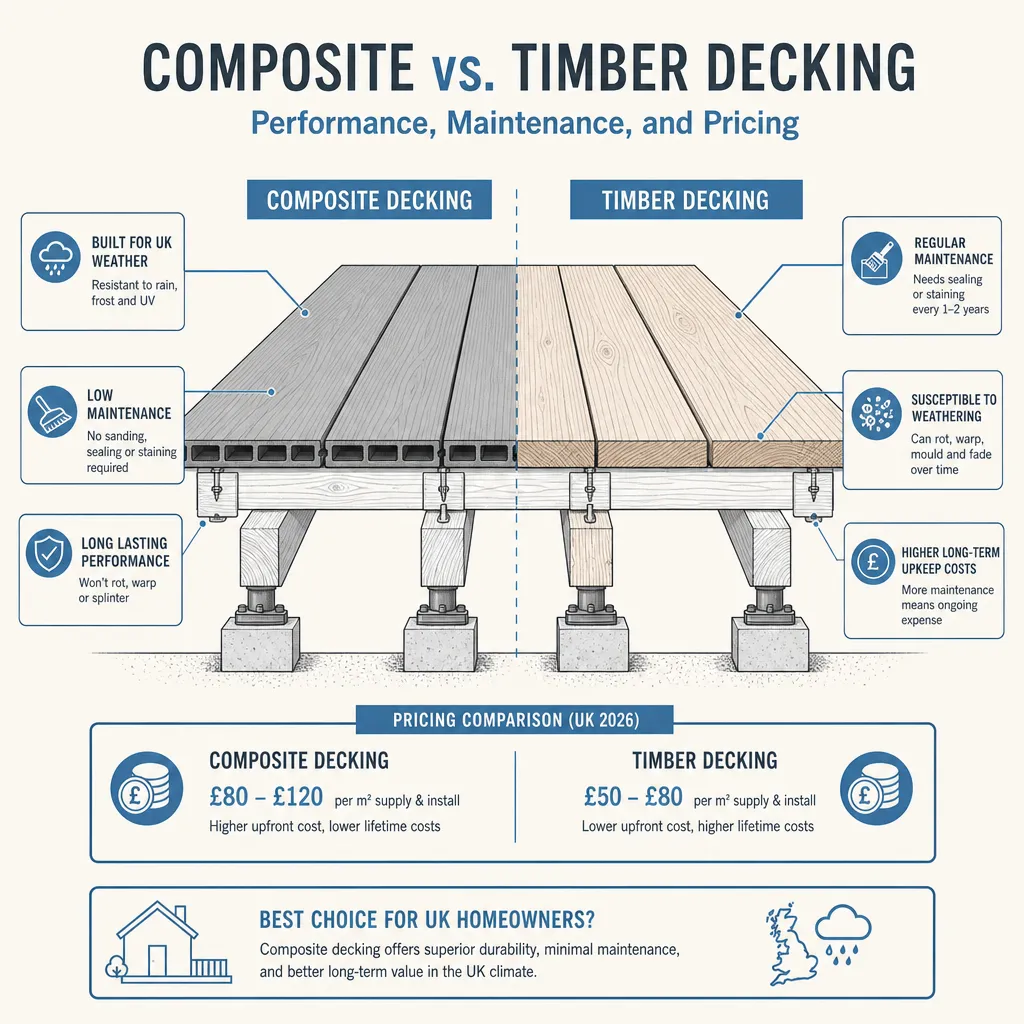
Composite vs. Timber Decking: Performance, Maintenance, and Pricing
Choosing between composite and timber decking is one of the most consequential material decisions in a garden build, affecting upfront cost, maintenance burden, and how well the surface holds up across decades in UK conditions. The question comes up most often when planning a new deck from scratch, replacing a warped or rotting timber structure, or trying to weigh long-term costs before getting contractor quotes. Both materials have genuine strengths — the right choice depends on budget, maintenance appetite, and site conditions.
Key points
- Composite decking boards typically cost £60–£120 per m² for materials alone; pressure-treated softwood costs £25–£60 per m² (indicative UK costs, last reviewed 2026-05-06).
- Installed composite decking is approximately £120–£220 per m²; treated softwood is typically £80–£150 per m² installed.
- Capped composite decking needs only periodic washing; timber requires annual cleaning and oiling or staining to resist rot and discolouration.
- Composite boards typically carry a 25-year manufacturer warranty; pressure-treated softwood has a realistic lifespan of 10–15 years with consistent maintenance.
- Decking over 30cm above ground level, or within 2m of a boundary, may require Building Regulations notification or a planning application — check before building.
How composite and timber decking compare
Factor | Composite decking | Pressure-treated timber |
|---|---|---|
Material cost (per m²) | £60–£120 | £25–£60 |
Installed cost (per m²) | £120–£220 | £80–£150 |
Typical lifespan | 25–30 years | 10–15 years (with maintenance) |
Annual maintenance | Wash twice a year | Clean and oil or stain annually |
Slip resistance when wet | Good (textured boards) | Variable; can be slippery untreated |
Splinters | None | Possible as timber ages and dries |
Appearance over time | Colour-stable (capped); may fade (uncapped) | Greys naturally unless treated |
Thermal expansion | Higher — requires specific fixing gaps | Lower |
Sustainability | Often contains recycled content | FSC-certified timber is renewable |
Repairability | Difficult to match boards later | Easy to replace individual boards |
Performance in UK conditions
Composite decking blends wood fibre and plastic (PVC or polyethylene), often with recycled content. Capped composite boards — where the core is encased in a protective polymer shell — resist moisture ingress, staining, and fading significantly better than uncapped boards in UK weather. Uncapped composite can absorb moisture and develop mould in shaded, north-facing gardens, which are common in UK properties.
Pressure-treated softwood is treated to Use Class 3 to resist fungal decay and insect attack above ground. Without annual oiling or staining, even treated timber will grey, check (develop surface cracks), and eventually delaminate. Hardwood species such as garapa, ipe, or Accoya are naturally more durable but cost significantly more per m² and still require regular oiling to maintain colour and water resistance.
Maintenance: what each material actually requires
Composite decking maintenance
- Sweep or leaf-blow debris from grooves regularly — organic matter promotes mould growth.
- Wash twice a year with warm soapy water or a composite-specific cleaner; avoid pressure washers above 1,400 PSI, which can damage the surface.
- Remove stains (grease, rust from furniture) promptly with a composite cleaner.
- Check fixings annually — boards expand and contract more than timber; loose fixings cause squeaking or board lift.
Timber decking maintenance checklist
Skipping annual treatment on softwood dramatically shortens its lifespan. In shaded, north-facing positions, untreated decking can become dangerously slippery with algae growth within a single season.
Planning and Building Regulations for decking
Permitted development generally allows decking without a planning application provided: the deck is within the curtilage of a dwelling house; it does not cover more than 50% of the garden area; and its height does not exceed 30cm within 2m of a boundary.
Raised decks over 30cm high, decks forming a balcony, or any decking on listed buildings or in conservation areas typically need a planning application. Building Regulations may apply to structural elements of significantly raised decks — if the finished deck level exceeds around 600mm above ground, confirm requirements with a building control officer before work starts.
Which material should you choose?
- Choose composite decking if you want minimal annual maintenance, have a shaded or damp north-facing garden prone to algae, and can absorb the higher upfront cost.
- Choose pressure-treated softwood if upfront cost is the priority and you are comfortable with annual maintenance over the life of the deck.
- Choose hardwood decking if you want a premium natural material and will maintain it with regular oiling; budget £80–£200 per m² for boards.
- Ask a landscaper or garden designer if the deck is raised, requires drainage management, or is part of a larger garden scheme where levels and materials need coordinating from the outset.
Red flags when comparing decking quotes
- No material specification: Without a named timber treatment class or composite manufacturer and grade, quotes cannot be compared fairly — ask for this in writing.
- Sub-frame excluded: Joists, bearers, and fixings can add 30–50% to board-only prices; always confirm what the sub-frame allowance covers.
- No weed membrane mentioned: Omitting it leads to vegetation growth beneath the deck that traps moisture and accelerates structural decay.
- Suspiciously low composite price: Cheap uncapped boards are significantly inferior to capped products from established brands such as Millboard, Trex, or Cladco; a very low price often indicates lesser specification.
- No fixing gap allowance for composite: Composite expands and contracts more than timber; boards will buckle in warm weather if expansion gaps are not built into the installation.
When to get professional help
Most ground-level decks can be installed by competent landscape or garden contractors. Seek specialist input when the deck is raised more than 30–40cm on a sloped site (structural calculations may be needed); when it connects to the house structure (building control notification may apply and damp detailing must be correct); when you are in a conservation area or have a listed building; or when drainage from the deck could affect a boundary or neighbouring property.
How Housey can help
Housey connects you with vetted landscapers who can install both composite and timber decking, and with garden designers who can help plan layout, levels, and materials before work begins. Comparing itemised quotes through Housey makes it straightforward to assess what each price includes and choose the right contractor.
Frequently asked questions
Is composite decking worth the extra cost?
For many UK homeowners, composite's lower maintenance requirements and longer warranty make it cost-competitive over a 15–20 year horizon once annual treatment costs, periodic sanding, and board replacement are factored in. The upfront premium is often recouped if softwood decking would otherwise need replacing once or twice in the same period.
Does composite decking get hot in summer?
Capped composite can become warmer than timber in direct sunlight as the polymer surface retains heat. In south-facing UK gardens this is sometimes noticeable, though lighter-coloured boards reduce the effect. UK summers are rarely hot enough for sustained heat retention to be a persistent problem for most households.
How long does decking installation take?
A ground-level deck of 20–30m² typically takes 2–4 days including sub-frame preparation. Larger or raised decks may take 5–10 days. Some composite manufacturers have supply lead times of 2–4 weeks — factor this into your project timeline before placing a materials order.
Can composite decking be laid over an existing timber deck?
Not generally recommended. The existing structure must be sound, level, and free of rot; adding height creates threshold, drainage, and fixing integrity issues. Most installers will recommend removing the old deck entirely and inspecting the sub-frame condition before installing new boards.
What board thickness do I need for domestic decking?
For most domestic decks, 25–32mm composite boards and 32mm treated softwood boards are standard on joists at 400mm centres. Thinner boards (19–20mm) suit shorter joist spans at lower cost. Confirm board thickness and joist spacing with your installer before ordering to avoid flex and movement underfoot.
Sources and further reading
- Permitted development rights for householders: technical guidance — GOV.UK
- Building Regulations approval — GOV.UK
- TRADA technical information on timber use classes — TRADA (Timber Research and Development Association)
- FSC UK: responsible timber sourcing — Forest Stewardship Council UK
Useful next reads
 Improvement & Build
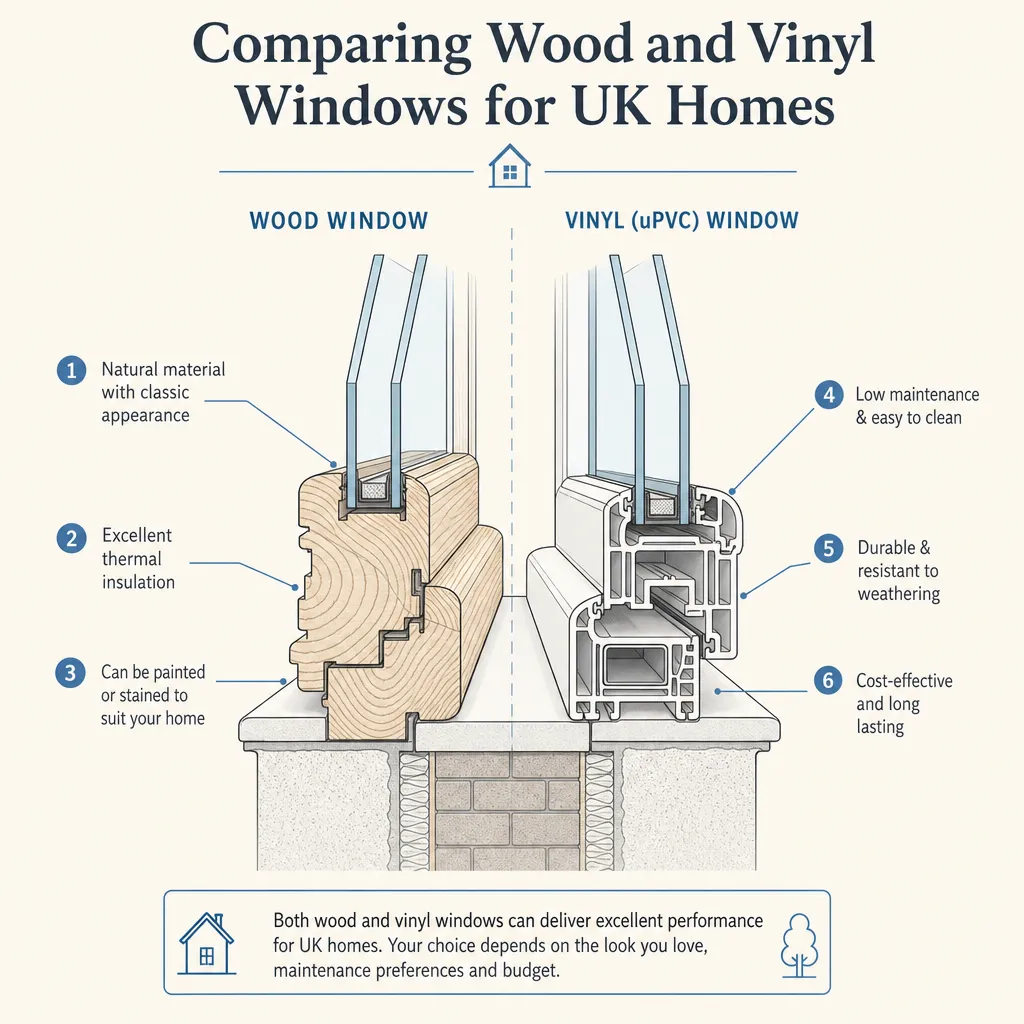
Comparing Wood and Vinyl Windows for UK Homes
Timber windows typically cost more upfront than uPVC but can last twice as long with regular maintenance.
 Improvement & Build
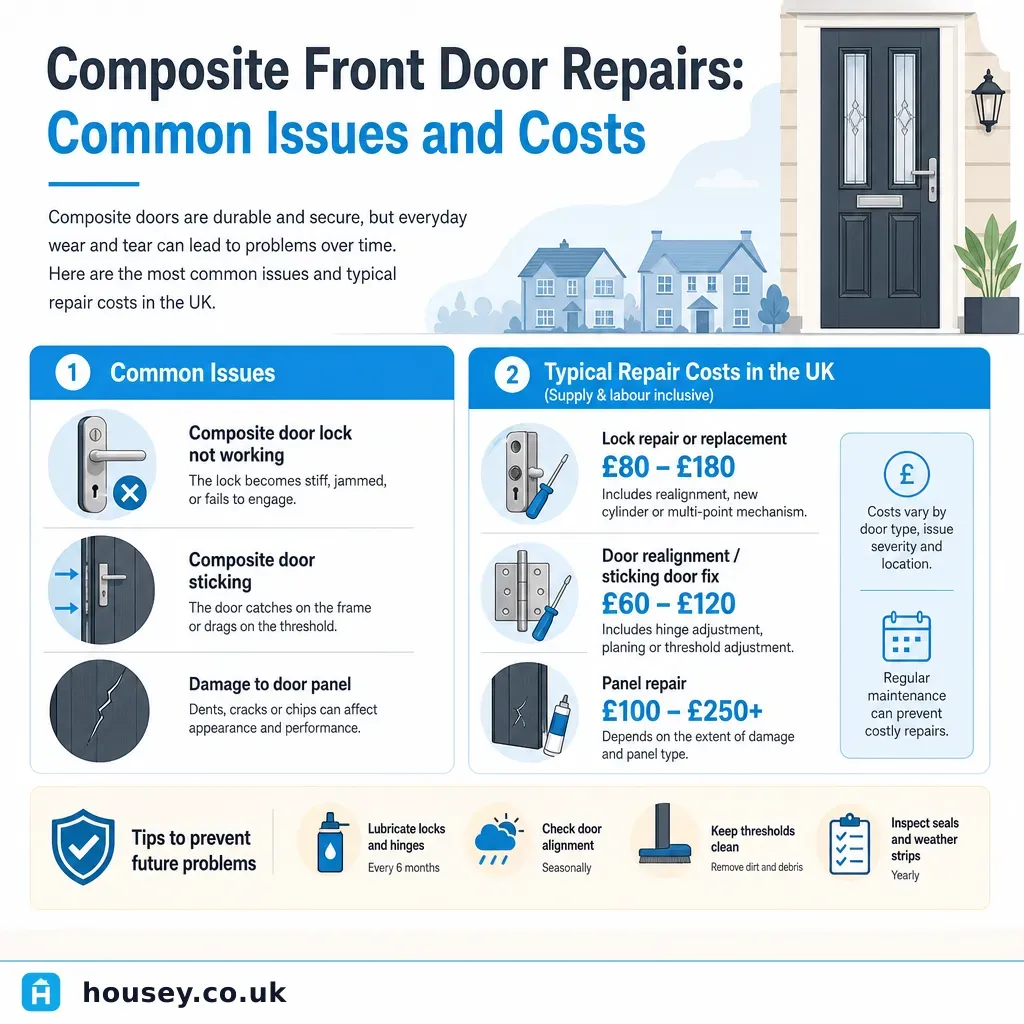
Composite Front Door Repairs: Common Issues and Costs
Common composite front door problems include misalignment, failing perimeter seals, multipoint lock faults, and cosmetic GRP damage.
 Improvement & Build
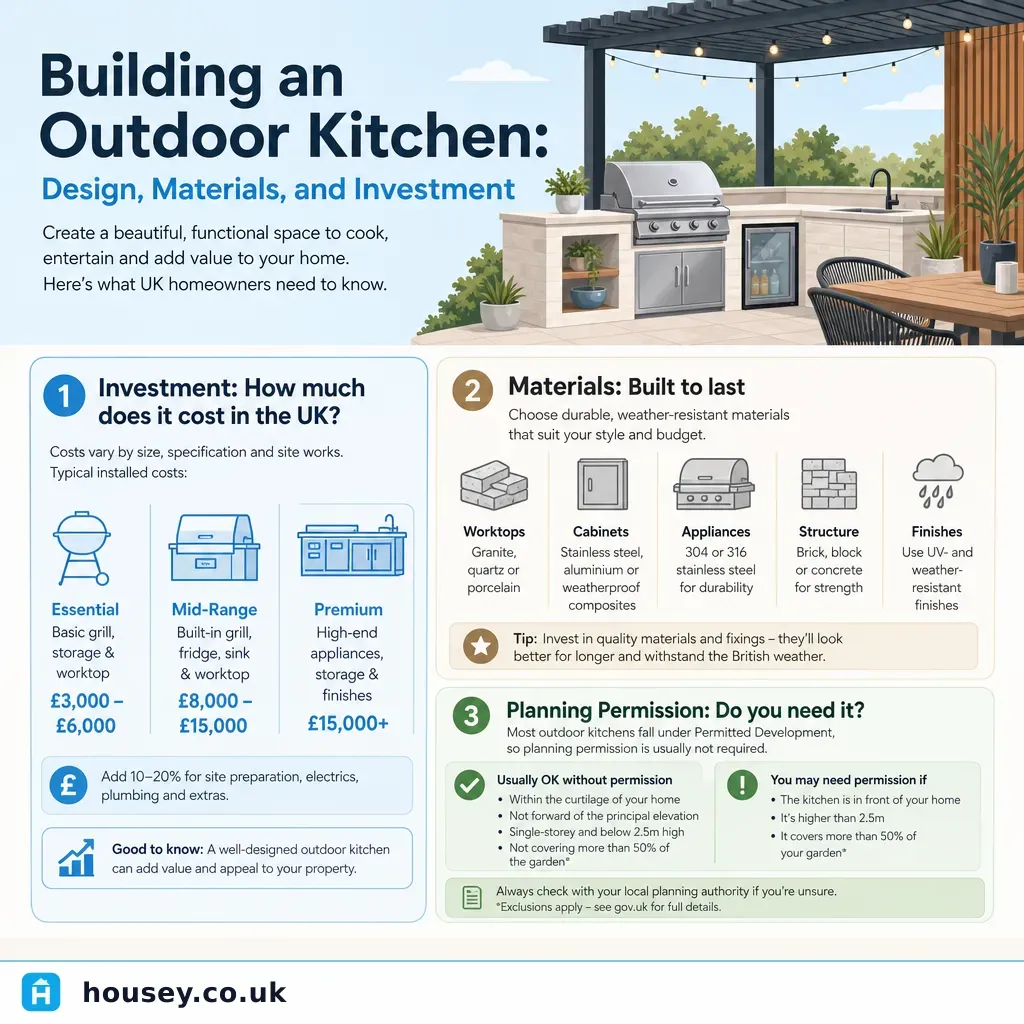
Building an Outdoor Kitchen: Design, Materials, and Investment
Building an outdoor kitchen in the UK costs roughly £3,000–£25,000 depending on size and materials.
 Improvement & Build
Window Screens and Insect Mesh: Options and Installation
UK window screens fall into four main types: fixed frame, roller retractable, pleated folding, and magnetic snap-fit.
 Improvement & Build
Cost of Wire Fence Installation in the UK
Wire fence installation in the UK typically costs £8–18 per metre for stock fencing, £15–35 per metre for chain-link, and £20–45 per metre for welded wire mesh panels, all installed.