Stock Tank Pools: Alternative Swimming Solutions and Installation Costs
By Housey · Last reviewed 24th of May 2026
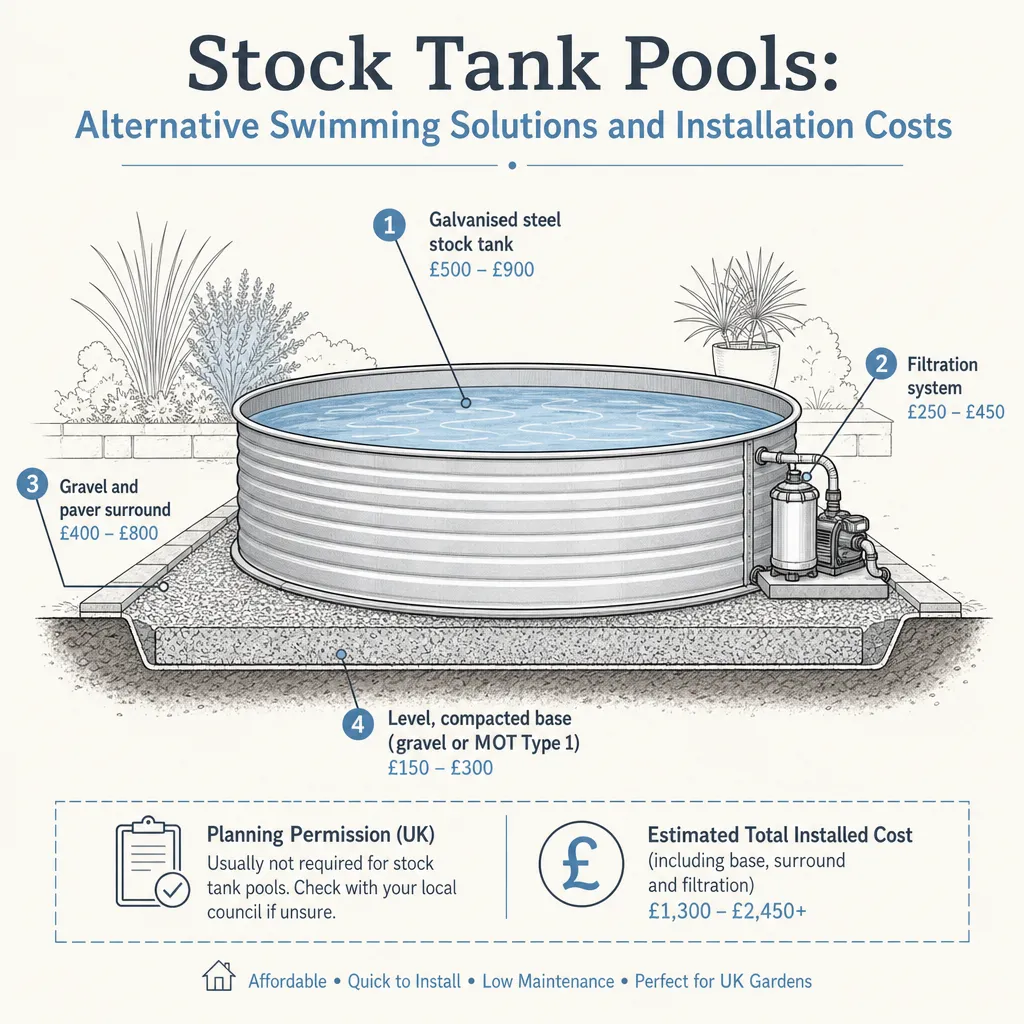
Stock Tank Pools: Alternative Swimming Solutions and Installation Costs
Stock tank pools have grown in popularity among UK homeowners looking for a cost-effective, compact alternative to a traditional built swimming pool. The question typically arises during a garden redesign or when a conventional pool feels financially or spatially out of reach — particularly in smaller urban gardens where a standard pool would dominate the available space. The decision involves balancing upfront cost, ongoing maintenance, planning considerations, and the practical realities of outdoor swimming in a variable UK climate.
Key points
- Stock tanks used as pools are galvanised steel agricultural water troughs, typically ranging from 1.5 m to 3.7 m in diameter and 0.6 m to 0.9 m deep.
- Indicative UK costs for a tank-only purchase range from £400 to £2,500; a fully installed setup including groundwork, filtration, and steps typically costs £2,000–£8,000.
- Most stock tank pools fall under permitted development and do not require planning permission, though properties in conservation areas, National Parks, or with listed building status should confirm with their local planning authority.
- A dedicated circulation pump and water treatment system (chlorine or saltwater) are required for safe use; untreated still water presents a health risk to bathers.
- Galvanised steel stock tanks are not insulated; without a heater, comfortable swimming conditions in the UK are typically limited to May–September.
What is a stock tank pool?
A stock tank pool is an agricultural water trough — typically galvanised mild steel — repurposed as a domestic plunge or swimming pool. Originally designed to water livestock, these tanks have gained traction as an affordable, relatively quick-to-install outdoor pool option across the UK.
Standard round tanks suitable for pool use range from approximately 1.5 m to 3.7 m in diameter, with depths of 0.6 m to 0.9 m. Oval and rectangular formats are also available from agricultural suppliers and a growing number of garden retailers.
Key characteristics:
- Material: Hot-dipped galvanised steel; some options use powder-coated or painted finishes
- Weight (empty): Much lighter than a concrete pool shell; a 2.4 m diameter tank typically weighs 80–130 kg
- Capacity: A 2.4 m diameter tank holds approximately 3,000–4,000 litres of water
- Lifespan: Galvanised steel tanks typically last 10–25 years depending on water chemistry and maintenance; corrosion is accelerated by unbalanced pH levels
Stock tank pool vs traditional pool
Feature | Stock tank pool | Traditional in-ground pool | Above-ground kit pool |
|---|---|---|---|
Typical UK installed cost | £2,000–£8,000 | £25,000–£80,000+ | £1,000–£5,000 |
Installation time | Days to weeks | Several months | Days |
Planning permission | Usually not required | Often required | Usually not required |
Typical lifespan | 10–25 years | 25–50+ years | 5–15 years |
Insulation and heating | Poor; add-on heater needed | Good (in-ground retains heat) | Moderate |
Aesthetics | Industrial/rustic | High-end | Utilitarian |
Groundwork required | Levelling slab or pad | Extensive excavation | Level ground |
Maintenance complexity | Low–moderate | High | Low–moderate |
Indicative UK costs, last reviewed 2026-05-24. Quotes vary significantly by region and specification.
How much does a stock tank pool cost in the UK?
Costs depend on tank size, filtration system, groundwork, and accessories such as steps, heating, and decking surround.
Tank purchase (indicative, 2026-05-24):
- 1.5 m diameter: £400–£800
- 2.4 m diameter: £700–£1,500
- 3.0 m diameter: £1,200–£2,500
Additional costs to budget for:
- Concrete levelling pad or compacted hardcore base: £300–£1,200
- Circulation pump and filter: £150–£600
- Saltwater or chlorine treatment system: £50–£300
- Steps or ladder: £80–£250
- Solar or electric heater: £200–£1,000
- Timber decking or surround: £500–£3,000+
- Professional installation labour: £300–£1,500
A realistic total for a 2.4 m tank, basic filtration, a levelling base, and simple steps typically falls between £2,000 and £5,000 when professionally installed. Obtain at least three quotes and ask what groundwork assumptions are included.
Indicative UK costs, last reviewed 2026-05-24.
Do I need planning permission for a stock tank pool?
In most cases, a stock tank pool is a moveable or temporary structure and does not require planning permission under standard permitted development rights. However, there are important exceptions:
- Conservation areas and National Parks: Permitted development rights may be restricted; confirm with your local planning authority before installation.
- Listed buildings: Any alteration to the curtilage of a listed building may require listed building consent.
- New builds with planning conditions: Some developments have conditions that restrict garden structures.
- Position near boundaries: In sensitive locations, pools visible from a public highway may attract additional scrutiny.
For most homes with a rear garden not in a designated area, a stock tank pool can typically be installed without a planning application. If in doubt, contact your local planning authority — pre-application advice for minor queries is usually free.
Installation: what the groundwork involves
Proper ground preparation is important for safety and longevity. A 2.4 m tank filled with water weighs approximately 3,000–4,500 kg, so the base must be engineered to support this load. Key steps:
- Site selection: Choose a level, well-drained area. Avoid low-lying ground prone to waterlogging.
- Ground preparation: A compacted hardcore base with a concrete pad, or a purpose-built timber platform, is usually required to support the full water weight safely.
- Drainage: Plan where the tank will drain when emptied; discharging chlorinated water directly onto a lawn can cause damage.
- Pump fitting: Most tanks require a hole cut for the pump inlet and outlet — care must be taken not to compromise the galvanised coating at cut edges.
- Water treatment setup: Establish a regular testing and chemical treatment routine before the first swim.
A professional groundworker can handle base preparation and siting. Pump wiring, if required, must be installed by a Part P registered electrician on an RCD-protected outdoor circuit.
Homeowner checklist before buying a stock tank pool
When to get professional help
Most stock tank pool installations are straightforward, but professional input is advisable when:
- The ground is uneven, sloped, soft, or waterlogged — a groundworker should assess base requirements before any purchase
- The tank will sit on or near a raised deck or structure — structural assessment may be needed to confirm load-bearing capacity
- Electrical connections for the pump require a new outdoor circuit — a Part P registered electrician must carry out this work
- Any drainage outlet connects to a public sewer — this may require consent from your water company or local authority
How Housey can help
If your stock tank pool project involves significant ground preparation, a concrete base, or levelling on an uneven site, an experienced groundworker can assess the site conditions and prepare a solid, safe foundation. Housey connects you with local groundworkers who can provide competitive quotes for your project.
Frequently asked questions
How long does a stock tank pool last in the UK?
A well-maintained galvanised steel stock tank typically lasts 10–25 years. The main risk is corrosion from unbalanced water chemistry. Keeping pH between 7.2 and 7.6 and alkalinity at recommended levels significantly extends tank life. Some owners apply a protective internal liner or coating for added protection.
Can I heat a stock tank pool in the UK?
Yes. A solar cover is the simplest option, typically raising water temperature by 4–8°C in warmer months. Electric heaters can also be fitted. Gas pool heaters require connection by a Gas Safe registered engineer. Without any heating, comfortable outdoor swimming in the UK is generally limited to late May through early September.
Do I need a pump and filter for a stock tank pool?
Yes. A circulation pump and filtration system are essential for any stock tank used for regular swimming. Still, untreated water quickly becomes unsafe. A basic pump and filter system costs from around £150; saltwater chlorination systems are popular as they require less manual chemical dosing than traditional chlorine treatment.
Is a stock tank pool safe for children?
Stock tank pools are shallow — typically 0.6–0.9 m deep — but present a drowning risk for young children, as with any body of standing water. A lockable pool cover, surrounding fencing, or a physical barrier is strongly advisable if children have access to the garden. Always supervise children near the pool.
Sources and further reading
- Planning Portal: swimming pools and hot tubs — Planning Portal (GOV.UK-affiliated)
- HSE: leisure swimming guidance — Health and Safety Executive
- BISHTA: water quality guidance for pools and spas — British and Irish Spa and Hot Tub Association
Useful next reads
 Improvement & Build
Designing an outdoor kitchen for entertaining and garden living
An outdoor kitchen in a UK garden needs a stable, level base — typically a concrete slab or quality paving — with weather-rated materials such as stainless steel grade 316 or frost-rated porcelain.
 Improvement & Build
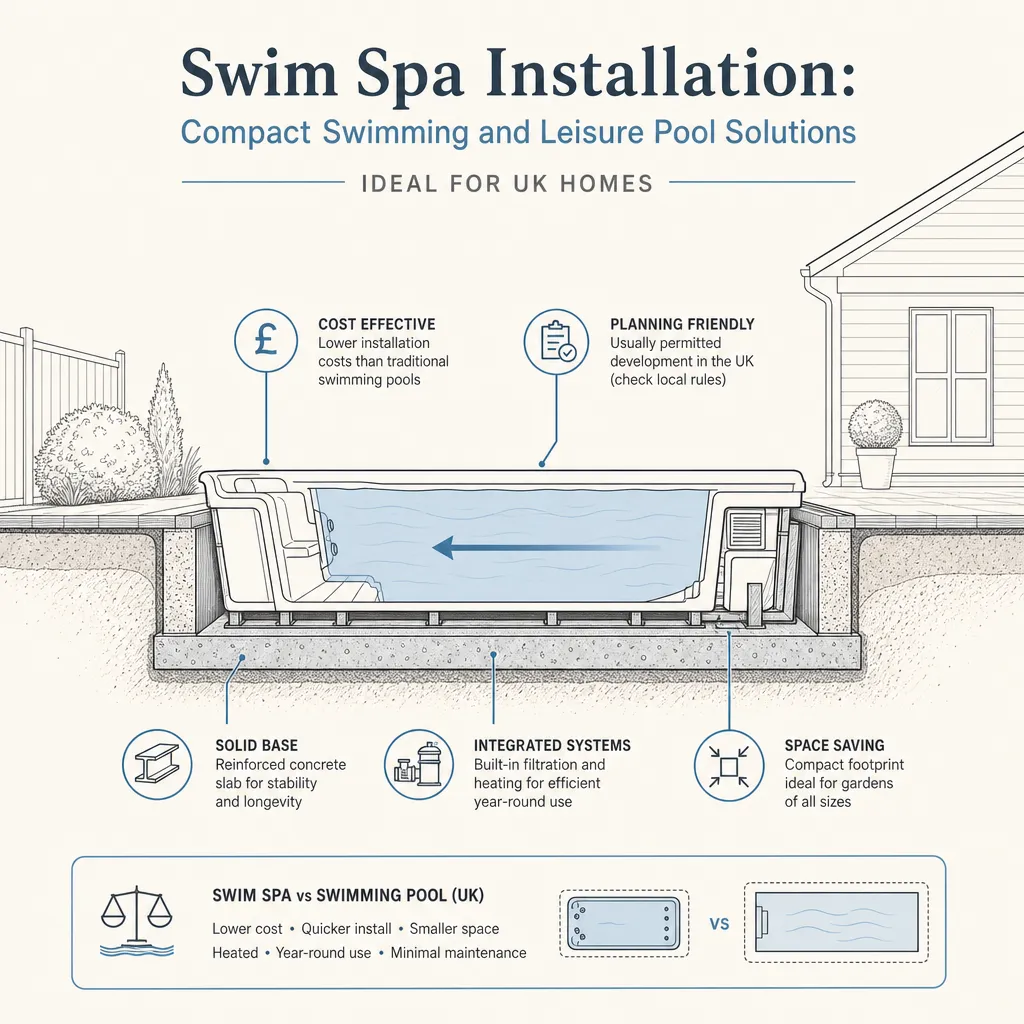
Swim Spa Installation: Compact Swimming and Leisure Pool Solutions
A swim spa typically needs a reinforced concrete base, a dedicated 32A or 63A electrical supply installed by a Part P-registered electrician, and site preparation by a groundworker.
 Improvement & Build
Solar-powered outdoor lighting: designing efficient garden illumination
Solar-powered outdoor lighting suits most UK gardens and requires no mains wiring, making it a practical, low-disruption option for paths, borders, and security.
 Improvement & Build
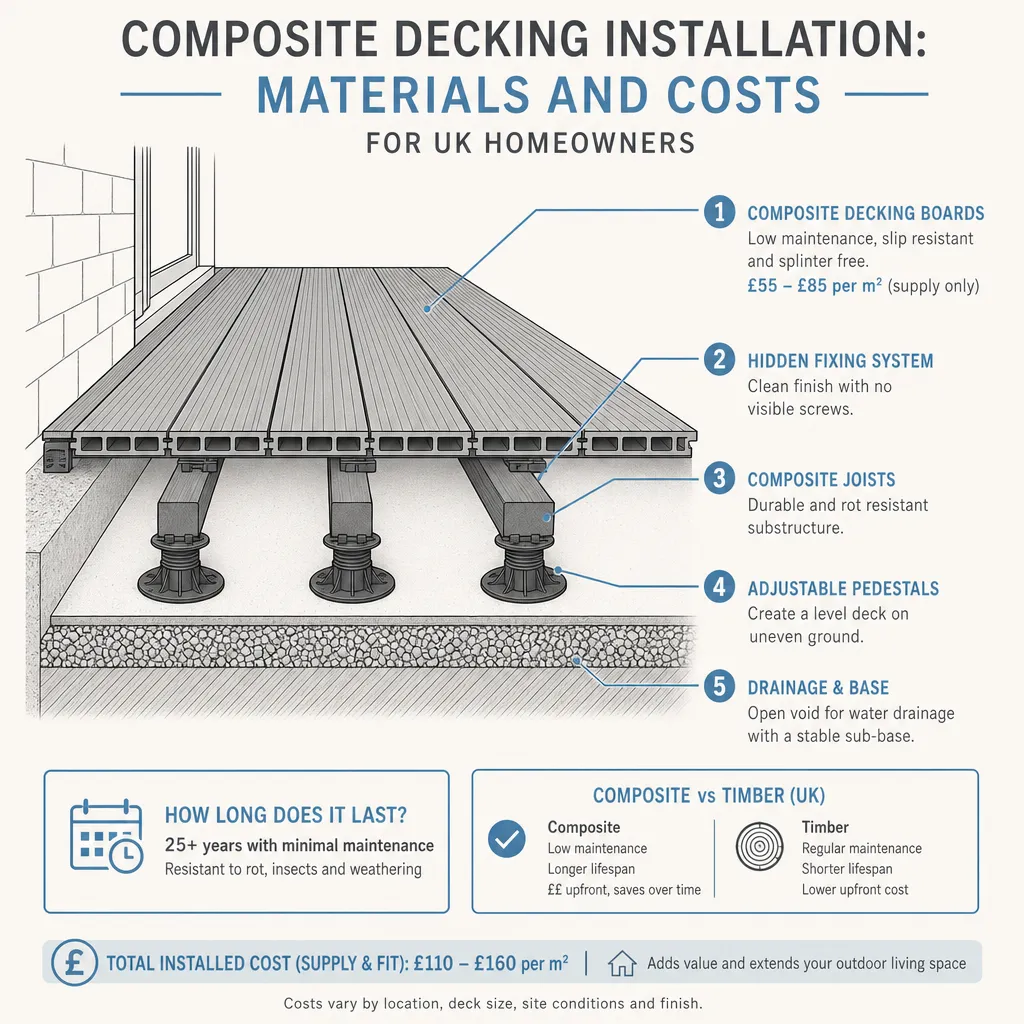
Composite Decking Installation: Materials and Costs
Composite decking typically costs £80–£200 per m² fully installed in the UK, depending on board grade, subframe type, and site conditions.
 Improvement & Build
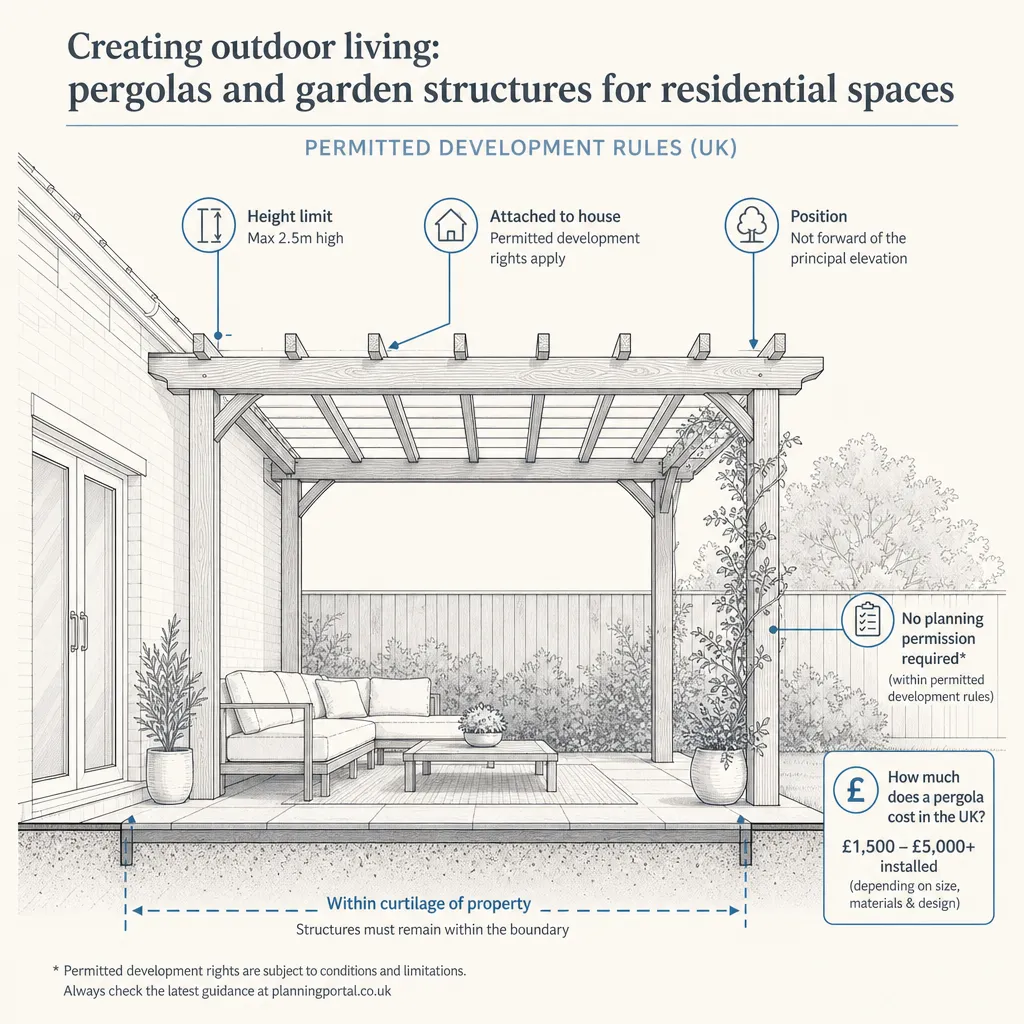
Creating outdoor living: pergolas and garden structures for residential spaces
Most freestanding pergolas in UK rear gardens are permitted development and don't need planning permission, provided they stay within height limits and outbuilding coverage stays below 50% of the original garden.