Composite doors versus uPVC doors: which should you choose?
By Housey · Last reviewed 11th of May 2026
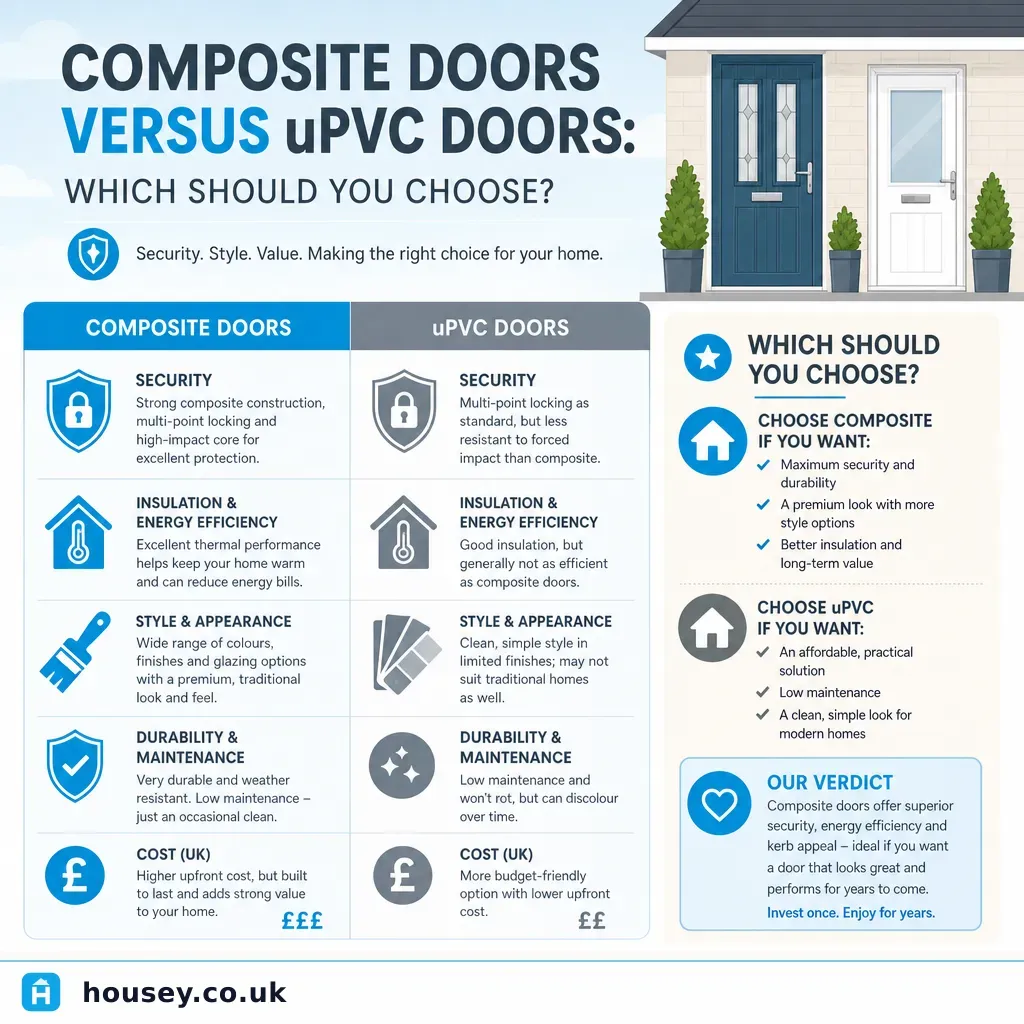
Composite doors versus uPVC doors: which should you choose?
The front door is one of the most-used parts of any UK home, and replacing it prompts immediate questions about materials, security, running costs, and budget. Composite and uPVC doors now dominate the replacement market for front and rear doors across Britain, but they serve different priorities, property types, and long-term expectations. Understanding what each is made of — and how that translates into real-world performance — makes the decision considerably easier.
Key points
- Under Building Regulations Part L (England), replacement external doors must achieve a U-value of no worse than 1.4 W/m²K; both modern composite and uPVC doors can meet this threshold.
- Installation by a FENSA-registered or CERTASS-registered installer allows self-certification of Part L compliance, avoiding the need for a separate local authority building control application.
- Most composite doors are supplied with PAS 24:2022 security testing as standard; some ranges also qualify for the Secured by Design police-preferred specification, which certain home insurers require.
- Indicative UK installed costs (last reviewed 2026-05-11): composite doors £800–£2,500; uPVC doors £400–£1,200. Costs vary significantly by style, glazing, hardware, and installer — obtain at least three quotes.
- Composite doors have a longer expected lifespan (35-plus years) compared with uPVC (20–25 years), which affects the long-term cost-per-year comparison.
How each door is constructed
Understanding the internal build of each door type explains most of the performance differences.
Composite doors are engineered multi-layer products. A typical composite door has:
- An outer skin of glass reinforced plastic (GRP), moulded and textured to resemble timber grain.
- A solid core of high-density polyurethane foam, sometimes bonded to a timber or laminated veneer lumber (LVL) subframe.
- A uPVC or steel outer frame.
- A multipoint locking system as standard on most ranges.
uPVC doors are built around a hollow uPVC profile with multiple internal chambers — the more chambers, the better the thermal and acoustic performance. The profile is reinforced with galvanised steel. Panels are typically flat or moulded uPVC rather than a separate skin over a core.
Side-by-side comparison
Feature | Composite door | uPVC door |
|---|---|---|
Construction | GRP skin over solid foam or timber core | Hollow multi-chamber uPVC profile |
Typical installed cost | £800–£2,500 | £400–£1,200 |
Expected lifespan | 35-plus years | 20–25 years |
Typical U-value | 1.0–1.4 W/m²K | 1.2–1.6 W/m²K |
Security standard | Usually PAS 24; Secured by Design options available | PAS 24 achievable; fewer ranges certified |
Aesthetic range | Wide; convincing timber effect; 20-plus colours | Good; less convincing timber effect |
Weight | Heavy (35–45 kg typical) | Lighter (20–30 kg typical) |
Maintenance | Wipe clean; no repainting required | Wipe clean; no repainting required |
Best for | Period homes, kerb appeal, long-term ownership | Modern builds, rentals, tighter budgets |
Indicative UK costs, last reviewed 2026-05-11. Quotes vary by specification and region.
Security: how the two compare
Security is usually the primary reason homeowners choose composite over uPVC. The solid foam or timber core of a composite door makes it significantly harder to force than a hollow uPVC panel. Most composite doors are supplied with multipoint locking systems that engage at three or more points along the doorframe, and good-quality ranges include cylinders tested to resist snapping, picking, drilling, and bumping.
PAS 24:2022 (Enhanced Security Performance Requirements for Doorsets) is the benchmark security test recognised by UK police forces and many home insurers. A PAS 24 certificate applies to the full door and frame assembly — ask to see the actual certificate rather than accepting a manufacturer's marketing claim. The Secured by Design website lists specific approved products by manufacturer and model.
uPVC doors can achieve PAS 24 with the right hardware specification, but fewer standard uPVC ranges carry certification as a default, and the hollow panel construction provides less resistance to physical attack than a composite core.
Thermal performance and Part L compliance
Both door types can meet the Part L replacement door threshold of U-value ≤1.4 W/m²K in England. In practice, the solid foam core of a composite door often allows it to achieve lower (better) U-values than equivalent uPVC panels — some composite doors achieve 1.0–1.1 W/m²K. If you are targeting a deeper energy retrofit or trying to improve your EPC rating, the lower U-value potential of composite is worth comparing on a product-by-product basis.
The British Fenestration Rating Council (BFRC) provides an energy rating scale for doors (A++ to G), similar to the system used for windows. Aim for at least a C rating as a minimum benchmark when comparing products from different manufacturers.
Aesthetics: period and modern homes
For pre-1980 UK properties — Victorian terraces, Edwardian semis, 1930s houses — a composite door with a GRP timber-effect skin is more likely to suit the character of the building. GRP can be ordered in a wide range of colours and, on many ranges, dual-colour finishes (different colour outside and inside). The moulded texture holds visual depth that flat uPVC panels rarely match at close range.
uPVC doors have improved significantly and work well on modern and new-build homes. They are available in a good range of colours and styles, but the material appearance is generally less convincing as a timber substitute in period settings.
For listed buildings or properties in conservation areas, neither door type may be acceptable without listed building consent or prior planning approval. Check with your local planning authority or conservation officer before ordering any replacement door.
Which door should you choose?
- Choose a composite door if your home was built before 1980, you want a convincing timber-effect finish, you are prioritising long-term security and thermal performance, or you plan to own the property for many years.
- Choose a uPVC door if you are on a tighter budget, the property is a modern or new-build home, you are a landlord seeking a durable low-cost solution, or you need a straightforward replacement without a long lead time.
- Ask a window and door installer to survey the existing doorframe before ordering — the condition of the frame determines whether a door-only swap or a full-frame replacement is needed, which changes the cost significantly.
- Check with your local planning authority if the property is listed, in a conservation area, or if the door faces a public highway — permitted development rights for door replacements can be restricted in these situations.
When to get professional help
Door replacement is straightforward for a qualified installer but carries a Building Regulations compliance obligation under Part L. Seek professional assistance if:
- The existing door frame is rotten, structurally compromised, or out of square — fitting a new door to a failing frame is a common and costly mistake.
- The property is listed or in a conservation area — planning advice is needed before purchase.
- You want Building Regulations self-certification — only FENSA or CERTASS-registered installers can issue this without a separate local authority application.
- You are buying a door online and using a separate contractor to install it — confirm in advance who will handle compliance certification.
How Housey can help
Housey connects UK homeowners with vetted window and door installers who can survey your existing opening, recommend the right specification, supply and fit a compliant replacement, and handle FENSA self-certification from start to finish.
Frequently asked questions
Do I need planning permission to replace my front door?
In most cases, replacing a like-for-like front door falls under permitted development and does not need planning permission. However, if the property is listed, in a conservation area, or if you are significantly changing the door's appearance, you may need listed building consent or prior approval. Always check with your local planning authority if you are unsure about your specific property.
Are composite doors worth the extra cost over uPVC?
For most homeowners planning to stay in their property for ten or more years, a composite door is likely to represent better long-term value. The longer expected lifespan — 35-plus years versus 20 to 25 for uPVC — and stronger security credentials offset the higher upfront cost. For a rental property or shorter-term ownership, uPVC is often the more practical choice.
Will replacing my front door improve my EPC rating?
A replacement door meeting Part L's U-value requirement of 1.4 W/m²K or better may slightly improve your EPC rating, but doors represent a relatively small proportion of a home's total heat loss compared with walls, roof, and windows. The improvement in EPC band is usually modest unless the old door was particularly draughty or had no insulation at all.
Sources and further reading
- Building Regulations Approved Document L — conservation of fuel and power — GOV.UK
- FENSA — find a registered window and door installer — FENSA
- Secured by Design — approved door products — Police Crime Prevention Initiatives
- British Fenestration Rating Council — energy ratings for doors — BFRC
- PAS 24:2022 Enhanced security performance requirements for doorsets — British Standards Institution (BSI)
Useful next reads
 Improvement & Build
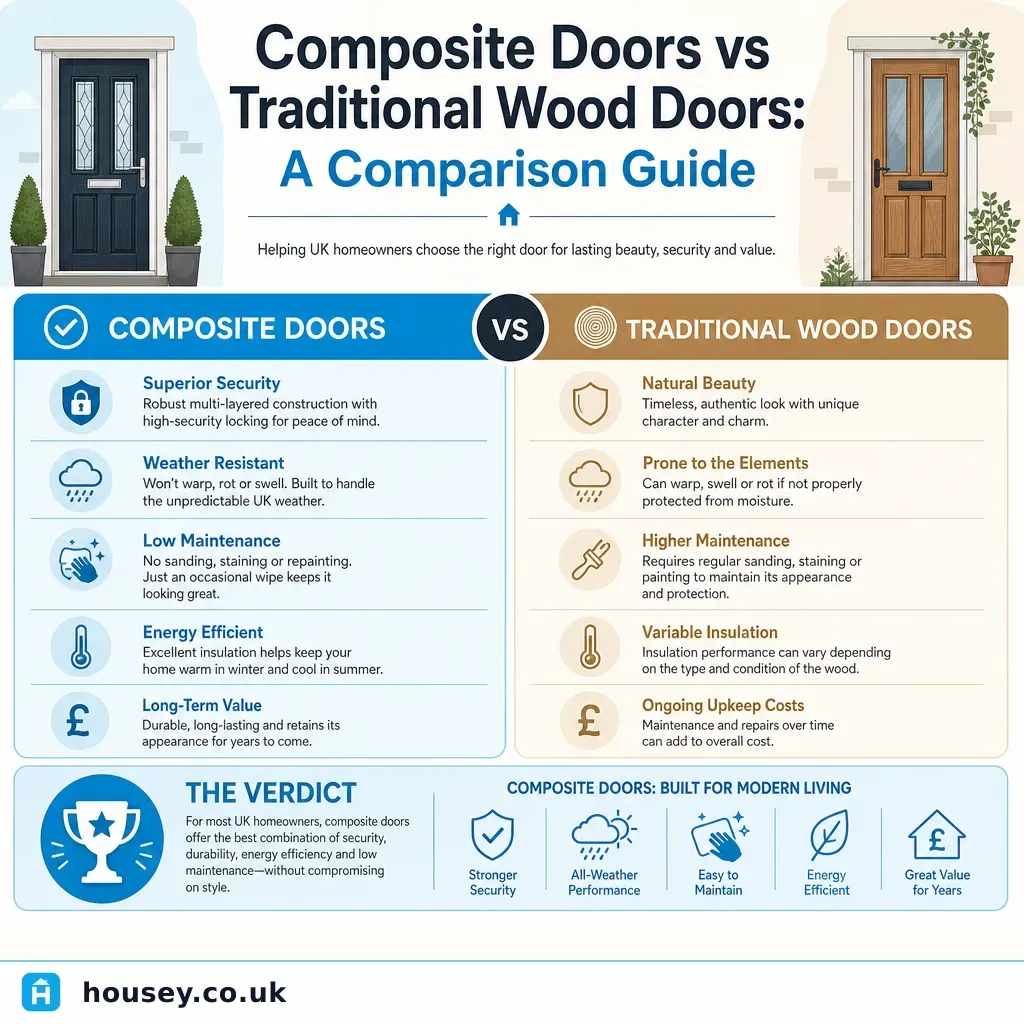
Composite Doors vs Traditional Wood Doors: A Comparison Guide
Composite doors offer lower maintenance, better thermal performance, and longer lifespan than traditional timber doors, making them the practical choice for most UK homeowners.
 Improvement & Build
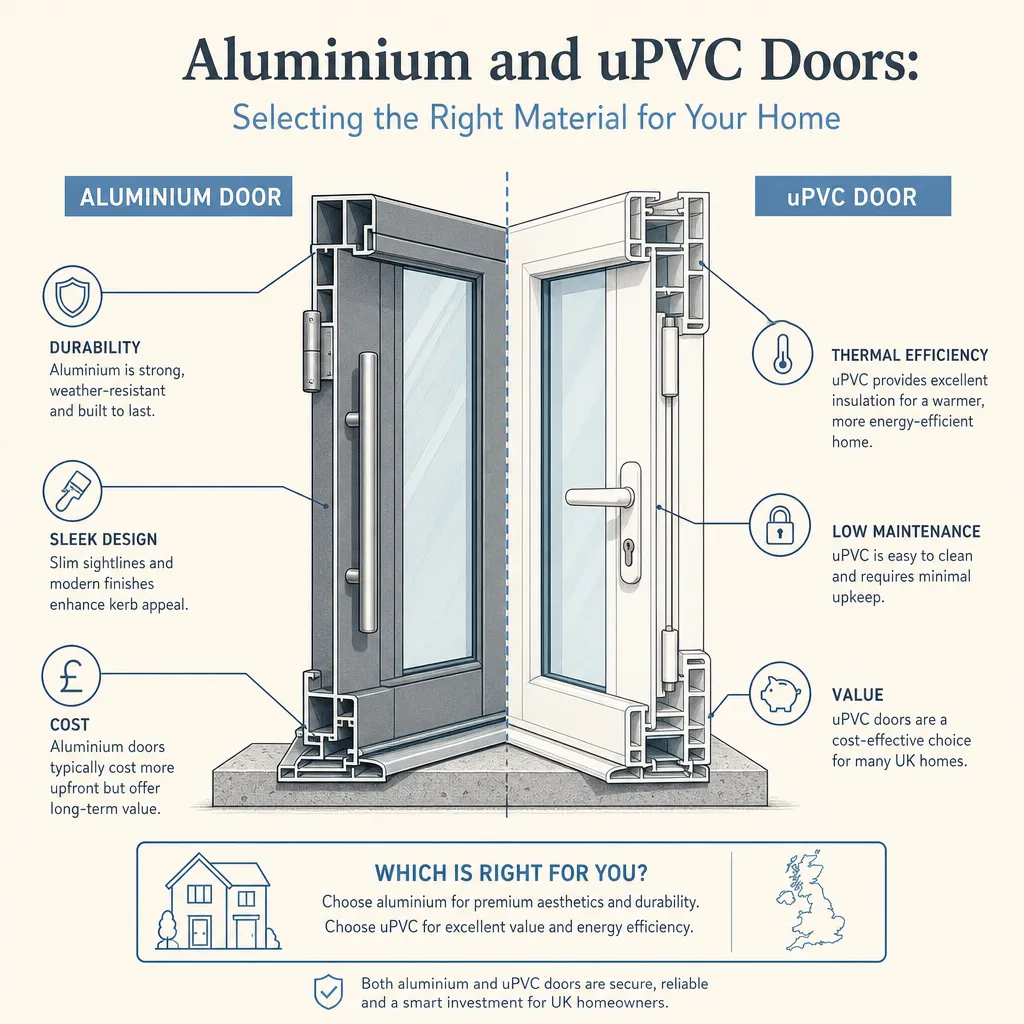
Aluminium and uPVC Doors: Selecting the Right Material for Your Home
uPVC doors are lower-cost and low-maintenance, making them a practical choice for most UK homes.
 Improvement & Build
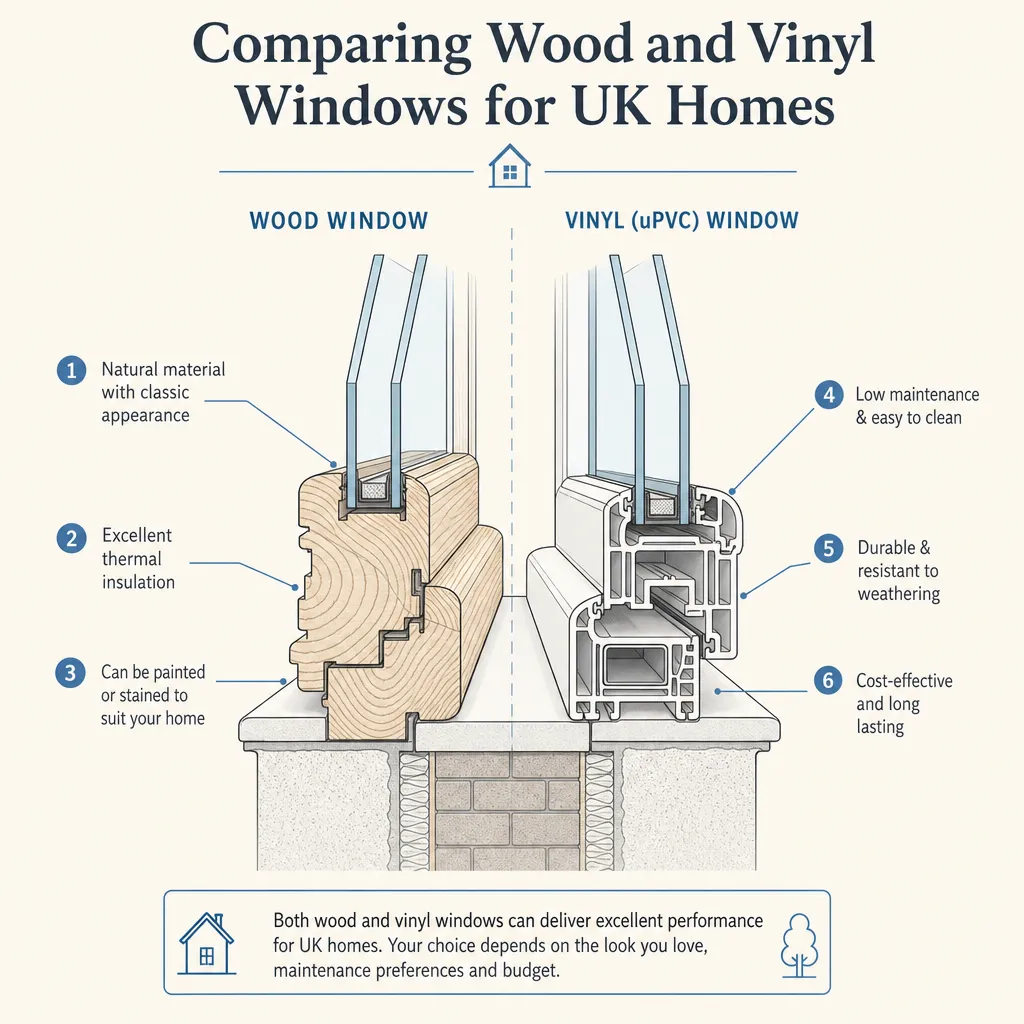
Comparing Wood and Vinyl Windows for UK Homes
Timber windows typically cost more upfront than uPVC but can last twice as long with regular maintenance.
 Improvement & Build
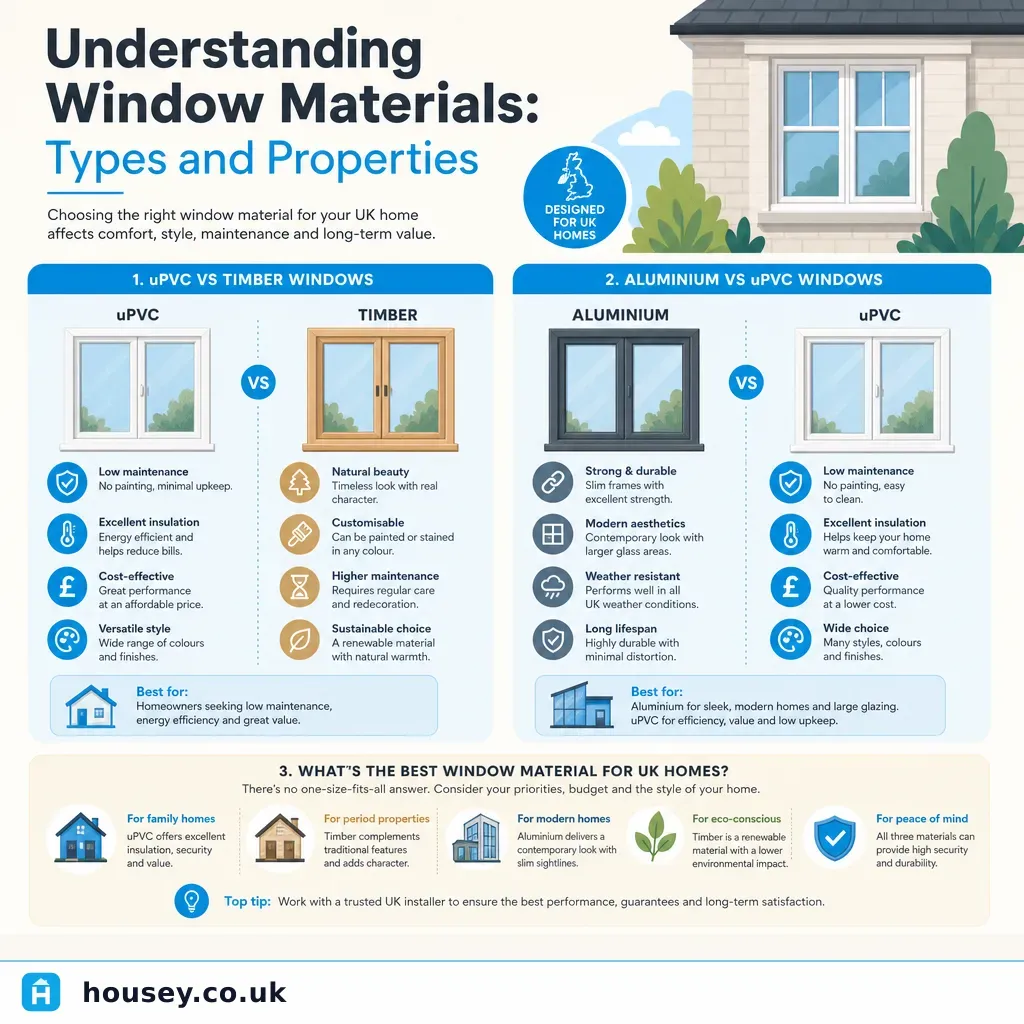
Understanding Window Materials: Types and Properties
uPVC is the most common UK window material, offering low maintenance and adequate thermal performance at a lower cost.
 Improvement & Build
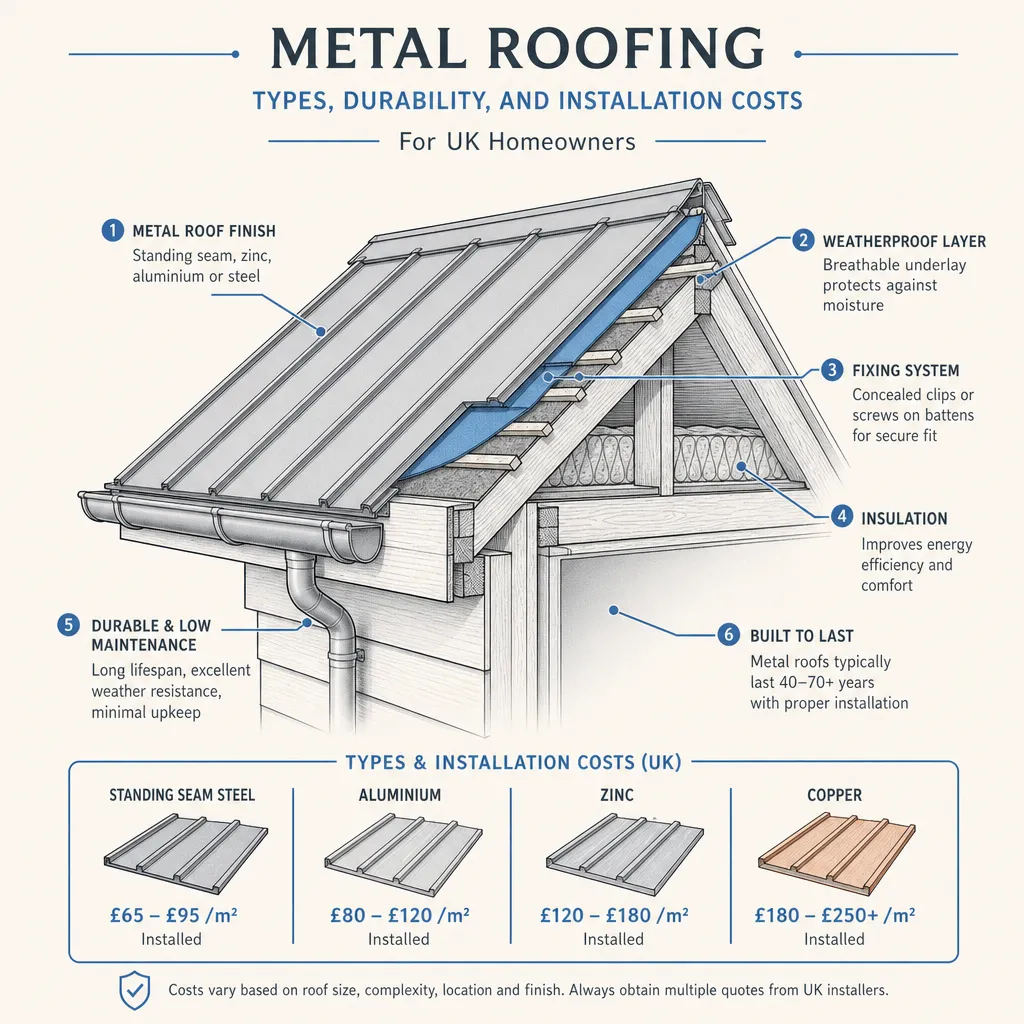
Metal Roofing: Types, Durability, and Installation Costs
Metal roofing in the UK includes standing seam, corrugated sheet, and metal tile systems in steel, aluminium, zinc, or copper.