Composite Doors vs Traditional Wood Doors: A Comparison Guide
By Housey · Last reviewed 11th of May 2026
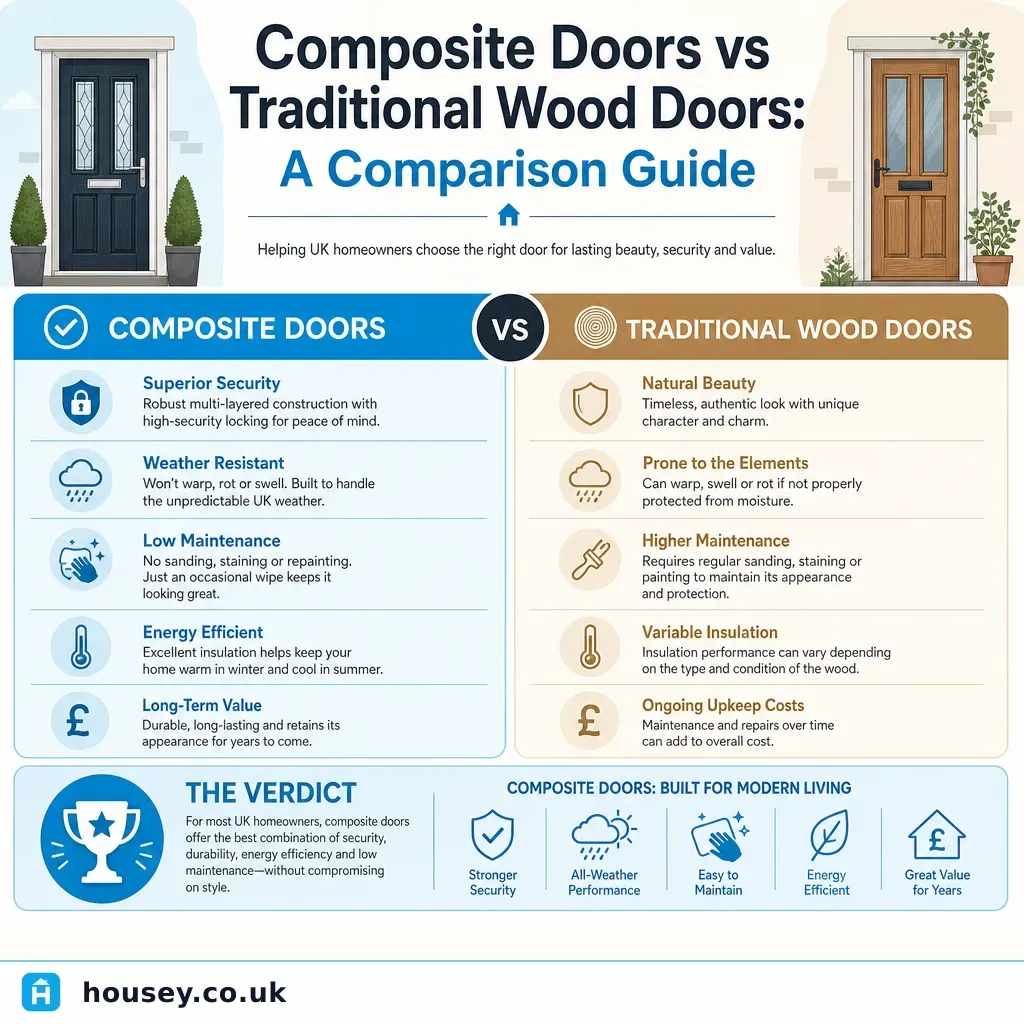
Composite Doors vs Traditional Wood Doors: A Comparison Guide
Choosing a new front or back door is one of the more visible decisions a homeowner makes — and the door market has changed considerably over the past two decades. Composite doors now dominate new installations across the UK, yet timber doors remain the natural choice for period properties, listed buildings, and homeowners who value authenticity over convenience. Understanding what each option actually delivers in performance, maintenance, cost, and planning terms helps you avoid a decision you will regret once the old door is off its hinges.
Key points
- Composite doors typically achieve a centre-of-door U-value of 1.0–1.8 W/m²K; an uninsulated solid timber door can reach 3.0 W/m²K or higher without draught sealing.
- All replacement external doors in England and Wales require either a FENSA- or CERTASS-registered installer (who self-certify compliance) or a separate building control application under the Building Regulations.
- Part Q of the Building Regulations requires doors in new dwellings to resist manual attack; PAS 24:2022 is the principal security standard against which products are independently tested.
- Timber doors on listed buildings or within a conservation area may require Listed Building Consent or planning permission before replacement — including like-for-like swaps.
- Most composite door manufacturer warranties run 10–20 years; a quality hardwood door maintained correctly can last 50 years or more.
How composite doors are constructed
A composite door is an engineered assembly rather than a single material. The outer skin is usually glass-reinforced plastic (GRP) or a pressed timber-effect moulding, bonded to a solid core that is typically dense polyurethane foam, a timber subframe, or a combination of both. The door blank sits inside an outer frame — usually uPVC or aluminium — with multi-point locking and compression weatherseals built in as standard.
The result is a door that is dimensionally stable: it does not expand, contract, or warp with seasonal moisture changes in the way timber does. The factory-applied surface finish is durable enough that repainting is generally not required within the warranty period, though faded surfaces can be refreshed with specialist composite door paints.
How traditional timber doors are constructed
Solid timber doors are made from softwood (pine, hemlock) or hardwood (oak, idigbo, sapele). External doors are typically ledged-and-braced for stability, or manufactured as panel doors with stiles, rails, and fielded panels. Higher-specification period doors use mortice-and-tenon joinery throughout.
Timber breathes — it absorbs and releases moisture with the seasons. Without regular decoration, it will swell, crack, or rot, particularly at the base and around glazing beads. However, timber damage is repairable in a way composite is not: a split panel can be filled, a swollen bottom rail planed back, and the whole door stripped and repainted. A composite door with a delaminated skin or damaged core usually requires full unit replacement.
Composite versus timber: a direct comparison
Feature | Composite door | Solid timber door |
|---|---|---|
Maintenance | Wipe clean; factory finish lasts 10–20 years | Repaint or restain every 3–5 years |
Typical centre U-value | 1.0–1.8 W/m²K | 2.0–3.5 W/m²K (untreated) |
Security | PAS 24 certification common as standard | PAS 24 achievable with quality hardware |
Expected lifespan | 25–35 years | 50 years+ with maintenance |
Repairability | Limited — damage often needs full replacement | Repairable: fill, plane, repaint |
Typical supply cost | £400–£1,500+ | £300–£2,500+ for solid hardwood |
Heritage suitability | Rarely approved for listed buildings | Preferred by conservation officers |
Sustainability | GRP and foam harder to recycle | FSC-certified timber available |
Indicative UK supply costs only, last reviewed 2026-05-11. Installed prices vary by size, specification, and region.
Which type should you choose?
Use this decision guide to narrow your options:
- Choose composite if you want low ongoing maintenance, a consistent modern appearance, and strong thermal performance without specialist upkeep.
- Choose timber if you own a listed building or a property in a conservation area, if you want to match original period joinery, or if you value natural materials and repairability over convenience.
- Check with your local planning authority before replacing any door on a listed building or within a conservation area — even a like-for-like replacement may require consent.
- Use a FENSA- or CERTASS-registered installer for any replacement external door in England or Wales; they self-certify compliance and issue a certificate on completion.
- Consider a draught-proofed timber door if your property is period-built and a composite would look out of place, but energy performance is still a priority.
What to check before you buy
Before committing to a product or installer, work through this checklist:
- Does the door carry a valid third-party security test certificate (PAS 24:2022 or Secured by Design)?
- What is the door's tested U-value as a complete unit, including the frame and threshold?
- Is the frame included in the quoted price, and what material and warranty does it carry?
- Is the installer FENSA- or CERTASS-registered, and will they provide a compliance certificate?
- Does your property have any planning restrictions — listed building designation, conservation area, or Article 4 Direction?
- For composite doors: what is the manufacturer's policy on repainting or colour-changing during the warranty period?
Planning permission and Building Regulations
Most door replacements in England are permitted development and do not require planning permission — provided the property is not listed and is not subject to an Article 4 Direction. Replacing a door in a conservation area can still require planning permission in some local authority areas, and any replacement on a listed building requires Listed Building Consent.
Under the Building Regulations, replacement doors must meet the thermal performance thresholds in Approved Document L. The current maximum U-value for a replacement door in an existing English dwelling is 1.6 W/m²K as a complete unit including frame. Many composite doors meet this comfortably; an unimproved solid timber door often does not without upgraded seals and draught-proofing. A FENSA- or CERTASS-registered installer confirms compliance and notifies building control on your behalf.
When to get professional help
Most door replacements are straightforward, but seek specialist advice if:
- Your property is listed or in a conservation area — consult your local planning authority or a conservation specialist before ordering.
- There is visible rot, damp, or structural damage to the existing frame, sill, or lintel — a builder should assess the opening before a door is manufactured to size.
- You want to upgrade multipoint locking on an older timber door — a locksmith or experienced joiner can advise on compatibility with the existing frame.
- The opening is non-standard or includes side panels — bespoke sizing affects cost, lead times, and installer choice significantly.
How Housey can help
If you are ready to compare installation quotes, window and door installers on Housey can connect you with FENSA-registered professionals in your area who will provide itemised, competitive proposals for composite or timber door supply and installation.
Frequently asked questions
Do I need planning permission to replace my front door with a composite?
In most cases, no. Replacing a front door is permitted development in England provided the property is not listed and is not subject to an Article 4 Direction. In conservation areas, some councils require planning permission even for like-for-like replacements, so check with your local planning authority before ordering.
How long does a composite door last?
Most composite doors carry manufacturer warranties of 10–20 years and have an expected service life of 25–35 years under normal UK conditions. The GRP outer skin resists fading and impact damage, though unlike timber it cannot be stripped and fully refinished if the surface degrades over time.
Can I repaint a composite door?
Yes, but check the manufacturer's warranty terms first. Many manufacturers offer a colour-change service, and specialist composite door paints are available. Using the wrong product can void the warranty and damage the factory finish, so confirm the approved method with the manufacturer or installer before proceeding.
Are timber doors less secure than composite doors?
Not necessarily. A solid hardwood door fitted with quality multipoint locks and an anti-snap cylinder can meet PAS 24:2022 security standards. However, many composite doors are sold with PAS 24 certification tested as a complete set, which simplifies the specification process and removes the need to verify individual component ratings.
What is FENSA and why does it matter?
FENSA (Fenestration Self-Assessment Scheme) is a government-authorised scheme allowing approved installers to self-certify that replacement windows and doors comply with the Building Regulations, without a separate building control application. You receive a FENSA certificate on completion, which you will need to produce when selling the property.
Sources and further reading
- Approved Document L: Conservation of fuel and power — GOV.UK
- Approved Document Q: Security — dwellings — GOV.UK
- FENSA: Information for homeowners — FENSA
- Planning Portal: Doors — do I need permission? — Planning Portal
- Historic England: Windows and doors — Historic England
Useful next reads
 Improvement & Build
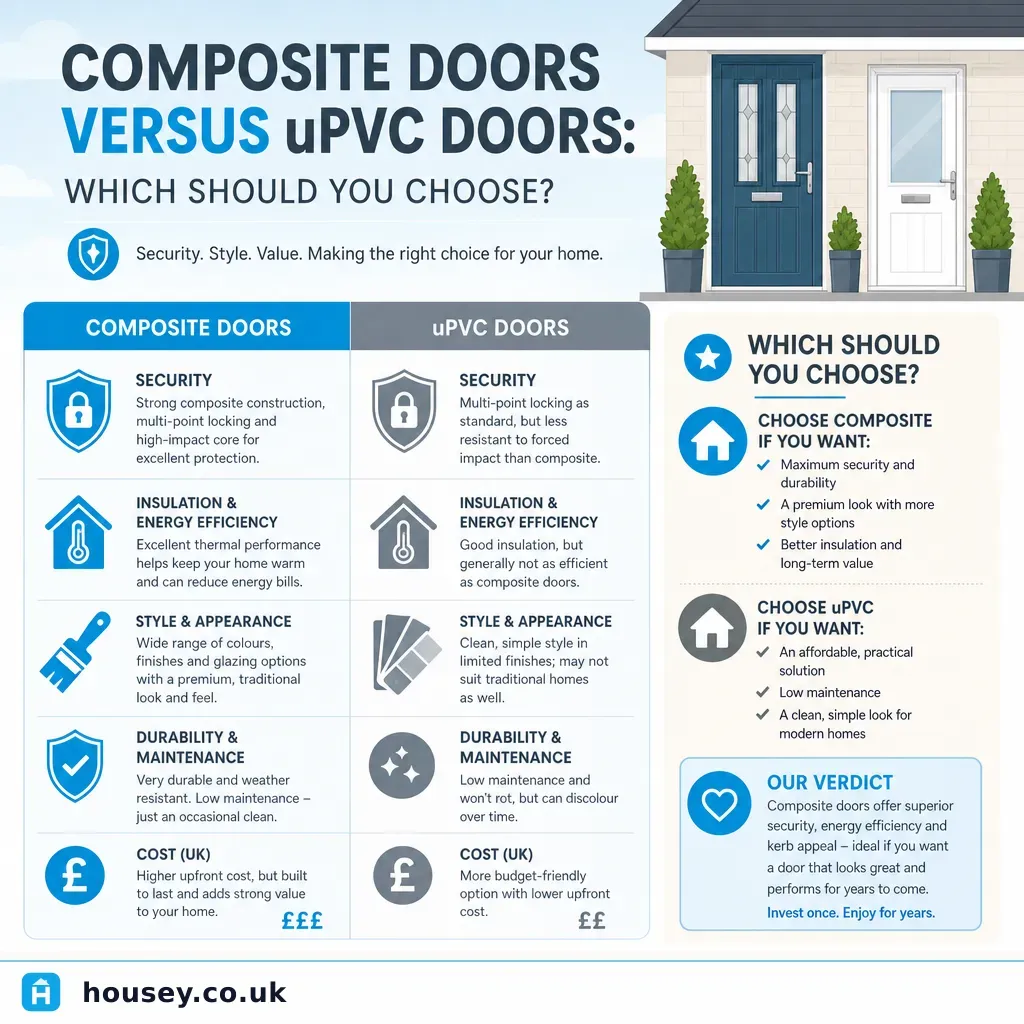
Composite doors versus uPVC doors: which should you choose?
Composite doors have a solid GRP-skinned core, stronger security credentials, and a typical lifespan of 35-plus years, but cost more than uPVC.
 Improvement & Build
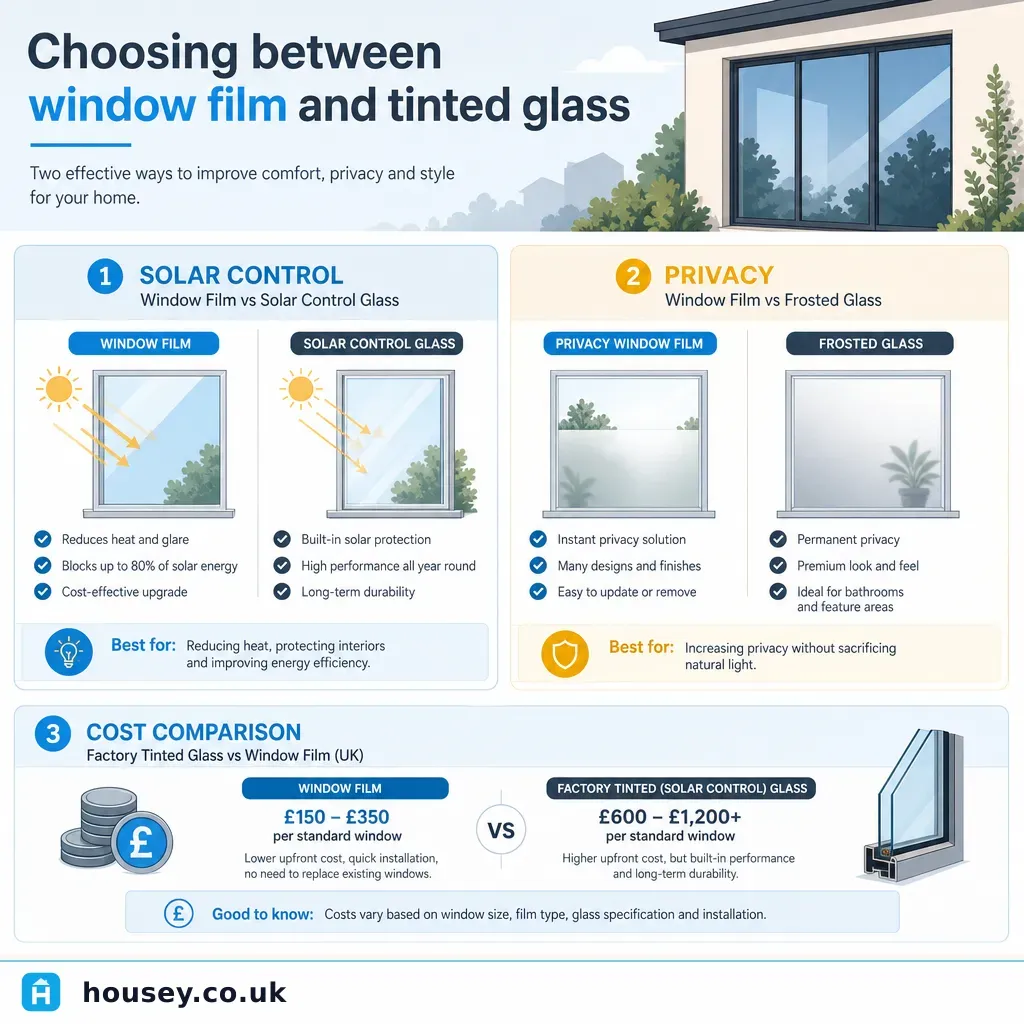
Choosing between window film and tinted glass
Window film is a retrofittable adhesive layer applied to existing glass — cheaper and reversible; factory-tinted or solar-control glass is manufactured with the tint integral to the pane, offering better durability and consistent performance.
 Improvement & Build
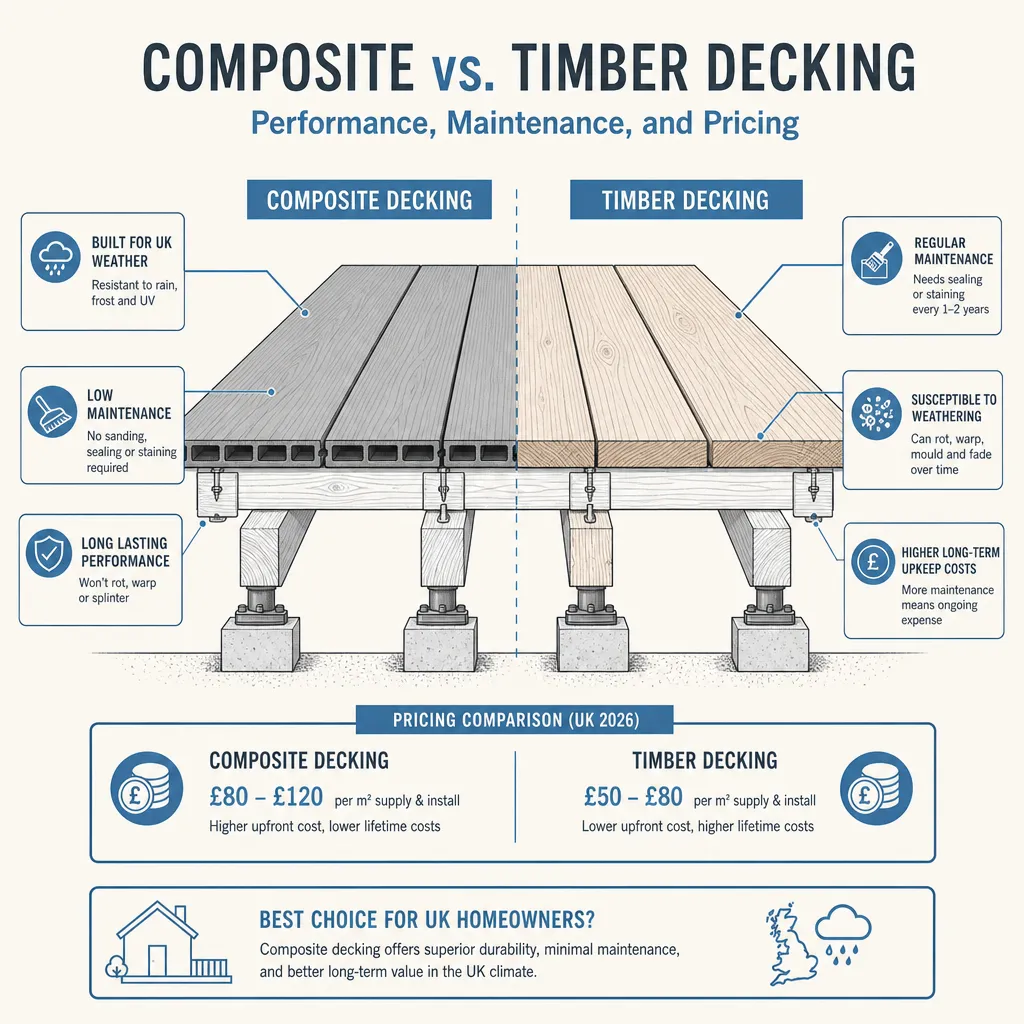
Composite vs. Timber Decking: Performance, Maintenance, and Pricing
Composite decking costs more upfront — typically £120–£220 per m² installed versus £80–£150 for treated softwood — but requires far less maintenance and carries a 25-year warranty.
 Improvement & Build
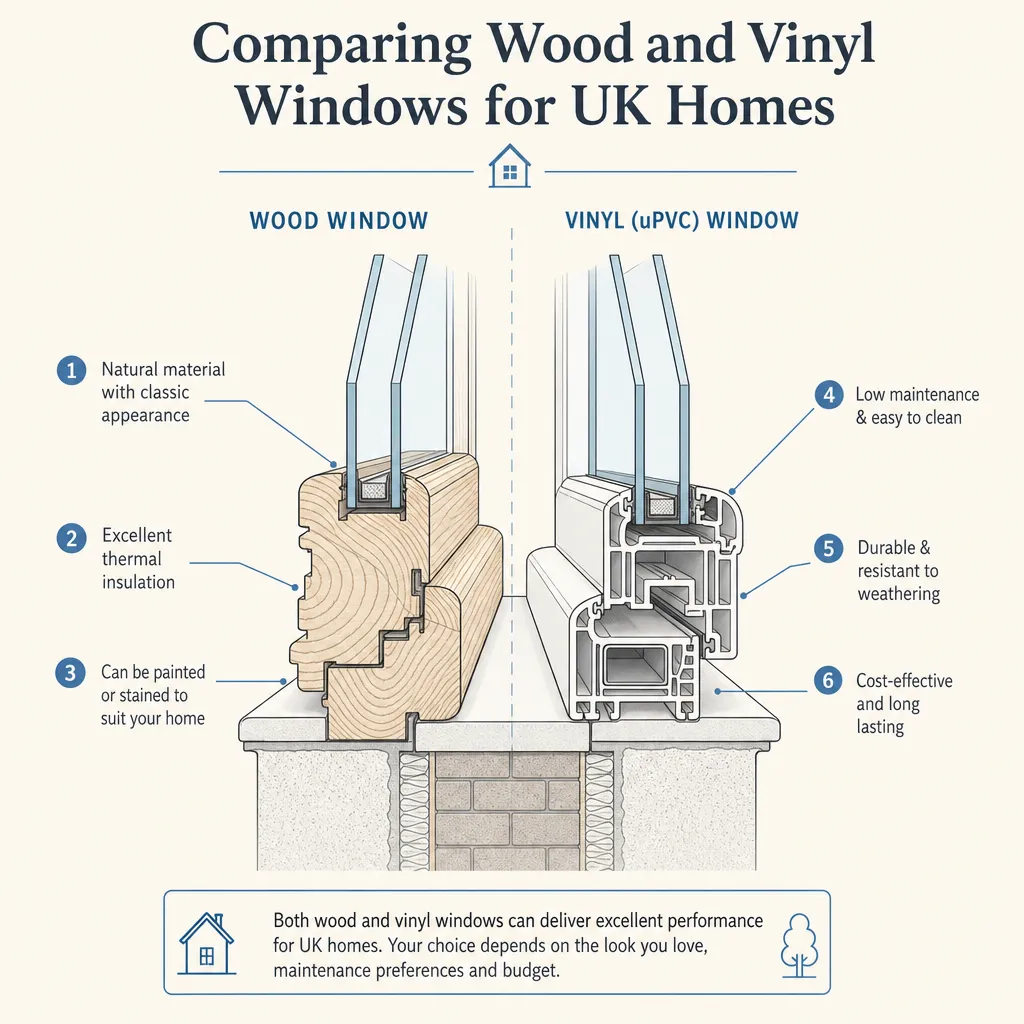
Comparing Wood and Vinyl Windows for UK Homes
Timber windows typically cost more upfront than uPVC but can last twice as long with regular maintenance.
 Improvement & Build
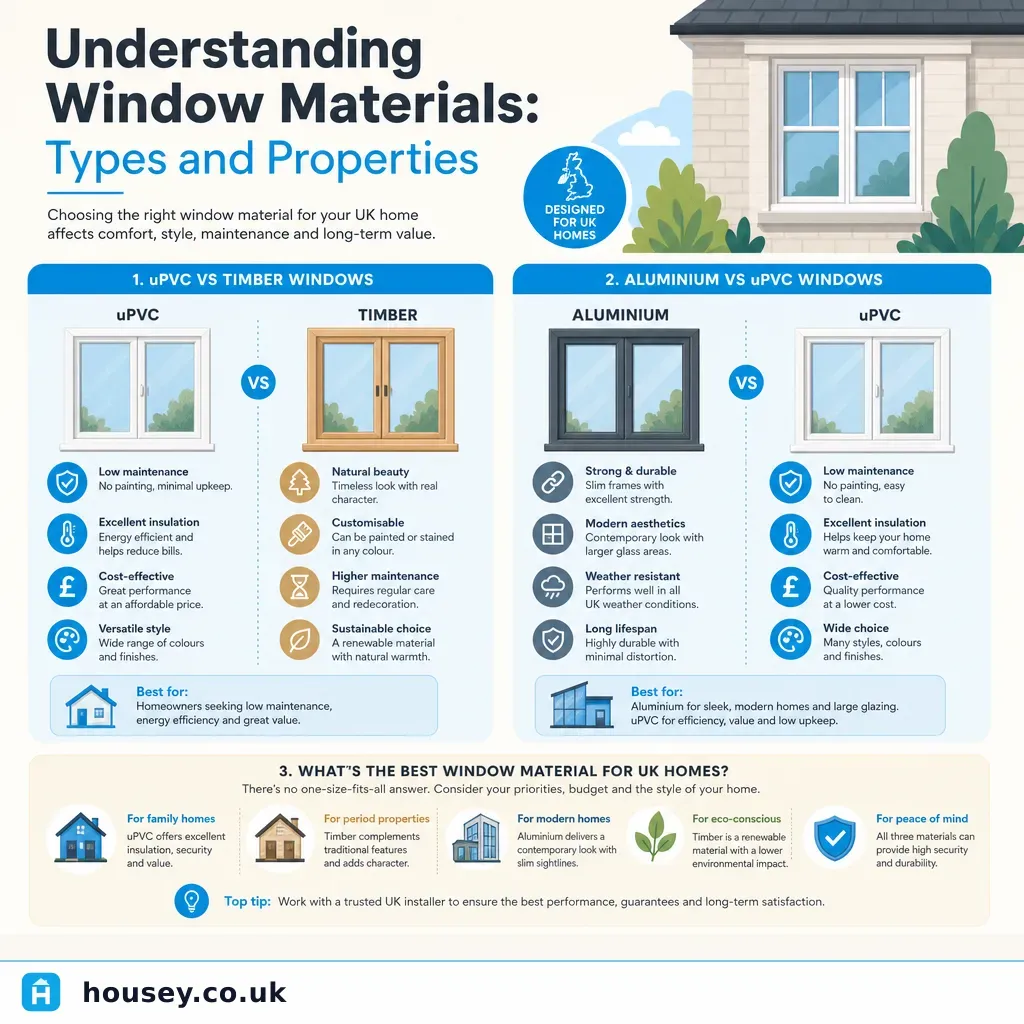
Understanding Window Materials: Types and Properties
uPVC is the most common UK window material, offering low maintenance and adequate thermal performance at a lower cost.