Understanding Window Materials: Types and Properties
By Housey · Last reviewed 19th of May 2026
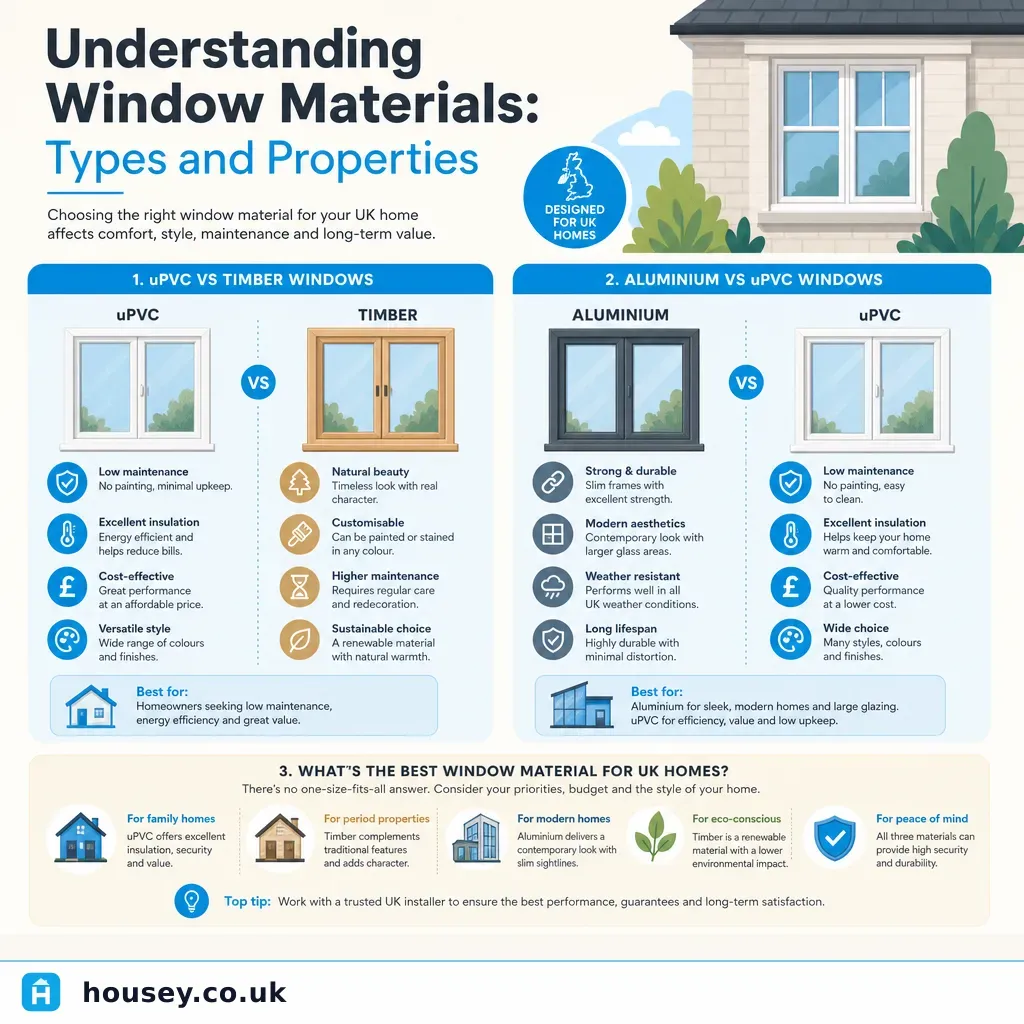
Understanding Window Materials: Types and Properties
Choosing a window frame material is one of the more lasting decisions in a home improvement project — frames fitted today may still be in place 30 or more years from now. The UK market offers uPVC, timber, aluminium, composite, and steel options, each with distinct thermal, aesthetic, maintenance, and planning profiles that suit different property types and homeowner priorities.
Key points
- uPVC windows account for approximately 80% of UK window installations, making them the most common replacement option in standard residential properties.
- Building Regulations Part L (England, 2021) requires replacement windows to achieve a whole-window U-value of no more than 1.4 W/m²K.
- Timber windows are often required in conservation areas and listed buildings, where planners may specify matching profiles, glazing bar layouts, and opening styles.
- Aluminium frames must be thermally broken — a plastic insulating barrier within the frame section — to meet current Building Regulations U-value requirements.
- Triple glazing, regardless of frame material, can achieve whole-window U-values of 0.5–0.8 W/m²K, compared with around 1.0–1.4 W/m²K for quality argon-filled, low-e double glazing.
How window frame materials compare
Material | Typical lifespan | Maintenance burden | Thermal performance | Conservation area suitability | Indicative installed cost per window |
|---|---|---|---|---|---|
uPVC | 25–35 years | Very low | Good with quality sealed unit | Often not accepted | £400–£900 |
Timber | 50–100+ years if maintained | High (paint every 3–5 years) | Good to excellent with modern unit | Generally accepted | £700–£1,800 |
Aluminium (thermally broken) | 40–60 years | Low | Good | Sometimes accepted | £700–£1,500 |
Composite (timber core, external cladding) | 30–50+ years | Low to medium | Very good | Sometimes accepted | £900–£2,000 |
Steel | 50+ years depending on coating | Medium | Moderate (slim profiles, thermal bridging risk) | Accepted in some heritage contexts | £1,200–£3,000+ |
Indicative UK costs, last reviewed 2026-05-19. Prices vary significantly by window size, opening style, glazing specification, and installer. Obtain at least three quotes.
uPVC windows: the UK mainstream choice
Unplasticised polyvinyl chloride (uPVC) frames dominate the UK replacement market because of their low upfront cost, minimal maintenance requirements, and adequate thermal performance when paired with quality sealed units. Modern multi-chamber uPVC profiles trap still air within the frame, improving insulation markedly over older single-chamber designs.
White is the most common finish, but foiled uPVC — a laminated wood-effect or colour film — is increasingly available in greys, anthracites, and timber tones. Foiled uPVC performs well but the film can delaminate over time if water ingress occurs at corner welds or joints.
Not suitable for: listed buildings or most conservation areas, where the uniform profiles and characteristically glossy finish are often unacceptable to local planning and conservation officers. Also less appropriate where slimline glazing bars or traditional sash profiles are required to match an existing street scene.
Timber windows: performance and heritage credentials
Timber frames have been used in UK buildings for centuries, and modern engineered timber — finger-jointed, kiln-dried, typically European redwood or oak — performs significantly better than Victorian originals. Fitted with modern double or triple-glazed sealed units and appropriate draught-stripping, timber windows can exceed the thermal performance of standard uPVC.
The maintenance burden is genuine: repainting or re-staining every 3–5 years is essential. Bare timber absorbs moisture and begins to degrade — particularly on south-west-facing elevations that receive the highest rainfall and wind-driven rain in England and Wales. Neglected frames can reach a point where repair is no longer practical, making full replacement necessary far sooner than the material's potential lifespan warrants.
Historic England and most local planning authorities prefer like-for-like timber replacement in listed buildings and conservation areas. The profile, glazing bar layout, and opening method may be specified as a planning condition, so always confirm requirements before ordering.
Aluminium windows: slim profiles and longevity
Aluminium frames offer the slimmest possible profiles, maximising glass area within a given structural opening — a significant advantage in contemporary architecture and where masonry or structural constraints limit opening size. Powder-coated aluminium is highly durable, resistant to corrosion, and available in virtually any RAL colour.
Critical specification point: aluminium is an excellent thermal conductor, which means frames without a thermal break will transfer cold from outside to inside, causing surface condensation on the frame and significant fabric heat loss. Current Building Regulations require thermally broken aluminium frames for all new residential installations. Always confirm with your supplier that the product specification includes a thermal break before purchasing.
Composite windows: combining materials' strengths
Composite frames typically use a timber or engineered timber core for thermal performance and structural integrity, clad externally in aluminium or GRP (glass-reinforced plastic) to eliminate the ongoing painting requirement. This gives the internal appearance of timber — attractive to planning authorities and homeowners seeking a traditional look — with the weather resistance and low maintenance of an aluminium exterior.
Composite windows are often accepted in conservation areas where the internal timber face is visible to occupants, though external profiles may still need to satisfy planning requirements specific to the area. They carry a higher upfront cost than uPVC but a lower lifetime maintenance cost than pure timber.
Glazing types: how the sealed unit affects performance
Frame material is only part of the thermal equation. The glazed unit itself — its glass type, cavity width, gas fill, and coating — significantly determines U-value and solar performance.
Glazing specification | Approximate centre-pane U-value | Typical application |
|---|---|---|
Single glazing | 5.0–5.8 W/m²K | Historic buildings where double glazing is refused by planners |
Standard double glazing (air fill, no coating) | 2.8–3.2 W/m²K | Rarely meets current Part L requirements |
Double glazing (argon fill, low-e coating) | 1.0–1.4 W/m²K | Most common compliant specification for UK replacement windows |
Triple glazing (argon fill, two low-e coatings) | 0.5–0.8 W/m²K | High-performance new builds, Passivhaus, exposed locations |
Low-emissivity (low-e) coatings reflect radiant heat back into the room in winter while allowing useful solar gain through in daylight hours. Most compliant double-glazed units include a low-e coating as standard — confirm this when ordering.
Which window material is right for your property?
Use this decision guide to narrow down your options:
- Choose uPVC if you want low maintenance and a lower upfront cost, your property is not listed or in a conservation area, and a white or foiled finish is acceptable aesthetically.
- Choose timber if your property is listed or in a conservation area, or if you specifically want a natural material with excellent thermal potential and are prepared for ongoing painting or staining maintenance.
- Choose thermally broken aluminium if you want slimline profiles, a contemporary aesthetic, a wide powder-coat colour choice, and a very long frame life with minimal maintenance.
- Choose composite if you want a timber internal face — for aesthetic preference or to satisfy planning requirements — without the full external maintenance burden of pure timber.
- Ask your local planning or conservation officer if your property is listed or in a conservation area before ordering. Approval may be required even for like-for-like replacements in some sensitive locations.
- Ask a FENSA-registered installer to confirm the glazing specification meets current Building Regulations Part L before signing any contract.
When to get professional help
All replacement windows in England, Wales, Scotland, and Northern Ireland are subject to building control requirements — either via a FENSA- or CERTASS-registered installer who self-certifies compliance, or by notifying your local authority building control directly. If your property is listed or in a conservation area, listed building consent or conservation area consent may additionally be required before any windows are removed or replaced.
For anything beyond standard uPVC replacement in a non-designated property, or where planning constraints are a factor, seek professional advice before placing an order. Incorrect specifications are expensive to correct once windows are manufactured.
How Housey can help
Housey connects UK homeowners with vetted window and door installers who can advise on material specifications, help you choose the right glazing for your property type and planning context, and provide comparable quotes. Getting multiple quotes before committing is always worthwhile — material and specification choices can substantially affect both price and long-term running costs.
Frequently asked questions
Do I need planning permission to replace my windows?
Most like-for-like window replacements in standard residential properties in England are permitted development and do not require planning permission. However, if your property is in a conservation area, the window faces a road or public footpath, or the building is listed, you may need conservation area consent or listed building consent. Always check with your local planning authority before proceeding.
Is uPVC an environmentally friendly window material?
uPVC production is energy-intensive and the material is difficult to recycle at end of life. However, uPVC windows' long lifespan and strong thermal performance offset some embodied carbon over time. Timber from sustainably managed forests — look for FSC certification — has a lower embodied carbon profile, though its environmental credentials depend on proper long-term maintenance to prevent premature replacement.
What U-value do replacement windows need to meet in England?
Under Building Regulations Part L (2021 edition, England), replacement windows must achieve a whole-window U-value of no more than 1.4 W/m²K. Scotland, Wales, and Northern Ireland have their own equivalent regulations with similar thresholds. Always confirm with your installer or local authority building control that the specification meets the requirements applicable in your nation.
Can I fit triple glazing into an existing window frame?
Triple-glazed sealed units are heavier and thicker than double-glazed equivalents, so existing frames may need replacing or reinforcing to accommodate them. It is far better to specify triple glazing at the frame-selection stage rather than attempting to retrofit. Not all frame types or casement sizes are structurally suited to triple-glazed units without adjustment, so check with your installer before ordering.
Sources and further reading
- Building Regulations Approved Document L — GOV.UK
- Windows in historic buildings — Historic England
- FENSA: registered window installers — FENSA
- Planning permission for windows — Planning Portal
- Double glazing guidance — Energy Saving Trust
Useful next reads
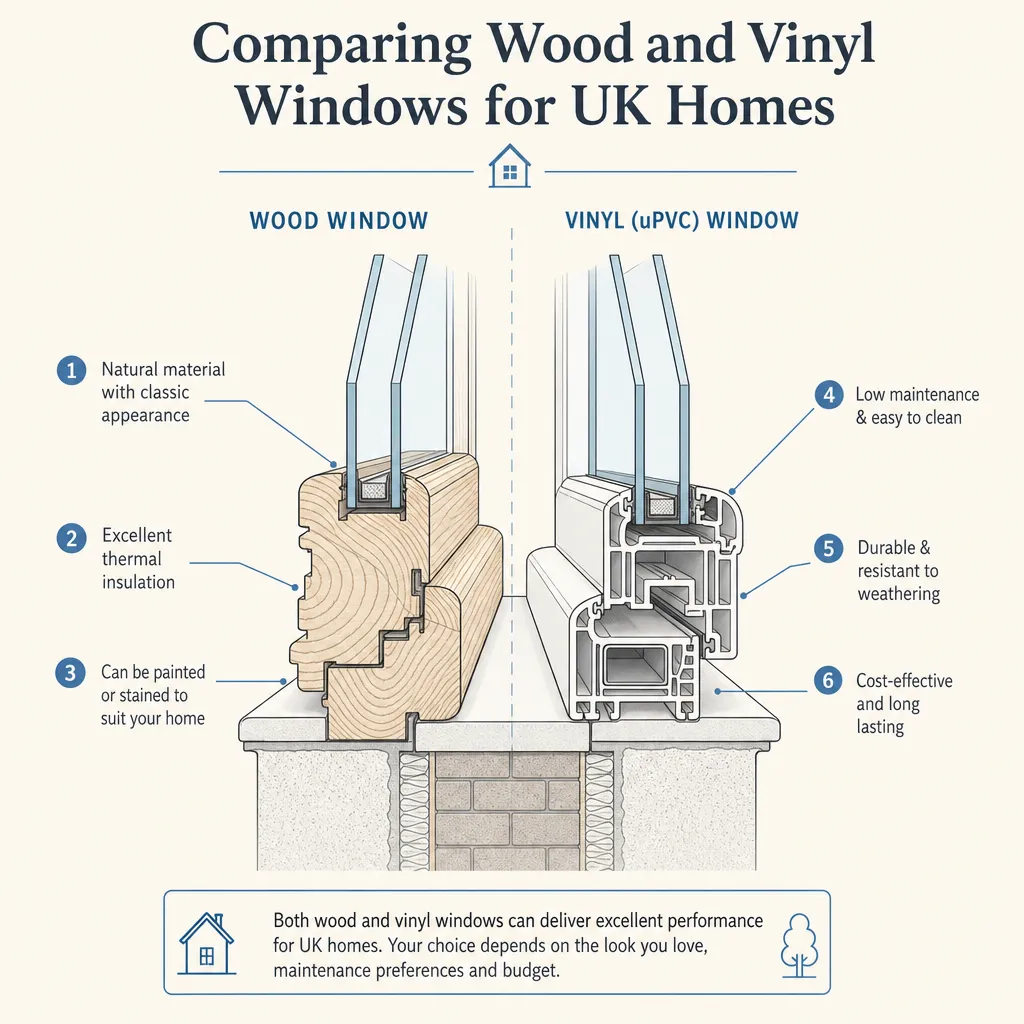 Improvement & Build
Comparing Wood and Vinyl Windows for UK Homes
Timber windows typically cost more upfront than uPVC but can last twice as long with regular maintenance.
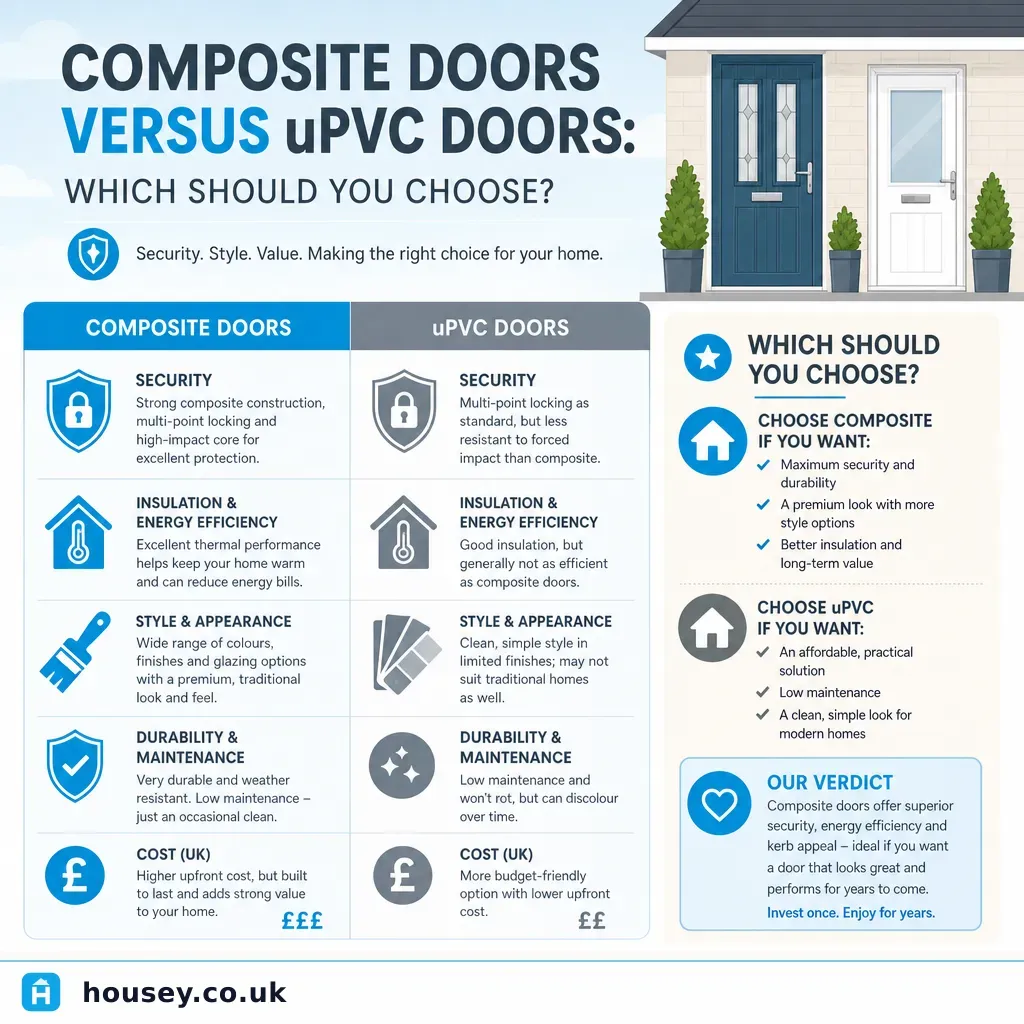 Improvement & Build
Composite doors versus uPVC doors: which should you choose?
Composite doors have a solid GRP-skinned core, stronger security credentials, and a typical lifespan of 35-plus years, but cost more than uPVC.
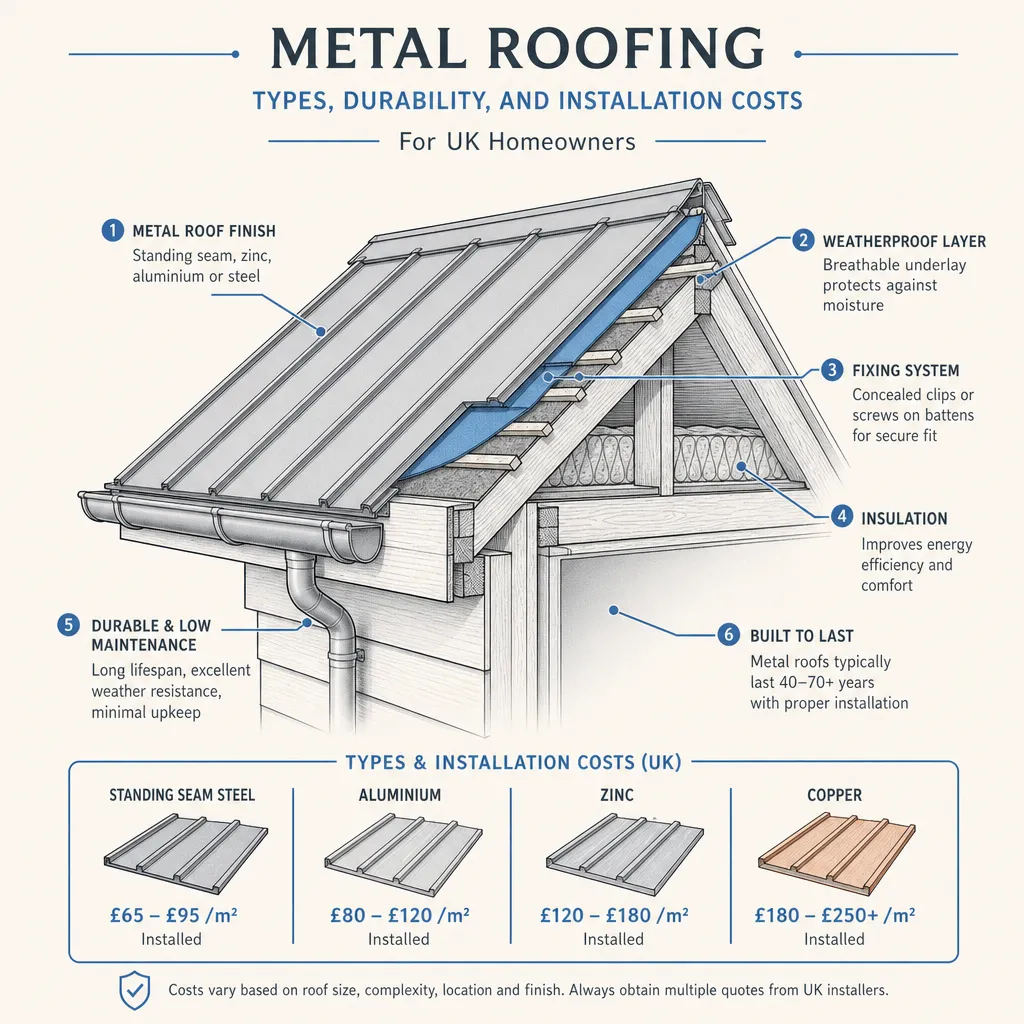 Improvement & Build
Metal Roofing: Types, Durability, and Installation Costs
Metal roofing in the UK includes standing seam, corrugated sheet, and metal tile systems in steel, aluminium, zinc, or copper.
 Improvement & Build
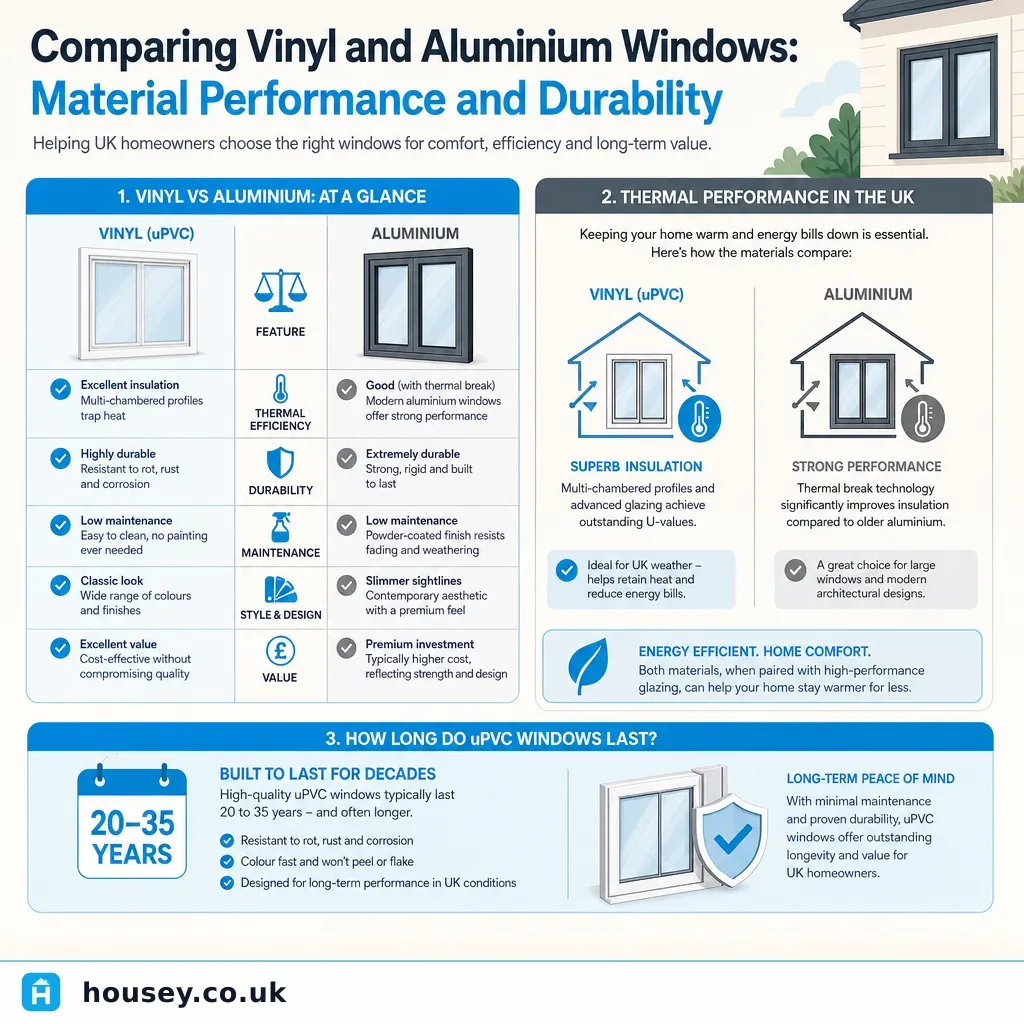
Comparing Vinyl and Aluminium Windows: Material Performance and Durability
uPVC (vinyl) and aluminium windows both meet UK Building Regulations Part L when properly specified.
 Improvement & Build
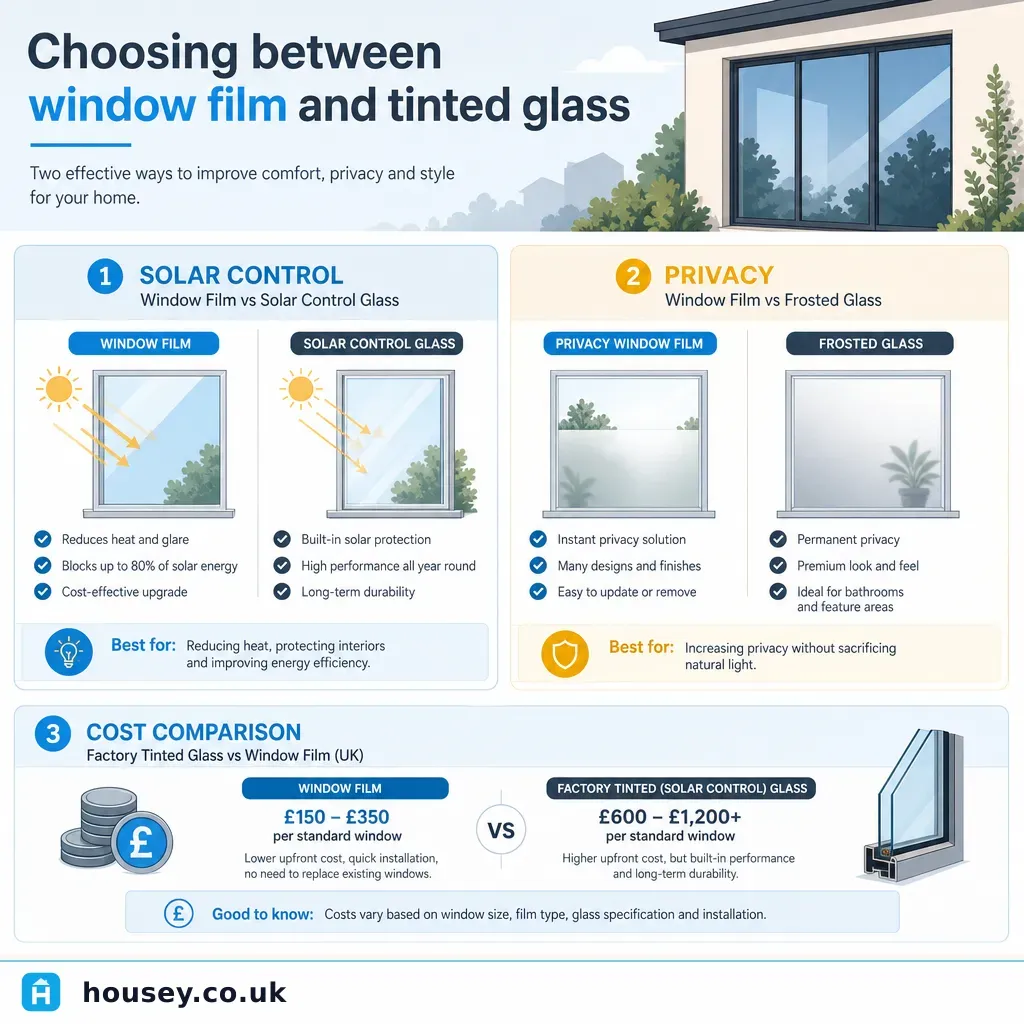
Choosing between window film and tinted glass
Window film is a retrofittable adhesive layer applied to existing glass — cheaper and reversible; factory-tinted or solar-control glass is manufactured with the tint integral to the pane, offering better durability and consistent performance.